
Entertainment
The Funniest Movie Ever Made Was Created By Accident

By Chris Snellgrove
| Published

The ‘80s were filled with plenty of killer comedies, including iconic films like Spaceballs, Goonies, and Ferris Bueller’s Day Off. For my money, though, the funniest film of the decade was Ghostbusters, a sci-fi blockbuster with more quotable lines than New York City has spooky spirits.
Later movies tried and failed to bite this earlier film’s style, including future Ghostbusters installments. Ghostbusters II was a decidedly sophomoric sequel that came nowhere close to the original Ghostbusters’ brilliance. Ghostbusters (2016) tried to go all-in on comedic improv, and it became the worst remake in movie history. Meanwhile, Ghostbusters: Afterlife tried to reinvent the franchise as a Spielbergian nostalgia fest rather than a cynical comedy.

Why, though, has it been so impossible for any other film to capture the spirit (so to speak) of what made the first Ghostbusters so awesome? Simple: the chief creators of this movie all had wildly different goals.
Dan Akyroyd wanted to make a more serious horror film, Bill Murray wanted to make a snarky comedy, and director Ivan Reitman wanted to create a high-concept blockbuster. The result is a lightning-in-a-bottle movie whose magic has never and will never be captured onscreen, ever again.
It Started As A Horror Movie

Ghostbusters is arguably the funniest comedy ever made. It didn’t start out that way, though. Dan Akyroyd, who is a big believer in ghosts and the paranormal, wrote an early draft of the movie (then called Ghost Smashers) that was designed as a relatively serious sci-fi piece where our heroes busted ghosts across various planets. In Making Ghostbusters, director Ivan Reitman revealed that this draft didn’t exactly bring the laughs. “Although I could detect a comic attitude, the whole thing was written rather seriously.” On top of that, the movie was designed as a horror movie far more likely to make you scream than smile.
What happened? Reitman wisely encouraged Akyroyd to rewrite the film as a comedy about screwball scientists going into business for themselves, and he brought in Harold Ramis to help with the new draft. The two proved to be quite the team, as Akyroyd was better at coming up with off-the-wall concepts (he insisted on the Stay Puft Marshmallow Man over Reitman’s objections), while Ramis was better at crafting funny dialogue. Meanwhile, Bill Murray had been brought in to replace the late John Belushi. Murray barely looked at the script, but, in a fun twist, technically ended up writing most of the film.
Embracing The Comedy Apocalypse

In 2020, Josh Gad got several original Ghostbusters stars (including Bill Murray, Dan Aykroyd, Ernie Hudson, Sigourney Weaver, and Annie Potts) together on a Zoom call, and they revealed some startling secrets about the film. According to Akyroyd, 80 percent of what we see onscreen was a result of improv, and he credits that to one cast member in particular. “When you bring a master comedian and charismatic leading man like Bill Murray into a project, you know there’s gonna be contributions on the writing side.”
In the final film, you can see the obvious tug of war between Akyroyd and Murray’s very different visions for Ghostbusters. Most of the movie is, of course, filled with Murray’s unique brand of snarky, quotable humor. But many of the more serious scenes echo Akyroyd’s desire to create a genuinely scary movie. The librarian’s ghostly jumpscare and Dana Barrett being kidnapped by a monster inside her couch is the stuff of childhood nightmares. To scare the older audience members, the film also includes a somber scene where Ray and Winston speculate that the ever-increasing number of ghosts is a portent of the biblical apocalypse.
Time Tables And Slime Tables

The final ingredient in Ghostbusters’ success was, of course, Ivan Reitman. In addition to directing the film, he helped with writing duties and also bluffed his way through studio negotiations. While pitching, he made up a budget (somewhere between $25-$30 million), choosing a number that was about three times what it cost to make Stripes, his previous comedy starring Bill Murray and Harold Ramis. Columbia Pictures exec Frank Price agreed, but on one condition: no matter what, this film would come out in June, 1984.
Reitman agreed, only realizing while walking out of Price’s office what a seemingly impossible task he had given himself. He had no idea if his arbitrary budget would be enough to bring Ghostbusters to life; he previously estimated that Akyroyd’s original script would have cost over $200 million to make. Furthermore, he had only 13 months to create a film that had no effects studio, no start date, and (most importantly) no finished script. Fortunately, he personally helped finish the script, keeping Akyroyd and Ramis on task by ensuring that the story had clearly defined goals, a memorable villain, and even mechanical explanations for why ghosts were suddenly haunting New York City.
Three Men, Three Visions

The rest is Hollywood history. Reitman met his deadline, and Ghostbusters became a blockbuster success, earning over $370 million at the box office. This success is even more impressive when you consider how everything about filming was rushed, that most of the dialogue was improvised, and that the final story (per Akyroyd and Murray’s competing visions) was a blend of silly and serious. On paper, these are all reasons why Ghostbusters should have been a disaster, but the opposite happened. With several creators trying to craft a completely different film (Akyroyd wanted serious horror, Murray wanted schlubby comedy, and Reitman wanted a high-concept blockbuster), they created a perfect movie.
Incredibly, they did so completely by accident. This is why there has never been a worthy follow-up to Ghostbusters: every subsequent movie has been trying to make a Ghostbusters film, but what made that first film special can’t be easily understood, much less copied. The people who made Ghostbusters were all trying to make different movies, resulting in a strange creative brew that can never truly be replicated. This is why Jason Reitman didn’t even try to recreate the magic of the original film and almost eschewed comedy entirely to transform Ghostbusters: Afterlife into Spielbergian schlock aimed squarely at nostalgic millennials.

While Afterlife has its charms, nothing beats the unflappable cool of the original Ghostbusters. If you’re ready to take a walk (Stay-Puft style) down memory lane, that ‘80s comedy classic is now streaming on Netflix. If you were disappointed by the Stranger Things final season, this is your chance to channel some nerdy nostalgia that actually delivers a satisfying third act. Just don’t try to watch them both at once; you never know what will happen to our dimension if you cross the streams!
Entertainment
The Sci-Fi Thriller That Killed Director's Career Deserves Another Look
By Brian Myers
| Published

The 2009 thriller The Box had all the makings of a Hollywood hit. A-list stars (Cameron Diaz, Frank Langella, James Marsden), a $30 million budget, and a hot new director to take the lead. However, the lukewarm reception at the box office and the mediocre critical response to The Box led director Richard Kelly’s career to take an almost immediate nosedive. Fifteen years later, streaming maks it possible for viewers to get a second look at a film that deserves a lot more credit than it originally received.
Kelly had scored a major success several years leading up to the production of The Box, serving as director and screenwriter for the sleeper hit 2001 film Donnie Darko. However, in the years since The Box was released, Kelly has only had a handful of projects in the industry.

Some of this has been attributed to his own admission of wanting to prove to studios that he’s worthy of another modestly budgeted film, and some due to sheer bad luck. Kelly was set to work on a crime film titled Amicus with Sopranos star James Gandolfini, only to have the actor die from a heart attack in 2013 before the project could be started.
The Box’s Moral Conundrum
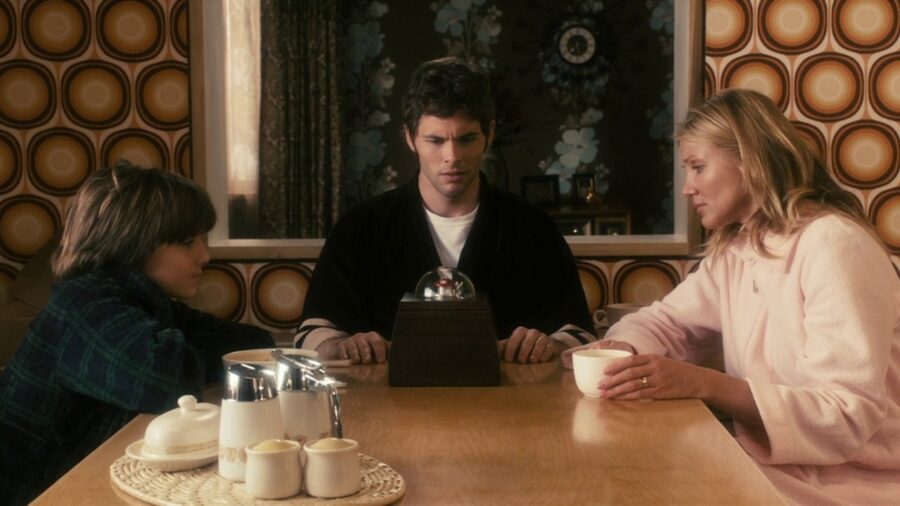
If you’ve never seen The Box, you’ll likely be intrigued by the storyline alone. Married couple Norma and Arthur Lewis (played by Diaz and Marsden, respectively) are approached by a disfigured stranger (Frank Langella) who gives them a mysterious box. Press the button inside the box, the stranger promises, and you’ll receive $1 million in cash.
However, the stranger reveals a caveat to receiving the prize money. Press the button, and someone that they do not know will die. The plot of The Box takes a good number of unpredictable twists and turns after Norma presses the button, and the young family sees a horrific fate unfold before their very eyes.
The Twilight Zone Episode
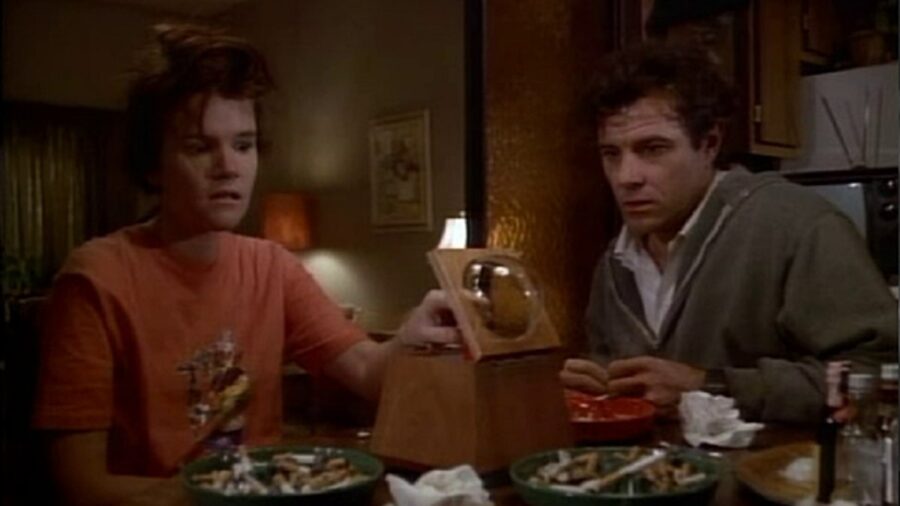
The Box was conceived from a short story written by acclaimed horror and science fiction writer Richard Matheson in 1970. Matheson’s original story, Button, Button, was turned into a radio show in the late 1970s. In 1986, a screenplay was written based on the story for an episode of the revived version of The Twilight Zone.
The theatrical version of Matheson’s story debuted in 2009 and wasn’t a favorite of critics. Though Roger Ebert gave it three out of four stars, other critics cited poor editing and the sense of the film being more of a pet project for Kelly as reasons for their dislike of The Box. Audiences at the time largely agreed as box office receipts led to barely making back the film’s budget.

The Box is certainly worth a look 15 years later, despite the lack of enthusiasm it received in 2009. The soundtrack alone should tempt a good number of curiosity seekers. Win Butler and Regine Chassagne of the pop band Arcade Fire teamed with composer Owen Pallett for a film score that more than redeems any of the film’s minor shortcomings that critics pointed out.
As of this writing, The Box can be rented or purchased on-demand through Amazon Prime Video, YouTube, Apple TV+, and Fandango at Home.
Entertainment
FIFA World Cup schedule today: Games, kickoff times, livestream info for July 5
Table of Contents
The 2026 World Cup weekend excitement reaches a crescendo today with two heated matches: Norway vs Brazil followed by England vs Mexico.
It all kicks off at 4 p.m. ET, with the first game taking place in the United States and the second taking place in Mexico City, where the hometown fans will have the opportunity to cheer on their national team in a decisive match.
Read on to learn where and when the games are being played, as well as how best to watch them.
FIFA World Cup schedule today: July 5
How to watch FIFA World Cup games today
Watch Brazil vs. Norway
Fan-favorite Erling Haaland, Norway’s 6’5″ giant center forward, is proving himself one of the game’s most unstoppable forces, but he will have his work cut out for him against the more experienced Brazil team, led by their all-time top goal scorer, Neymar da Silva Santos Júnior. Legendary soccer manager and current coach of the Brazil team, Carlo Ancelotti, known as “Don Carlo” to the soccer faithful in Brazil, will battle Norway’s Ståle Solbakken in what is sure to be a chess-like battle of wits between the two master strategists.
Live coverage will be on Fox and Fox One. Peacock will carry the live Spanish-language coverage.
Mashable Top Stories
Watch Mexico vs. England
Coming into Sunday’s match, Mexico has not allowed a single goal in the entire tournament thus far, the only team to have held their opponents scoreless going into the round of 16, but if they’re going to continue this streak, they’ll have to shut down the two-pronged attack of Harry Kane (now the nation’s top scorer in the history of the World Cup!) and top-tier midfielder Jude Bellingham, who has already racked up four goals and one assist in England’s journey to the top.
And for this match, there’s an added twist: Mexico will have home-field advantage in Mexico City, one of the loudest venues in all of soccer. ¡Olé!
Live coverage will be on Fox and Fox One. Peacock will carry the live Spanish-language coverage.
$39.98
$59.97
Save $19.99
More live streaming options
Live TV cable replacement
Not interested in signing up for a standalone streaming service like Fox One or Peacock? You can sign up for a live TV cable replacement service, like YouTube TV or Hulu + Live TV.
These services carry over 100 live channels, but run off a WiFi connection. You’ll get live access to Fox and FS1, plus a whole lot more. Here are some options to consider:
Watch the World Cup for free with a VPN
It’s possible to watch the World Cup for free on international services like ITVX, BBC iPlayer, NOS, or RTÉ. Our global World Cup watch guide can walk you through the process.
You will need a VPN to live stream the World Cup on these free streaming services. We recommend ExpressVPN — a Mashable-tested service and an Official Tournament Supporter of the FIFA World Cup in the U.S., Canada, and Europe — as our VPN of choice for sport. It offers servers in 105 countries, a user-friendly app available on all major devices, a speedy connection, and up to 10 simultaneous connections.
$12.99 only at ExpressVPN
Entertainment
Marvel Icon Punished For Having A Huge Bulge
By Chris Snellgrove
| Published

Have you played Marvel Rivals? If you can get over the fact that it’s basically a reskinned version of Overwatch, it’s a lot of fun. This is a hero shooter where you take control of a character from the wide world of Marvel. There are a variety of team-based multiplayer modes; this variety, along with the fact that the game is free-to-play, keeps players coming back for more. How do the developers make money, though? Simple: they charge players for “skins” which completely change the look of the character. Many skins are modeled after famous outfits from the comics, and others are modeled after character designs in the MCU.
Whatever their original inspiration was, though, all of these skins have one thing in common: they are way hornier than you’d expect them to be. There are plenty of revealing outfits that pair perfectly with thirsty character designs that players can’t stop drooling over. Unfortunately, players recently discovered that the game had gone a little too far with Captain America’s latest summer skin. You see, the skin gave Cap a bulge so big that it messed up some of his in-game animations. This caused the Chinese developer to do the unthinkable: they shrunk Captain America’s penis, and they waited until the Fourth of July to do it!
The Battle Of The Bulge

Every year, Marvel Rivals developer NetEase Games releases skimpy summer swimwear outfits for various characters. This may seem like just a cheap way to appeal to gooner gamers, but it’s arguably a throwback to the ‘90s, when Marvel similarly appealed to horny comic book nerds with thirsty swimsuit specials. Captain America got an especially scandalous skin this summer, one that was basically short shorts and a skimpy tank top that showed off his hairy, muscled chest. Normally, fans would be panting about Cap’s thick legs and arms, but this skin made them fixate on something else: the comically huge bulge of the character’s penis.
Seriously, this thing wobbled with its own physics. While fans were both excited and scared (scaroused, if you will), some wondered if Captain America having such a huge package was an accident. Like, maybe the character model got tweaked in such a way that its pelvis was extending outward, giving the appearance of a much larger bulge. At any rate, it definitely seemed to be a mistake. In the game, Cap has an emote that echoes the recording in Spider-Man: Homecoming where he pulls out a chair and then sits in it. Previously, players activating this emote with the summer skin encountered a bug: Cap’s big, floppy unit clipping right through the chair!

Now, without making any kind of official announcement, NetEase games seems to have fixed the issue. While Captain America still has an impressive bulge, it’s not as obscenely huge as it once was. Furthermore, it no longer clips through the chair when players use the aforementioned emote. All’s well that ends well, right? Sort of. While the timing could be a coincidence, many players couldn’t help but notice how the Chinese developer waited until Independence Day to shrink Captain America’s weiner down to size. Do y’all really think this will even slow down an aroused Cap, though? It’s like the man says: he can do this all day!

Astros snap Rays' 9-game win streak on Yordan Alvarez walk-off HR
The Sci-Fi Thriller That Killed Director's Career Deserves Another Look


