
Tech
Bluesky issues its first transparency report, noting rise in user reports and legal demands
Bluesky released its first transparency report this week documenting the actions taken by its Trust & Safety team and the results of other initiatives, like age-assurance compliance, monitoring of influence operations, automated labeling, and more.
The social media startup — a rival to X and Threads — grew nearly 60% in 2025, from 25.9 million users to 41.2 million, which includes accounts hosted both on Bluesky’s own infrastructure and those running their own infrastructure as part of the decentralized social network based on Bluesky’s AT Protocol.
During the past year, users made 1.41 billion posts on the platform, which represented 61% of all posts ever made on Bluesky. Of those, 235 million posts contained media, accounting for 62% of all media posts shared on Bluesky to date.
The company also reported a fivefold increase in legal requests from law enforcement agencies, government regulators, and legal representatives in 2025, with 1,470 requests, up from 238 requests in 2024.
While the company previously shared moderation reports in 2023 and 2024, this is the first time it’s put together a comprehensive transparency report. The new report tackles other areas outside of moderation, like regulatory compliance and account verification information, among other things.
Moderation reports from users jump 54%
Compared with 2024, when Bluesky saw a 17x increase in moderation reports, the company this year reported a 54% increase, going from 6.48 million user reports in 2024 to 9.97 million in 2025.
Though the number jumped, Bluesky noted that the growth “closely tracked” its 57% user growth that occurred over the same period.
Techcrunch event
Boston, MA
|
June 23, 2026
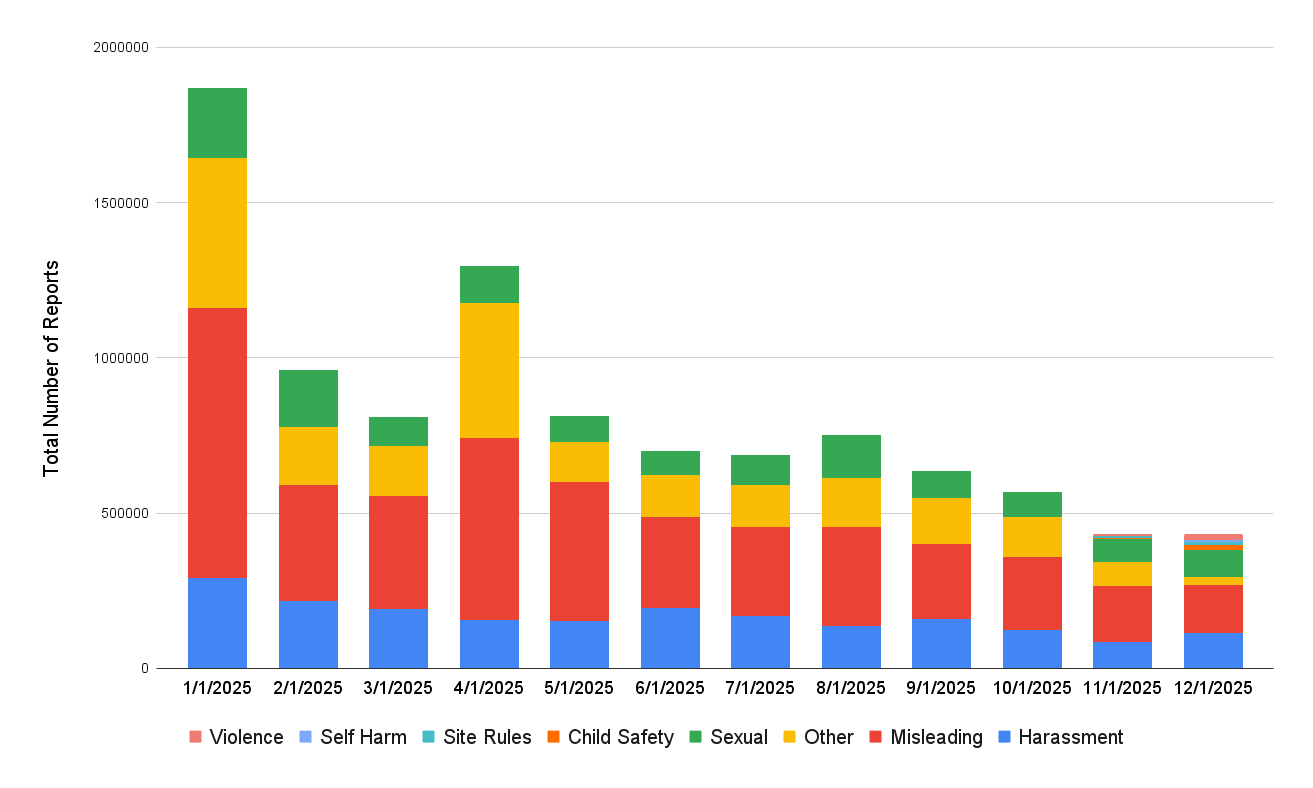
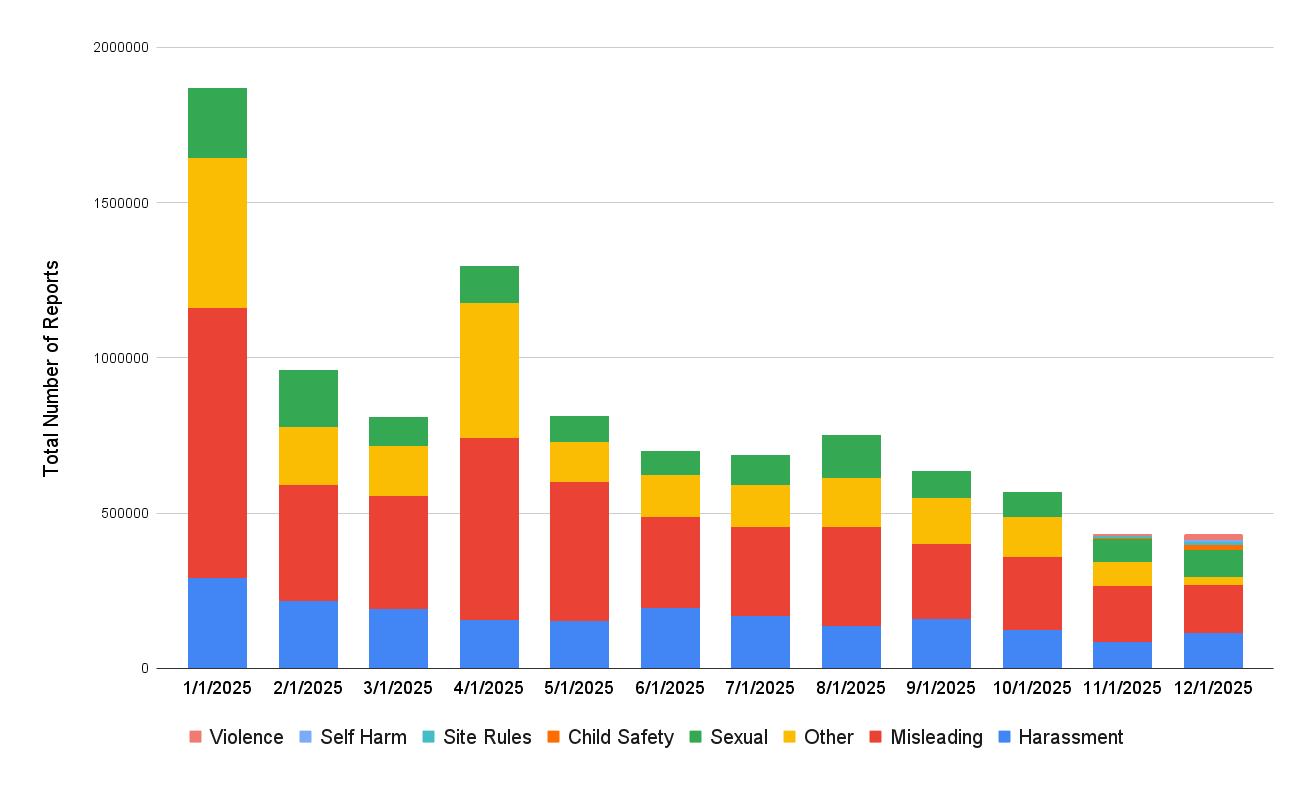
Around 3% of the user base, or 1.24 million users, submitted reports in 2025, with the top categories being “misleading” (which includes spam) at 43.73% of the total, “harassment” at 19.93%, and sexual content at 13.54%.
A catch-all “other” category included 22.14% of the reports that didn’t fall under these categories, or others like violence, child safety, breaking site rules, or self-harm, which accounted for much smaller percentages.
Within the “misleading” category’s 4.36 million reports, spam accounted for 2.49 million reports.
Meanwhile, hate speech accounted for the largest share of the 1.99 million “harassment” reports, with about 55,400 reports. Other areas that saw activity included targeted harassment (about 42,520 reports), trolling (29,500 reports), and doxxing (about 3,170 reports).
However, Bluesky said that the majority of “harassment” reports included those that fell into the gray area of antisocial behavior, which may include rude remarks, but didn’t fit into the other categories, like hate speech.
Most of the sexual content reports (1.52 million) concerned mislabeling, Bluesky says, meaning that adult content was not properly marked with metadata — tags that allow users to control their own moderation experience using Bluesky’s tools.
A smaller number of reports focused on nonconsensual intimate imagery (about 7,520), abuse content (about 6,120), and deepfakes (over 2,000).
Reports focused on violence (24,670 in total) were broken down into subcategories like threats or incitement (about 10,170 reports), glorification of violence (6,630 reports), and extremist content (3,230 reports).
In addition to user reports, Bluesky’s automated system flagged 2.54 million potential violations.
One area where Bluesky reported success involved a decline in daily reports of antisocial behavior on the site, which dropped 79% after the implementation of a system that identified toxic replies and reduced their visibility by putting them behind an extra click, similar to what X does.
Bluesky also saw a drop in user reports month-over-month, with reports per 1,000 monthly active users declining 50.9% from January to December.
Outside of moderation, Bluesky noted it removed 3,619 accounts for suspected influence operations, most likely those operating from Russia.
Increases in takedowns, legal requests
The company said last fall it was getting more aggressive about its moderation and enforcement, and that appears to be true.
Last year, Bluesky took down 2.44 million items in 2025, including accounts and content. The year prior, Bluesky had taken down 66,308 accounts, and its automated tooling took down 35,842 accounts.
Moderators also took down 6,334 records, and automated systems removed 282.
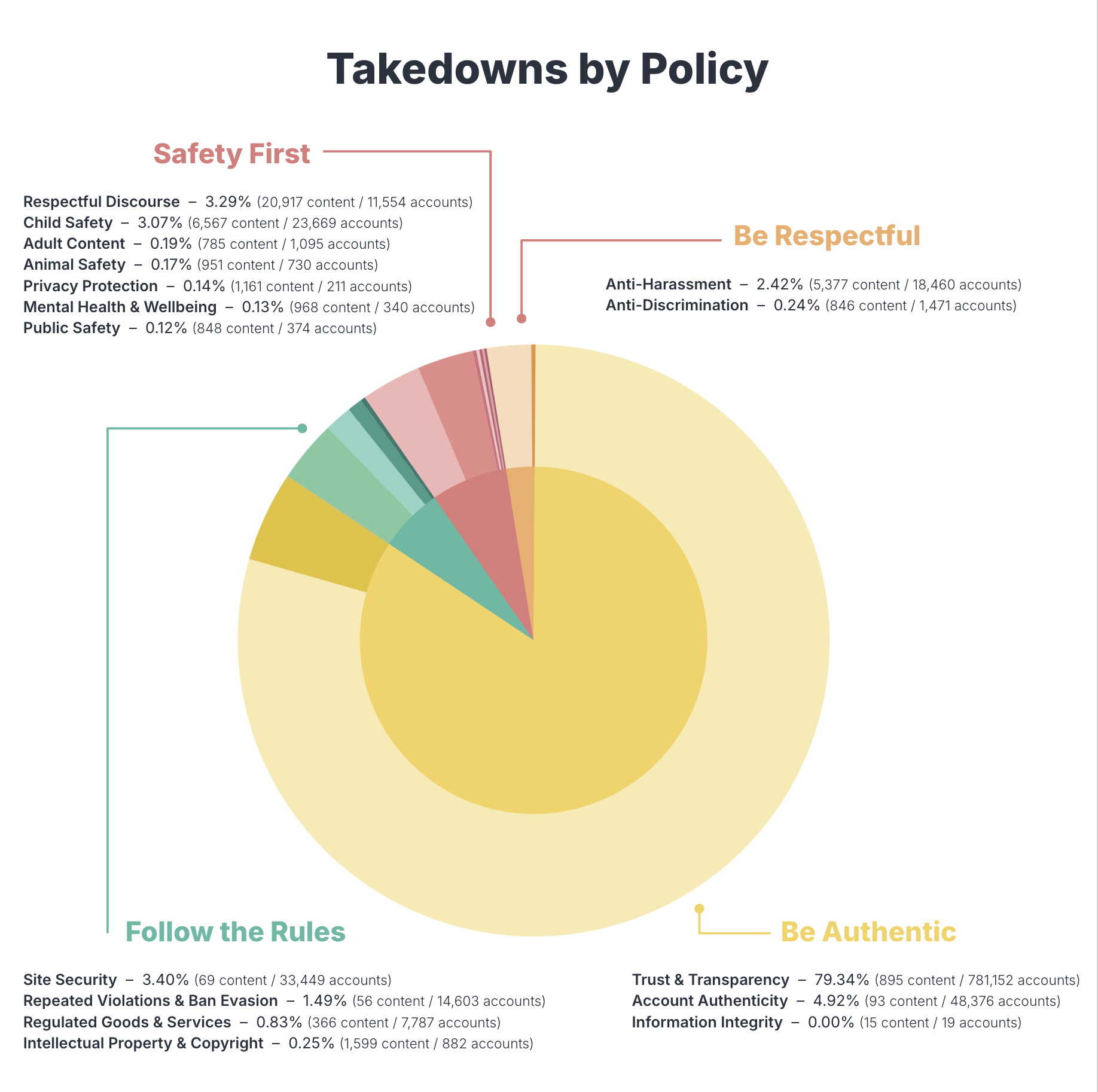
Bluesky also issued 3,192 temporary suspensions in 2025, and 14,659 permanent removals for ban evasion. Most of the permanent suspensions were focused on accounts engaging in inauthentic behavior, spam networks, and impersonation.
However, its report suggests that it prefers labeling content more than it does booting out users. Last year, Bluesky applied 16.49 million labels to content, up 200% year-over-year, while account takedown grew 104% from 1.02 million to 2.08 million. Most of the labeling involved adult and suggestive content or nudity.
Tech
Source: Elastic agrees to buy CRV-backed Deductive AI for up to $85M

Deductive AI, a startup that uses AI to catch and resolve bugs in software, has agreed to be sold to enterprise software company Elastic for up to $85 million, according to a person with knowledge of the deal.
Deductive, which was founded in 2023, came out stealth last November when it announced a $7.5 million seed round led by CRV with participation from Databricks Ventures, Thomvest Ventures, and PrimeSet. The investment valued the startup at $33 million, according to PitchBook.
Elastic and Deductive did not respond to multiple requests for comment. TechCrunch will update this article if either company responds.
The sale marks a speedy exit for Deductive, which is operating in a fast-growing sector known as AI site reliability engineering (AI SRE). Building AI-powered SRE tools has become an important area, driven by the massive influx of AI-written code. Replacing manual debugging with AI enables human SREs to shift focus from constantly fixing outages and other problems to spending more time on helping with product development.
The acquisition reflects a broader trend in which established tech incumbents are looking to buy AI-native startups to integrate agentic technologies into their existing product suites, the source told TechCrunch.
Elastic, which went public in 2018, is best known for Elasticsearch, the search and analytics engine that helps organizations store, search, analyze, and monitor large amounts of data in near real time.
The company’s observability software — essentially tools that let engineers monitor software systems and detect security threats — could benefit from Deductive’s tech. According to the source, integrating Deductive’s AI technology into Elastic will enhance its observability platform by giving customers tools to automatically monitor performance and resolve system failures in real time.
Deductive was co-founded by Rakesh Kothari, who was previously VP of engineering at Lightspeed-backed business analytics startup ThoughtSpot, and Sameer Agarwal, who formerly worked at Apache Software Foundation and Meta. Agrawal was one of the founding engineers at Databricks.
While Deductive reached roughly $1 million in annual recurring revenue (ARR,) according to the source, the startup’s growth lagged behind Resolve AI, one of the sectors’ perceived early winners. The two-year-old Resolve was co-founded by former Splunk executive Spiros Xanthos and Mayank Agarwal. The Greylock and Lightspeed-backed startup was last valued at $1.5 billion when it raised a $40 million Series A extension in April.
When you purchase through links in our articles, we may earn a small commission. This doesn’t affect our editorial independence.
Tech
The US says ASML’s top chip tool may be in China, but how?
According to Bloomberg, U.S. Commerce Secretary Howard Lutnick has, in a series of recent meetings, told senior ASML executives he’s concerned that one of the Dutch chipmaker’s extreme ultraviolet lithography machines — the EUV systems that are the only tools on Earth capable of printing the most advanced semiconductor patterns — may have ended up in China. That would be a major breach of export controls that have barred ASML from selling EUV to China since the first Trump administration.
It’s a serious claim. Senior administration officials told Bloomberg they have evidence that ASML shipped EUV-related components and transport equipment to China, though they’ve declined, repeatedly, to show it — to Bloomberg or, apparently, to ASML itself. The company says no such machine exists in China and has never existed there. The Commerce Department didn’t respond to Bloomberg’s questions about whether it has evidence of an actual EUV system on Chinese soil.
You might think this isn’t worth paying attention to if you’re outside the chip industry, but it is. ASML is a Dutch company most people have never heard of, but it is, by a wide margin, the most important company in the global AI buildout that isn’t named Nvidia or one of the hyperscalers. It makes the only machines on the planet capable of EUV lithography — the process of printing the microscopic circuit patterns that define the most advanced chips.
Every cutting-edge processor made by TSMC, the foundry behind Nvidia’s and Apple’s chips, depends on ASML tools that took the company roughly two decades and untold billions to develop. There is, at present, no second supplier. That monopoly has made ASML Europe’s most valuable public company, with a market capitalization that has been trading in the neighborhood of $700 billion as of this week, up sharply over the past year on the back of insatiable AI-driven chip demand.
That scale is exactly why the China question matters so much. If even one EUV machine made it into Chinese hands, it would represent one of the most consequential breaches of the export-control regime the U.S. has built over the past several years to keep advanced AI capability out of Beijing’s military and industrial base.
I sat down with ASML CEO Christophe Fouquet six weeks ago, well before this story broke, and asked him directly about the China question.
Fouquet told me ASML tracks every machine it has ever shipped — they’re either in active use with monitored customers or have been dismantled and returned to the company. He said the firm built an internal firewall years ago: Employees who can access EUV technology, documentation, and training are walled off from those who can’t, and ASML’s China-based staff sit on the wrong side of that wall by design. He argued the only reason ASML could build an EUV machine at all was that 80% of it already existed from decades of prior knowledge, and that solving the one genuinely new problem — generating EUV light itself — took 20 years on its own. His broader point seemed to be that you can’t reverse-engineer a machine you’ve never had, and nobody in China has had one.
There’s also a simpler commercial logic that cuts against the idea that ASML would risk its export license to quietly arm a Chinese customer. ASML does sell older-generation deep ultraviolet tools to China — gear it first shipped a decade ago — but Fouquet framed that explicitly as a protective calculation, not a loophole. The idea, he suggested, is that it keeps enough of a generational gap that customers can still do business — but without manufacturing its own future competitor. ASML expects roughly 20% of its 2026 revenue to come from already-permitted sales to China. Risking the EUV ban entirely would put that revenue, and the company’s standing as the most valuable monopoly in European industry, on the line over a single illegal sale.
None of this proves the allegations are false. The government hasn’t yet made its evidence public, and it’s worth withholding judgment until it does.
The Commerce Department, under Lutnick’s leadership, agreed late last year to put up to $150 million of taxpayer money into xLight, a startup developing a next-generation light-source technology that’s been written about as a long-term challenge to the core of ASML’s EUV monopoly. xLight’s own CEO told me last year that the company sees itself as a future partner to ASML, not a rival, building hardware meant to plug into ASML’s machines rather than replace them. When I put that framing to Fouquet in May, he was polite about it but unconvinced; ASML, he made clear, doesn’t see itself as needing xLight’s technology to keep its lead.
Does that have anything to do with why Lutnick is suddenly pressing ASML on EUV? Nothing public connects the two. It could be entirely unrelated. But a federal official scrutinizing a monopoly while his own agency has money riding on a startup angling to improve that monopoly’s core technology is worth examining.
xLight isn’t the only outside bet on the future of lithography. Peter Thiel — who has his own long-running ties to Trump’s political orbit — has backed Substrate, a separate startup explicitly pursuing its own EUV-rival technology, with ambitions to compete with ASML more directly than xLight says it intends to.
As Bloomberg notes, a bipartisan bill moving through Congress would go much further than EUV — it calls for an effective ban on all of ASML’s deep ultraviolet (DUV) shipments to China, the less advanced lithography tools that account for roughly a fifth of the company’s expected 2026 revenue. The bill cleared a key committee in April, and the Trump administration hasn’t taken a formal position on it.
Pictured above: ASML CEO Christophe Fouquet.
When you purchase through links in our articles, we may earn a small commission. This doesn’t affect our editorial independence.
Tech
The CEO of Allbirds’ new AI biz has a plan, but no team
When Allbirds pivoted to AI in April, it felt like a joke from “Silicon Valley” breaking free of the TV: The direct-to-consumer shoe purveyor whose flimsy kicks helped define what we’ll loosely call “Silicon Valley style” had discovered a new trend to chase.
The move was right out of the meme stock playbook written by GameStop: Take a troubled public company, latch on to the hottest fad, and reap the rewards of a rising stock price as retail investors pile in.
Well, it worked. The company sold its shoe business for $43 million, raised another $100 million from the stock market, and now it’s called Smartbird.
Now Nadia Carlsten has to make it work. A former AWS executive with an engineering PhD, Carlsten most recently led the European compute company DCAI before she began yesterday as Smartbird’s CEO.
“We’re going to be recruiting a brand-new team for the AI business, and we’re going to be getting an office,” Carlsten told TechCrunch from Amsterdam. “The shoe business has officially closed as of yesterday, so that’s all done … The first task that I’m tackling right now is rounding up the leadership team, looking for somebody to lead infrastructure operations, for example.”
Call it a startup with a sole founder and a very large seed round. What’s next is less clear.
Smartbird aims to be an AI infrastructure provider, latching on to the seemingly bottomless demand for compute to train and run deep learning models. But unlike neoclouds, which relentlessly arbitrage the price of chips against the cost of GPU time or inference tokens, Carlsten will be aiming at more carefully managed deployments. The ideal Smartbird customers need direct control over the servers running their models — typically for political or business-model reasons — and value data sovereignty over the scalability of the public cloud.
Carlsten couldn’t yet estimate the size of that market and argued that it was fairly nascent, since many companies are still just piloting AI tools. At DCAI, she worked with Novo Nordisk and other European firms that take a special interest in data sovereignty or operate bespoke models: “We certainly have anybody that’s within the pharmaceutical industry, energy industry, financial, the public sector,” she said.
To Carlsten’s view, that means Smartbird isn’t competing with hyperscalers or neoclouds, but with internal company projects. Still, there are established companies in this space — Hewlett Packard offers a single-tenant managed AI compute service, as does Equinix, the data center giant.
It’s a real business model, but it’s not clear if it has the same growth potential as the cloud services, where expansion is the be-all and end-all. Carlsten said she expects to have compute clusters deployed for several customers by the end of the year. Other startups, like the inference cloud General Compute, have bigger ambitions — the company announced a $300 billion chip order when it came out of stealth last month.
Carlsten says she doesn’t need big chip commitments to realize Smartbird’s vision, because her potential customers needs sit in the range of hundreds to thousands of chips — it’s “not about large scales and huge numbers of GPUs; they’re more about agility of these clusters, and more about having control of the infrastructure stack.”
Smartbird is also unlikely to compete with rivals on price, since cloud services go to great lengths to optimize chip usage 24 hours a day to offer the cheapest compute, though Carlsten suspects that companies with specialized workflows will be able to work more efficiently with their own servers.
Demand for AI infrastructure is a powerful force in the market, driving up the stock prices for chipmakers, cloud providers, and energy companies, even convincing investors that orbital data centers are a feasible idea. But Carlsten insists that Allbird’s transition was carefully thought through.
“It wasn’t, ‘Let’s just do AI, because it’s AI, and it’s hot,’” Carlsten, who will be paid a $700,000 annual salary and was awarded stock worth about $9 million to take the job, said. “It was really about, do we have a chance to build a business over time that is going to find this niche in the market and be able to grow over time?”
When Allbirds pivoted, one thing that went by the wayside was its public benefit corporation (PBC) status, which had been intended to enshrine the sustainability commitments that were part of the shoe company’s pitch. PBC charters are often used by companies to highlight non-financial promises. OpenAI, for example, is a PBC with a focus on AI safety. This change of direction, however, suggests PBCs are hardly ironclad.
Carlsten said that Smartbird’s board made a long-term commitment to execute against her AI strategy.
“There are some companies out there chasing AI,” she told TechCrunch, “but at the end of the day, what matters is, is there actual weight behind the chasing?”
When you purchase through links in our articles, we may earn a small commission. This doesn’t affect our editorial independence.

Tigers' Dillon Dingler homers, drives in 2 in win over White Sox
Wyndham Clark ahead by 6 at US Open, Scottie Scheffler leads chasing pack


