
Entertainment
The Tragedy That Gave Us Star Trek’s Greatest Guest Star
By Chris Snellgrove
| Published

One of the best episodes of Star Trek: The Next Generation is “The Most Toys,” in which Data gets kidnapped by a collector obsessed with owning the rarest items in the galaxy. That collector is played by Saul Rubinek, who arguably gives one of the best guest performances in the entirety of this beloved franchise. However, it’s a performance rooted in tragedy because Rubinek only got the role because the actor originally performing his part nearly died!
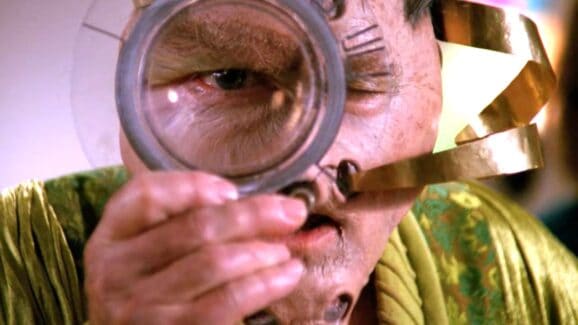
In “The Most Toys,” Rubinek plays Kivas Fajo, an amoral collector who kidnaps Data, making the advanced android his most prized possession. When the episode came out, however, many fans were confused by the appearance of Star Trek’s latest villain. That’s because David Rappaport was originally cast in this role, and Paramount had already distributed promotional photographs of him as a very different-looking Fajo.
The Toys Are Back In Town

Why, though, did Star Trek: The Next Generation have to replace Rappaport in the first place? “The Most Toys” director Timothy Bond is quoted in Captain’s Log: The Unauthorized Complete Trek Voyages that “[T]here was a story going around that they had found him in his car with a tube running from the exhaust.” This created a major liability for the network, and the stress of filming might have contributed to a potential act of self-harm, so the director ended up replacing Rappaport with Saul Rubinek.
Sadly, David Rappaport continued to sink further and further into depression after he was ejected from the role. Only two months later, he was found dead in a Los Angeles park from what was apparently a self-inflicted gunshot wound. It was a tragic end to a troubled life, creating a permanent stain on one of the best episodes of Star Trek: The Next Generation.
Hailing Frequencies Open

Fortunately, Timothy Bond was able to quickly find a replacement for Rappaport, and he was able to refilm all scenes featuring the deceased actor’s character with equal speed. How, though, was he able to recast the important role of Kivas Fajo so quickly? As it turns out, everything started with a phone call from an old friend!
At just the right time, Bond received a phone call from Saul Rubinek, an old schoolmate who was passing through town to film Bonfires of the Vanities, a movie that would later flop. As luck would have it, the actor was a huge fan of Star Trek: The Next Generation, and he asked Bond if he might be able to swing by and visit the sets. Knowing that he had to recast the crucial role of Kivas Fajo, Bond responded with a question of his own: “How much do you want to see these sets?”
A Fanboy’s Dream Come True
The director formally offered the role to Rubinek, and the actor happily accepted the opportunity to become part of the show he loved so much. If he hadn’t been a fanboy, he might have otherwise declined the offer. As Bond (quoted in Captain’s Logs: The Unauthorized Complete Trek Voyages) noted, “He never does guest spots on television, but I persuaded him to do it.”

The recasting worked well for a number of reasons, including the fact that Rubinek is much taller than David Rappaport. This helped him look more physically intimidating onscreen, which is always an important quality for a villain. That quality is so important that Bond came up with a crazy idea back when Rappaport had the part: to shrink all the Kivas Fajo sets down so they had four-foot ceilings, essentially forcing everyone who visited the short actor’s character to bow down before him!
Firing Rappaport meant that the producers didn’t have to do anything so drastic, and Bond remains eternally grateful that they hadn’t already made any changes to the sets. Rubinek went on to do an amazing job as Kivas Fajo, one that effectively straddled the line between menacing and charming. However, what most fans don’t know is that we would not have gotten Rubinket (the greatest guest star in Star Trek: The Next Generation history) if not for the tragic mental illness and eventual death of David Rappaport, a gifted performer who was ultimately unable to overcome his personal demons.
Entertainment
Light Flip is a minimalistic, cheap flip phone that wont distract you

Remember Light, the New York-based company that builds super-simple, distraction-free, cheap smartphones?
It’s back with a new device; its first-ever flip phone called the Light Flip.
Once again, this is a cheap phone designed to free you from endless scrolling and social media addiction, while still offering the basic tools you need for everyday life. To do this, the company has built an Android-based, minimalistic operating system called LightOS that’s mostly textual and displays everything in just two colors. You do get access to music, messages, alarms, and other basic apps, but you don’t get to scroll the flashy new TIkTok video; that’s what your other phone is for.

The Light Flip is available in six colors: Black, Navy, Red, Pink, Yellow, and Light Gray.
Credit: Light Phone
The Light Flip doesn’t stray far from the formula, but approaches it with the body of a flip phone. In many ways, it’s far more simple than the company’s previous phone, the Light Phone III, which has an OLED touchscreen. The Light Flip is basically your flip phone of old, with a plastic body, a numeric, T9 keypad, some function buttons, and a 2.8-inch, non-touch display.
Mashable Light Speed

Numeric keypad? That’s right, but at least it supports T9 predictive input.
Credit: Light Phone
Inside, it’s powered by a MediaTek MT8873 chip, 6GB of RAM, 128GB of storage, and has a 50-megapixel camera and a (replaceable) 1,800mAh battery. Other amenities include a headphone jack (nice!), a USB-C port, Wi-Fi, Bluetooth, and 5G connectivity.

The camera on the back has a 50-megapixel sensor but takes 12-megapixel images.
Credit: Light Phone
The numeric keypad might be a tough sell to folks that are used to touchscreens or at least QWERTY keyboards. Fortunately, the Light Flip does support voice-to-text and audio messaging, too.
The phone is available in six colors: Black, Navy, Red, Pink, Yellow, and Light Gray.
The Light Flip retails for $299 or $39 per month with the Light Service plan. It starts shipping in April 2027.
Entertainment
The Ecovacs Goat 01000 RTK robot lawn mower is on sale for under $700 at Amazon
SAVE $301: The Ecovacs Goat 01000 RTK robot lawn mower is on sale for $698.99 at Amazon, down from the standard price of $999.99. That’s a 30% discount.
$698.99
at Amazon
$999.99
Save $301
Not many people consider the chore of mowing the lawn to be enjoyable. It’s a task we often hand off to the neighborhood kids or a professional landscaping crew. But if you’d rather take matters into your own hands, we have a great solution these days. Plus, an affordable model is on sale.
As of July 21, the Ecovacs Goat 01000 RTK robot lawn mower is on sale for $698.99 at Amazon, marked down from the list price of $999.99. That winds up being a savings of $301 from a 30% discount.
By now you’ve probably seen a robot lawn mower rolling around someone’s yard, but it’s still an abnormal sight. Just like the rollout of robot vacuums, we’ll slowly start to see more and more robots take over mowing the lawn. As someone with allergies, I’m totally cool with never touching a lawn mower ever again.
The Ecovacs Goat 01000 is designed to maintain lawns that span up to 0.25 acres in size. You don’t need to worry about a wire perimeter because it maps your yard and stays on course thanks to LiDAR RTK navigation that even works in the shade or under trees. It can even avoid obstacles when mowing in dark conditions.
Mashable Deals
The small mower body that measures 2.3 feet means it can mow in tight areas like between raised vegetable beds or small walkways. Plus, it has an IPX6 waterproof design. You get to decide on your ideal cutting length between 1.2 and 3.2 inches.
Today’s Amazon deal on the Ecovacs Goat 01000 applies to the robot mower with a care kit which includes 36 blades and an RTK AC adapter. Since the mower and the care kit are on sale for under $700, today is a great day to wave goodbye to the heavy and loud push mower and make the upgrade. Spend the rest of summer perfecting homemade slushies instead of doing yardwork.
Entertainment
Amazon has my favorite Bissell carpet cleaner marked down by 25% right now
SAVE 25%: As of July 21, you can get the Bissell Little Green Max Pet SmartMix carpet cleaner (38572) for $119.99, down from $159.99, at Amazon.

$119.99
at Amazon
$159.99
Save $40.00
I used to have a Bissell Little Green machine, and it worked right up until I poured liquid into the wrong compartment. But before my little mishap, this little thing was a lifesaver (I seldom use that word, but in this case, it’s true). With two beagles running around my apartment, having a carpet cleaner is a necessity.
And right now, you can get your own Bissell Little Green Max Pet SmartMix carpet cleaner for $119.99, down from $159.99. That’s a 25% discount or $40 in savings.
Mashable Trend Report
It comes with a specialized Pet Hair Removal Tool designed to grab embedded fur and debris from your upholstery, and once you’re done scrubbing, the Self-Cleaning Tough Stain Tool rinses out the leftover dirt and residue from the hose with the touch of a button (my machine didn’t have that feature).
Another major upgrade on this specific model is the SmartMix Technology, which automatically mixes the water and cleaning formula together for you so you don’t have to measure anything. Just be sure you pour it into the correct tank!

Fresh off extension, Connor Bedard eyes Blackhawks' playoff return
Former Bucs S Jordan Whitehead cleared to play


