
Entertainment
The old and New Edition cast comes together to perform
Neque porro quisquam est, qui dolorem ipsum quia dolor sit amet, consectetur, adipisci velit, sed quia non numquam eius modi.
Sed ut perspiciatis unde omnis iste natus error sit voluptatem accusantium doloremque laudantium, totam rem aperiam, eaque ipsa quae ab illo inventore veritatis et quasi architecto beatae vitae dicta sunt explicabo.
Neque porro quisquam est, qui dolorem ipsum quia dolor sit amet, consectetur, adipisci velit, sed quia non numquam eius modi tempora incidunt ut labore et dolore magnam aliquam quaerat voluptatem. Ut enim ad minima veniam, quis nostrum exercitationem ullam corporis suscipit laboriosam, nisi ut aliquid ex ea commodi consequatur.
At vero eos et accusamus et iusto odio dignissimos ducimus qui blanditiis praesentium voluptatum deleniti atque corrupti quos dolores et quas molestias excepturi sint occaecati cupiditate non provident, similique sunt in culpa qui officia deserunt mollitia animi, id est laborum et dolorum fuga.
“Duis aute irure dolor in reprehenderit in voluptate velit esse cillum dolore eu fugiat”
Quis autem vel eum iure reprehenderit qui in ea voluptate velit esse quam nihil molestiae consequatur, vel illum qui dolorem eum fugiat quo voluptas nulla pariatur.
Temporibus autem quibusdam et aut officiis debitis aut rerum necessitatibus saepe eveniet ut et voluptates repudiandae sint et molestiae non recusandae. Itaque earum rerum hic tenetur a sapiente delectus, ut aut reiciendis voluptatibus maiores alias consequatur aut perferendis doloribus asperiores repellat.
Lorem ipsum dolor sit amet, consectetur adipisicing elit, sed do eiusmod tempor incididunt ut labore et dolore magna aliqua. Ut enim ad minim veniam, quis nostrud exercitation ullamco laboris nisi ut aliquip ex ea commodo consequat.
Nemo enim ipsam voluptatem quia voluptas sit aspernatur aut odit aut fugit, sed quia consequuntur magni dolores eos qui ratione voluptatem sequi nesciunt.
Et harum quidem rerum facilis est et expedita distinctio. Nam libero tempore, cum soluta nobis est eligendi optio cumque nihil impedit quo minus id quod maxime placeat facere possimus, omnis voluptas assumenda est, omnis dolor repellendus.
Nulla pariatur. Excepteur sint occaecat cupidatat non proident, sunt in culpa qui officia deserunt mollit anim id est laborum.


Entertainment
The Extremely R-Rated Sci-Fi Masterpiece Destroyed By Stallone Stink

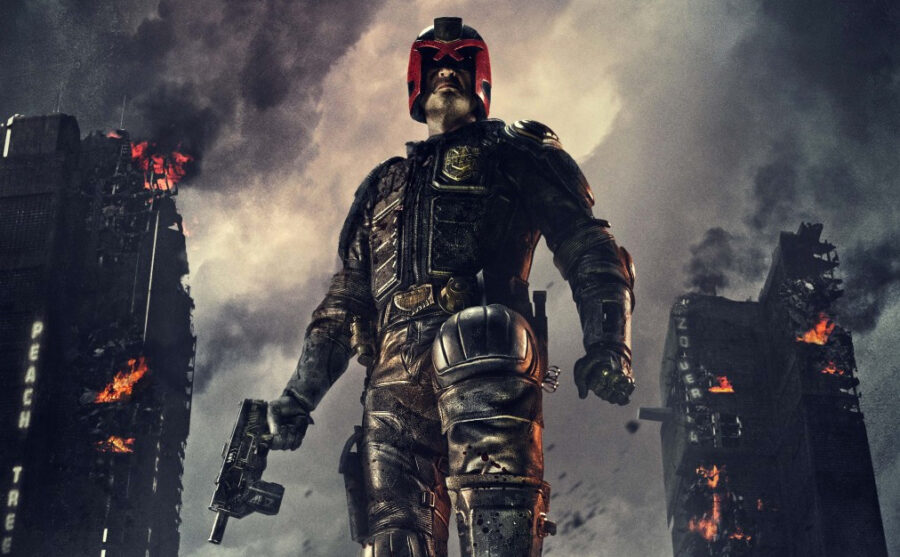
Dredd is another in a long line of movies that, for one reason or another, failed to find a theatrical audience despite being fantastic.
By Brent McKnight
| Updated

Sometimes movies don’t click with audiences when they’re initially released. It may be timing, it may be the style, maybe it lacks a big-name star to put butts in theater seats. Movies tank for any number or combination of factors, but that doesn’t mean they’re not still great. Such is the case with 2012’s Dredd.
Let us not confuse the movie we’re talking about today with the much-maligned 1995 Sylvester Stallone debacle, Judge Dredd. Based on the same source material, they are very, very different animals. (I have a weird affection and place in my heart for that film, though I will never go so far as to argue that it’s good.) In fact, that confusion, or at least association, is one reason people often cite for why the latter film fell on its face at the box office. It certainly didn’t help matters.
Dredd is another in a long line of movies that, for one reason or another, failed to find a theatrical audience despite being fantastic. Worldwide, it only took in $41 million, with a dismal $13 million domestic haul.
Why Dredd Deserved Better

Dredd may be based on a comic (he first appeared in 1977 via a long-running British comic called 2000 AD), but it’s not your typical comic book movie. This isn’t the episodic long-form superhero storytelling of Marvel, nor the darker, brooding, but still PG-13 fare DC often trades in. No, directed by Pete Travis, Dredd is violent and brutal and hard-R to the point it had to be toned down to get there.
Set in the future after a nuclear incident destroys much of the world, the remnants of humanity cram into sprawling metropolises. These become dystopian hell-holes, full of violence and depravity. The only force of order is the Judges, roving cops who serve as judge, jury, and executioner all in one, dispensing tyrannical justice. Our story takes place in Mega-City One, which accounts for much of the East Coast of the United States. There are 17,000 serious crimes reported daily, to which law enforcement responds in 6% of cases.

The plot of Dredd is fairly simple. Legendary Judge Dredd (Karl Urban) is tasked with training and evaluating a new recruit, Judge Anderson (Olivia Thirlby), a mutant with strong psychic ability. They respond to a trio of murders in Peachtrees, a 200-story high-rise slum, and have to fight their way through the building, which is controlled by a vicious drug dealer named Ma-Ma (Lena Headey). She controls the trade of a new drug called Slo-Mo, which slows down how the user experiences time to one percent normal speed.
Dredd takes a certain amount of flak for having a similar plot to Gareth Evans’ martial arts banger The Raid. The Raid did come out first; after a festival run, Evans’ film got a theatrical release in March 2012, while Travis’ debuted in September, and they are, at least on the surface, similar. That said, and for the sake of clarity, one didn’t rip off the other. This is a case where two films with comparable plots came out near each other. Though it arrived later, due largely to significant post-production special effects work, Dredd actually filmed first.
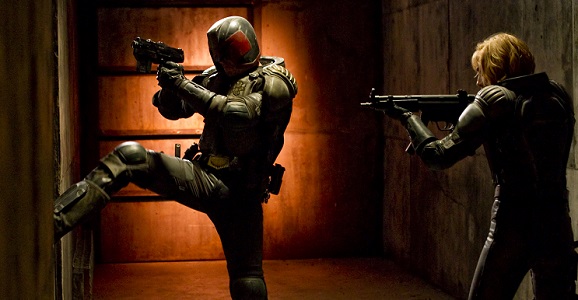
It doesn’t really matter; in addition to being their own individual things, both movies are completely badass and should be watched, often.
Though the setup of Dredd may be relatively straightforward, the finished product is anything but. Written by Alex Garland, who penned the likes of 28 Days Later, and who went on to direct heady sci-fi, like Ex-Machina and Annihilation, Dredd has more on its mind than just empty action. The surface machinations may be minimal, but the film as a whole is deceptively complex and nuanced.
Since his inception, Judge Dredd was always intended as a critique
of the creeping fascism and totalitarian idealism that was on the rise in the political
realm at the time, especially in Britain, but elsewhere as well. He’s a brutal
tool of a corrupt system, draconian in the way he dispenses justice. When we
first meet him, via a high-speed chase full of guns and bullets and viscera strewn
across the highway, he’s a black-and-white, letter-of-the-law lawman. No matter
the situation, no matter the circumstances, this is what the law says, this
is what he does.

Dredd carries this stance to extremes. When he and Anderson are trapped in Peachtrees, taking fire from Ma-Ma’s gang, he still trains her, barking out orders and questions. Because that’s his job and nothing will push him off that path. He’s like a wind-up toy, blindly going in one direction, unable to deviate.
That’s where Anderson comes in. She introduces shades of gray into Dredd’s world. Her psychic abilities give her insight into people and a corresponding empathy. She’s an orphan, a mutant, a product of one of these slums. Dredd looks up, and all he sees is the crime, gangs, the 96% unemployment rate; she sees a place very much like home, full of mostly good people struggling in a tough situation.
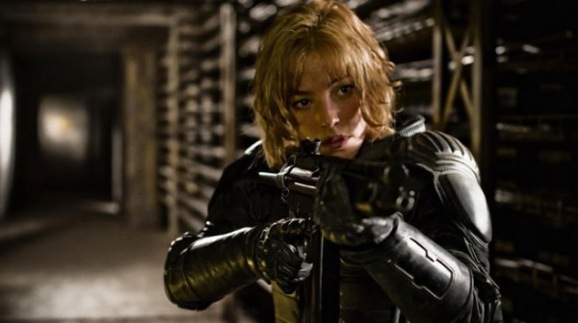
Dredd is bleakly nihilistic, a kind of futuristic Travis Bickle, while she’s earnest and idealistic. Over the course of the movie, they find something of a middle ground. She realizes maybe she shouldn’t always expect the best out of people, while he realizes maybe everything isn’t as cut-and-dried as he’s always thought.
Over the course of their day, Anderson commits errors that should fail a recruit, like losing her primary service weapon. But so did he. Or consider the case of a character like Domhnall Gleeson’s Techie. Yes, he works for Ma-Ma, but only because he has no other choice. If he denies her, she’ll eviscerate him. In fact, by this point, she’s already taken his eyes. Anderson sees that, whereas Dredd can’t, or at least couldn’t before.
Within the larger thematic puzzle, Urban and Thirlby (both actors who should be in way more stuff) carry all of this. When the film was announced, Karl Urban delighted fans ahead of time when he said one of his conditions for accepting the role was that, like in the comics, the character never take off his trademark helmet. Even though we can only see the lower third of Dredd’s face, he manages to portray much more than just clamp-jawed stoicism and a grim demeanor.

Urban has such a great range. He’s charming and funny as Bones in the new Star Trek movies. Here he’s in total big-time action-movie mode, which he more than pulls off. Even with what could easily be a one-note throwaway role like Skurge in Thor: Ragnarok, he gives the character pathos and an arc.
Thirlby’s Anderson could easily have fallen into first-day-on-patrol cop-movie clichés. She’s earnest, but not gullible; hopeful, but not to the point of naivete; frightened, but still strong and capable. Willing to resort to violence (when Dredd declares a criminal guilty and sentences him to die on the spot, she pulls the trigger), it’s not her natural first move. Her character balances and tempers Dredd’s impulses, influencing him. It builds to the point when his superior asks if Anderson passed; he says yes, even though, by the book, she committed failable sins.
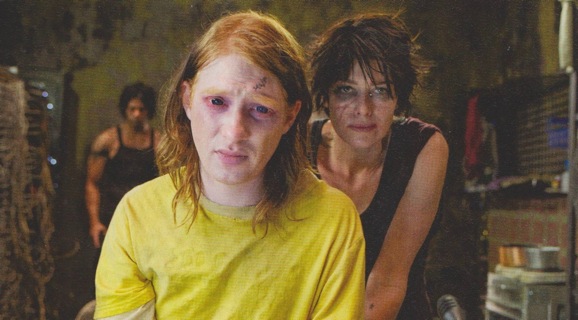
Lena Headey may be the unsung all-star of Dredd, though. She’s straight-up terrifying. A former prostitute wearing a gnarly face scar, she rules through absolute fear. This is a person not afraid to skin enemies alive and dose them with Slo-Mo before tossing them off the top floor, so the 200-story fall takes that much longer. Ma-Ma is equally as terrifying and relentless as Headey’s Cersei Lannister in Game of Thrones, but played in a much different way.
Working with cinematographer Anthony Dodd Mantle (127 Hours), Travis created a fantastic-looking movie. The Mega-City One of Dredd has a palpable grime, like if you touched it, your fingertips would come back covered in grit and something sticky you’d rather not know the origin of. But it also has a hypnotic beauty. We never really see the Cursed Earth beyond the walls of the city, but wide helicopter shots show the expanse of decayed urban sprawl. It’s dirty and smelly and looks a little like a large-scale Die Antwoord video.

It’s the Slo-Mo shots, however, that set Dredd apart aesthetically. This isn’t typical slow motion, just the normal action slowed down; this is molasses compared to that. When a character takes a hit, the subsequent movement practically drips. Travis and Mantle use it to great effect. They use enhanced, borderline psychedelic colors; bullets rip through flesh practically frame by frame; spurts of blood and exploding heads are raw and visceral in a unique way, but also gorgeous and mesmerizing. This is gore elevated to art.
All of this still comes through on streaming, but Dredd hit theaters in 3D. 2012 was the middle of that boom where every big movie of this ilk was upscaled to 3D, whether it was shot that way or not. It was overused and oversold, but Dredd knows what it’s doing in that regard. More than simply things flying at your face, it created an immersive feel more akin to the likes of Avatar than other comic book movies. Especially the Slo-Mo scenes. They put you right in the middle, creating an almost uncomfortable sensation of being there.
Critical And Audience Response To Dredd

Dredd offers up a tense pot-boiler of a movie. From end to end, it’s all escalating pressure, fantastic, epic action, and brutal violence juxtaposed with raw humanity. It’s legitimately great, which begs the question: why did it fail in such spectacular fashion at the box office?
Dredd presents an interesting case for a couple of reasons. It’s not as if no one liked the movie. On Rotten Tomatoes, which collects critical reviews, it has a 79% approval rating. Critics generally liked it at the time as well as now.
Beyond theaters, it made a huge splash on home video (which was still a thing back then). It was the best-selling DVD/Blu-ray release when it hit the market, where it moved 300,000 units in its first week of release, on its way to more than 650,000.

After all this, there were multiple fan petitions that collected hundreds of thousands of signatures calling for Dredd 2. They started almost immediately after it tanked at the box office and have popped up sporadically ever since. There were even annual fan Days of Dredd for a few years to call on Hollywood to make more Dredd movies. We’ve seen comics, animated shorts, and all kinds of talk, particularly from producer Adi Shankar, who, for a time, would chat about sequels every chance he got.
For his part, star Karl Urban has often said he’s game to return to the square-jawed character. Saying this even as recently as March 2020. (Though writer Alex Garland said in October of 2019, he has no intention of ever returning to this universe.)
Why Dredd Failed
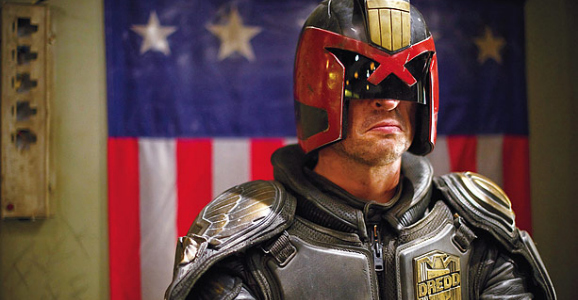
If it’s so popular, why did Dredd fail? There are a lot of potential answers to this. One is that the stank of Stallone’s 1995 version was still on people’s minds and that kept many away. That Stallone movie isn’t good, but is it that bad?
Another theory is that Dredd was marketed as another superhero movie and was a victim of superhero fatigue. It is based on a comic book, but while Judge Dredd is popular, it’s always been more niche and less mainstream. You can slap Batman, Superman, or Spider-Man on anything and people will see it. But Judge Dredd doesn’t have the same drawing power. Also add in the hard-R rating, the violence, the blood, the fact that it is very not family-friendly; that may have had something to do with it.
Dredd also isn’t the product of a major marketing conglomerate. Disney bought Marvel in 2009 and created a monolith. DC has Warner Bros. behind their movies. This is a much smaller-scale production from a bunch of smaller producers. Dredd cost a reported $50 million. Compare that to the other comic book movies in the summer of 2012: The Avengers cost $220 million, The Amazing Spider-Man cost $230 million, and Christopher Nolan’s The Dark Knight Rises set the studio back $250 million. Dredd isn’t in that same echelon, though people made it out that it was.

More than anything, I’m a believer that timing killed Dredd. The film opened in September 2012, which has become a bit of a barren wasteland between summer blockbusters and winter award-season bait. This was also a summer with movies like The Avengers, The Dark Knight Rises, Amazing Spider-Man, Men in Black 3, The Bourne Legacy, and tons of other big franchise movies. It’s one of my jobs to see movies, but even I’m usually exhausted and sick of sitting in theaters by the time September rolls around. So are general audiences, who often stay away from theaters for a while at that time of year. Theatergoers may not have had another big movie in them at that particular moment.
Couple that with a lower budget, a lesser-known comic
property, no significant star power to speak of, and a much smaller marketing
budget, and it adds up to a missed opportunity. And I’m kind of okay with that.
Granted, I have no financial skin in the game, and I would definitely be jacked to see more Dredd movies. Still, we never had to suffer through subpar sequels, or had to hope the next one will be good. Instead, we have this one awesome movie. Dredd kicks all kinds of ass on many levels and we should be psyched we can watch it whenever we want.
Who Really Directed Dredd?
There is one additional thing to note about Dredd. Though it doesn’t necessarily affect how the film is viewed, it may change how some people view it. It’s also a curious story, one that has been floating around for some years, more or less since the initial release.
Looking at the credits, Dredd lists Pete Travis as the director and Alex Garland as the writer. The long-circulating rumor is that Garland actually directed much, if not most, of Dredd. It’s one of those inside-baseball, not-really-a-secret secrets.
And it’s not without some merit. As recently as 2018, Karl Urban said as much. In an interview with JoBlo, he said: “I would love to have the opportunity to play Dredd again, but if it doesn’t happen then I’m happy with the fact that we’ve made a film that has become a cult classic and that people have discovered over time. A huge part of the success of Dredd is in fact due to Alex Garland, and what a lot of people don’t realize is that Alex Garland actually directed that movie.”

That seems pretty definitive. He later went on to say that people should count Dredd as Garland’s directorial debut. There has even been talk that Travis was barred from the editing process, and Garland even sought a co-director credit.
This is all conjecture and gossip, but it makes a bit of sense. Garland obviously had eyes on a directing career and made his debut two years later in 2014. It may not mesh with the look and feel of Ex-Machina and Annihilation, but it does show some of his trademarks. On the other hand, it’s quite different from Travis’ filmography as well. In reality, it doesn’t really feel quite like the work of either filmmaker, and it’s easy to believe it’s a bit of a hybrid.
If Karl Urban and others are to be believed, Dredd is
the result of Garland more than Travis. Whether or not that’s how you lean, the
movie still totally rules.
Entertainment
How The 2000s Raunchiest Comedy Erased Nerds
By Joshua Tyler
| Published

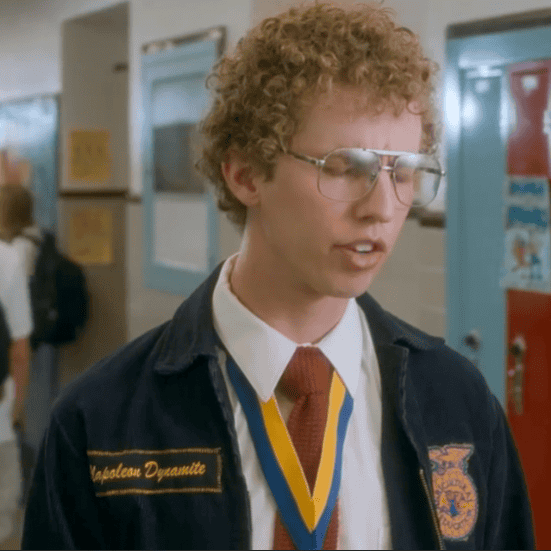
The year is 2004, and audiences are buying tickets to have a laugh at the expense of a boy named Napoleon in the movie Napoleon Dynamite. The film becomes a box office hit, and no one minds that its protagonist is pitiable. He’s a nerd, part of a cultural group everyone feels comfortable subjecting to ridicule. No one wanted to be a nerd like Napoleon, and that was the point.
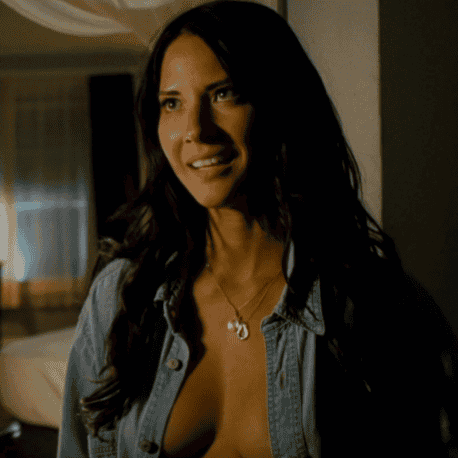
The year is 2006, and being a geek is so cool that a model named Olivia Munn begins portraying herself as a nerd. It may or may not have been true, but it works, and diving into the world of nerds helps make her famous. Munn builds an entire career out of being a desirable dweeb, and soon, the world is filled with attractive celebrities claiming geek status.
Modern readers may have a hard time imagining a world in which geeks and nerds weren’t accepted, but that was the norm until 2005, when one movie changed everything people thought about them.
The 40-Year Old Virgin was that inciting movie, and this is the story of how it trapped the world into thinking there’s nothing wrong with nerds.
Judd Apatow Makes Freaks And Geeks A Priority
The world changed in 2005. By 2006, American culture was geek culture, a place where it would surprise no one to hear the captain of the football team talking about his newly purchased lightsaber.
What happened between Napoleon Dynamite in 2004 and the rise of the aforementioned Olivia Munn in 2006 wasn’t organic. People didn’t change their minds about nerds because they suddenly realized they should be nicer to them. The world changed its mind about geeks because it was tricked into loving them by a singular piece of entertainment called The 40-Year Old Virgin.
Released in 2005, The 40-Year Old Virgin was the first movie directed by comedian-turned-filmmaker Judd Apatow. In 1999, he’d previously tried to make a TV series around the idea of lovable and sympathetic nerds. The show was called Freaks & Geeks, and it was critically acclaimed. Those rave reviews didn’t matter. Audiences were so turned off by the concept that the series was canceled after airing only a handful of episodes.
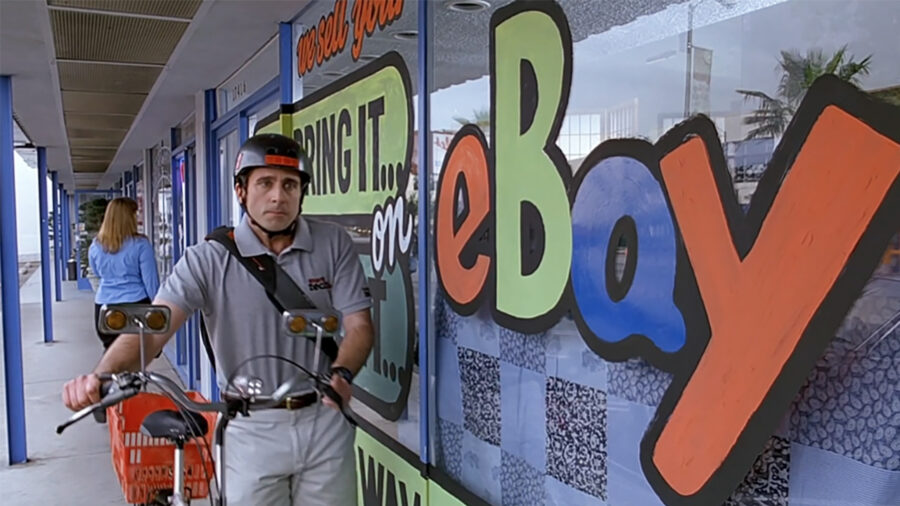
Judd Apatow didn’t give up. He found a new way to deliver his pro-geek message when he later teamed up with comedic actor Steve Carell and, with him, convinced Hollywood to greenlight an R-rated comedy called The 40-Year Old Virgin.
“I thought of it as Freaks and Geeks 20 years later if one of them never had sex,” he told GQ. “That was my secret thought as I made the movie.”
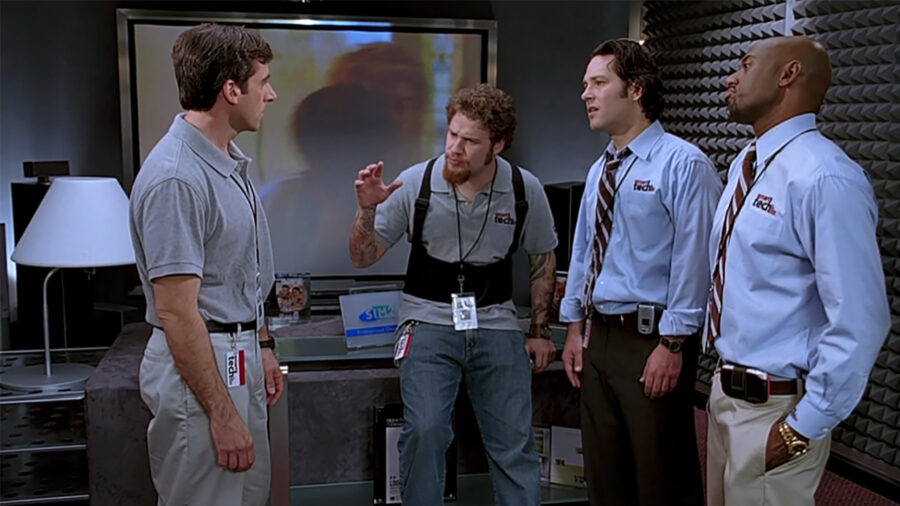
He’d learned important lessons from his past failures. This time Judd took a less obvious approach to sympathetic geekiness. He did it with a trick, a trick that transformed nerd-hating viewers into full-on nerd lovers.
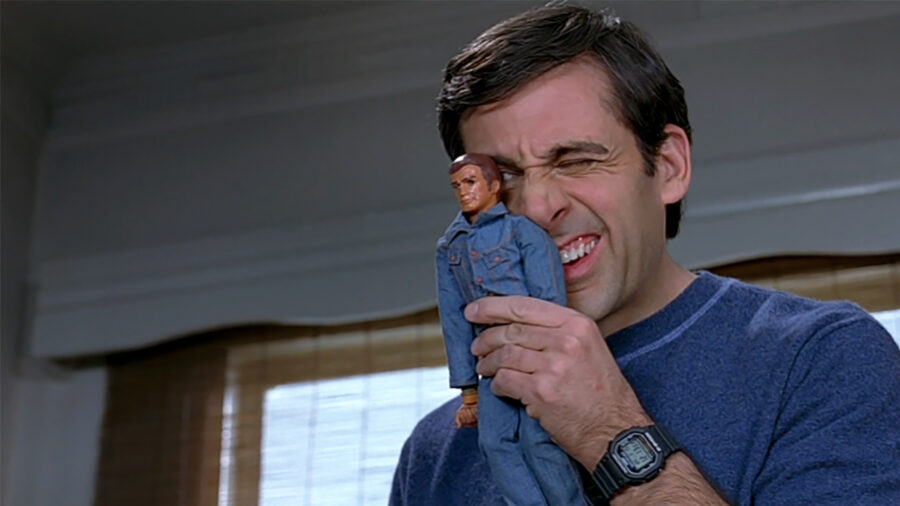
Andy Stitzer is the movie’s main character, and he is exactly what the movie’s title says he is. He also has a massive collection of vintage action figures and knows a few magic tricks. He may not wear glasses, but Andy’s not only a 40-year-old virgin, he’s also a 40-year-old nerd.
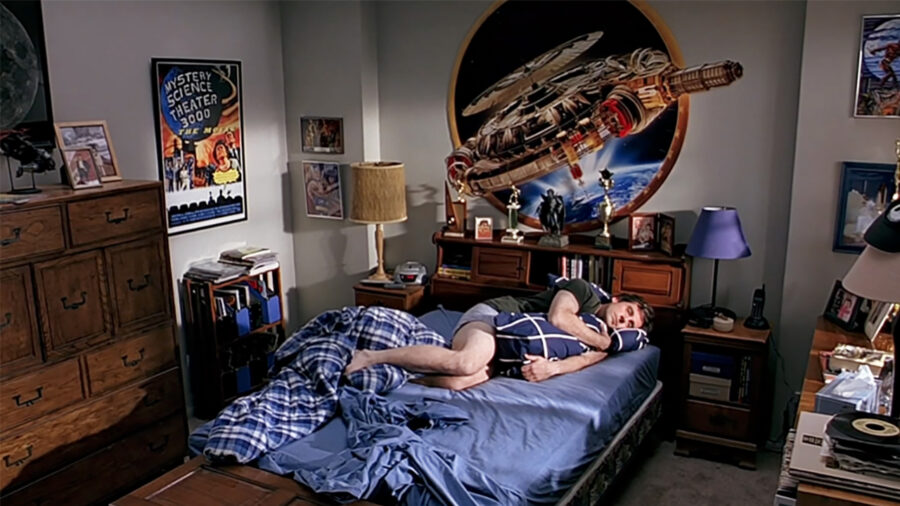
In the minds of those buying tickets to see it, The 40-Year Old Virgin was supposed to be another piece of nerd abuse comedy in the style of Napoleon Dynamite. That trick is the source of the movie’s screenwashing success. The 40-Year-Old Virgin is designed to appear as if it’s mocking Andy while quietly making the audience root for him. Then, when they least expect it, they fall in love with him.
This is a Derision Inversion. A derision inversion is a persuasion technique in which a narrative initially encourages the audience to mock or dismiss a character, then gradually transfers audience identification onto that same character, transforming ridicule into sympathy or emotional allegiance.

The Apatow comedy’s name sells the idea of promised geek mockery, and the movie’s trailers only further relayed this notion by focusing on The 40-Year Old Virgin’s lead character making a fool of himself while getting his chest waxed. The film’s marketing wisely avoided anything too heartfelt.
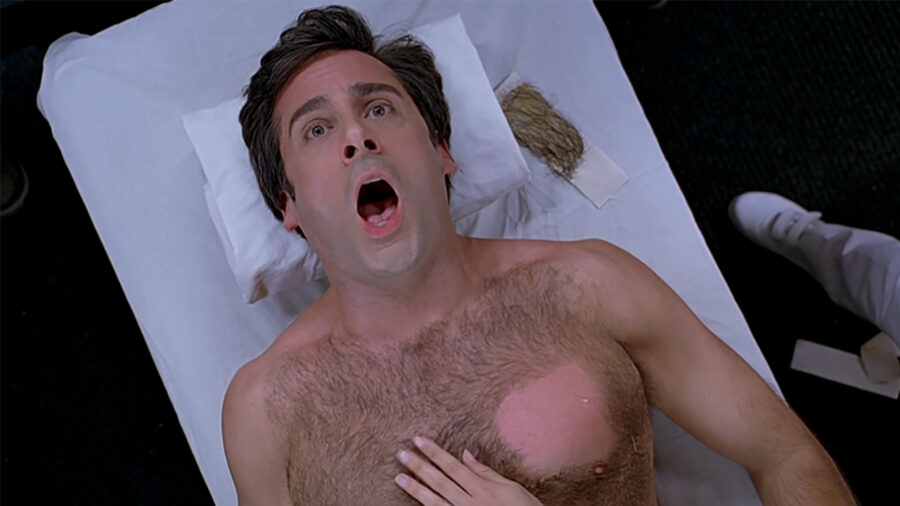
A chest-waxing laugh at the expense of Andy Stitzer isn’t all the movie is and wasn’t something it could have been. The film’s chief nerd is played by Steve Carell, an actor incapable of being unlikable. That’s exactly what Judd Apatow wanted.
How The 40-Year Old Virgin Hypnotized The World
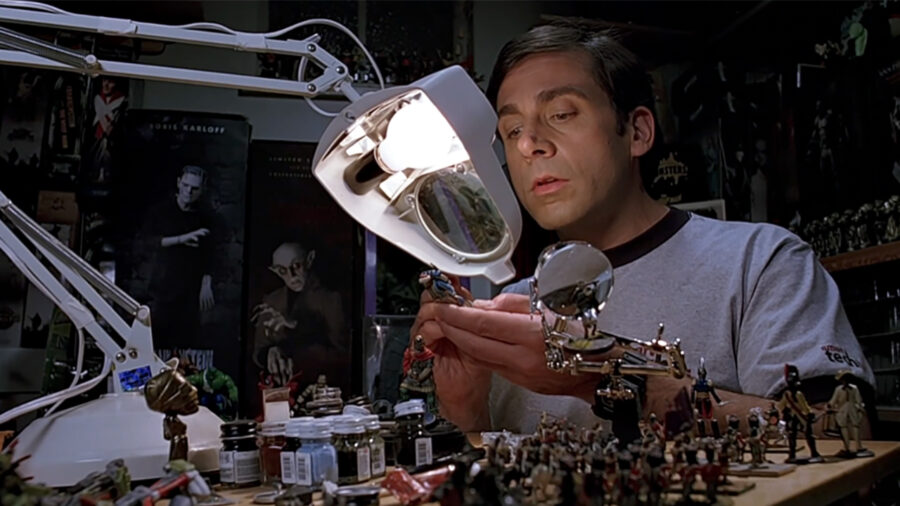
Audiences walked into The 40-Year Old Virgin ready to laugh at Steve Carell’s Andy Stitzer. By the time they walked out, they were laughing with him.
In the minds of viewers, Andy became the kind of guy you’d love to be friends with, the kind of guy you’d like to see date your daughter. He became that person not because he changed but because you did. He doesn’t stop building scale replica models or staying up late playing tuba. Andy Stitzer is the same nerd at the end that he was at the beginning, except with a new confidence built up by realizing people care about him.
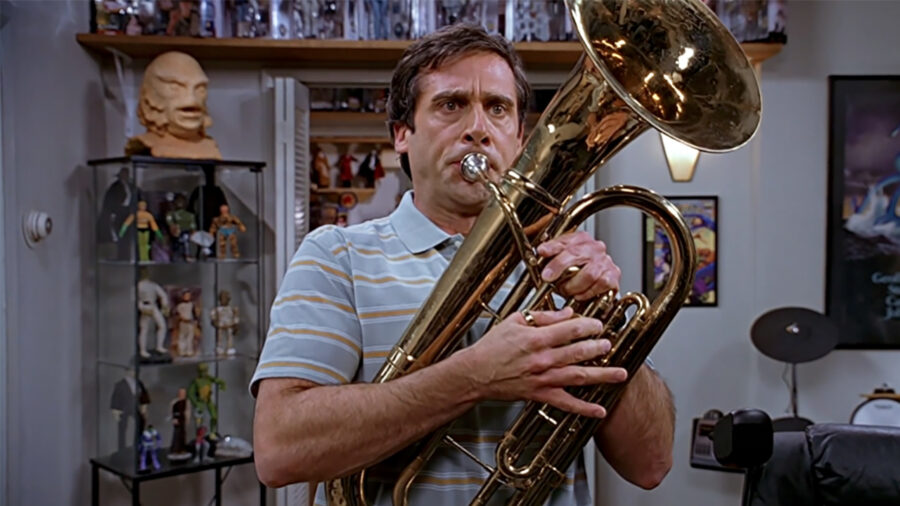
Andy’s journey is not one of abandoning his nerdiness to become someone else. He doesn’t become Stefan Stitzer to get the girl. Andy’s arc in The 40-Year Old Virgin is completed when he learns to accept himself as he is, and then surrounds himself with people who love him, geekiness and all.
The 40-Year Old Virgin was a huge hit. The movie opened at number one and stayed there for two weeks. It remained in the top two for five weeks. Those who saw it went back with their friends. Those who didn’t see it likely heard the news media talking about it and saw lovable Steve Carell out there, front and center, as the movie’s prototypical nerd.
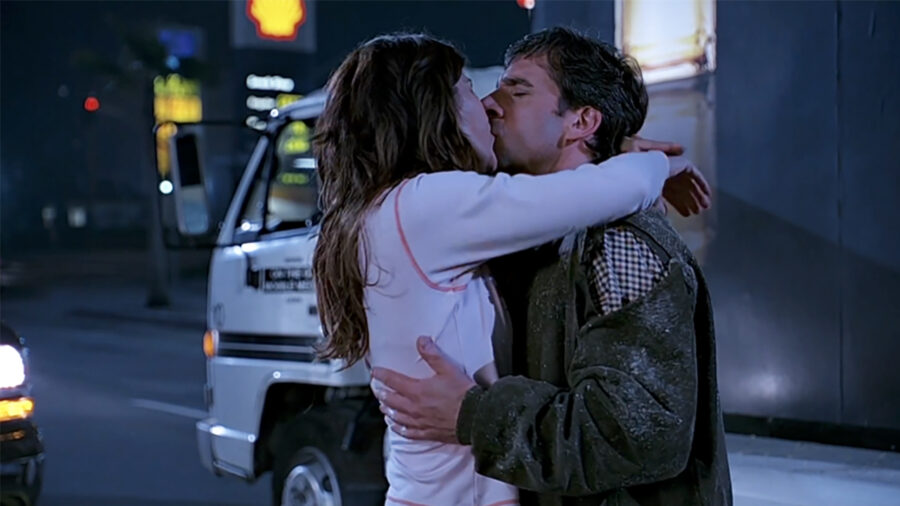
The movie went on to spawn a whole generation of Judd Apatow-related movies, like Knocked Up and Forgetting Sarah Marshall. Steve Urkel was no longer the nerd image in people’s heads. Judd Apatow’s movie and Steve Carell’s warm, friendly character took root there instead.
It doesn’t matter whether you’ve seen the film. The movie’s success created a huge cultural shift by reprogramming the brains of the people who saw it. Those people then took that programming with them and spread it to others. The nerd positivity The 40-Year Old Virgin designed spread through American culture like a mind virus, carried to new, impressionable brains by talk shows and other pieces of corporate entertainment rushing to duplicate that success. The entertainment media battled each other to be on the cutting edge of what Judd Apatow had now convinced them was a new trend.
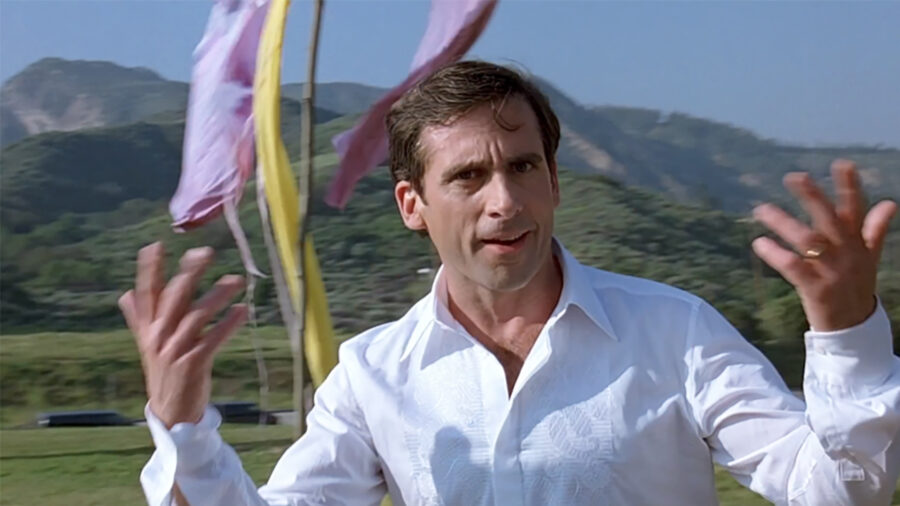
Maybe your first indoctrination was watching Superbad or a documentary on the dangers of bullying. It doesn’t matter where you got the idea that nerds weren’t so bad; it was The 40-Year Old Virgin that put it in your head.
The Origins Of Andy Stitzer
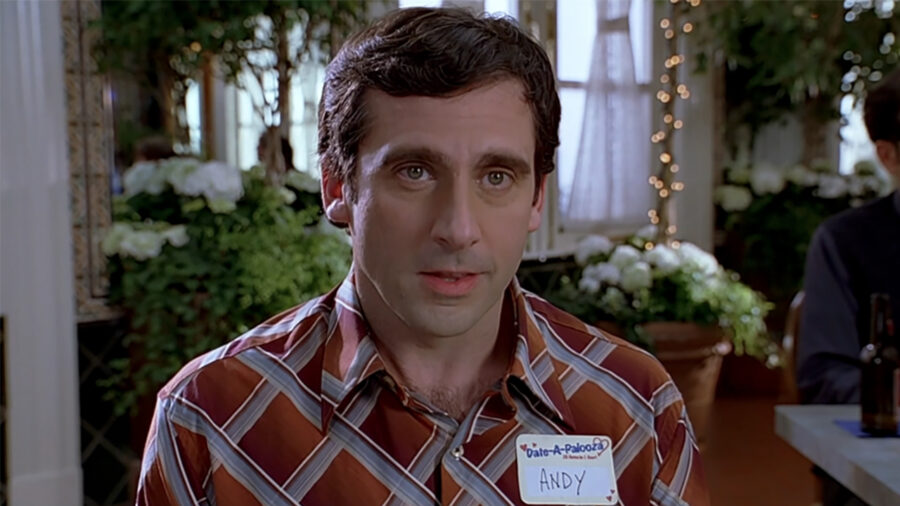
None of it would have happened if Apatow hadn’t served as a producer on a previous R-rated comedy called Anchorman: The Legend of Ron Burgundy. Steve Carell has a supporting role in that film. He steals every scene he shows up in.
Judd Apatow was so impressed he told Steve to call him, if he ever had an idea for something he wanted to do. Steve Carell did. He’d come up with a character to use in sketches with the legendary Second City Improv group and told Apatow about it. Carell told GQ: “It was about a guy playing poker with his friends, and they were all telling really dirty sex stories, and slowly, you realize that he’s a virgin, and his stories make no sense.”
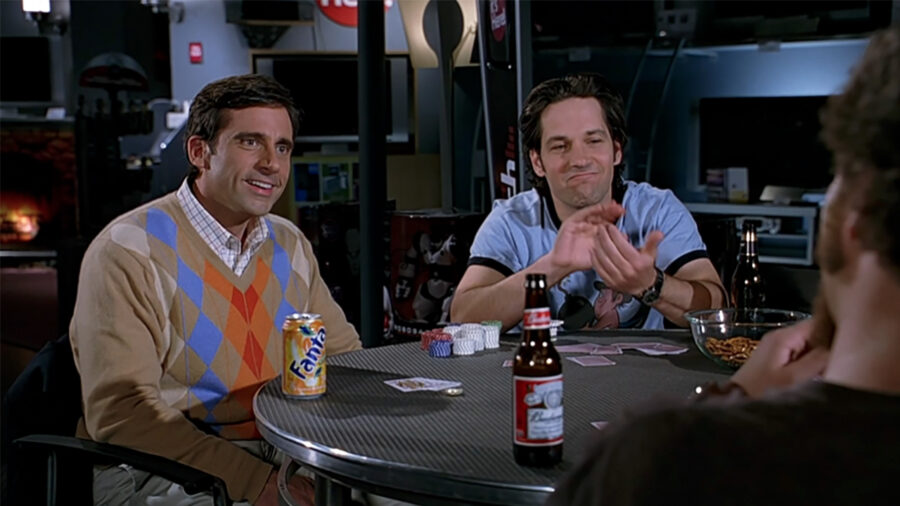
That sketch would eventually become one of the funniest and best scenes in the movie, but as Apatow and Carell fleshed out the concept, they realized they wanted to do something more than a cheap sketch. They wanted people to understand their geeky virgin as a real person.
Apatow told GQ: “We learned from our research when we read a lot of blogs on the internet from virgins that they are all just nice, shy people, and they weren’t odd. There wasn’t any big joke to it.”
They took the same approach with Andy’s friends who, in a standard movie about an awkward virgin might have mocked him or bullied him. But Judd Apatow tells Entertainment Magazine: “At first glance, these guys embody every bad, misogynistic attitude toward women…but deep down, they are sweet guys with the best of intentions who cover up their own terror with horrible theories on women.”
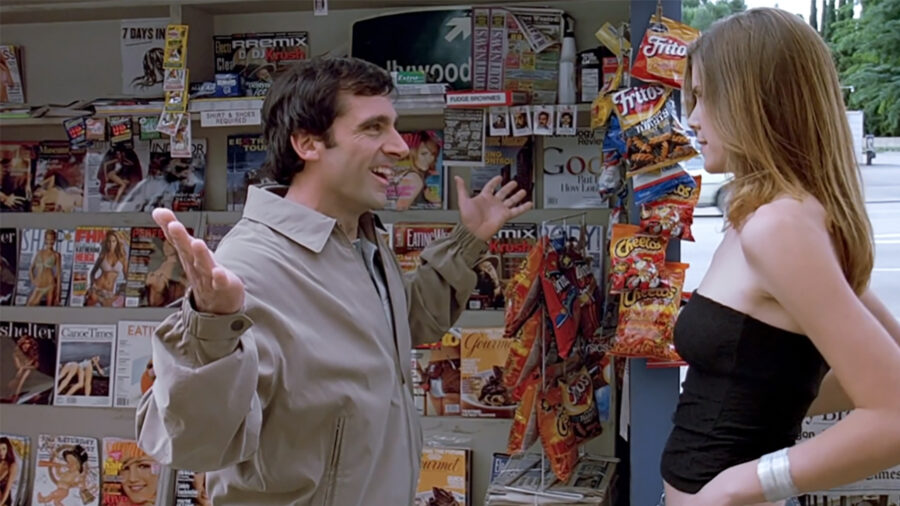
The movie never tries to hide Andy’s quirks. Apatow says, “Andy has turned his energy—decades of pent-up sexual energy—into his other interests. So he’s amassed a rather large collection of action figures and video games. He’s not exactly a hermit, but he’s an introvert who keeps to himself amidst his collection of stuff.”
Andy is a good, kind, lovable person and also a legitimately introverted, card-carrying geek who keeps his action figures vintage and knows an assortment of magic tricks. He’s the kind of guy you’d have met at the San Diego Comic Con, in the early days before attending became acceptably cool.
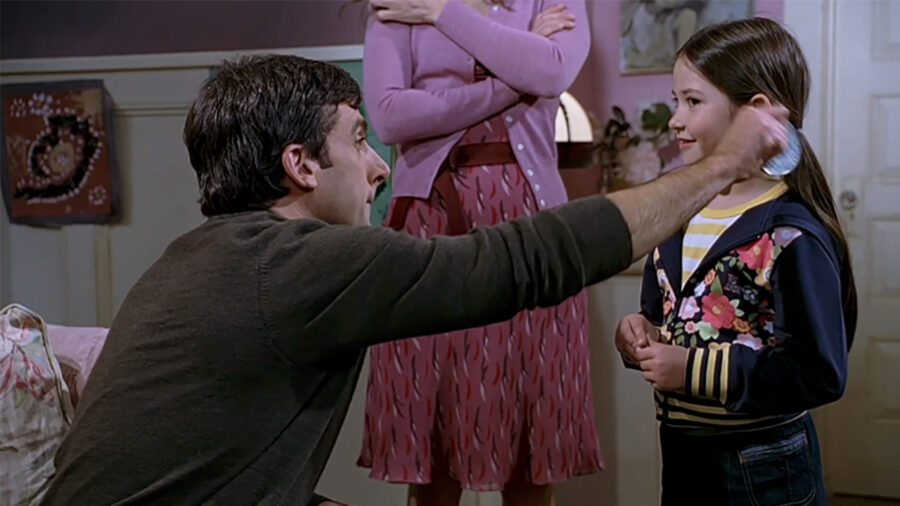
Making Andy sympathetic may have been Apatow’s intention, but the studio funding his film was still stuck in a mindset that had them thinking of nerds as less than human. After only five days of filming, Univeral Pictures got cold feet and tried to kill the movie.
Maybe they’d seen Napoleon Dynamite too many times and weren’t ready to take off their nerd-hatred colored glasses, but Universal decided Steve Carell’s character looked like a serial killer and wanted nothing to do with it. Apatow and his team calmed them down, allowing the movie to resume filming.
When Nerds Were The Disease And Punching Was The Cure

Before The 40-Year-Old Virgin, nerd perceptions were very different. To prove that point, take a trip back in time with me to the release of the movie Back to the Future. Arriving in 1985, the film features a prototypical nerd character named George McFly.
When the movie starts, George McFly is an adult nerd, and as a result, the movie assumes he’s also a total loser. By the time Back to the Future ends, his character arc is completed only when he gives up his nerd tendencies and starts acting like the kind of cool, confident guy who punches assholes in the face and plays tennis on the weekend.

Changing George McFly from a nerd into a tennis-playing tool is, in a sense, the entire reason for Marty McFly’s adventure. Because, after all, who’d want a nerd for a father? No thanks. Get that man a doubles partner.
It worked because this was the ideology eighties audiences were most comfortable with. No one paused their VCR and asked, “Hey, what’s wrong with being a nerd?”
The best example of America’s pre-2005 anti-nerd bias is found in the most famous nerd of all time: Bill Gates.
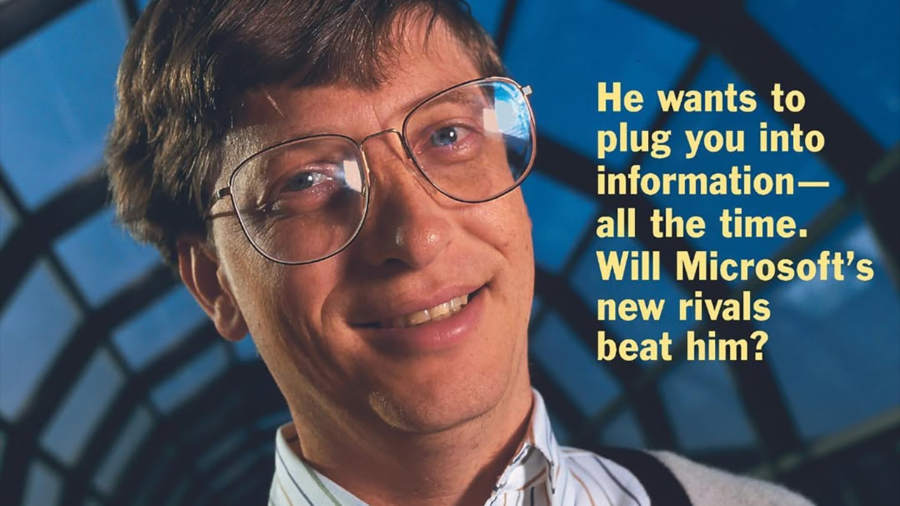
Long before Elon, Bill Gates was famous for being a geek, and also famous for being uniquely hated. He was frequently criticized for overly aggressive business practices and being evasive when faced with government scrutiny. The view of the general public in the 80s and 90s, when it came to Bill Gates, was that he was a creep who spent way too much time reading books and stole everything he’d accomplished. He was also viewed as the prototypical modern representation of a nerd.
Gates was once so hated that it became unsafe for him to go out in public. It culminated in 1998 when, while walking down the street, he was attacked and hit with a pie in the face by a French activist, Noel Godin. The act was seen as a protest against Bill’s monopolistic practices, and the public didn’t exactly feel bad for Bill when it happened. Most felt he had it coming.
While he’s become unpopular again in recent years, after The 40-Year-Old Virgin, people viewed him favorably. Gates became Geek Jesus, a super-smart savior traveling the world dispensing vaccines to sick kids.
The Steve Urkel Effect
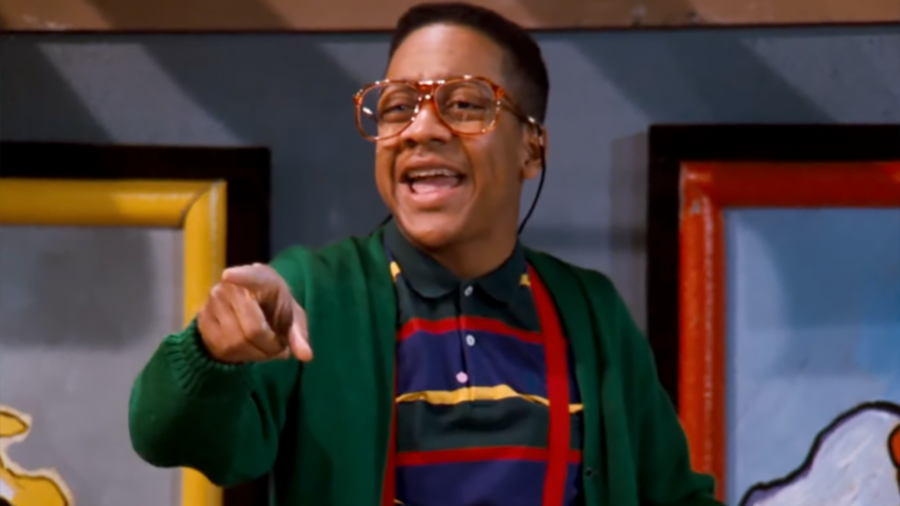
Not all nerds were hated in that pre-2005 world. Hated or not, none of them were respected. Few figures embodied this form of anti-nerd bigotry better than Steve Urkel.
Steve Urkel was one of the most popular characters in television history. In the early 1990s, people quoted him, dressed as him for Halloween, and bought thousands of talking Steve Urkel dolls.
As played by Jaleel White on the sitcom Family Matters, Steve Urkel was loved specifically because people enjoyed mocking him. Laughing at Steve made viewers feel better about themselves because at least they weren’t like him.
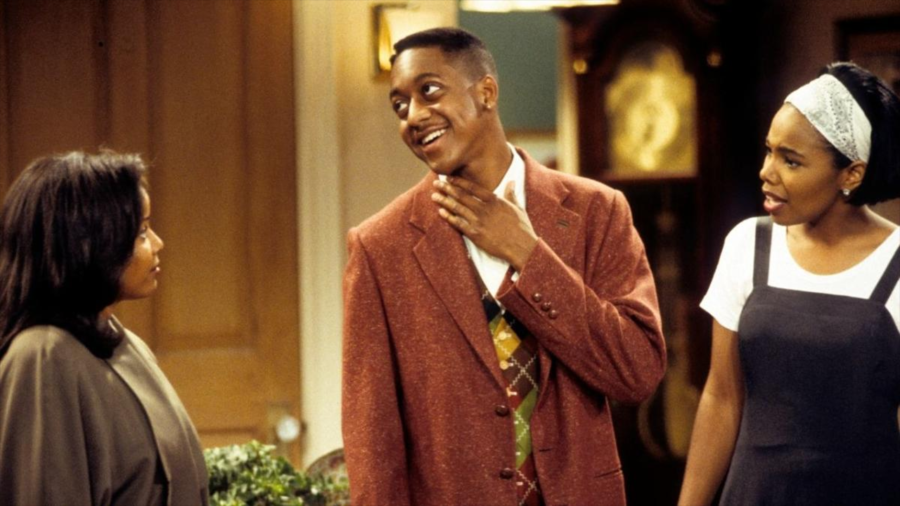
In one of the later Family Matters seasons, Steve develops a magic formula called “cool juice” that transforms him into a less intelligent, more suave version of himself called Stefan. When it happened, the audience did not bemoan the loss of their beloved nerd. Instead, fans celebrated Steve’s victory over his nerdiness. In the context of the show, Stefan is rewarded for his coolness by getting the girl whose heart nerdy Steve Urkel had been trying and failing to win all along.
The most popular, long-running gag on Family Matters revolved around Carl Winslow throwing Steve Urkel out of his house. He tosses him out because Steve is an annoying nerd. It was funny every time it happened because Carl was always right. Steve was annoying, and like all nerds, he had it coming.
The Early Foundations Of Nerd Acceptance
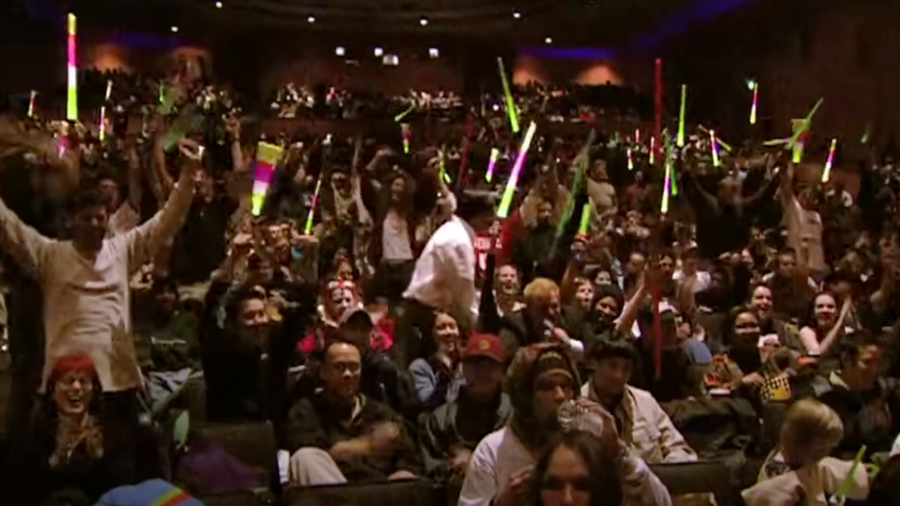
The foundation for full nerd acceptance was laid in 1999 when corporations looked up and noticed that nerdy things were becoming exceptionally profitable.
Lines wrapped around the block for The Phantom Menace. Star Wars toys were flying off shelves, and they weren’t being sold to kids. The Matrix was the surprise hit of the decade, and the adult men in line for it looked like they’d fallen out of a Volkswagon bus on its way to a permanently single convention.
The geeks who opened their wallets for those 1999 cash cows did not gain acceptance by rote of their numbers. If you were one of many bespectacled Star Wars fans who slept outside a movie theater that year, there’s a good chance a carload of frat boys drove past, rolled down their windows, stuck out their backsides, and shouted, “Nerds!” at you and your fellow line campers.
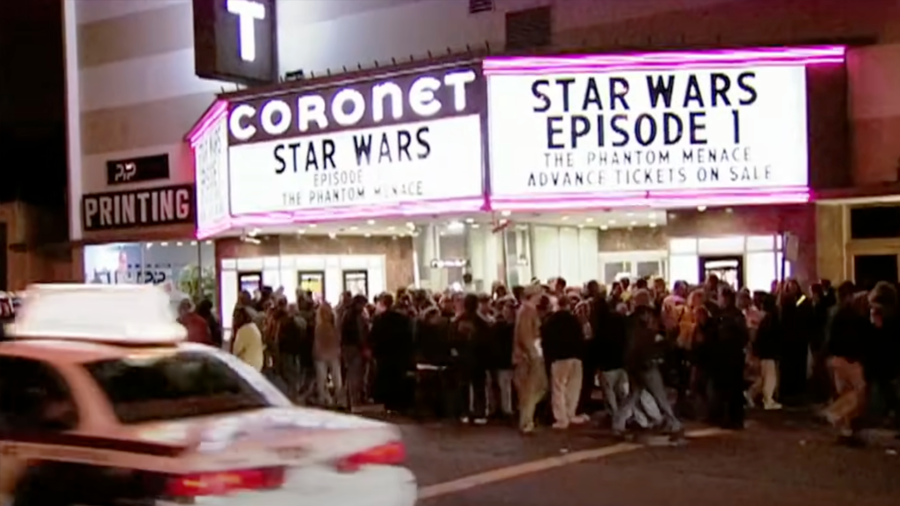
The local news was also present at those Jedi campouts. Their aim was to cover the massive popularity of geek sci-fi properties with a strongly slanted “hey, look at these crazy weirdos!” angle. Making fun of nerds got them ratings.
Those big companies that noticed the profit potential built up inside those line-standers spent the next few years greenlighting more geek-friendly projects. Slowly, as movies like The Matrix gained more widespread acceptance, the cultural stigma against geekery began to soften. It didn’t dissolve.
The Last Gasp of a Nerd-Hating Culture
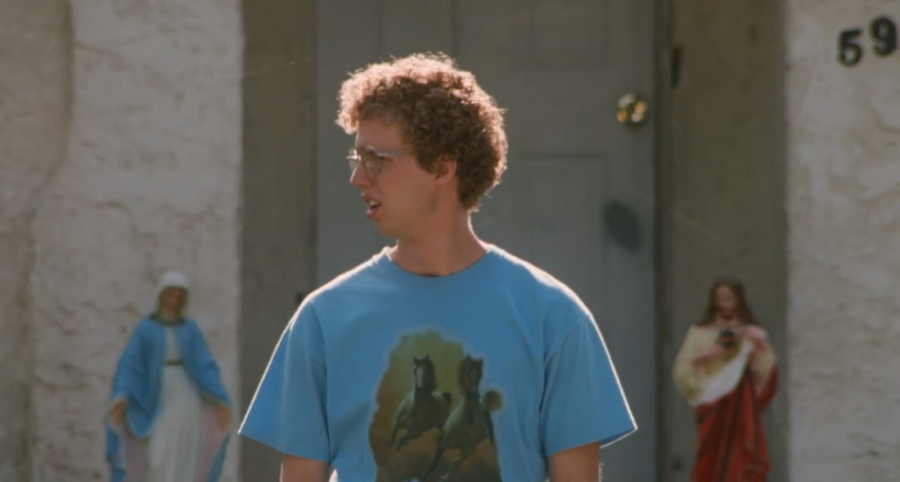
When released in 2004, Napoleon Dynamite, for all its uniqueness, was the last gasp of a nerd-hating culture. The character was popular in the same way Steve Urkel was popular. Audiences loved laughing at him, but no one was interested in laughing with him.
Without the built-in negative feelings American culture had about nerds, it would not have been OK to laugh at all. Instead, the audience might have felt sorry for Napoleon, who lives a horrible and sad life deserving of pity, not scorn.
Napoleon Dynamite’s a nerd, so no one cared. That left the 2004 audience members buying tickets to his movie, free to laugh at him.
The Current State Of Nerds

Being a geek is now chic. Nerds have gained such broad acceptance that much of our world has been realigned to protect them. Anti-bullying campaigns are the standard in public schools, and social media is filled with super-attractive celebrities telling stories about how they were abused and bullied in high school before they got hot.
Stories of past nerd suffering make the tellers more popular, or they wouldn’t share them. Take the time to investigate, and you’ll likely find most of them aren’t true.
It doesn’t matter. When an attractive would-be star declares themselves a nerd, it’s viewed as a good marketing move. Entire YouTube empires have been built off that simple premise. It may not last forever, but in 2025 things have never been better for the word nerd.
Elon Musk Owes It All To Steve Carell
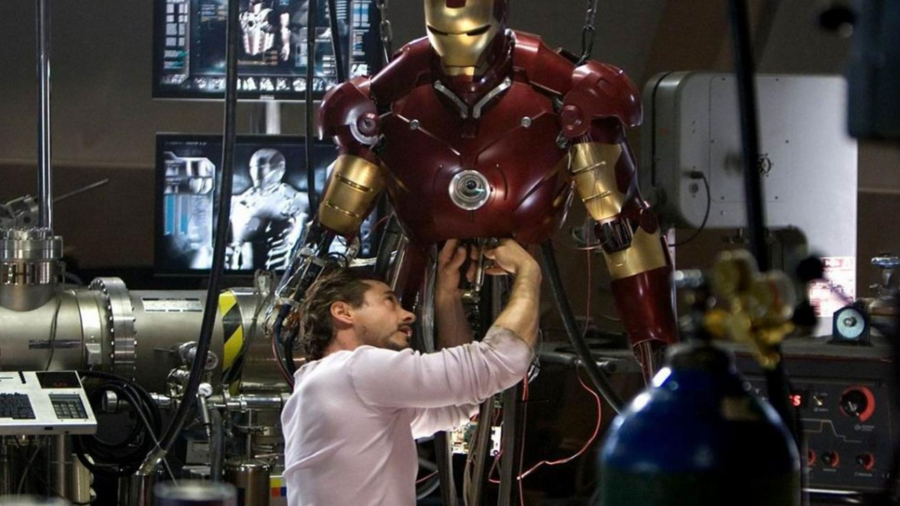
If pop culture’s view on nerds before 2005 was embodied by Steve Urkel, then in a post-2005 world, it is best embodied by Tony Stark. Stark is the smartest and quirkiest character in the Marvel Universe. Like the many other fictional and real-life nerds who came before him, Tony talks too fast because his mouth can’t keep up with the ideas in his head.
Tony’s every bit the nerd Steve Urkel is, except he’s handsome, rich, and can get any woman he wants without the aid of cool juice to unleash his inner Stefan. And, of course, Tony Stark only wears glasses when doing so will give him superpowers or make him look awesome.
If pre-2005’s real-world nerd representative is best embodied by Bill Gates, then in a post-Apatow world, he’s been replaced by Elon Musk.
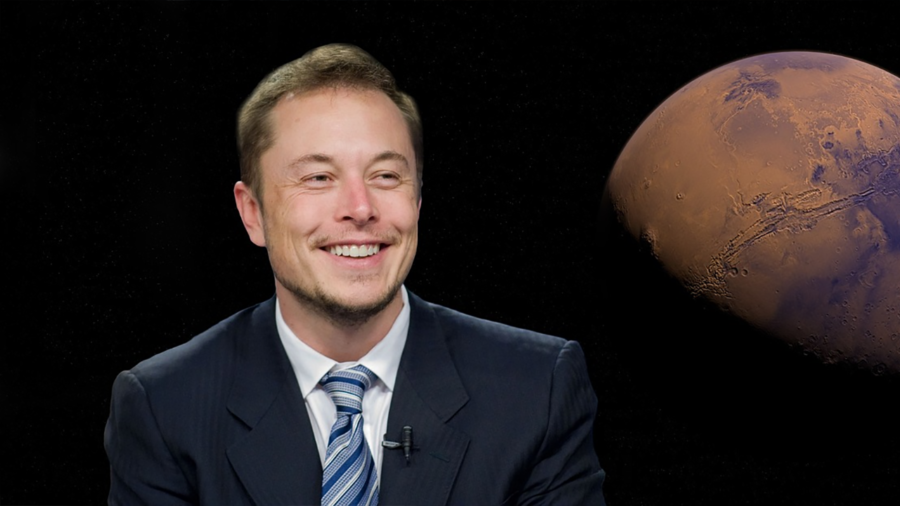
Where Gates repulsed everyone who encountered him, Elon Musk is the toast of the social media and the podcasting world. Elon’s notorious for the number of beautiful women he juggles, and he’s the kind of celebrity most Hollywood stars only dream of being.
There’s no doubt about it: Elon Musk is a nerd. He talks too fast, slurs his words, plays video games, geeks out about space, and has the posture of a middle-aged writer. Yet, everyone wants to be him. If they don’t, it’s only because they’re jealous.
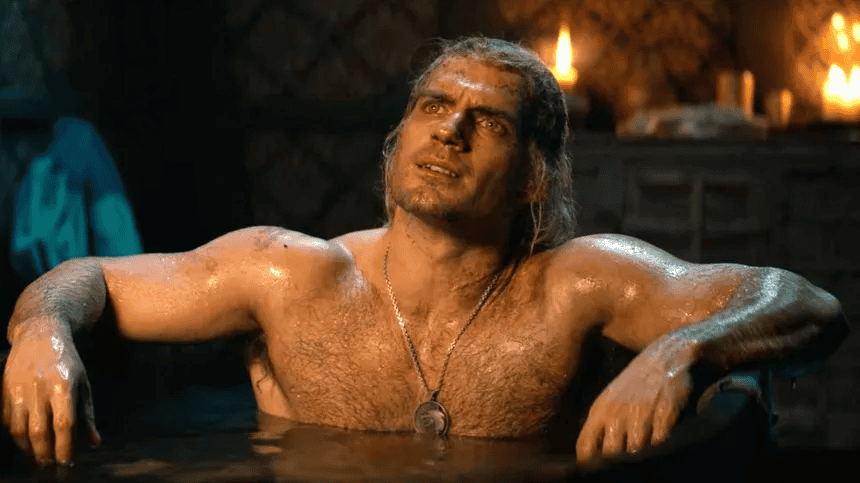
Things have changed, and nerds, at least the good-looking or rich ones, have Judd Apatow’s artful screenswashing in The 40-Year-Old Virgin to thank for it. When it comes to the less physically fortunate nerds out there, maybe things are as bad as ever. Except now they’ve lost their identity to the likes of hunky Henry Cavill (who loves nerdy games and building computers).
If Henry Cavill is now a nerd, then I suppose we’ll have to come up with a new word for the poor, introverted, fat kid still living in his mother’s basement and hoping to meet a supermodel who won’t expect him to look like Superman. Sorry kid, it’s probably not going to happen. Here’s to the losers, one and all.

Entertainment
FIFA World Cup schedule today: Games, kickoff times, livestream info for June 14
Table of Contents
After the action kicked off on Thursday, June 11, Matchday 4 of the 2026 FIFA World Cup has arrived. Don’t worry if you missed the first few days; there are plenty more to go, with 48 teams competing in the largest World Cup tournament in history. Groups A through D have already got the ball rolling, and today will see Groups E and F do the same.
Today, June 14, is another busy day with four matchups in the U.S. and Mexico. The action kicks off at 1 p.m. ET. There’s a lot to keep up with, especially if you’re new to the World Cup madness, so we’ve broken down the details for you below. Here’s what you need to know to tune in live today.
FIFA World Cup schedule today: June 14
How to livestream FIFA World Cup games today
Watch Germany vs. Curaçao
Group E kicks things off on Sunday, June 14, with a first-ever meeting between Germany and Curaçao at Houston Stadium. Kickoff is at 1:00 p.m. ET, and live coverage will be on Fox and Fox One. Peacock will carry the live Spanish-language coverage.
Watch Netherlands vs. Japan
Group F’s first matchup will see the Netherlands take on Japan at Dallas Stadium on Sunday, June 14. The Netherlands has the edge in the all-time series between the two teams, but both teams bring strong tournament experience. Kickoff is set for 4 p.m. ET, and coverage will be on Fox and Fox One, with Spanish-language coverage on Peacock.
Mashable Top Stories
Watch Ivory Coast vs. Ecuador
A fresh matchup on the global stage, dark horse Ecuador takes on the Ivory Coast at Philadelphia Stadium. The Group E matchup kicks off at 7 p.m. ET and live coverage will be on FS1 and Fox One. Spanish-language coverage will be streaming on Peacock.
Watch Tunisia vs. Sweden
Group F teams Sweden and Tunisia will go head-to-head on Sunday, June 14, at Monterrey Stadium. The two teams have never faced each other at the FIFA World Cup, making this a fresh matchup on the tournament stage. Kickoff is set for 10 p.m ET, and live coverage is on FS1 and Fox One, with Spanish-language coverage on Peacock.
$39.98
$59.97
Save $19.99
only for a limited time
More live streaming options
Live TV cable replacement
Rather than a standalone streaming service like Fox One or Peacock, you can sign up for a live TV cable replacement service, like YouTube TV or Hulu + Live TV. These options have a cable-like format, with over 100 live channels, but run off a WiFi connection. You’ll get live access to Fox and FS1, plus tons of other popular networks. They can get pretty expensive, but most offer a free trial and a discounted introductory rate. Here are a few options to consider:
Watch for free on ITVX, BBC iPlayer, and more with a VPN
Don’t want to sign up for yet another streaming service? Consider subscribing to a VPN and streaming the World Cup matches for free on international services like ITVX, BBC iPlayer, NOS, or RTÉ. We recommend ExpressVPN — a Mashable-tested service and an Official Tournament Supporter of the FIFA World Cup in the U.S., Canada, and Europe — as our VPN of choice for the sporting event. It offers servers in 105 countries, a user-friendly app available on all major devices, a speedy connection, up to 10 simultaneous connections, and a 30-day money-back guarantee. If you’re new to VPNs, our global World Cup watch guide will help you nail down the details.
$12.99 only at ExpressVPN (with money-back guarantee)

The Extremely R-Rated Sci-Fi Masterpiece Destroyed By Stallone Stink
As AI companies race to go public, who else is along for the ride?


