
Entertainment
Streaming Found A Way To Ruin Sports Too

By Jennifer Asencio
| Published

Basketball season is winding down and at the time of this writing is in the first round of its playoff tournament. Before that could begin, there was also a play-in tournament meant to fill out the rest of the playoff brackets through one-game matches whose winners would continue to the next round. The games have been frenetic, with most of them decided in the last minutes. Basically, basketball is hurtling down the canyon, about to drop the torpedo into the Death Star.
Imagine you are watching Luke Skywalker just about to use the force to make his shot, when all of a sudden the streaming service you are watching it on interrupts the action for “technical difficulties.” That is exactly what happened to basketball fans on not one but two streaming services.
Peacock and Amazon Prime are splitting the duty of airing the NBA postseason. Amazon Prime aired the play-in tournament, while the two networks are swapping the playoff games back and forth. During three different games, both within the final minute of very close matches, both streamers suffered technical difficulties that interrupted the broadcast.
Technical Interruptions Interfere With Gameplay

On April 14, 2026, the Orlando Magic and Charlotte Hornets were in a match-up for all the marbles. The winner would go on to the next round of the play-in tournament, while the loser went home. With 30 seconds left in the game, the score was 123-120, which, if you know basketball, means the Hornets only needed one shot from the right part of the court to tie the game, and they had the ball. Suddenly, Prime, which aired that game, put up a “technical difficulties” card, during which the Hornets did score another basket, making the score 123-122 while no one could see on television. The contentious game ended with the Magic winning, 127-126, but fans only got to see it because the teams called a time-out while Prime fixed its issue.
A week later, on April 20, 2026, the New York Knicks played the Atlanta Hawks on Peacock. The game ended with the Knicks losing 107-106, but once again, the final minute was interrupted by a “technical difficulties” card. This time, the difficulties were offset by a time out and viewers didn’t miss any of the action, but the Knicks-Hawks game wasn’t the only difficulty Peacock had that night.

Also playing that night after the Knicks-Hawks game were the Denver Nuggets and the Minnesota Timberwolves. For most of the game, the teams traded the lead, ending halftime tied. But in the last quarter (12 minutes of active game time), the ‘Wolves started a major comeback. In the final minute, it was anyone’s game, with both teams bringing their best play to the match … and then technical difficulties struck again.
To the credit of the NBA teams playing these games, all three called time-outs when the technical difficulties overtook the broadcast. Often, interruptions like this cause viewers to miss the action, and the broadcast usually just resumes when it is fixed rather than showing viewers what they missed. The rules of basketball serendipitously offset this with time-outs and frequent breaks for players who are literally running at full speed for minutes at a time, but a lot of live broadcasts do not have breaks like that.
The Streaming Blob Absorption Conundrum

Paramount+ also suffers issues with its streaming services often lagging, and the live TV function on that service is also often inaccessible. Survivor 50 fans lost 15 minutes of the premiere episode because the live TV feature was frozen for many viewers as numerous people tried to watch the show. MLB.TV bills itself as the home of all things baseball, but it also lags and freezes during live broadcasts of games.
With more live broadcasts getting absorbed by the streaming blob, interruptions like this mark an infuriating turn. It is bad enough that many services have interruptions to movies or demand high prices to eliminate commercials from their content. As streaming services become ubiquitous, they are also demonstrating that they can’t handle the load brought on by live television events.

The Balkanization of streaming services has made subscribing to them similar to subscribing to each cable channel individually (can you imagine having to pay separately for CNN, TNT, AMC, USA, and TBS, on top of premium channels like ESPN, HBO or Showtime?). As it is, to watch post-season basketball out of market requires two different premium streaming services (the Peacock games are also aired on NBC, but only regionally). Watching the NFL postseason this past winter required four. Watching the Oscars is going to require a YouTube subscription starting in 2028.
Past Is Prologue, But We Still Haven’t Learned
Interruptions in the middle of live events are so unpardonable from any channel that it was made official policy to show the entirety of a game and preempt the shows following after the infamous “Heidi Bowl” incident in 1968. During this New York Jets NFL home game, the then-Oakland Raiders were dominating the field of play, so the network decided to switch to a made-for-TV version of the German folk story “Heidi.” The Jets came back to win the game in an exciting upset that only fans in the stadium got to see. While this was a bad network decision and not a technical difficulty, it set a precedent for live broadcasting that existed all the way until the Prime-Peacock NBA postseason broadcasts.

What streaming customers are getting isn’t as consistent as what we got from comparable cable channels. The more broadcasting, live or not, that moves over to streaming, the more the services are going to have to address these problems. Streaming was supposed to be a superior alternative to television. Instead, as the NBA playoffs debacle has demonstrated, they are becoming more of a monster than cable and can’t even provide the same level of service.
Entertainment
The ASUS TUF Gaming F16 gaming laptop is down to a record-low price at Amazon — now $400 off
TL;DR: Amazon has the ASUS TUF Gaming F16 gaming laptop on sale for $899.99, down from its $1,299.99 list price. That saves you $400 on a 2025 gaming laptop with an Intel Core i5-13450HX processor, NVIDIA GeForce RTX 5050 graphics, 16GB of DDR5 memory, and a 165Hz FHD+ display.
$899.99
at Amazon
$1,299.99
Save $400
Finding a current-gen gaming laptop in today’s economy for under $1,000 is already amazing, but Amazon’s latest ASUS deal is offering you an all-time low bargain.
As of April 28, the ASUS TUF Gaming F16 gaming laptop is on sale for $899.99 at Amazon, marked down from $1,299.99. Price tracker camelcamelcamel has confirmed that this is the lowest-ever price for this gaming laptop.
For that price, you’re getting the RTX 5050 and Intel Core i5 version of the TUF Gaming F16, which is built around an Intel Core i5-13450HX processor and NVIDIA GeForce RTX 5050 Laptop GPU. It also comes with 16GB of DDR5 RAM and a 512GB PCIe Gen4 SSD, so it should be nicely suited for jumping between games, school work, everyday browsing, and plenty of tabs without causing your sessions to come to a sudden crash.
With those sorts of specs, this version of the ASUS TUF Gaming F16 lets you comfortably run games from the latest graphically demanding titles — including Crimson Desert, Cyberpunk 2077, Black Myth: Wukong, Kingdom Come: Deliverance 2, and Pragmata.
Mashable Deals
The 16-inch FHD+ display is a big part of the appeal, with ASUS’s fitted 165Hz 16:10 panel with 100% sRGB color giving you extra vertical space compared to a standard 16:9 screen while keeping motion smoother in fast-paced games like Fortnite and Counter-Strike 2. The handy Adaptive-Sync also helps cut down on stuttering and screen tearing when your frame rate starts shifting during intense firefights or brawls with lots of assets moving around at the same time.
Mashable Deals
The TUF Gaming F16 keeps the series’ usual more rugged angle, as well. ASUS has had the laptop tested to MIL-STD-810H standards, while its 2nd Gen Arc Flow Fans, full-width heatsink, and full-width vent are designed to help keep performance steady without making the machine unnecessarily loud.
If you’re after a laptop that’s more for work than gaming, Samsung’s ultra-sleek Galaxy Book5 Pro 360 just got a $450 price cut.
Entertainment
Beloved Star Trek Character Busted Franchise’s Biggest Myth With Single Line
By Chris Snellgrove
| Updated

Star Trek has some of the most passionate fans on the entire planet. For the most part, those fans are unified in their love for this decades-old sci-fi franchise. However, there are a few things the fandom has bitterly debated over the years. One of the most intense arguments involves a seemingly innocuous question: can Vulcans lie? Some fans are convinced that these logic-loving aliens are far too moral and upstanding to deceive anybody. Other fans believe Vulcans are fully capable of lying and have successfully convinced the galaxy that they always tell the truth.
This persistent Star Trek myth goes back to The Original Series and claims made by characters like Spock and Dr. McCoy. Eventually, this myth was busted by Tuvok, who reluctantly told Seven of Nine that Vulcans were capable of lying but generally preferred not to do so. After decades of fan debate, this finally settled the matter. However, what most fans don’t know is that Tuvok accidentally busted this myth far earlier in the show. In “Twisted,” he blatantly lies to Captain Janeway in a scripted exchange that seriously upset Tuvok actor Tim Russ.
The Man, The Myth

First, we need to talk about how the “Vulcans don’t lie” myth came about. Back in The Original Series episode, “The Enterprise Incident,” a Romulan commander asks Spock if it’s true that Vulcans can’t lie, and Spock responds, “It is no myth.” This idea is also backed up by Dr. McCoy, who offered his medical opinion on the matter in “The Menagerie, Part 1” when he says of Spock, “the simple fact that he’s a Vulcan means he’s incapable of telling a lie.” Even the android Data agrees. In the Next Generation episode, “Data’s Day,” he wrote a message to Bruce Maddox about how Vulcans couldn’t lie.
If you pay close attention, though, Spock himself sometimes justified telling blatant lies. In The Wrath of Khan, when Saavik realizes Spock told Kirk that Enterprise repairs would take longer than they did, she confronts him: “You lied!” Spock (who was speaking in code to Kirk) simply replies, “I exaggerated.” In The Undiscovered Country, his apprentice, Valeris, does something similar. When asked to name her fellow Starfleet traitors, she says she does not remember. When Spock asks, “A lie?”, she responds, “A choice.”
A Secret Onscreen Lie
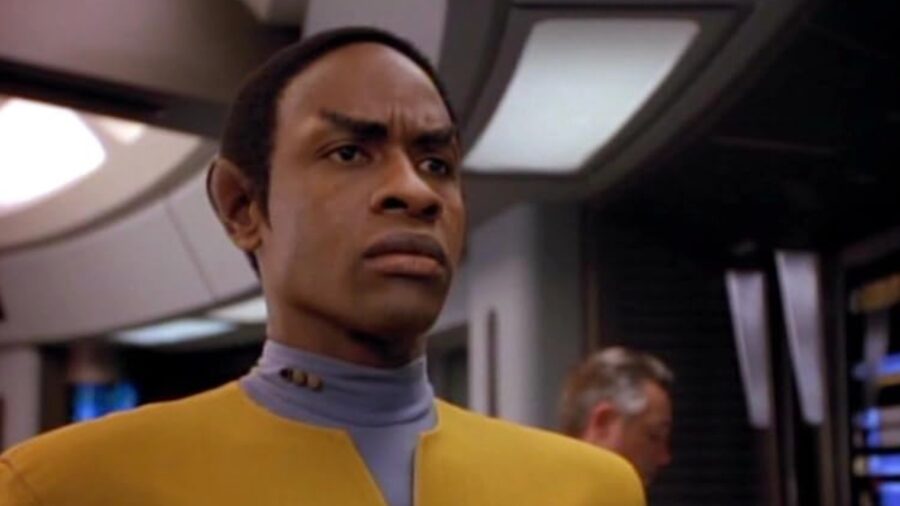
When he began working on Star Trek: Voyager, Tuvok actor Tim Russ seemingly bought into the idea that Vulcans don’t lie. In an interview with Cinefantastique, the actor discussed some dialogue from the episode “Twisted” that he disagreed with. “There’s a line in an episode we just finished, ‘I’ve always respected the Captain’s decisions.’ And that line was difficult to say.” Elaborating, he said, “[The] line was difficult to say when, in fact, we know he […] violated protocols [in ‘Prime Factors’] by taking matters into his own hands.” He’s referring to an earlier incident where Tuvok traded Starfleet technology to aliens for technology that could transport the Voyager crew 40,000 light-years.
To those closely watching Star Trek: Voyager, this settled the old debate: Vulcans can lie, as we saw Tuvok do to Captain Janeway. On other occasions, Tuvok has found ways to (like Spock before him) justify his deception. After he tells Chakotay, “As a Vulcan, I am at all times honest,” the commander says that Tuvok clearly lied when he passed himself off as a loyal member of the Maquis. Tuvok replies, “I was honest to my own convictions within the defined parameters of my mission.” To this Vulcan, it seems, lies are in the eye of the beholder.
A Borg Assimilates The Truth

Later, Star Trek: Voyager would bust this old franchise myth in a much more blatant way. In the episode “Hunters,” Seven of Nine asks, point-blank, if Vulcans can lie. Tuvok reluctantly admits to her that Vulcans have the capability of lying, but that he has never found it useful or necessary. Given Tuvok’s previous moral flexibility, this information might square the circle with the line about always respecting Janeway’s decision. In Tuvok’s mind, he may respect her decision without following it.
With any luck, this helps settle the debate, once and for all. Vulcans can lie. They just mostly choose not to do so. This explains what they are capable of while also explaining their reputation for honesty. If nobody ever sees you lying, why would they doubt you are honest? If you doubt what I’ve written, though, you can always wait until First Contact Day and ask the first Vulcan you see about all this. Don’t worry: I’m sure he’ll tell the truth!
Entertainment
Charlize Theron Is Hunted For Sport In Relentless, R-Rated Netflix Thriller
By Robert Scucci
| Published

Confession time: ever since Mad Max: Fury Road came out in 2015, the fantasy of getting beaten up by Charlize Theron was born. Just two years later, Atomic Blonde hit theaters, and all bets were off. While I’ve always appreciated Theron’s dramatic range, with 2003’s Monster showing her menace and 2011’s Young Adult showing how brilliantly she could portray a woman’s ongoing mental health crisis and alcoholism, I will check out any action thriller she ever stars in because, like Keanu Reeves with the John Wick films, she’s clearly put in the work to be a total badass on screen.
Which brings us to her latest outing, a Netflix Original action thriller that dropped April 24, 2026, called Apex. After watching, the fantasy still stands. I would love to get into a fistfight with Charlize Theron and lose. I’m not a masochist, and this isn’t normal territory for me, but if I found out I only had six months to live, I’d make it a bucket list item and go out on my own terms by encouraging her to fight me on top of a skyscraper or a moving train.
You may say that I’m a dreamer, but I’m not the only one.

As for the movie itself, Apex is solid. It’s a chase thriller. It’s The Most Dangerous Game for a modern audience. Charlize Theron plays a grieving widow who is hunted for sport in the Australian wilderness by a total psycho with a home-field advantage, and she has to rely on grit and intuition to survive. If you’ve seen one of these movies, you’ve basically seen them all, but the performances here cannot be overstated.
Like The Ice-T Movie, But In The Forest
One of my favorite “hunting humans for sport” plots can be found in 1994’s Surviving the Game, starring Ice-T, Rutger Hauer, and Gary Busey. In this film, Ice-T’s Jack Mason is hunted by a group of wealthy men who regularly get together to let a human loose on their sprawling property designed for exactly this kind of activity. They give him a head start, then roll out on their ATVs, armed to the teeth and ready to kill.

It’s an inherently ridiculous premise, but it’s totally unhinged and worth your time because everybody knows the assignment.
Apex takes a more grounded approach while still exploring that same familiar territory. Context is everything, though, and it plays out as a much more serious film. Here, Sasha (Charlize Theron) takes a solo trip to the Grand Isle Narrows just months after her husband Tommy (Eric Bana) fell to his death during a climbing expedition in Norway.

During her travels, she has an unwholesome run-in with a couple of hunters, as well as a kindly stranger named Ben (Taron Egerton). While briefly talking shop at a petrol station, Ben tells her to start her trip at Blackwater Bay if she really wants to experience next-level hiking and kayaking. She takes his advice, but quickly learns she shouldn’t have when she crosses paths with him again the following day. This happens after she’s harassed by the same hunters from earlier and has her supplies stolen while sleeping in her tent.
At first, Ben is hospitable. He offers her warmth by the fire, food, and water. Sasha quickly realizes he’s the one who stole her bag, and his demeanor shifts immediately. He pulls out a crossbow and a boombox and tells her that her head start will only last as long as the song he’s currently playing. From here on out, the chase is on. Ben is the hunter, and Sasha has to move fast if she wants to avoid getting executed in the middle of nowhere by somebody who’s clearly engaged in this kind of activity before.
Far From Original, But Beyond Adequate

Apex does not offer anything new in this subgenre, but it’s still worth your time if you like movies with this setup. Plot-wise, there’s not much to it. You get some drama leading up to the hunt, and from that point forward it’s Sasha versus nature versus Ben. The real tension comes from the fact that Ben knows the terrain and Sasha doesn’t, while the fun comes from watching Sasha adapt and prove she knows how to survive in harsh environments.
The third act tension is palpable when things stop going according to plan for either of them, forcing a fragile truce when options run out. It’s a small twist on a tired setup that I appreciated. Add in some beautiful nature shots, and you almost forget this is a Netflix Original because the lighting actually holds up.

If you’re a fan of the tried-and-true chase thriller formula, you’ll likely find Apex satisfying. It’s in and out in 95 minutes, establishes its conflict quickly, and doesn’t overstay its welcome. Charlize Theron and Taron Egerton have strong chemistry as things escalate toward the inevitable breaking point.

Truth be told, if you’ve seen one movie like this, you’ve seen them all. But that applies to most subgenres that are this hyperspecific. If you know what you like and this is your lane, Apex should be your next Netflix watch, and you won’t be disappointed.


Brewers' Jackson Chourio, Andrew Vaughn on track to return next week
Vancouver police denied motorcade request for FIFA's Gianni Infantino


