
Entertainment
Starfleet Academy Is Secretly The Least Diverse Star Trek Show

By Chris Snellgrove
| Published

Starfleet Academy is the latest Star Trek show, and one of its big hallmarks is diversity. This includes showcasing characters from very different backgrounds (a human thief, a childlike hologram, an empathic princess, a pacifist Klingon, etc), complete with a wide range of sexualities (gay, straight, and bi? Oh my!). There is even diversity in age: the show focuses on both young characters and their older instructors, and Chancellor Ake alone has a few centuries on her young students.
However, calling itself diverse is a lie. Starfleet Academy is secretly the least diverse Star Trek series ever made. That’s because it has one flaw that effectively cancels out all of the diversity of its character backgrounds and sexualities. Namely, that every single alien character is written like a boring old human being.
The Oldest Trope In Star Trek

Since the days of The Original Series, Star Trek has had an unofficial rule: each show must include an outsider alien character who helps the audience learn more about their own humanity. Spock’s emotionless Vulcan ways contrasted with McCoy’s fiery passion, for example, and Spock ultimately sacrificed his life after learning the value of Kirk’s relentless drive (there’s no such thing as a no-win scenario). After Spock died foiling the ultimate no-win scenario, Kirk declared, “Of all the souls I’ve encountered, his was the most human.”
This wasn’t literally true, of course: not only did Spock remain fully green-blooded, but his decision to save the ship was rooted in his flawless Vulcan logic (the needs of the many outweigh the needs of the one). But his death helped Kirk to find joy in life and rededicate himself to new beginnings. In this way, Spock began the oldest trope in Star Trek: the outsider alien helping others learn more about their own humanity.
Trek Trope: The Next Generation
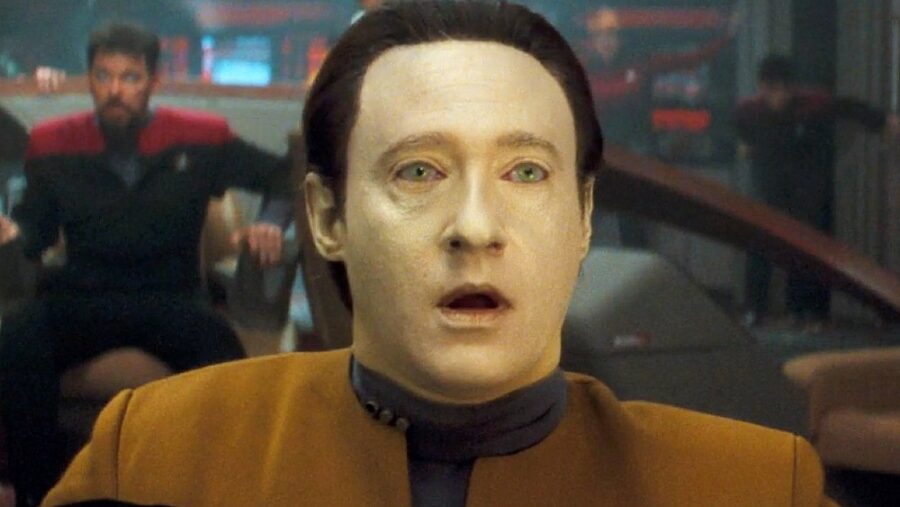
Later Star Trek shows embraced this trope to great effect: on The Next Generation, the android Data dreamed of becoming more human, and his quest helped everyone learn more about the power and promise of their own human journey. On Deep Space Nine, Odo was a Changeling who could never master looking like a solid, but his efforts to understand everyone else helped everyone gain new perspectives on what they took for granted. Neelix helped Voyager’s human crew discover joy in the small things, while T’Pol helped the humans of the Enterprise crew learn from their species’ mistakes as they began exploring strange, new worlds for the first time.
NuTrek has dabbled in this trope: on Discovery, Saru teaches the crew how to adapt to any situation, and Michael Burnham’s Vulcan upbringing helped her discover (for better or for worse) the importance of her emotions. Picard also dabbled in different alien outsiders, ranging from the android Soji to her positronic papa, Data. The return of Data hailed the return of TNG’s beloved alien outsider, and Strange New Worlds brought things full circle by putting Spock front and center.
Starfleet Academy Is Too Human For Its Own Good

Starfleet Academy is often praised for its diversity, and the cast of characters is truly unlike anything we have previously seen in other Star Trek series. Fully eight of the show’s 12 main characters are aliens, and over half of them are women. The show also puts men and women of color front and center: holographic SAM is the show’s biggest link between both Voyager and Deep Space Nine, and Jay-Den Kraag is showing us a strange new world of Klingon culture. Caleb, meanwhile, is the show’s de facto main character, and he often bridges the gap between the more dramatic and comedic elements of the show.
However, once you get past the diverse character archetypes and occasional forehead loaf, a surprising truth emerges: pretty much all the alien characters are written to be human. Darem is meant to be an exotic alien (he’s Khionian, b*tch!), but he is simply written as a cocky human, which is why he and would-be Alpha Caleb are constantly butting heads. SAM is an emissary from a holographic race who knows nothing about humanity, but she is constantly and inexplicably written as a teenage human.
The same goes for Genesis, an alien who is so human that she likes to chew bubblegum and wax philosophic about Daddy issues. Chancellor Ake is a Lanthanite who is nearly half a millennium old, but she is virtually indistinguishable from a quirky wine mom. On paper, the Klingon Jay-Den would be the most alien of them all because he hails from a warrior race, but in making him a softspoken, quippy pacifist making moony eyes at his crush, Starfleet Academy has made him the most human Klingon we’ve ever seen (yes, even more than Alexander).
They’re Only Human

Making all these aliens effectively human is by design, of course: Starfleet Academy is designed to appeal to young audiences, so this is a way of ensuring that these young characters are relatable despite their alien heritage. No matter what exotic planet they hail from, all of these 32nd-century cadets utilize slang and references very familiar to 21st-century youngsters. In this way, Paramount hopes to retain the old guard of Star Trek fans while appealing to Zoomers and even Generation Alpha.
Time will tell if Starfleet Academy manages to secure the (ahem) “next generation” of Star Trek fans, but they are already alienating older fans through (ironically enough) the lack of truly alien characters. There is no alien outsider to help characters and viewers appreciate their own humanity; instead, every alien is written as a human with a chip on their shoulder and a mouth like a sailor. Sure, this makes the latest Star Trek series feel like other popular drama series, but it also dilutes the new show by removing one of the franchise’s most distinctive sci-fi elements.
When Is A Star Trek Show Not Actually A Star Trek Show?
That leads to some downright philosophical questions, like “When is a Star Trek show not actually a Star Trek show?” Paramount is gambling that stripping the franchise of everything familiar in the name of mass appeal is the only way forward, but it’s an approach that has been driving away legacy fans in droves. Now, the studio is about learn the answer to “when is a Star Trek fan no longer a Star Trek fan?”
Simple: when they unsubscribe from Paramount+, the worst streaming platform the galaxy has ever known.
Entertainment
Maddies Secret trailer reveals John Early as youve never seen him before

Comedian John Early makes his feature directorial debut with Maddie’s Secret, an offbeat homage to melodrama that he wrote and headlines as its eponymous heroine.
As an aspiring food influencer, Maddie Ralph (Early) is passionate about her cuisine. And at first glance, she’s got a picture-perfect life: a loving husband (Eric Rahill), a devoted best friend (Kate Berlant), and a job at a culinary content studio called Gourmaybe. But as the title suggests, there’s a side to Maddie she can’t stomach sharing with her loved ones. And this secret could kill her.
Out of the movie’s premiere at the Toronto International Film Festival last fall, I cheered Maddie’s Secret, writing in my review for Mashable, “The film is silly and strange, but even amid campy bits, sincere. So, you’ll laugh at its parody elements, but may well be genuinely moved by Early’s commitment to this strange and splendid film.”
I also said “John Early is a better ingénue than Sydney Sweeney,” comparing Maddie’s Secret to another earnest (but less entertaining) TIFF offering, Christy. And I stand by it.
Maddie’s Secret opens in theaters in New York on June 19, and in Los Angeles on June 26.
Entertainment
Pride is almost here! Check out the best dating apps for LGBTQ women.
We know Pride is all year round, but there is something special about the month of June. We’re not there quite yet, but if you want a main squeeze for all the parades and parties, you gotta start looking now. How about on a dating app?
As a lesbian, you probably know all about them. Lesbian Americans (along with bisexual and gay Americans) are far more likely to have ever used dating apps than straight Americans: 51 percent to 28 percent, according to the Pew Research Center.
There are a few reasons why LGBTQ people might turn to online dating more quickly than straight folks. For one, you might live in an area without a thriving LGBTQ community, and in-person dating may be hard. If you don’t know other lesbians to begin with, how can you meet more IRL to date? (Sometimes, lesbian spaces can also be co-opted by The Straights.) Unfortunately, in-person dating may also be less safe, depending on where you live.
Hookup apps for everyone
AdultFriendFinder
—
readers’ pick for casual connections
Tinder
—
top pick for finding hookups
Hinge
—
popular choice for regular meetups
Thankfully, we live in a time where we can find people like us with a few swipes. Lesbians are welcome on major dating apps, and there are also niche ones specifically for lesbians and other queer women and people. But which one to choose?
How to find the best dating apps for lesbians

Niche lesbian dating apps aren’t your only option for finding love.
Credit: Stacey Zhu / Mashable
In Mashable’s recommendations below, you’ll find both general dating apps and apps specifically for queer people. As the former appeals to the general population, you’ll find more users in these spaces. The caveat, however, is that when you swipe on other women, you might find those coupled with men who are looking for another woman to have a threesome with (aka unicorn hunters). No judgment here, but that’s probably not what you’re looking for. Then again, people of all types are on dating apps like Tinder and Hinge. You never know who you may come across.
Then there are apps specifically for the community, like HER and Lex. If you yearn for a smaller dating scene, head for these apps. While there’s no “Grindr for lesbians” — we go into why in the FAQ section — these apps are more so like stepping into your neighborhood lesbian bar than an app like Bumble.
You can also try multiple dating apps, as each one below has a free version. You can filter by the gender you identify with and are looking for, and sometimes, as with OkCupid, there are many options to choose from.
Diving into the dating pool isn’t easy, but the water’s fine. Check out our guide below for the full rundown of our recommendations and dating app reviews.
Entertainment
OpenAI rolls out ChatGPT 5.5 Instant as the new default model for everyone
Last week, OpenAI managed to stop ChatGPT from talking about goblins all the time. This week, there’s a whole new model for users to play with.
The company announced in a blog post on Tuesday that ChatGPT 5.5 Instant has begun rolling out to all users as the new default model for the popular AI chatbot. The new model is a follow-up to GPT 5.5, which was released in April.
GPT-5.5 Instant replaces 5.3 Instant, which will remain available for the next three months for paid users but will otherwise be sunsetted.
Unlike Claude Opus 4.7 from Anthropic and GPT-5.5, which are only available to paid customers, GPT-5.5 Instant is “available to everyone.” OpenAI says it should produce fewer hallucinations and better overall results for everyday ChatGPT usage.
“This update makes everyday interactions more useful and more enjoyable: stronger and tighter answers across subject areas, a more natural conversational tone, and better use of the context you’ve already shared when personalization can help,” OpenAI’s blog post said.
Mashable Light Speed
According to OpenAI, GPT-5.5 Instant produced 52.5 percent fewer hallucinated claims in internal testing than GPT-5.3 in “high stakes” topics like law, finance, and medicine. In addition, the new model “reduced inaccurate claims by 37.3% on especially challenging conversations users had flagged for factual errors.”
The company also says the new model is better at deciding when to use web search for a prompt and analyzing image uploads than before. The new model is also allegedly more concise in its answers, while also maintaining something of a personality in how it talks to the user. GPT-5.5 Instant should also be better at understanding and referencing context from a connected Gmail account and other integrations to provide quality answers.
And, again, most importantly, it should avoid mentioning goblins unless absolutely necessary.
Want to learn more about getting the best out of your tech? Sign up for Mashable’s Top Stories and Deals newsletters today.
Disclosure: Ziff Davis, Mashable’s parent company, in April 2025 filed a lawsuit against OpenAI, alleging it infringed Ziff Davis copyrights in training and operating its AI systems.

Maddies Secret trailer reveals John Early as youve never seen him before
Pride is almost here! Check out the best dating apps for LGBTQ women.


