
Entertainment
Starfleet Academy Is Secretly The Least Diverse Star Trek Show

By Chris Snellgrove
| Published

Starfleet Academy is the latest Star Trek show, and one of its big hallmarks is diversity. This includes showcasing characters from very different backgrounds (a human thief, a childlike hologram, an empathic princess, a pacifist Klingon, etc), complete with a wide range of sexualities (gay, straight, and bi? Oh my!). There is even diversity in age: the show focuses on both young characters and their older instructors, and Chancellor Ake alone has a few centuries on her young students.
However, calling itself diverse is a lie. Starfleet Academy is secretly the least diverse Star Trek series ever made. That’s because it has one flaw that effectively cancels out all of the diversity of its character backgrounds and sexualities. Namely, that every single alien character is written like a boring old human being.
The Oldest Trope In Star Trek

Since the days of The Original Series, Star Trek has had an unofficial rule: each show must include an outsider alien character who helps the audience learn more about their own humanity. Spock’s emotionless Vulcan ways contrasted with McCoy’s fiery passion, for example, and Spock ultimately sacrificed his life after learning the value of Kirk’s relentless drive (there’s no such thing as a no-win scenario). After Spock died foiling the ultimate no-win scenario, Kirk declared, “Of all the souls I’ve encountered, his was the most human.”
This wasn’t literally true, of course: not only did Spock remain fully green-blooded, but his decision to save the ship was rooted in his flawless Vulcan logic (the needs of the many outweigh the needs of the one). But his death helped Kirk to find joy in life and rededicate himself to new beginnings. In this way, Spock began the oldest trope in Star Trek: the outsider alien helping others learn more about their own humanity.
Trek Trope: The Next Generation
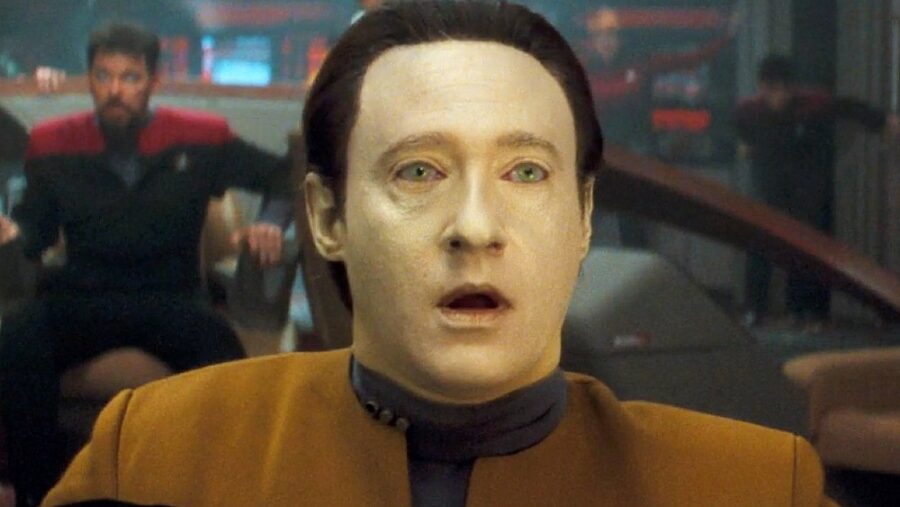
Later Star Trek shows embraced this trope to great effect: on The Next Generation, the android Data dreamed of becoming more human, and his quest helped everyone learn more about the power and promise of their own human journey. On Deep Space Nine, Odo was a Changeling who could never master looking like a solid, but his efforts to understand everyone else helped everyone gain new perspectives on what they took for granted. Neelix helped Voyager’s human crew discover joy in the small things, while T’Pol helped the humans of the Enterprise crew learn from their species’ mistakes as they began exploring strange, new worlds for the first time.
NuTrek has dabbled in this trope: on Discovery, Saru teaches the crew how to adapt to any situation, and Michael Burnham’s Vulcan upbringing helped her discover (for better or for worse) the importance of her emotions. Picard also dabbled in different alien outsiders, ranging from the android Soji to her positronic papa, Data. The return of Data hailed the return of TNG’s beloved alien outsider, and Strange New Worlds brought things full circle by putting Spock front and center.
Starfleet Academy Is Too Human For Its Own Good

Starfleet Academy is often praised for its diversity, and the cast of characters is truly unlike anything we have previously seen in other Star Trek series. Fully eight of the show’s 12 main characters are aliens, and over half of them are women. The show also puts men and women of color front and center: holographic SAM is the show’s biggest link between both Voyager and Deep Space Nine, and Jay-Den Kraag is showing us a strange new world of Klingon culture. Caleb, meanwhile, is the show’s de facto main character, and he often bridges the gap between the more dramatic and comedic elements of the show.
However, once you get past the diverse character archetypes and occasional forehead loaf, a surprising truth emerges: pretty much all the alien characters are written to be human. Darem is meant to be an exotic alien (he’s Khionian, b*tch!), but he is simply written as a cocky human, which is why he and would-be Alpha Caleb are constantly butting heads. SAM is an emissary from a holographic race who knows nothing about humanity, but she is constantly and inexplicably written as a teenage human.
The same goes for Genesis, an alien who is so human that she likes to chew bubblegum and wax philosophic about Daddy issues. Chancellor Ake is a Lanthanite who is nearly half a millennium old, but she is virtually indistinguishable from a quirky wine mom. On paper, the Klingon Jay-Den would be the most alien of them all because he hails from a warrior race, but in making him a softspoken, quippy pacifist making moony eyes at his crush, Starfleet Academy has made him the most human Klingon we’ve ever seen (yes, even more than Alexander).
They’re Only Human

Making all these aliens effectively human is by design, of course: Starfleet Academy is designed to appeal to young audiences, so this is a way of ensuring that these young characters are relatable despite their alien heritage. No matter what exotic planet they hail from, all of these 32nd-century cadets utilize slang and references very familiar to 21st-century youngsters. In this way, Paramount hopes to retain the old guard of Star Trek fans while appealing to Zoomers and even Generation Alpha.
Time will tell if Starfleet Academy manages to secure the (ahem) “next generation” of Star Trek fans, but they are already alienating older fans through (ironically enough) the lack of truly alien characters. There is no alien outsider to help characters and viewers appreciate their own humanity; instead, every alien is written as a human with a chip on their shoulder and a mouth like a sailor. Sure, this makes the latest Star Trek series feel like other popular drama series, but it also dilutes the new show by removing one of the franchise’s most distinctive sci-fi elements.
When Is A Star Trek Show Not Actually A Star Trek Show?
That leads to some downright philosophical questions, like “When is a Star Trek show not actually a Star Trek show?” Paramount is gambling that stripping the franchise of everything familiar in the name of mass appeal is the only way forward, but it’s an approach that has been driving away legacy fans in droves. Now, the studio is about learn the answer to “when is a Star Trek fan no longer a Star Trek fan?”
Simple: when they unsubscribe from Paramount+, the worst streaming platform the galaxy has ever known.
Entertainment
Billy Zane's New Horror Comedy Announced
How It Started
One of Jonathan’s uncles shared with him X-Men comics from the early ’80s, starting a lifelong passion for superheroes. That same uncle introduced him to role-playing games with Dragon Warrior 3, creating a lifelong love for video games, reading, and writing.
The first gaming newsletter Jonathan wrote was in 1996 over America Online for his very first gaming club, The Society of Nus. With a membership of around 30 like-minded gamers, this turned out to be a sign of where he’d end up, but it took over 10 years to get there.
In 2009, Jonathan started writing news for TrueAchievements, helping the fast-growing gaming website to develop a News Bible, and putting in place policies and procedures that have stayed in place to this day. Soon after, Jonathan became the Community Manager for 360voice, another achievement-based website, with over 200,000 registered users and the home of many gaming contests.
When the PlayStation 4 came out, Jonathan switched to TrueTrophies, continuing to write gaming news, reviews, and opinion pieces. One of the original hosts of the TrueAchievements podcast, he’d also be a frequent guest on other podcasts related to achievements and gaming, while earning his Master’s in Library and Information Science.
In 2022, Jonathan left his job as a librarian to pursue writing full-time, working for GameRant and DualShockers as a news writer.
How It’s Going
Jonathan now works as a Deputy Editor for GIANT FREAKING ROBOT, continuing to live the dream of writing for a living. His co-workers include two cats, Poe and Sir Arthur Conan Doyle, that frequently spend his entire shift curled up at his feet.
When not working, Jonathan continues to enjoy reading, keeping up with comics, still playing video games, and attending every wrestling event he can find between Warhammer weekends.
Entertainment
NYT Pips hints, answers for February 14, 2026
Welcome to your guide to Pips, the latest game in the New York Times catalogue.
Released in August 2025, the Pips puts a unique spin on dominoes, creating a fun single-player experience that could become your next daily gaming habit.
Currently, if you’re stuck, the game only offers to reveal the entire puzzle, forcing you to move onto the next difficulty level and start over. However, we have you covered! Below are piecemeal answers that will serve as hints so that you can find your way through each difficulty level.
How to play Pips
If you’ve ever played dominoes, you’ll have a passing familiarity for how Pips is played. As we’ve shared in our previous hints stories for Pips, the tiles, like dominoes, are placed vertically or horizontally and connect with each other. The main difference between a traditional game of dominoes and Pips is the color-coded conditions you have to address. The touching tiles don’t necessarily have to match.
The conditions you have to meet are specific to the color-coded spaces. For example, if it provides a single number, every side of a tile in that space must add up to the number provided. It is possible – and common – for only half a tile to be within a color-coded space.
Here are common examples you’ll run into across the difficulty levels:
-
Number: All the pips in this space must add up to the number.
-
Equal: Every domino half in this space must be the same number of pips.
-
Not Equal: Every domino half in this space must have a completely different number of pips.
-
Less than: Every domino half in this space must add up to less than the number.
-
Greater than: Every domino half in this space must add up to more than the number.
If an area does not have any color coding, it means there are no conditions on the portions of dominoes within those spaces.
Easy difficulty hints, answers for Feb. 14 Pips
Equal (1): Everything in this purple space must be equal to 1. The answer is 1-1, placed vertically; 1-5, placed vertically.
Number (5): Everything in this orange space must add up to 5. The answer is 3-6, placed vertically; 4-2, placed vertically.
Equal (4): Everything in this purple space must be equal to 4. The answer is 4-2, placed vertically; 5-4, placed vertically.
Number (5): Everything in this red space must add up to 5. The answer is 5-4, placed vertically.
Mashable Top Stories
Medium difficulty hints, answers for Feb. 14 Pips
Equal (1): Everything in this space must be equal to 1. The answer is 4-1, placed horizontally; 1-5, placed vertically.
Greater Than (4): Everything in this space must be greater than 4. The answer is 1-5, placed vertically.
Equal (5): Everything in this dark blue space must be equal to 5. The answer is 2-5, placed vertically; 5-5, placed horizontally.
Equal (4): Everything in this orange space must be equal to 4. The answer is 4-4, placed horizontally; 0-4, placed vertically.
Equal (0): Everything in this red space must be equal to 0. The answer is 0-4, placed vertically; 0-3, placed horizontally.
Hard difficulty hints, answers for Feb. 14 Pips
Number (2): Everything in this space must add up to 2. The answer is 1-1, placed horizontally.
Number (1): Everything in this space must add up to 1. The answer is 1-4, placed horizontally.
Number (4): Everything in this space must add up to 4. The answer is 1-4, placed horizontally.
Equal (3): Everything in this orange space must be equal to 3. The answer is 3-4, placed vertically; 3-3, placed horizontally.
Equal (2): Everything in this dark blue space must be equal to 2. The answer is 2-2, placed horizontally; 2-5, placed vertically.
Number (6): Everything in this space must add up to 6. The answer is 6-6, placed horizontally.
Number (10): Everything in this space must add up to 10. The answer is 1-5, placed horizontally; 2-5, placed vertically.
Equal (4): Everything in this green space must be equal to 4. The answer is 2-4, placed vertically; 3-4, placed vertically; 4-4, placed horizontally.
Number (1): Everything in this space must add up to 1. The answer is 1-5, placed horizontally; 0-2, placed horizontally; 0-0, placed vertically.
If you’re looking for more puzzles, Mashable’s got games now! Check out our games hub for Mahjong, Sudoku, free crossword, and more.
Entertainment
Starfleet Academy Stops Playing Around With Standout Episode Perfect For Actual Trekkies
By Chris Snellgrove
| Published

Starfleet Academy has proven divisive to fans in large part because it is a strange brew: great actors and top-notch special effects mixed with weird characterization and writing straight out of an early aughts boner comedy. Defenders of the show have maintained that everyone just needs to give the series more time to find its space legs, and the latest episode may have effectively proved them right. “Come, Let’s Away” drops the awkward, forced humor of earlier episodes to deliver a tale full of action, romance, and higher stakes than Starfleet Academy has ever had before.
Part of what makes this particular Starfleet Academy episode so effective is the misdirection baked directly into its plot. “Come, Let’s Away” starts out with scenes of our characters hooking up, and it wisely leverages the solid chemistry between Caleb and Tarima before jumping into the main plot: a joint training exercise where Academy and War College cadets must restart a derelict starship. But when those cadets are kidnapped by killer cannibals, Chancellor Ake must turn to her old nemesis, Nus Braka, for help in saving her students’ lives.
Somehow, Star Trek Returned

For Star Trek fans wanting Starfleet Academy to be more like the Golden Age of Star Trek, this is the episode you’ve been waiting for. First of all, it employs tropes and story beats very familiar to The Next Generation: for example, the cadets having to restart an old starship feels a lot like Riker having to get the USS Hathaway working for war games in “Peak Performance.” Speaking of Number One, “Come, Let’s Away” leans into Caleb and Tarima being the new Riker/Troi by giving them an Imzadi-esque mind link and having their shared romantic connection be a major key to resolving this plot.
While some Star Trek fans have enjoyed the show’s often lowbrow humor, I felt that this Starfleet Academy episode was much stronger for ditching the jokes and giving us an episode that plays out like a tense action thriller. From the moment they are captured, it is clear that our heroes are in mortal danger from bad guys (the Furies) who simply don’t play around. This is made abundantly clear when they partially eat a charismatic War College instructor (!) and then shoot his body out of the airlock to send a message to Starfleet.
The New Big Bad Is Finally Scary

The Furies are so dangerous that Chancellor Ake, at the urging of Admiral Vance, requests the help of Nus Braka, a notorious space pirate who has dealt with these foes before. This is definitely a stronger performance from Paul Giamatti than we saw in the first Starfleet Academy episode, and it helps that he is written much better. While his dialogue still has a few rough edges (like when he describes himself as “wanked” and “spanked”), he mostly comes off as genuinely dangerous, and his weirdly intimate interactions with Ake make him seem less like a Scooby-Doo villain and more like a flamboyant Hannibal Lecter.
Nus Braka is actually the personification of this episode’s greatest strengths: that it’s not afraid to raise the stakes by putting likable characters in mortal danger. In addition to offing the fun new War College instructor (and beware some major spoilers from here on out), they also kill B’avi, arguably the most likable of the War College cadets. Thanks to Nus Braka completely outwitting the Federation, his buddies were able to destroy a Starfleet vessel and ransack a starbase, giving this episode a shockingly high body count.
By Their Powers Combined

“Come, Let’s Away” is a far cry from the more carefree adventures of Starfleet Academy, but the grim subject matter also lends the show something it has desperately needed: some narrative weight. Previously, the show’s constant need to undercut tension robbed various episodes of their power, like filling the big, emotional Sisko episode with jokes about flatulence and genitalia. Also, it was tough to take SAM (a fairly solid character in her own right) very seriously in that Sisko episode because she spent most of her time onscreen talking and acting like a deranged TikTok skit come to life.
But SAM really shines in “Come, Let’s Away,” utilizing her powers in a logical way to restore power to a derelict vessel. Tarima uses her powers in a similarly logical way, and once she fully unleashes her abilities to pop some dude’s heads (Scanners-style!), we see how dangerous a Betazed warrior can be. Caleb also shines, both as Tarima’s partner in telepathic crime and as someone more resourceful than the average member of either the Academy or the War College.
The Ensemble Cast Finally Shines
While the plot involved sidelining some of the main characters (Darem and the Doctor mostly do little more than twiddle their thumbs), this episode of Starfleet Academy did a great job of highlighting most of the ensemble cast. The youngsters got to finally stop being quippy cadets and put their training to use in a life-and-death situation, and they all brought unique strengths to the table while working as a team. In this way, this is probably the most traditional Star Trek episode we have seen so far, and to my surprise, it really left me wanting more.
From the beginning, I have been one of Starfleet Academy’s harshest critics, but it’s not because I want the show to fail; the cast is talented, the SFX are beautiful, and the writers (especially Tawny Newsome) are passionate about the franchise. However, episodes are frequently hampered by bad comedy and low-stakes, teenage drama. To make matters worse, the show occasionally makes huge changes to the lore (like making most Klingons extinct in an offscreen event) that inevitably upset old-school Star Trek fans.
However, “Come, Let’s Away” ditches both the forced comedy and the teen drama, and we get to see these young characters deal with the most Star Trek situation of them all: an Away Team mission that goes catastrophically wrong. The characters are competent, the stakes are high, and the new villains are generally loathsome, adding to the show’s own lure rather than (ahem) cannibalizing older lore. Speaking of loathsome, Giamatti’s Nus Braka establishes himself as the guy you love to hate, and the combination of his master manipulation and his casual cruelty has made this former joke of a character as chilling as Gul Dukat ever was.
Is The New Star Trek Series Finally Worth Watching?

Only time will tell if Starfleet Academy can keep up the breathtaking momentum of this episode: Vance promises that capturing Braka is now Starfleet’s highest priority, and I can only imagine Chancellor Ake (who was uncharacteristically subdued for most of this episode) is itching for payback. This (plus Tarima being in critical condition) certainly implies that the rest of the season will be relatively serious, which is a relief to fans like me who have hated the hokey humor. Of course, the show has been wildly uneven from the beginning, so we may very well be back to goofy shenanigans in the very next episode.
Optimistically, though, I want to believe that Starfleet Academy writers have successfully pulled the rug on our expectations, pivoting the show from a goofy YA comedy fest to something more in line with the golden age of Star Trek. This would be a great way to thread the needle of appealing to older and younger fans, and it would even match the general arc of most YA stories (which inevitably pit their young protagonists against serious, seemingly unstoppable foes). If (and it’s admittedly a big if) that happens, Starfleet Academy could do what NuTrek has been failing to do for nearly a decade: bring generations of fans together in their love of the greatest sci-fi franchise ever made.

Tru Washington's late free throws give Miami win over NC State
NBA commissioner Adam Silver sends message to tanking teams


