
Tech
Social network UpScrolled sees surge in downloads following TikTok’s US takeover
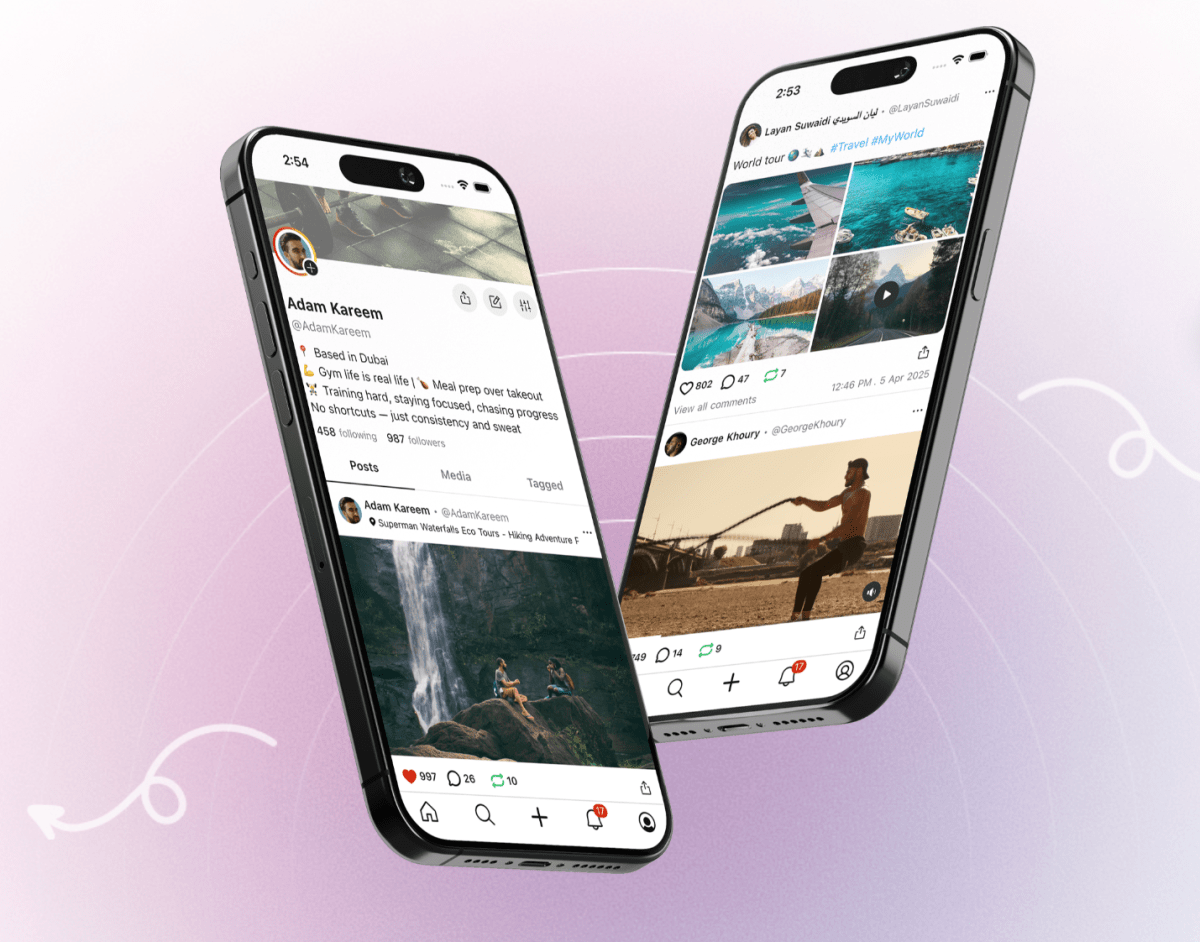
In the wake of TikTok’s U.S. ownership change last week, some users are seeking out alternative platforms. One app gaining traction is UpScrolled, a social network that pledges to remain impartial to political agendas. The app currently ranks 12th overall in Apple’s App Store and second in the social networking category.
UpScrolled blends familiar features from Instagram and X, letting users share photos, videos, and text posts, discover new content, and send direct messages.
The app was founded last year by Issam Hijazi, a Palestinian-Jordanian-Australian technologist, with the aim of giving users a place to “freely express thoughts, share moments, and connect with others,” according to the app’s website. The team behind the app says they’re “building a platform that belongs to the people who use it — not to hidden algorithms or outside agendas.”
“UpScrolled is the foundation for a digital ecosystem that puts power back into the hands of the people — not the corporations,” Hijazi said in a statement on UpScrolled’s website. “It’s more than just an alternative to Meta, X, or TikTok — it’s a reimagining of what social media should be: a space where creators, communities, and businesses thrive independently, with real control, transparency, and accountability.”
The app, available on both iOS and Android, is grappling with a surge of new users but says it’s scaling to keep up with the demand.
According to data from the market intelligence provider Appfigures, UpScrolled saw approximately 41,000 downloads between Thursday, the day the TikTok deal was finalized, and Saturday, accounting for nearly one-third of its lifetime installs. UpScrolled has seen an average of about 14,000 daily downloads since Thursday, representing a 2,850% increase in daily downloads.
In total, the app has been downloaded 140,000 times to date, with 75,000 of those being U.S.-based installs.
Techcrunch event
San Francisco
|
October 13-15, 2026
“Well, this is new … You showed up so fast our servers tapped out,” the company wrote in a post on X. “Frustrating? Yes. Emotional? Also yes. We’re a tiny team building what Big Tech stopped being. Right now we’re scaling on caffeine to keep up with what YOU started. Bear with us. We’re on it.”
The surge comes as TikTok announced last Thursday that it signed a deal with a group of non-Chinese investors to form a majority American-owned joint venture to keep the social app operating in the U.S. TikTok’s Chinese parent ByteDance owns less than 20% of the new entity, while the venture’s three managing investors — Oracle, private equity firm Silver Lake, and Abu Dhabi-based investment company MGX — each hold a 15% stake. Some users worry that TikTok’s new U.S. investors may have political allegiances to Trump.
Following the takeover, some users accused the app of potentially censoring certain political content. This criticism included a handful of high-profile users, including Senator Chris Murphy and singer Billie Eilish, who raised concerns that TikTok was suppressing or limiting posts criticizing ICE. Additionally, some said they were unable to search for information about ongoing protests in Minneapolis following the killing of Alex Pretti by border patrol agents.
However, TikTok attributed these issues to an ongoing data center outage, which has been impacting its app’s functionality.
Concerns also grew when TikTok released an updated privacy policy that allows the app to track users’ GPS coordinates, among other things. This led to some users encouraging people to delete the app in favor of alternatives, with UpScrolled being one of the popular choices, largely due to its promise to not shadowban anyone and give “every post a fair chance to be seen.”
UpScrolled isn’t the only app that’s seeing a surge in users following the takeover. Skylight, a TikTok alternative built on open source technology, says it has now topped over 380,000 sign-ups and is continuing to grow.
Tech
The Xteink X4 Pro could be the tiny e-reader of your dreams

Xteink’s tiny e-readers have gone viral among book lovers on social media, and for good reason: What could be more delightful than an e-reader that can fit in your wallet? Xteink has the answer. The Chinese hardware maker has now improved upon its existing e-readers with the Xteink X4 Pro, a swift response to widespread feedback from users who really wanted a touchscreen and a front light.
If you haven’t seen Xteink’s existing X3 and slightly larger X4, let’s catch you up to speed: They’re likely the smallest e-readers you can buy; small enough to magnetize to the back of your phone or toss in your pocket on your way out the door. Ideally, having this device on hand will help you read a few pages of a book instead of scrolling Instagram while you’re waiting in line at the store. Though the X3 and X4 were promising enough to cultivate a cult following, I wouldn’t call them user friendly — their button-based navigation is clunky. Still, the idea of a magnetic, pocketable e-reader was so promising that I couldn’t wait to see what Xteink would do next.
Fortunately, the wait for a fix wasn’t long. The addition of the touchscreen and front light makes the Xteink X4 Pro more viable as a device that you can use as your main e-reader, rather than just an on-the-go companion to your Kindle. At 72 grams and 5.95 mm thin, the X4 Pro is about the same size as the X4.

Every night before I go to bed, I turn off the lights and read on my Kindle until I’m sleepy enough to close my eyes. But with the added front light, the X4 Pro has firmly wedged itself into my nightly routine — during the review period, I almost exclusively read on the X4 Pro before bed, using the front light on the dimmest setting (which is still a bit brighter than I’d like for bedtime reading), with the color temperature tinted slightly warm. I’ve since reverted back to my Kindle solely because I’m re-reading the Odyssey, and let’s face it, it would be pretty annoying to read poetry with line breaks on a 4.26-inch screen.
When I read with the X4 Pro before I fall asleep, I feel like I’m mimicking my old bad habit of scrolling in bed. You can interpret this as either a good or a bad thing. On one hand, this goes to show just how comfortable and easy it feels to read on the X4 Pro — you can turn the pages either by tapping on the side of the screen or by using the side buttons, which gives you more flexibility with how you want to hold your X4 Pro. But also, like a phone, the e-reader is so small that you have to hold it closer to your face to read than you would a Kindle. I worry this might impact my sleep, though it’s still far easier to fall asleep after looking at a dimly lit e-ink screen than an iPhone.
Like other e-ink devices, the X4 Pro has pretty great battery life — I’ve been using my device most days for about three weeks, and I’m only down to 60% battery. Naturally, the light means that the battery will dwindle a bit more quickly than its predecessors, but I barely notice the difference. What people will notice, however, is that the X4 Pro charges using a magnetic pogo charger, while the X4 had a USB-C. This isn’t a big deal to me, since the device has to charge so infrequently, but if you’re really passionate about the universality of USB-C, this could be a dealbreaker.

The X4 Pro also comes with updated software, which is a big upgrade from the previous models, but the device also will continue to allow users to load open source code. The process of uploading content via Wi-Fi and Bluetooth is doable, though it remains a bit clunky — I find it easier to just remove the micro SD card and use the provided micro SD to USB adapter to add files from my computer.
If you’re used to more mainstream e-readers, it’s also worth mentioning that you’re probably not going to be able to read library e-books on the X4 Pro. Xteink can’t integrate directly with apps like Libby, and even if you borrow an e-book from the library, you won’t be able to add it to your X4 Pro (libraries use protected versions of .epub files that you can’t copy). But if you buy an .epub file from a publisher, you’ll be able to add it to your Xteink device without a problem. (Just don’t try buying books on Amazon. It’s a walled garden, so you can only read Amazon e-books on Amazon devices, even though you literally purchased the book! Booooo!)
The Xteink X4 Pro costs $99, and at launch, it’s only available on Xteink’s website.
When you purchase through links in our articles, we may earn a small commission. This doesn’t affect our editorial independence.
Tech
UK government scraps plans for digital ID cards after millions of Brits opposed
The U.K.’s incoming prime minister Andy Burnham has confirmed the U.K. government is scrapping a controversial digital ID card scheme announced last year by the country’s previous leader.
The Burnham administration said the savings from the scrapped ID cards program will fund a tax cut aimed at cutting household electricity bills amid the rising costs of living. The newly appointed finance minister, John Healy, said the changes aim to bring some “breathing room on bills, and provide some reassurance this winter.”
The plan to roll out digital identity cards was introduced by the former prime minister Keir Starmer, who argued that state-issued IDs would crack down on migrants working illegally and would modernize access to government services. The national ID card system would have cost the government £1.8 billion ($2.4 billion) over three years, but that figure came under dispute as money to fund the scheme was allegedly never allocated.
Starmer announced his intention to resign as prime minister on June 22. He was formally replaced by Burnham on Monday.
Millions of Brits had opposed the plan for mandatory digital ID cards, leading to the second-largest public parliamentary petition on record, gathering close to 3 million signatures rejecting the plan. Critics said that the introduction of ID cards would enable surveillance.
The effort brought back memories of a similar government program to roll out identity cards during the 2000s under the Tony Blair government but was axed in 2011 soon after a new opposition-led coalition government took power following a national election.
Tech
AI music generator Suno breach affects 55M users, per Have I Been Pwned
A cyberattack at AI music generator Suno last year allowed a hacker to steal the personal information of more than 55.3 million people, according to the data breach notification service Have I Been Pwned, offering the first glimpse into the scale of the data theft.
Per Have I Been Pwned, which obtained a copy of the breached dataset, the stolen data included customers’ names, physical addresses and email addresses, phone numbers, purchases, and partial payment card numbers taken from the company’s Stripe account, including card expiry dates.
The breach happened in November 2025, but was only recently revealed thanks to reporting by independent news outlet 404 Media.
The data theft also included Suno’s source code, which revealed how the company allegedly scraped millions of songs and lyrics from popular streaming sites, including Deezer, Genius, and YouTube, to train its AI models. Several major record labels are currently suing Suno, claiming that its mass-scraping efforts violate copyright law.
Suno has not yet publicly disclosed the cyberattack, or notified individuals that their information was taken. Suno co-founder Mikey Shulman did not respond to TechCrunch’s request for comment about the incident.

The Xteink X4 Pro could be the tiny e-reader of your dreams
Nationals' potent offense ready to back Miles Mikolas vs. Rockies


