
Sports
NBA roundup: Stephen Curry scores 56 in Warriors' win
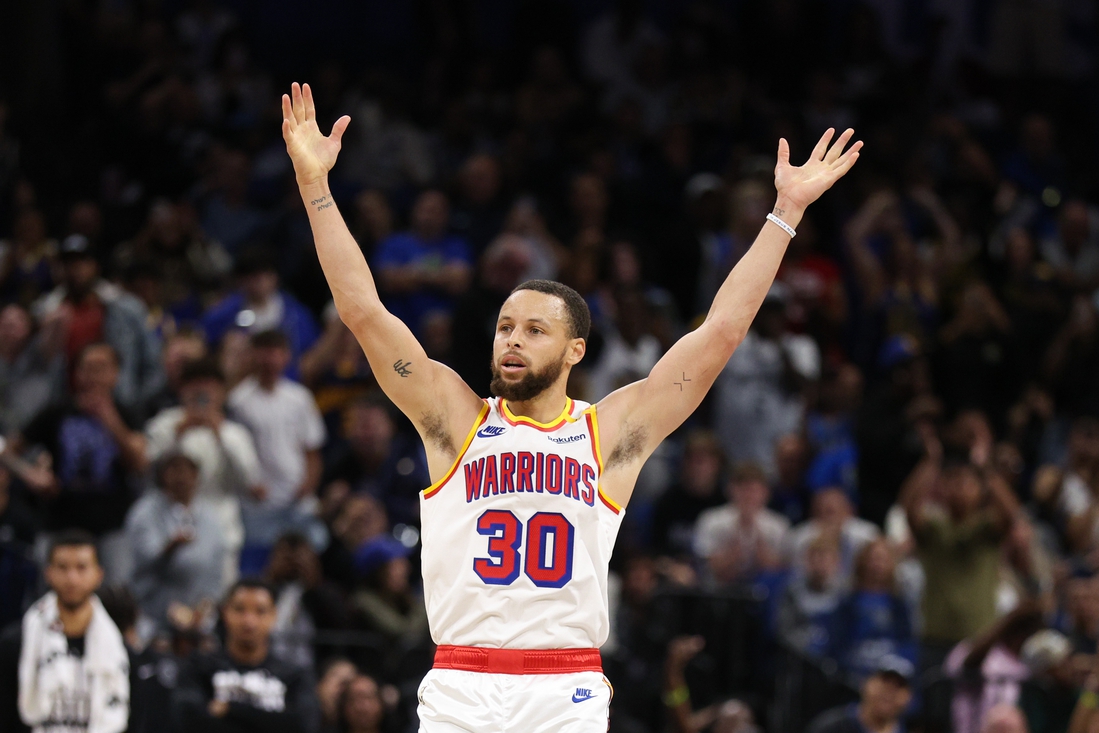
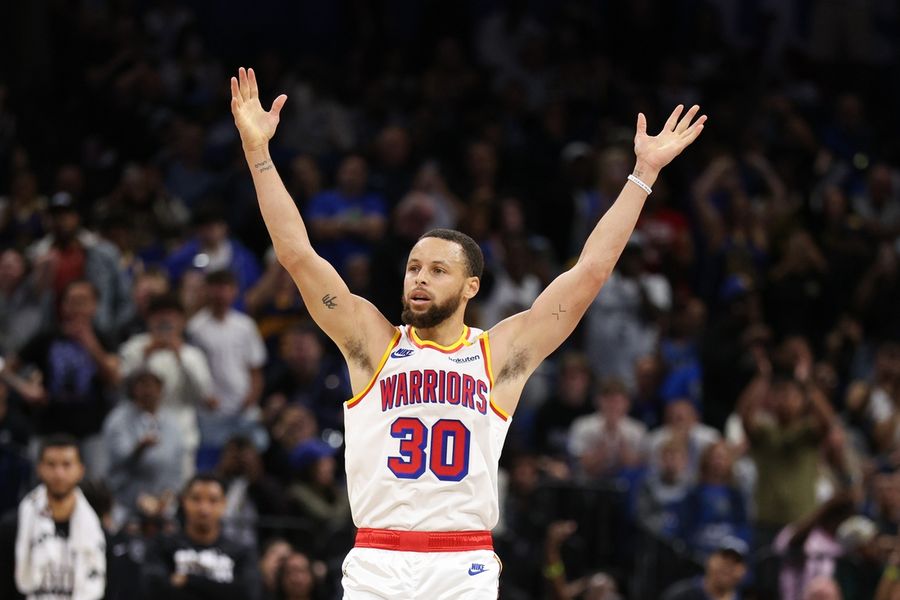 Feb 27, 2025; Orlando, Florida, USA; Golden State Warriors guard Stephen Curry (30) celebrates after a basket against the Orlando Magic in the fourth quarter at Kia Center. Mandatory Credit: Nathan Ray Seebeck-Imagn Images
 Stephen Curry ignited his own third-quarter explosion with a 50-footer at the halftime horn, then capped a 56-point performance with his 11th and 12th 3-pointers to protect a late lead that resulted in the Golden State Warriors’ 121-115 victory over the host Orlando Magic on Thursday night.
Curry’s 56 points were the fourth most of his career and his 12 3-pointers equaled his second most, helping the Warriors win their fifth in a row and their seventh in eight games since acquiring Jimmy Butler in a trade. Curry shot 16-for-25 overall, 12-for-19 on 3s and 12-for-12 at the free throw line.
Quinten Post finished with 18 points off the bench, Draymond Green scored 12 to complete a double-double with a team-high 10 rebounds, and Moses Moody had 10 points for Golden State, which completed a season-series sweep of the Magic.
Led by Paolo Banchero’s 41 points, the Magic got within 108-104 with 2:56 remaining and to 111-109 with 1:55 left. But Curry countered both times with 3-pointers, allowing Golden State to retain a lead the rest of the way.
Pelicans 124, Suns 116
Zion Williamson scored 27 points, matched his career high of 11 assists and collected 10 rebounds for his first career triple-double while leading New Orleans to a win in Phoenix.
Williamson made 13 of 17 field-goal attempts as New Orleans won its third straight game and fourth in its past five outings. CJ McCollum scored 19 points, Trey Murphy III added 18 points and Karlo Matkovic had 17 points and 10 rebounds for the Pelicans.
Devin Booker recorded 36 points, nine assists and seven rebounds but couldn’t prevent the underachieving Suns from losing for the 10th time in their past 12 games. Kevin Durant scored 28 points, Tyus Jones had 15 points and matched his season best of 12 assists, Bol Bol tallied 15 points.
Mavericks 103, Hornets 96
Kyrie Irving poured in 25 points while powering Dallas past visiting Charlotte.
Irving, who tallied 19 points in the second half, tied his season best with nine rebounds. Moses Brown tacked on season bests of 20 points and 11 rebounds, and Klay Thompson logged 18 points as the Mavericks ended a two-game skid.
Mark Williams (26 points, 16 rebounds) and Miles Bridges (20 points, 12 rebounds) both picked up double-doubles for the Hornets, who absorbed their fifth loss in a row.
Bucks 121, Nuggets 112
Giannis Antetokounmpo scored 28 points, grabbed 19 rebounds and dished seven assists to lead Milwaukee over visiting Denver.
Brook Lopez added 22 points for Milwaukee, which earned its fifth win in six games. Damian Lillard poured in 19 points, and Kyle Kuzma produced 16 points and nine rebounds.
Nikola Jokic compiled 32 points, 14 rebounds and 10 assists for the Nuggets, who have lost two of the past three since winning nine straight. Jamal Murray added 20 points while Christian Braun (13 points, 10 rebounds) and Michael Porter Jr. (12 points, 10 boards) each had a double-double.
–Field Level Media
Sports
Jeff Kent's Hall of Fame Election Could Open the Door for Overlooked Second Basemen

Jeff Kent’s election to the Baseball Hall of Fame is going to provide a boost to players representing one of Cooperstown’s most underrepresented positions.
It just may be a while before a second baseman can point to Kent as the player who helped him get over the top.
Kent will become the 23rd second baseman ushered into baseball immortality next Sunday, when he joins centerfielders Carlos Beltran and Andruw Jones on the Clark Sports Center stage a little more than a mile from the Hall of Fame.
Kent was elected last December, when he received 14 of the 16 votes from the contemporary baseball era committee. A month later, fellow keystone star Chase Utley positioned himself for induction far sooner than later by finishing with 59.1 percent of the vote, the third-largest share behind Beltran and Jones. A candidate must finish with 75 percent of the vote on his ballot in order to be inducted.
But Utley has already established himself as a potential Hall of Famer by accumulating 28.8 percent and 39.8 percent of the vote in his first two years on the ballot. Who’s next after Utley knocks down the door?
“Over the years, you look at guys who are great players and why they haven’t gotten in it’s probably because their offense doesn’t stack up as a whole to the greats that are in there,” Kent said during a Zoom call with reporters Friday afternoon. “Some of my numbers don’t even stack up to the greats that are in there.”
While Kent’s 351 homers as a second baseman are the most all-time, he ranks 11th among Hall of Famers at the position with 2,461 hits, 12th with a .290 average and 19th with a Baseball-Reference WAR of 55.4.
By these measures, the players who would benefit most from Kent’s induction are fellow Era members candidates Bobby Grich, Willie Randolph and Lou Whitaker, all of whom were either retired or winding down by the time Kent made his big league debut in 1992.
Kent has more hits and a higher average than Grich, Randolph and Whitaker, though the latter trio all finished with a WAR between 65.9 and 75.1.
But Era ballots are notoriously stuffed, especially for players such as Grich, Randolph and Whitaker who could land within either the Modern Baseball Era (for players who constructed all or most of their career prior to 1980) or the Contemporary Era (for players since 1980). Some of their competition for ballot spots include Dwight Evans, Keith Hernandez, Graig Nettles, Luis Tiant, Tommy John, David Cone…and maybe Pete Rose, which is a thorny mess for another time.
Grich, Randolph and Whitaker also all went one-and-done on the writer’s ballot back in the days before WAR was an accepted Hall of Fame metric. Kent had far more success remaining in the conversation on the writer’s ballot, where he peaked at 46.5 percent of the vote in his final year of eligibility in 2023.
And he made it to the contemporary era ballot in the same year as the PED-stained Barry Bonds, Roger Clemens and Gary Sheffield, all of whom have about as much chance of being elected as anyone reading these words.
Speaking of PED stains, Robinson Cano, who was on pace to finish with 3,000 hits and a .300 average before he got busted twice for PEDs, will go one-and-done in 2028, by which time Utley will likely be in the Hall of Fame as the first example of a second baseman elected for his peak and not his counting numbers. Utley has a 64.6 WAR but just 1,885 hits, which would be the eighth-fewest hits for any player in Cooperstown.
Amongst active second basemen, Jose Altuve has the numbers (a .303 average with 2,455 hits and 53.4 WAR) for election, though he has to hurdle any fallout from his role on the sign-stealing 2017 Houston Astros. But the election of Beltran, the only Astros player punished for his role in the scheme, is a good sign for Altuve, who is signed through 2029 and unlikely to appear on a ballot before the mid-2030s.
There may be a sizable gap before and after Altuve. New York Mets second baseman Marcus Semien has 48.8 WAR to go along with 1,675 hits, 262 homers and two Gold Gloves, but appears to be in steep decline at 35. The Arizona Diamondbacks’ Ketel Marte has 37.2 WAR at age 32 and is signed through 2030, though his peak has not yet generated much Cooperstown debate.
Dustin Pedroia, who played for the Boston Red Sox from 2006 through 2019, accumulated 51.8 WAR and batted .299 with 1,805 hits. He joined the ballot in 2025 and received 20.7 percent of the vote last year — an indication his candidacy will get a much closer look than those of Grich, Randolph and Whitaker, but also a reminder of how far Kent’s predecessors and successors at the keystone have to go between here and Cooperstown.
Sports
Why Spain Won the World Cup and 5 Teams That Could Stop Them From Repeating
 July 19, 2026; East Rutherford, New Jersey, U.S.; Spain’s Ferran Torres celebrates scoring their first goal with Lamine Yamal and teammates. Mandatory Credit: James Lang-Imagn Images
 It took eight matches into his joint-record sixth World Cup. But in Sunday’s final, a 39-year-old Lionel Messi may have finally become a liability to his national team, at least when playing against the very best competition the world has to offer.
Don’t get it wrong. Messi wasn’t at fault for Argentina’s 1-0 loss directly. And keeping him on the field for the entirety of the 120-minute encounter was probably the best of manager Lionel Scaloni’s imperfect options.
But at this stage in Messi’s career, he has to actively conserve energy on the defensive side of the ball to make sure he can be effective as an attacker in the late stages. And that put Argentina at an almost impossible disadvantage as they tried desperately in vain to limit Spain’s possession while essentially defending a technically gifted La Roja squad 11 on 10.
The totals from an Argentine perspective were ugly, even if the score was close. Spain had nearly twice as much of the ball. They completed more than twice as many passes, and had four times as many touches in the opposition box. And while it was clear Lionel Scaloni wanted to try and disrupt the Spaniards’ exceptional ball movement with occasional pressure at times, it was just as clear he had to be very selective about when to apply it.
You might look at the match summary and suspect some of this imbalance owed to Enzo Fernandez being sent off toward the end of normal time. But no. Spain’s statistical superiority was more or less distributed evenly across time. Ironically, it was only down a man — and a goal — when Argentina finally managed a shot during the second half of extra time.
Messi was still the primary creative source of those late chances, showing why he probably had to remain on the field. He remains the world’s most gifted player with the ball at his feet. There’s just a bigger defensive price paid for using him.
You might also argue Scaloni got another crucial decision wrong.
If the plan was to sit as deep and play as direct as Argentina did, Lautaro Martinez — not Julian Alvarez — is the far better back-to-goal center forward. In the end, the Inter Milan man never got off the bench, perhaps because of substitutions forced by injuries or Fernandez’s dismissal.
But in retrospect, the needle was always going to be exceptionally difficult to thread against a team as good on the ball as Spain. The good news for Messi, should he long to continue with Argentina, is that there is only one Spain.
Third Time the Charm?
And so Argentina became the second team in as many World Cups to fall short of back-to-back titles. Now the question is whether Spain can be the first repeat winners since Brazil in 1958 and 1962 while playing in 2030 as a tournament co-host.
There’s no obvious reason why not. Spain were actually one of the younger sides in 2026, starting an XI with an average age of 27.0 or younger on six occasions. On Sunday, they were the first team ever to send two teenagers out in the formation for a World Cup Final, attacker Lamine Yamal and defender Pau Cubarsi.
Four years later, conventional wisdom says a La Roja squad with Lamine entering his prime at age 22 would be even better.
Who Joins Spain as Early 2030 Contenders?
 July 18, 2026; Miami Gardens, Florida, U.S.; England’s Bukayo Saka celebrates scoring their third goal. Mandatory Credit: Sam Navarro-Imagn Images
 Here’s an (entirely too) early guess at which nations may be most likely to challenge Spain four years from now.
Portugal: Another talented 2030 co-host that may play much more freely now that the Cristiano Ronaldo World Cup era is officially over following their 2026 exit in the round of 16.
England: Despite a brutal semifinal defeat to Argentina, the Three Lions are another promising squad whose talent skews younger. And Harry Kane is still likely to be a very good center forward at age 36.
France: As good as the extended managerial tenure of Didier Deschamps was, it does feel like it’s time for a change of voice, be it the expected Zinedine Zidane or a more surprising hire.
Morocco: Don’t forget the North African co-hosts, who have now gone to the last eight in consecutive tournaments and were doomed by some key injuries in their 2-0 quarterfinal defeat to France on July 9.
Brazil: This will be Vinicius Junior’s team now with Neymar out of the picture. He looked ready for that in 2026, even if his team suffered a disappointing round of 16 exit to Norway.
Sports
G Jack Campbell officially retires
 Oct 19, 2023; Philadelphia, Pennsylvania, USA; Edmonton Oilers goaltender Jack Campbell (36) makes a save against the Philadelphia Flyers during the first period at Wells Fargo Center. Mandatory Credit: Eric Hartline-Imagn Images
 Former NHL goaltender Jack Campbell announced his retirement on Sunday.
Campbell, 34, last played in the NHL with the Edmonton Oilers during the 2023-24 season.
He went 93-52-18 with 10 shutouts, a .909 save percentage and a 2.76 goals-against average with four teams.
Campbell was an All-Star with the Toronto Maple Leafs in 2021-22 and signed a five-year, $25 million deal with the Oilers in July 2022. Edmonton bought out the final three years of his contract and placed him on waivers on Nov. 7, 2024.
Campbell posted on social media that he is starting a new chapter as an identity and performance coach.
“I grew up my entire life chasing one dream and that was to play in the NHL,” he said in a video posted on his Instagram account. “I was fortunate enough to accomplish that goal of playing eight seasons in the NHL, becoming an NHL All-Star (2021-22) and thankfully on paper, living a pretty awesome life. Super grateful for my days of playing but what a lot of people don’t see is the personal battles that I went through throughout my career. Not having somebody to hold me accountable for having a well-balanced life, that’s when I found four years ago my life coach, who’s completely changed everything for me.”
The Dallas Stars drafted Campbell with the No. 11 pick in 2010. He made one appearance for the Stars in 2013-14 before stints with the Los Angeles Kings (2016-20), Maple Leafs (2020-22) and Oilers (2022-24).
“Walking away from hockey wasn’t easy,” Campbell said. “It gave me more than I could have ever imagined. But over the last few years, I realized the work that brought me the most fulfillment wasn’t stopping pucks, it was helping people become who they’re capable of becoming.”
Campbell appeared in 18 Stanley Cup playoff games, finishing 7-8 with a 2.28 GAA, .920 save percentage and two shutouts.
–Field Level Media

Jeff Kent's Hall of Fame Election Could Open the Door for Overlooked Second Basemen
Why Spain Won the World Cup and 5 Teams That Could Stop Them From Repeating


