
Entertainment
Star Trek’s Greatest Writers Thought The Best Episode Would Be A Disaster

By Chris Snellgrove
| Updated

One of the most fascinating things about insanely talented writers is that they are typically overly critical of their greatest works. Sometimes, this is because they lack confidence in themselves and worry that everything (no matter how successful) could always be better. Other times, it’s simply because they were writing under a tight deadline and became convinced they could have done better if they only had more time. This actually happened to some of the greatest writers of Star Trek: The Next Generation when they were working on one of the show’s best episodes: “Yesterday’s Enterprise.”
These days, fans look back on this episode as a defining episode of the series, one that demonstrated how much potential TNG really had. At the time, though, the writers (including future Deep Space Nine showrunner Ira Steven Behr and future Battlestar Galactica showrunner Ronald D. Moore) feared that the episode would be a disaster because they had to work over Thanksgiving and turn a completed script in by the end of the weekend. However, the sheer quality of the episode proved one thing once and for all: if there’s anything these guys can do, it’s work well under pressure!
Star Trek Into Darkness (Literally)
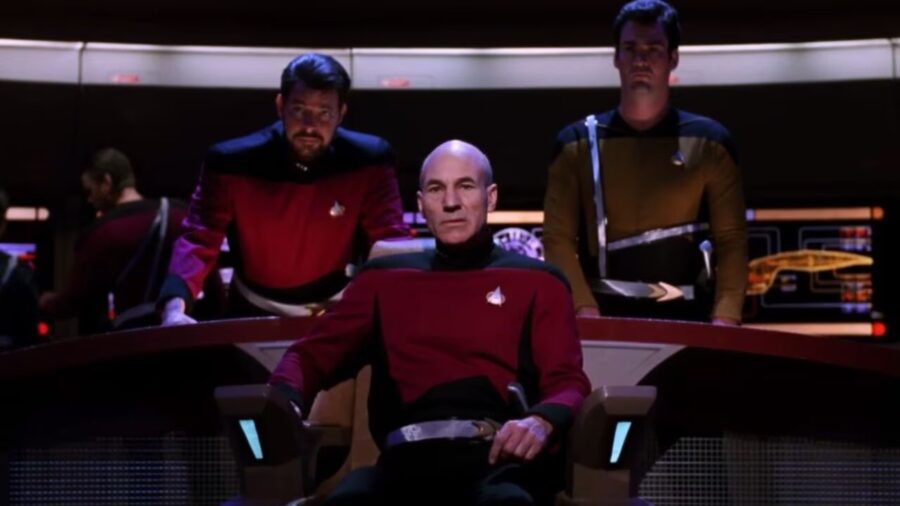
Why did the writers for “Yesterday’s Enterprise” have to work on the episode over Thanksgiving? This had everything to do with the episode’s special guest stars, Denise Crosby and Whoopi Goldberg. Crosby’s character had been killed off back in Season 1, so she was busy with other projects during filming for Season 3. Meanwhile, Goldberg was a big-deal movie star who only appeared on Star Trek because she loved the franchise so much. The episode was originally going to be written after Christmas, but to accommodate both actors’ schedules, the writers had to suddenly have a completed script by the end of Thanksgiving weekend.
According to the reference book The Making of Yesterday’s Enterprise, Ira Steven Behr said that the writers (which included himself, Ronald D. Moore, Hans Beimler, and Richard Manning) were understandably grumpy about having to work over a holiday weekend. In order to get the episode done under the deadline, each writer was given a different portion of the script to handle. For example, Moore was the main guy handling the romance between Tasha Yar and the time-displaced Richard Castillo.
Dropping Everything For Some Very Special Guest Stars
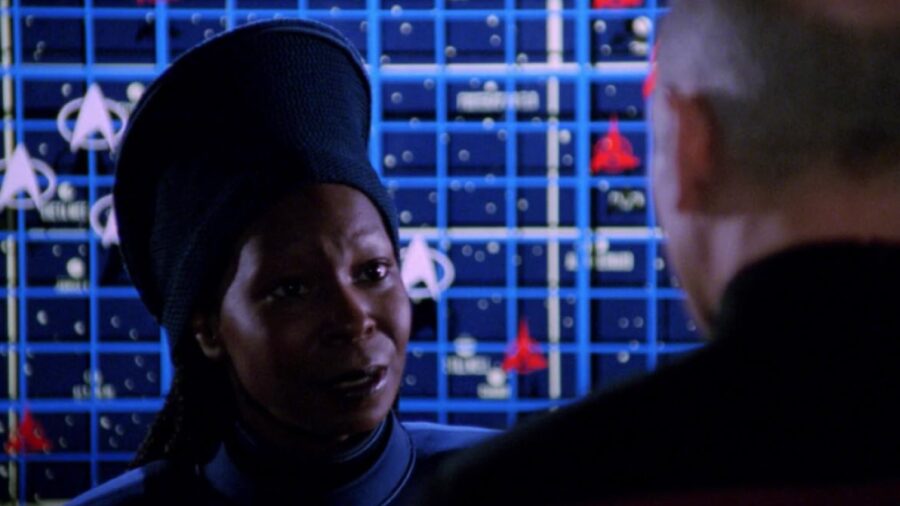
Despite having a game plan, they feared the episode would suck; according to Star Trek: The Next Generation–The Continuing Mission, Eric Stillwell (who developed the story) claimed, “Most of the writers were not very happy with the script. They thought it was going to be horrible, because they don’t like having to write [something] and make it work in three days.” However, these writers embraced a silver lining: they finally got to write the kind of dark, tension-filled episode that various Trek bigwigs (notably, Gene Roddenberry himself) always rejected. Fortunately, their hard work paid off, and “Yesterday’s Enterprise” became the third highest-watched episode of the entire series.
It’s hard to understate the influence of “Yesterday’s Enterprise,” which became a favorite episode of Denise Crosby, Rick Berman, and episode director David Carson. It won an Emmy and was voted the best episode of Star Trek: The Next Generation on six different occasions. And, for better or for worse, Roberto Orci later said this episode was the primary influence of Star Trek (2009), which kickstarted the Kelvinverse. Ironically enough, though, this insanely successful and influential TNG episode was written by four annoyed writers over three days, all of whom thought it would be completely awful and just wanted to eat some leftover turkey!
Entertainment
Everything we expect from Samsung’s July event (Fold 8, watches, and glasses!)
Samsung’s next big event could reveal foldables, smartwatches, and its first Android XR glasses.
on
The biggest stories of the day delivered to your inbox.
Thanks for signing up. See you at your inbox!
Entertainment
AI just disproved a major math problem. A mathematician explains.
While the rest of the world was watching the World Cup on Sunday evening, mathematician Levent Alpöge casually announced on X that he had used Anthropic’s Fable 5 to disprove the Jacobian conjecture.
This Tweet is currently unavailable. It might be loading or has been removed.
The Jacobian conjecture is a long-standing open problem in algebraic geometry that’s bedeviled highly accomplished mathematicians for almost 90 years. It was included in “Smale’s problems,” a list of unresolved math problems put forward by mathematician Stephen Smale in 1998.
But that proved no obstacle for Fable 5, Anthropic’s latest frontier AI model. (You may remember Fable 5 as the public version of Claude Mythos Preview, the AI model that Anthropic says has such advanced cybersecurity capabilities that it was too dangerous for public release.)
Alpöge is part of Harvard’s Society of Fellows, and his Linkedin profile notes an affiliation with Anthropic. We’ve reached out to Anthropic with questions about Alpöge’s work.
Meanwhile, for those of us who don’t understand polynomial functions from n-dimensional space, the question is: Does this represent a major breakthrough in artificial intelligence, or mathematics, or neither?
“This did not cause me to update my priors about what AI can and can’t do,” professor and mathematician Andrew Blumberg told Mashable. “This is exactly the kind of thing I would expect AI to be able to do. If there was a counterexample that was concise and easy to state that people haven’t found because it’s a pain to search through all this stuff, AI will find it.”
Blumberg, who has a joint appointment in mathematics and computer science at Columbia University, is involved in the First Proof project, an effort to test the capabilities of frontier large language models in solving research-level mathematics. So, it’s safe to say he understands mathematics and AI better than most of us.
Mashable Light Speed
‘You want to learn something from the answer’
Providing a counterexample to the Jacobian conjecture is still a significant achievement for AI in mathematics, Blumberg notes. But he also says there’s a big difference between providing a positive proof for a major math problem and providing a single counterexample that disproves it. Here’s the metaphor Blumberg used to explain.
“Suppose that Moses came down from the mountain with tablets, and on the tablet was written, ‘Cancer can be cured.’ Would you care? You don’t just want the answer to the question. You want to learn something from the answer. And the reason Smale thought this problem was important is because he thought that if we solved it, we would understand more things about the about the way nature is structured.”
In other words, Blumberg says, “this counterexample tells us essentially nothing. It’s just, you know, there are a lot of polynomials, and it’s hard for people to check them all, but it’s not hard for machines.”
The Jacobian conjecture isn’t the only math problem AI has tackled in recent months. OpenAI announced in May an “internal model” had disproved the Erdős unit distance conjecture, a central conjecture in discrete geometry.
However, in that case, the result was more productive, Blumberg says. That’s because OpenAI didn’t just provide a counterexample — but a disproof of the problem itself.
“The disproof there already has led to interesting things because experts in the area unpacked what was going on in the disproof and then used it to do other things,” Blumberg says.
And that’s not necessarily the case with the Jacobian conjecture counterexample, he adds — while conceding he’s not expert enough to see if there’s something special about the structure of the counterexample that we can learn from. “But it’s not in and of itself interesting.”
Disclosure: Ziff Davis, Mashable’s parent company, in April 2025 filed a lawsuit against OpenAI, alleging it infringed Ziff Davis copyrights in training and operating its AI systems.
Entertainment
macOS 27 Beta has a secret Siri AI interface. How to try it.
You’ve waited long enough for Apple’s relaunch of Siri as an AI assistant, and now you can finally try out the Siri AI beta for iOS. But, psst, don’t tell anyone, but there’s even more Siri AI for you to try out with a secret Siri AI interface on Mac.
A Reddit user on the r/MacOSBeta subreddit has discovered a “hidden lightweight UI” for Siri AI in the macOS 27 Golden Gate beta. This feature basically provides users with an array of AI tools, presented in a pop-up menu whenever text is highlighted.
The Siri AI pop-up interface includes AI tools such as Rewrite, Proofread, “How does this sound?,” and “Edit with Siri.” There are also menu options for summarization and providing bullet points from the selected text.
Siri AI can also provide a selection of specific tools dependent on the context of what’s selected. For example, highlighting a phone number provides a pop-up to “Add to contacts” or when selecting an address the pop-up offers an “Open in Maps” option. There are tools for creating calendar events, composing messages and emails, and tracking flights and packages as well.
Why is the feature hidden? Well, as MacRumors points out, the Siri AI interface in macOS 27 developer beta 3 and public beta 1 is simply an unfinished product. Certain features don’t yet work how they’re supposed to. Some options don’t work at all. Clearly, Apple has yet to make it available because it’s simply not ready.
Mashable Light Speed
However, Reddit users say there is a way to turn the interface on in the macOS Golden Gate Beta. According to Redditor pdfu, if users running the macOS 27 beta simply need to open up the Terminal and input a few lines of code.
Please note: We do not recommend running terminal instructions or changing important OS files unless you fully understand what you’re doing. We have not tested these terminal instructions, so proceed at your own risk.
sudo mkdir -p /Library/Preferences/FeatureFlags/Domain && sudo defaults write /Library/Preferences/FeatureFlags/Domain/WritingTools LightweightUI_macOS -dict Enabled -bool true
After that, the Reddit threat instructs users to restart their computer and the Siri AI interface will be enabled.
If you’ve had enough of the unfinished interface, you can turn it back off by once again opening Terminal and the following input:
sudo defaults write /Library/Preferences/FeatureFlags/Domain/WritingTools LightweightUI_macOS -dict Enabled -bool false
It’s unclear if the Siri AI interface will launch with the official version of the new macOS. However, it’s certainly interesting to see Apple further brand its Siri AI relaunch as an all-in-one AI tool across the company’s products.

Angel Reese exits Dream's win after injuring leg
Joey Logano fastest to finish in first North Wilkesboro points race since '96


