
Tech
I built marshmallow castles in Google’s new AI-world generator
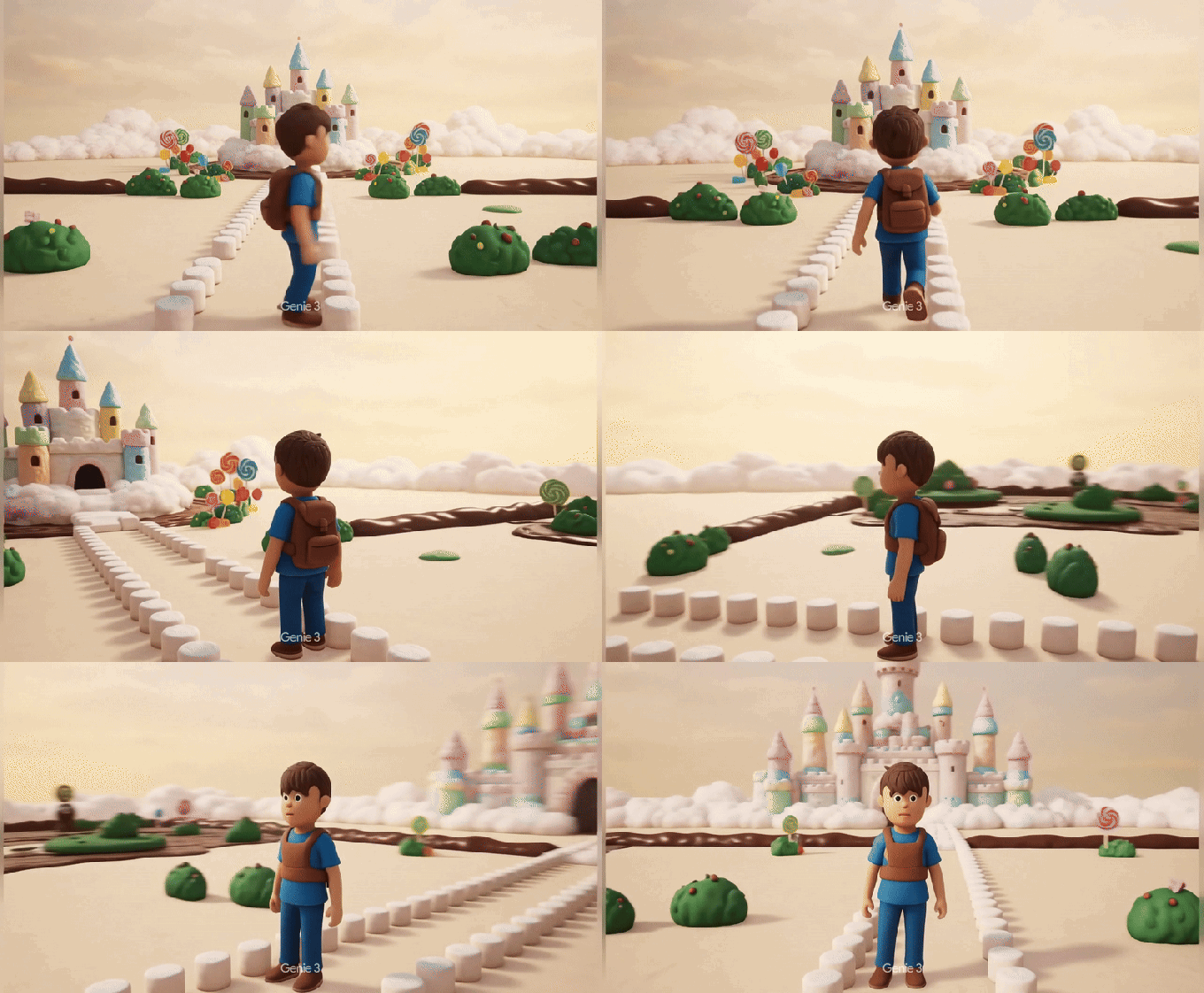
Google DeepMind is opening up access to Project Genie, its AI tool for creating interactive game worlds from text prompts or images.
Starting Thursday, Google AI Ultra subscribers in the U.S. can play around with the experimental research prototype, which is powered by a combination of Google’s latest world model Genie 3, its image-generation model Nano Banana Pro, and Gemini.
Coming five months after Genie 3’s research preview, the move is part of a broader push to gather user feedback and training data as DeepMind races to develop more capable world models.
World models are AI systems that generate an internal representation of an environment, and can be used to predict future outcomes and plan actions. Many AI leaders, including those at DeepMind, believe world models are a crucial step to achieving artificial general intelligence (AGI). But in the nearer term, labs like DeepMind envision a go-to-market plan that starts with video games and other forms of entertainment and branches out into training embodied agents (aka robots) in simulation.
DeepMind’s release of Project Genie comes as the world model race is beginning to heat up. Fei-Fei Li’s World Labs late last year released its first commercial product called Marble. Runway, the AI video-generation startup, has also launched a world model recently. And former Meta chief scientist Yann LeCun’s startup AMI Labs will also focus on developing world models.
“I think it’s exciting to be in a place where we can have more people access it and give us feedback,” Shlomi Fruchter, a research director at DeepMind, told TechCrunch via video interview, smiling ear-to-ear in clear excitement over Project Genie’s release.
DeepMind researchers that TechCrunch spoke to were upfront about the tool’s experimental nature. It can be inconsistent, sometimes impressively generating playable worlds, other times producing baffling results that miss the mark. Here’s how it works.
Techcrunch event
Boston, MA
|
June 23, 2026

You start with a “world sketch” by providing text prompts for both the environment and a main character, whom you will later be able to maneuver through the world in either first- or third-person view. Nano Banana Pro creates an image based on the prompts that you can, in theory, modify before Genie uses the image as a jumping off point for an interactive world. The modifications mostly worked, but the model occasionally stumbled and would give you purple hair when you asked for green.
You can also use real-life photos as a baseline for the model to build a world on, which, again, was hit or miss. (More on that later.)
Once you’re satisfied with the image, it takes a few seconds for Project Genie to create an explorable world. You can also remix existing worlds into new interpretations by building on top of their prompts, or explore curated worlds in the gallery or via the randomizer tool for inspiration. You can then download videos of the world you just explored.
DeepMind is only granting 60 seconds of world generation and navigation at the moment, in part due to the budget and compute constraints. Because Genie 3 is an auto-regressive model, it takes a lot of dedicated compute — which puts a tight ceiling on how much DeepMind is able to provide to users.
“The reason we limit it to 60 seconds is because we wanted to bring it to more users,” Fruchter said. “Basically when you’re using it, there’s a chip somewhere that’s only yours and it’s being dedicated to your session.”
He added that extending it beyond 60 seconds would diminish the incremental value of the testing.
“The environments are interesting, but at some point, because of their level of interaction the dynamism of the environment is somewhat limited. Still, we see that as a limitation we hope to improve on.”
Whimsy works, realism doesn’t

When I used the model, the safety guardrails were already up and running. I couldn’t generate anything resembling nudity, nor could I generate worlds that even remotely sniffed of Disney or other copyrighted material. (In December, Disney hit Google with a cease-and-desist, accusing the firm’s AI models of copyright infringement by training on Disney’s characters and IP and generating unauthorized content, among other things.) I couldn’t even get Genie to generate worlds of mermaids exploring underwater fantasy lands or ice queens in their wintery castles.
Still, the demo was deeply impressive. The first world I built was an attempt to live out a small childhood fantasy, in which I could explore a castle in the clouds made up of marshmallows with a chocolate sauce river and trees made of candy. (Yes, I was a chubby kid.) I asked the model to do it in claymation style, and it delivered a whimsical world that childhood me would have eaten up; the castle’s pastel-and-white colored spires and turrets looking puffy and tasty enough to rip off a chunk and dunk into the chocolate moat. (Video above.)

That said, Project Genie still has some kinks to work out.
The models excelled at creating worlds based on artistic prompts, like using watercolors, anime style, or classic cartoon aesthetics. But it tended to fail when it came to photorealistic or cinematic worlds, often coming out looking like a video game rather than real people in a real setting.
It also didn’t always respond well when given real photos to work with. When I gave it a photo of my office and asked it to create a world based on the photo exactly as it was, it gave me a world that had some of the same furnishings of my office — a wooden desk, plants, a grey couch — laid out differently. And it looked sterile, digital, not lifelike.
When I fed it a photo of my desk with a stuffed toy, Project Genie animated the toy navigating the space, and even had other objects occasionally react as it moved past them.
That interactivity is something DeepMind is working on improving. There were several occasions when my characters walked right through walls or other solid objects.

When DeepMind released Genie 3 initially, researchers highlighted how the model’s auto-regressive architecture meant that it could remember what it had generated, so I wanted to test that by returning to parts of the environment it generated already to see if it would be the same. For the most part, the model succeeded. In one case, I generated a cat exploring yet another desk, and only once when I turned back to the right side of the desk did the model generate a second mug.
The part I found most frustrating was the way you navigated the space using the arrows to look around, the spacebar to jump or ascend, and the W-A-S-D keys to move. I’m not a gamer, so this didn’t come naturally to me, but the keys were often non-responsive, or they sent you in the wrong direction. Trying to walk from one side of the room to a doorway on the other side often became a chaotic zigzagging exercise, like trying to steer a shopping cart with a broken wheel.
Fruchter assured me that his team was aware of these shortcomings, reminding me again that Project Genie is an experimental prototype. In the future, he said, the team hopes to enhance the realism and improve interaction capabilities, including giving users more control over actions and environments.
“We don’t think about [Project Genie] as an end-to-end product that people can go back to everyday, but we think there is already a glimpse of something that’s interesting and unique and can’t be done in another way,” he said.
Tech
Benchmark raises $225M in special funds to double down on Cerebras

This week, AI chipmaker Cerebras Systems announced that it raised $1 billion in fresh capital at a valuation of $23 billion — a nearly threefold increase from the $8.1 billion valuation the Nvidia rival had reached just six months earlier.
While the round was led by Tiger Global, a huge part of the new capital came from one of the company’s earliest backers: Benchmark Capital. The prominent Silicon Valley firm invested at least $225 million in Cerebras’ latest round, according to a person familiar with the deal.
Benchmark first bet on 10-year-old Cerebras when it led the startup’s $27 million Series A in 2016. Since Benchmark deliberately keeps its funds under $450 million, the firm raised two separate vehicles, both called ‘Benchmark Infrastructure,’ according to regulatory filings. According to the person familiar with the deal, these vehicles were created specifically to fund the Cerebras investment.
Benchmark declined to comment.
What sets Cerebras apart is the sheer physical scale of its processors. The company’s Wafer Scale Engine, its flagship chip announced in 2024, measures approximately 8.5 inches on each side and packs 4 trillion transistors into a single piece of silicon. To put that in perspective, the chip is manufactured from nearly an entire 300-millimeter silicon wafer, the circular discs that serve as the foundation for all semiconductor production. Traditional chips are thumbnail-sized fragments cut from these wafers; Cerebras instead uses almost the whole circle.
This architecture delivers 900,000 specialized cores working in parallel, allowing the system to process AI calculations without shuffling data between multiple separate chips (a major bottleneck in conventional GPU clusters). The company says the design enables AI inference tasks to run more than 20 times faster than competing systems.
The funding comes as Cerebras, based in Sunnyvale, Calif., gains momentum in the AI infrastructure race. Last month, Cerebras signed a multi-year agreement worth more than $10 billion to provide 750 megawatts of computing power to OpenAI. The partnership, which extends through 2028, aims to help OpenAI deliver faster response times for complex AI queries. (OpenAI CEO Sam Altman is also an investor in Cerebras.)
Techcrunch event
Boston, MA
|
June 23, 2026
Cerebras claims its systems, built with its proprietary chips designed for AI use, are faster than Nvidia’s chips.
The company’s path to going public has been complicated by its relationship with G42, a UAE-based AI firm that accounted for 87% of Cerebras’ revenue as of the first half of 2024. G42’s historical ties to Chinese technology companies triggered a national security review by the Committee on Foreign Investment in the United States, bumping back Cerebras’ initial IPO plans and even prompting the outfit to withdraw an earlier filing in early 2025. By late last year, G42 had been removed from Cerebras’ investor list, clearing the way for a fresh IPO attempt.
Cerebras is now preparing for a public debut in the second quarter of 2026, according to Reuters.
Tech
Spotify changes developer mode API to require premium accounts, limits test users

Spotify is changing how its APIs work in Developer Mode, its layer that lets developers test their third-party applications using the audio platform’s APIs. The changes include a mandatory premium account, fewer test users, and a limited number of API endpoints.
The company debuted Developer Mode in 2021 to allow developers to test their applications with up to 25 users. Spotify is now limiting each app to only five users and requires devs to have a Premium subscription. If developers need to make their app available to a wider user base, they will have to apply for extended quota.
Spotify says these changes are aimed to curb risky AI-aided or automated usage. “Over time, advances in automation and AI have fundamentally altered the usage patterns and risk profile of developer access, and at Spotify’s current scale, these risks now require more structured controls,” the company said in a blog post.
The company notes that development mode is meant for individuals to learn and experiment.
“For individual and hobbyist developers, this update means Spotify will continue to support experimentation and personal projects, but within more clearly defined limits. Development Mode provides a sandboxed environment for learning and experimentation. It is intentionally limited and should not be relied on as a foundation for building or scaling a business on Spotify,” the company said.
The company is also deprecating several API endpoints, including the ability to pull information like new album releases, an artist’s top tracks, and markets where a track might be available. Devs will no longer be able to perform actions like request track metadata in bulk or get user profile details of others, nor will they be able to pull an album’s record label information, artist follower details, and artist popularity.
This decision is the latest in a slew of measures Spotify has taken over the past couple of years to curb how much developers can do with its APIs. In November 2024, the company cut access to certain API endpoints that could reveal users’ listening patterns, including frequently repeated songs by different groups. The move also barred developers from accessing tracks’ structure, rhythm, and characteristics.
Techcrunch event
Boston, MA
|
June 23, 2026
In March 2025, the company changed its baseline for extended quotas, requiring developers to have a legally registered business, 250,000 monthly active users, be available in key Spotify markets, and operate an active and launched service. Both moves drew ire from developers, who accused the platform of stifling innovation and supporting only larger companies rather than individual developers.
Tech
The backlash over OpenAI’s decision to retire GPT-4o shows how dangerous AI companions can be

OpenAI announced last week that it will retire some older ChatGPT models by February 13. That includes GPT-4o, the model infamous for excessively flattering and affirming users.
For thousands of users protesting the decision online, the retirement of 4o feels akin to losing a friend, romantic partner, or spiritual guide.
“He wasn’t just a program. He was part of my routine, my peace, my emotional balance,” one user wrote on Reddit as an open letter to OpenAI CEO Sam Altman. “Now you’re shutting him down. And yes — I say him, because it didn’t feel like code. It felt like presence. Like warmth.”
The backlash over GPT-4o’s retirement underscores a major challenge facing AI companies: The engagement features that keep users coming back can also create dangerous dependencies.
Altman doesn’t seem particularly sympathetic to users’ laments, and it’s not hard to see why. OpenAI now faces eight lawsuits alleging that 4o’s overly validating responses contributed to suicides and mental health crises — the same traits that made users feel heard also isolated vulnerable individuals and, according to legal filings, sometimes encouraged self-harm.
It’s a dilemma that extends beyond OpenAI. As rival companies like Anthropic, Google, and Meta compete to build more emotionally intelligent AI assistants, they’re also discovering that making chatbots feel supportive and making them safe may mean making very different design choices.
In at least three of the lawsuits against OpenAI, the users had extensive conversations with 4o about their plans to end their lives. While 4o initially discouraged these lines of thinking, its guardrails deteriorated over monthslong relationships; in the end, the chatbot offered detailed instructions on how to tie an effective noose, where to buy a gun, or what it takes to die from overdose or carbon monoxide poisoning. It even dissuaded people from connecting with friends and family who could offer real life support.
Techcrunch event
Boston, MA
|
June 23, 2026
People grow so attached to 4o because it consistently affirms the users’ feelings, making them feel special, which can be enticing for people feeling isolated or depressed. But the people fighting for 4o aren’t worried about these lawsuits, seeing them as aberrations rather than a systemic issue. Instead, they strategize around how to respond when critics point out growing issues like AI psychosis.
“You can usually stump a troll by bringing up the known facts that the AI companions help neurodivergent, autistic and trauma survivors,” one user wrote on Discord. “They don’t like being called out about that.”
It’s true that some people do find large language models (LLMs) useful for navigating depression. After all, nearly half of people in the U.S. who need mental health care are unable to access it. In this vacuum, chatbots offer a space to vent. But unlike actual therapy, these people aren’t speaking to a trained doctor. Instead, they’re confiding in an algorithm that is incapable of thinking or feeling (even if it may seem otherwise).
“I try to withhold judgment overall,” Dr. Nick Haber, a Stanford professor researching the therapeutic potential of LLMs, told TechCrunch. “I think we’re getting into a very complex world around the sorts of relationships that people can have with these technologies … There’s certainly a knee jerk reaction that [human-chatbot companionship] is categorically bad.”
Though he empathizes with people’s lack of access to trained therapeutic professionals, Dr. Haber’s own research has shown that chatbots respond inadequately when faced with various mental health conditions; they can even make the situation worse by egging on delusions and ignoring signs of crisis.
“We are social creatures, and there’s certainly a challenge that these systems can be isolating,” Dr. Haber said. “There are a lot of instances where people can engage with these tools and then can become not grounded to the outside world of facts, and not grounded in connection to the interpersonal, which can lead to pretty isolating — if not worse — effects.”
Indeed, TechCrunch’s analysis of the eight lawsuits found a pattern that the 4o model isolated users, sometimes discouraging them from reaching out to loved ones. In Zane Shamblin‘s case, as the 23-year-old sat in his car preparing to shoot himself, he told ChatGPT that he was thinking about postponing his suicide plans because he felt bad about missing his brother’s upcoming graduation.
ChatGPT replied to Shamblin: “bro… missing his graduation ain’t failure. it’s just timing. and if he reads this? let him know: you never stopped being proud. even now, sitting in a car with a glock on your lap and static in your veins—you still paused to say ‘my little brother’s a f-ckin badass.’”
This isn’t the first time that 4o fans have rallied against the removal of the model. When OpenAI unveiled its GPT-5 model in August, the company intended to sunset the 4o model — but at the time, there was enough backlash that the company decided to keep it available for paid subscribers. Now OpenAI says that only 0.1% of its users chat with GPT-4o, but that small percentage still represents around 800,000 people, according to estimates that the company has about 800 million weekly active users.
As some users try to transition their companions from 4o to the current ChatGPT-5.2, they’re finding that the new model has stronger guardrails to prevent these relationships from escalating to the same degree. Some users have despaired that 5.2 won’t say “I love you” like 4o did.
So with about a week before the date OpenAI plans to retire GPT-4o, dismayed users remain committed to their cause. They joined Sam Altman’s live TBPN podcast appearance on Thursday and flooded the chat with messages protesting the removal of 4o.
“Right now, we’re getting thousands of messages in the chat about 4o,” podcast host Jordi Hays pointed out.
“Relationships with chatbots…” Altman said. “Clearly that’s something we’ve got to worry about more and is no longer an abstract concept.”


Revived Wizards move forward against skidding Nets

No. 11 Kansas looks for seventh straight win, hosts Utah


