
Entertainment
Deleted Buffy The Vampire Slayer Scene Completely Changes Every Fan's Favorite Character

By Chris Snellgrove
| Published

Ever notice how fans go crazy for deleted scenes, especially when it comes to their favorite shows? If you love a series hard enough, it’s easy to look at deleted content like something that was taken from you. When the scene in question is good enough, you might even start to wonder why it was cut in the first place.
Well, very few series are as popular as Buffy the Vampire Slayer, a show with more than a few deleted scenes. This includes a snippy interaction between Willow and Cordelia in “Phases” that many fans wished had been kept in the episode. However, it’s good that this dialogue was cut because it would have completely changed Willow’s character, effectively hinting at her later transformation into a much darker character.
A Self-Defense Class Gone Wrong

“Phases” was, of course, the episode where we discover that the eternally Zen character Oz has quite the secret: he’s a werewolf who transforms into a dangerous, ravenous monster by the light of the full moon. The Slayer keeps the big, bad wolfman from harming anybody, and she also stops a hunter hellbent on making Oz his latest prize. Along the way, our Sunnydale High students took a self-defense class, and some dialogue between Willow and Cordelia was ultimately removed from the final episode.
In the scene, Cordelia is about to spar with Xander, who sarcastically tells her, “Be gentle with me.” Matching his sarcastic vibes, Cordelia turns to Willow and says, “You’re first. I wouldn’t want to be accused of taking your place in line.” In response, Willow replies, “Oh, I think you pushed your way to the front long before this.”
Girls Can Be So Mean

Things get increasingly snippy between the young women, with Cordelia claiming, “Hey, I can’t help it if I get the spotlight just because some people blend into the background.” Willow frostily responds, “Well, maybe some people could see better if you weren’t standing on the auction block, shaking your wares.” Cordelia tells her, “Sorry, we haven’t all perfected that phony ‘girl next door’ bit” before Willow brings this deleted scene to an end with a distinctively vindictive response: “You could be the girl next door, too. If Xander lived next to a brothel!”
Important context for this episode is that Cordelia and Xander have been secretly dating behind everyone’s back. However, Xander is preoccupied with Willow’s relationship with Oz, even stopping his makeout session with Cordelia to wonder what his witchy friend sees in this wolfy senior. While Willow isn’t directly aware of this particular relationship drama, that same drama helps to explain why Cordelia was being so mean in this deleted scene from “Phases.”
A Girlfight Scarier Than Any Vampire Fight

What the drama doesn’t really explain, though, is why this scene portrays Willow as a Cordelia-esque mean girl in her own right. Historically, early Buffy the Vampire Slayer portrayed Cordelia as the preppy mean girl and Willow as the mousy nerd. The two women had a rather cantankerous relationship going back to before the show starting, and in their very first onscreen interaction, we see Cordelia criticizing Willow for how she dresses.
In early Buffy episodes, Willow wasn’t afraid to get back at Cordelia, but she usually did so in relatively subtle ways. Perhaps the most infamous (and funniest) example of this is when Willow tracks the other women into deleting an assignment on the computer by convincing Cordelia that the DEL key on her keyboard stands for “deliver.” However, she didn’t really push back against Cordelia’s snark more directly until Season 3, which included the messy plot point of stealing Cordelia’s boyfriend (they are openly dating by this point), Xander.
The Mousy Girl Bites Back

In this deleted scene from “Phases,” however, Willow’s sarcastic replies seem out of character, much more in line with the snappy repartee of Buffy Summers. Willow basically tells Cordelia to her face that the other woman, despite having advantages like wealth and beauty, is still neurotically obsessed with being popular. She then calls Cordelia a prostitute, accusing her of selling her body to men before outright saying she belongs in a brothel.
Is it funny? Of course, and it’s not like ditzy mean girl Cordelia didn’t have it coming. But I keep reflecting on the fact that this is much more like what we’d expect of Willow in Season 6: that was the season where she began recklessly using magic, needlessly resurrecting Buffy, brainwashing Tara, and eventually becoming a threat to the entire world. Dark Willow was always great for sassy quotes, including calling a foe “superb*tch” and saying “bored now” right before she rips the skin off another human being.
A Scary Glimpse Of What She Would Become

Obviously, the Willow in the deleted scene of “Phases” isn’t in danger of ripping the flesh off anyone’s body. But she is in the business of dropping the kind of harsh truth bombs that Dark Willow would be known for, and like her later villain persona, she’s suddenly not taking crap from someone who gives her attitude. This is arguably an improvement over mousy Willow, of course, but it’s also completely out of character with the Willow of Season 2, one who had yet to fully come out about her love of magic (among other things).
Long story short? It’s good that this Buffy the Vampire Slayer scene was cut, even though countless fans would give up their Mr. Pointy replicas to see it in the final episode. Cutting the scene meant cutting out a severely out-of-character moment for everyone’s favorite girl next door, and that helped make it all the more surprising when Willow later stopped playing by the rules and showed everyone just how dangerous a mean girl could really be.
Entertainment
Iconic Star Trek Character Was Written So Badly, The Showrunner Intervened

By Chris Snellgrove
| Published

Here’s a story that dates me (hey, it’s not like anyone else was dating me at the time): I was a high school student when Star Trek: Voyager was on the air. I watched the show with the rest of my geeky friends, and we generally enjoyed the wacky adventures of Captain Janeway and her misfit crew. We also spent hours (and I mean hours) making fun of Neelix. He was the ship’s cook, but he might as well have been its mascot because he was always written as the broadest form of comic relief. Why, we wondered, did Star Trek go out of its way to make a new character such a butt-of-the-joke oaf?
As it turns out, Voyager showrunner Michael Piller shared those same concerns. When reading the script for the Season 2 episode “Twisted,” he began to worry that the writers were transforming Neelix into nothing more than “the buffoon of the ship.” That’s when Piller decided to take definitive action. He didn’t make Neelix into a deadly serious character, but he decided to do the next best thing. In the very next episode, he removed the character’s growing jealous streak that he rightly assumed viewers would absolutely hate.
Orange Man Bad

This all goes back to the most problematic thing about Neelix: his extremely underage girlfriend. In the Voyager premiere episode “Caretaker,” Neelix goes out of his way to save Kes, his Ocampan mate, and they both join Captain Janeway’s crew. Kes presents as an attractive young woman in her early ‘20s, but her species ages at a different rate than those of us here on Earth. She’s only one year old when she joins the crew (no, really!), and the writers had to take care not to present Neelix as the dirtiest old man in the Delta Quadrant.
That’s actually how Michael Piller’s concerns about Neelix began. The previous episode, “Elogium,” dealt with Kes’s mating drive activating years ahead of time, forcing her and Neelix to consider whether they were ready for children. While it’s bizarre enough to watch the weird orange alien try to figure out if he is ready to breed his one-year-old girlfriend, “Elogium” also made Neelix into a jealous figure. Specifically, he started thinking Tom Paris was being too friendly towards her and that the pilot was secretly trying to put the moves on Kes.
Jealousy, That Orange-Skinned Monster

When Piller read the script for “Twisted,” he became concerned about an early plot point in which the crew was celebrating Kes’s birthday (she had finally turned two). Neelix made her a cake, but Tom Paris gave her a locket. Once more, Neelix felt jealous of the hotshot human pilot. According to Captains’ Logs Supplemental – The Unauthorized Guide to the New Trek Voyages, Piller was “terribly concerned about Neelix.” He was “afraid we were going to destroy this character if we made him the buffoon of the ship. If all he is is comic relief, we’re in trouble.”
For better or for worse, Piller decided to focus on only one of the ways the writers had transformed Neelix into the comic relief: his jealousy. “The jealousy he was showing toward Kes was becoming irritating, so we wanted to put that to bed quickly,” he said. Accordingly, Piller made sure that “Parturition” (the episode that came directly after “Twisted”) killed this particular character conflict. That episode begins with Neelix and Paris having a fight over Kes, but then they are sent on a mission where they crash land on a hellish planet. They must fight for their survival and take care of a baby alien, ultimately becoming friends who never fight over Kes again.

It’s a heavy-handed fix, admittedly, but Michael Piller’s decision is one that Gene Roddenberry would have agreed with. The Star Trek creator never wanted his main characters to constantly bicker with one another, but Paris and Neelix were constantly fighting over Kes. Thanks to “Parturition,” Piller effectively killed the conflict that was driving these two characters apart. If you think that kept Neelix from being written as bad comic relief, though, I’ve got a whole shipload full of leola roots to sell you!
Entertainment
The Most Banned Series In America Is About To Blow Up On Netflix
By Jonathan Klotz
| Updated

When someone says they’re an anime fan, it can mean anything. That’s the equivalent of saying “I like watching TV.” Anime is a huge swath of genres, stories, franchises, movies, and shows about anything you can possibly imagine. Who knew a show about giant, naked people would turn out to be one of the best anime of all time? And who would have thought that an anime about an ultrapowerful octopus who destroys the Moon and finds meaning in life working as a teacher for underprivileged children tasked by the Japanese government to kill him before he destroys the planet would be such a touching, thought-provoking, and humorous series?
That’s Assassination Classroom, and with its arrival on Netflix, it’s going to become even more popular. Then again, that also means even more people will judge it for its name, which, coincidentally, plays into one of the themes of your next favorite series.
Assassination Classroom Is Not What It Sounds Like
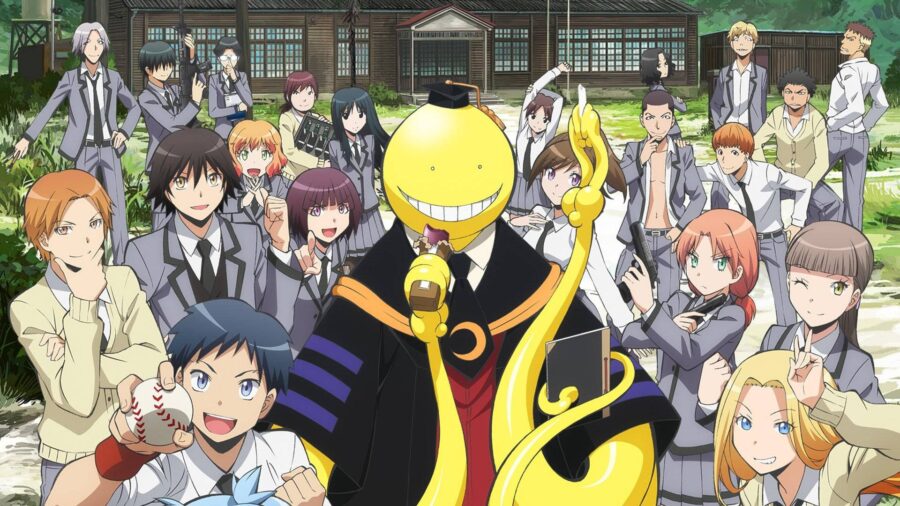
Assassination Classroom starts off with the mystery of how this strange, yellow creature managed to destroy the Moon. For what purpose? Why is the Earth going to be next? And why does the creature agree to become a teacher for a year, with the instruction that one of his students will be the one to kill him? Finally, why is the creature, named Koro-sensei by his students, so good at the job?
The Junior High students in Class 3-E are the real stars of the series, which quickly reveals itself to be more classroom than assassination. Sure, there’s other assassins that show up periodically, but the real joy of Assassination Classroom is to be found in the comedy of Koro-sensei’s hijinks while imparting real life lessons.

Season 1 follows the basic plot of the students bonding with Koro-sensei and grappling with the idea that, eventually, they will have to kill him. It can be a little slow, and the humor isn’t for everyone, but then Season 2 hits, and the entire series takes off with the speed of a bullet train. By the end, you’ll not only have your own favorite among the students of Class 3-E, but you’ll wish you had Koro-sensei as a teacher.
Assassination Classroom Faces Constant Bans And Boycotts
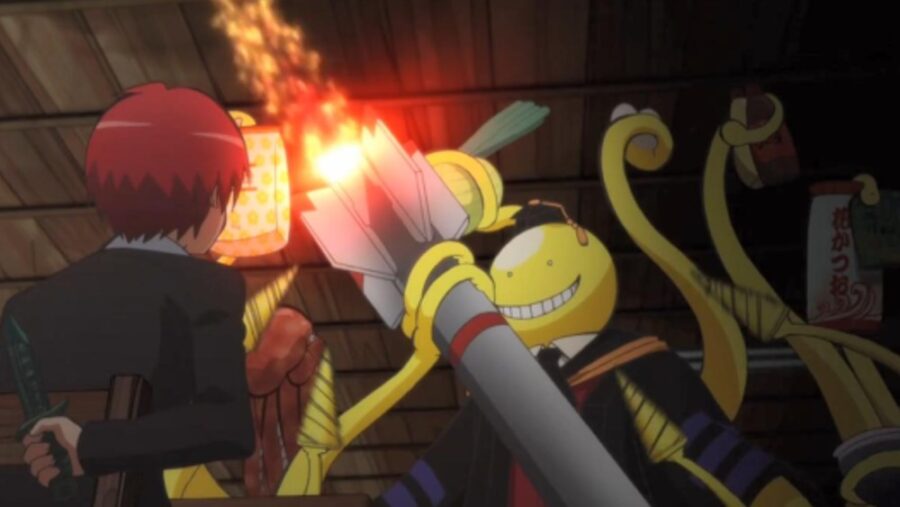
If Assassination Classroom is an emotional, comedic version of Dead Poet’s Society, then why has it joined a very different type of school anime and been banned in over 50 libraries and school districts across the United States? The name, for one, as Assassination Classroom puts an image in your head that’s technically correct, but there’s so much more to the story than that. Secondly, students having to kill their teacher sounds horrible in a vacuum, but in context, it’s an uplifting journey. Those who pushed for the bans never read the manga, never saw the anime, and, honestly, they likely haven’t read a book since eighth grade.
Now that Assassination Classroom is coming to Netflix in May, you can experience the journey of Koro-sensei and Class 3-E for yourself. Lerche, the animation studio behind the series, isn’t a huge name in anime, but they went on to animate Dangonronpa 3 and Classroom of the Elite, making them the go-to for a very specific anime niche. You’ll laugh, you’ll cry, you’ll be impressed at Lerche’s animation style, and in the end, you’ll wonder how one of the best series of the last decade could be hidden away from those who would enjoy it the most.

Entertainment
Ask.com shuts down after 30 years
Ask.com, originally founded as the Y2K stalwart Ask Jeeves, is officially dead.
“As IAC continues to sharpen its focus, we have made the decision to discontinue our search business, which includes Ask.com. After 25 years of answering the world’s questions, Ask.com officially closed on May 1, 2026,” the homepage now reads.
Ask Jeeves was launched in 1997 by the Berkeley-based duo Garrett Gruener and David Warthen, a year before Google’s now-dominant search engine debuted to the masses. At the time, Ask Jeeves’ natural language processing, combined with its personality-filled voice and branding, made it the go-to web search and answer engine for early internet adopters. The website’s butler mascot, Jeeves, modeled after the P.G. Wodehouse character, made appearances at the Macy’s Thanksgiving Day Parade, holding its own against other iconic corporate logos of the early 2000s.
Mashable Trend Report
“Can one man have all the answers?” If he has access to the entire internet, absolutely.
But while many still refer to the site by its 1990s name, Ask.com hasn’t been “Ask Jeeves” for nearly 20 years, with the brand dropping the latter word and its valet logo in 2006. The shift came after a change in ownership, when the brand was transferred to American holding company IAC. In 2009, Ask.com was dubbed the official search engine of NASCAR.
“We are deeply grateful to the brilliant engineers, designers, and teams who built and supported Ask over the decades. And to you — the millions of users who turned to us for answers in a rapidly changing world — thank you for your endless curiosity, your loyalty, and your trust,” Ask.com reads. “Jeeves’ spirit endures.”
Amid an overwhelming shift toward generative AI-powered search engines and a repositioning of AI agents as the future of web browsing, the loss of Ask.com feels like a true end of the early dot-com era. So long Jeeves, hello AI.

Visiting D.C. United short-handed for clash with NYCFC
Iconic Star Trek Character Was Written So Badly, The Showrunner Intervened


