
Entertainment
Claude Fable 5 vs GPT 5.5: Is this why the Trump admin banned one and not the other?

Earlier this week, Anthropic released its most powerful public model yet: Claude Fable 5. This model is the “safe” version of an even more powerful model, Mythos, that Anthropic has yet to release to the public due to potential dangers.
Just days later, the Trump administration issued an export control directive barring the use of Fable 5 from foreign nationals. As a result, Anthropic was forced to disable Fable 5 for all its customers to comply with the order.
In a statement, Anthropic said it believed the order was issued by the U.S. government to use a method to “jailbreak” Fable 5 to identify vulnerabilities. Anthropic claimed in its statement that other AI models could do the same without a bypass. The company specifically named GPT 5.5, the latest AI model from its biggest competitor, OpenAI, as one such model.
There are currently too many unknown variables to determine if this is accurate. However, Mashable was preparing a piece comparing Anthropic’s Claude Fable 4 and OpenAI’s GPT 5.5 prior to the Trump administration’s order.
It appears the U.S. government’s concerns could be related to just how powerful Claude Fable 5 appears to be, even with its safeguards.
Here’s how Fable 5 stacked up against GPT 5.5.
Claude Fable 5 vs GPT 5.5: Feature set
According to Anthropic, “Fable 5’s capabilities exceed those of any model we’ve ever made generally available.”
“It is state-of-the-art on nearly all tested benchmarks of AI capability, showing exceptional performance in software engineering, knowledge work, vision, scientific research, and many other areas,” Anthropic says. “The longer and more complex the task, the larger Fable 5’s lead over our other models.”
When GPT 5.5 rolled out in late April, OpenAI said that the model had improved on its “agentic coding, computer use, knowledge work, and early scientific research” capabilities.
Mashable Light Speed
Both are very similar when it comes to their feature set and stated purpose. These aren’t images or videos. generation models. These are large language models used for document analysis, data interpretation, and advanced coding and development. Both are definitely competitors when it comes to use cases.
The difference between the two competing models will be how they perform.
Claude Fable 5 vs GPT 5.5: Leaderboards and benchmarks
On the popular Arena leaderboard, Fable 5 far and away leads all of the other AI models.
Claude Fable 5 currently sits at the top of the Arena leaderboard with Claude Opus 4.7 Thinking and Claude Opus 4.8 Thinking taking the second and third spots. The top three are all Anthropic’s models, with OpenAI’s GPT 5.5 coming in fourth.
Fable 5 also leads in Artificial Analysis, Simple Bench, and practically every other leaderboard that has ranked the AI model.

Credit: Anthropic
According to Anthropic’s own comparison chart, when it launched Fable 5, the AI model simply blows GPT 5.5 away across multiple benchmarks, from agentic coding and knowledge work to cybersecurity.
While it may be accurate that other models can also identify these alleged vulnerabilities, perhaps the U.S. government calculated that Claude Fable 5 was just too dangerously good at it based on the data.
Claude Fable 5 vs GPT 5.5: Availability and pricing
Before Anthropic pulled Fable 5 due to the U.S. government’s order, Fable 5 was available to paid subscribers on Pro, Max, Team, and seat-based Enterprise plans at no additional cost until June 22. Anthropic planned to remove Fable 5 from these plans on June 23 and temporarily move to a usage-based paid add-on model until demand for Fable 5 dissipated.
Fable 5 was priced on its Claude API and consumption-based Enterprise plans at $10 per million input tokens and $50 per million output tokens.
Fable 5 is no longer available for any of Anthropic’s users.
OpenAI has made GPT 5.5 available to OpenAI Plus, Pro, Business, and Enterprise users in ChatGPT and Codex. Usage-based API pricing for GPT 5.5 starts at $5 per million input tokens and $30 per million output tokens.
GPT 5.5 is currently available for OpenAI’s users.
Entertainment
MacBook Neo review: 3 months later, I love this laptop even more
Table of Contents
On March 11, Apple dropped the MacBook Neo like a bomb on the laptop market. I was at a New York City launch event to see its big unveiling, and the colorful budget laptop made a strong first impression. As I wrote at the time: If I were a Windows laptop that cost under $1,000, I’d be shaking in my boots.
Well, after spending an extra three months with this laptop on my desk, I’m updating my initial review. After months of RAMageddon price increases in the Windows world, the MacBook Neo is doubly impressive.
The Neo brings premium MacBook features — Liquid Retina Display, the intuitive macOS, a sleek aluminum design — to an entirely new market segment: the budget laptop.
The laptop starts at $599 — a version with Touch ID and 512GB costs $699 — and if you qualify for the $499 education price, this is truly a laptop with no viable competition, full stop.
Who is the MacBook Neo for?

The MacBook Neo in citrus and indigo at the Mashable office.
Credit: Joe Maldonado / Mashable
The MacBook Neo is Apple’s first MacBook without an M-series chip since 2020. For that reason, the Neo is not a laptop for professionals like myself. If you need to do heavy-duty photo or video editing, work with 3D modeling programs, or run open-source AI models on your device, you’ll want that MacBook Air or Pro with the latest M5 chips.

The Neo has an all-aluminum design; Apple matches the color of the keys to the aluminum.
Credit: Joe Maldonado / Mashable
Instead, the MacBook Neo is meant to be baby’s first laptop, and I mean that as a compliment. It’s a starter laptop you might buy for a high school or college student who will eventually graduate to the Air or Pro, depending on their needs. But I also foresee another popular use case for this device — the party laptop.
Lots of people, including myself, use two laptops on a daily basis. You have your work laptop — in my case, a MacBook Pro — and then you have what I call the party laptop. It could be a simple Chromebook, an old work laptop, a gaming laptop, or even a tablet. When your workday is done, you put away the work laptop with your email and calendar, and fire up your party laptop for streaming, music, casual browsing, and retail therapy.
The MacBook Neo would be a perfect party laptop or Chromebook alternative, and while it lacks storage and RAM, Apple definitely didn’t skimp on the entertainment features.
MacBook Neo design: We gotta talk about the colors

Credit: Timothy Werth / Mashable
No tech brand does design better than Apple, at least, not for the mass market. And in the under-$1,000 laptop category, the Neo stands out for its premium design. Lately, we’ve seen many Windows laptops imitating the MacBook’s metal body and rounded edges, but those are typically Ultrabooks that cost quite a bit. The Neo offers a budget price without compromising on Apple’s signature all-aluminum build quality.
Let’s look at the competition: Our No. 1 budget Windows laptop in 2026 is the Acer Aspire 16 AI, which costs $699. It’s a good laptop, but it also has a flimsy hinge and plastic components. With the Neo, you get an aluminum chassis, plus it’s $100 cheaper, plus it comes in fun colors, plus it has Dolby Atmos speakers.
The MacBook Neo comes in four colors: silver, indigo, citrus, and blush. Now, I will say, the blush is a very subtle pink. I say, if you’re going pink, go pink. But in person, the citrus and indigo really pop. Apple also color-matches the keys to the aluminum finish, and it’s those little details that elevate the design. The Apple team has been having a lot of fun with this product launch, and I think shoppers will, too.
MacBook Neo: Performance and battery

Be honest, did you notice the home screen artwork says “MAC”?
Credit: Joe Maldonado / Mashable
When Apple unveiled the Neo, two competing opinions spread in the tech world. The MacBook Neo, with its fun colors and killer price, would either disrupt the entire Windows laptop market, or it would be an underpowered waste of space with its old iPhone chip and a measly 8GB of RAM.
In this case, the optimists were proven right.
To be sure, you’re not going to edit a professional music video, mix a song, or work on an animation project with 8GB of RAM and the A18 Pro chip, first introduced for the iPhone 16 Pro. But don’t believe what the haters are saying online: You can still do a lot with 8GB of RAM.
Here’s what people are forgetting: Over the past few years, Apple has quietly made its MacBook Air and Pro laptops way overpowered for the average user. (The same is true for the iPad Air and Pro, as I explain in my M4 iPad Air review.) The original M1 MacBook was a legendary laptop that truly changed the category for good. Six years later, I know professional film editors who are still working on M1-era MacBook Pros and have zero complaints about performance or speed.

Apple M-series silicon changed the laptop market for good.
Credit: Mashable
As you can see in this chart, ever since Apple launched the M1 chip in 2020, the company’s M-series silicon has progressed by leaps and bounds. At one point, it seemed like Qualcomm’s Snapdragon X Elite chip might finally offer some true competition for Apple silicon, but then Apple released a new M chip.
Apple’s M series chips have made such massive leaps in performance that you have to be a serious superuser to tax these devices to their limits. So, a simpler MacBook with less firepower makes sense for a ton of reasons. You don’t need 16GB of RAM and an M5 chip to stream Netflix, make Word documents, and send emails.
But let’s get specific. Let’s talk benchmarks.
MacBook Neo review: Geekbench performance and stress tests

Credit: Joe Maldonado / Mashable
When testing a new laptop, Mashable runs a series of standardized tests, including the latest Geekbench 6 benchmark. The MacBook Neo received a multi-core score of 8,770, nearly identical to the 8,783 we recorded for the M1 MacBook Air. We also assessed its single-core performance, since that’s a good measure of what we call snappiness, or how quickly it responds in everyday use. And this is where it gets interesting. The MacBook Neo achieved a single-core score of 3,484, significantly higher than most other laptops.
For reference, the Razer Blade 18 with an Intel Core i9-275HX processor scored 3,057 in single-core testing. So, it’s no wonder I’ve been able to do a surprising amount with the A18 Pro Chip.
I was able to edit a simple, cheesy video in Final Cut Pro using the MacBook Neo without struggling against the spinning wheel of death. Even when I layered video clips on top of each other and added a series of totally unnecessary transitions, the Neo handled the tasks just fine, as you can see for yourself:
For my MacBook Neo review, I also set up multiple Apple Shortcuts to perform complex tasks. I set up one Shortcut to automatically convert raw image files into JPEGs, crop them into a 16:9 aspect ratio, auto-adjust the color balance, hue, and saturation, and then save them in a specific folder. Using this Shortcut, the Neo edited a dozen massive image files with ease in under 30 seconds.
I set up another Shortcut to automatically convert all my video files into GIFs, also without problems.
The MacBook Neo does have one big flaw

The lack of Thunderbolt 4 ports is a big drawback.
Credit: Joe Maldonado / Mashable
In stress-testing the Neo, I found its kryptonite, which won’t be a surprise. Because the Neo lacks a Thunderbolt 4 port, it can only offer transfer speeds of up to 10Gb/s, compared to 40Gb/s with the latest MacBook Air. Likewise, the A18 Pro chip offers 60GB/s memory bandwidth, compared to 153GB/s memory bandwidth on the M5 Air.
The A18 Pro chip offers:
The only time I encountered the spinning wheel of death? When importing or exporting large files. M-series MacBooks can multitask while doing this, but as you can see in my screen recording, the Neo really struggled to multitask while transferring large video files.
MacBook Neo battery life
Apple promises “all-day” battery life with the Neo. Specifically, the company promises up to 16 hours of battery for video streaming (and 11 hours for wireless web browsing). In our battery rundown test, we got exactly 14 hours and 50 minutes of battery performance.
If you want the MacBook Neo to last for an entire day of classes or a long travel day, I think it will be up for the challenge. And once again, it compares very favorably to Windows laptops under $1,000. In Mashable’s testing database, the media battery life for this category is only 10.5 hours. So, once more, the MacBook Neo can do more for less money.
MacBook Neo: Display and speakers

The headphones jack and side-firing speakers.
Credit: Joe Maldonado / Mashable
The MacBook Neo has the same Liquid Retina display tech that you’ll find on the $1,099 M5 MacBook Air and other Apple laptops. (The Neo’s Display is 0.9 inches smaller than the Air, however.) It can offer up to 500 nits of brightness on its 13-inch, 2,408 x 1,506 resolution display. The color, clarity, and sharpness are as impressive as ever, particularly when you compare them to the average Windows laptop in this price range. It’s a premium display in a budget laptop.
The MacBook Neo isn’t simply a MacBook Air with a bunch of performance sacrifices, however. Apple actually improved the speaker system for the Neo (further solidifying it in my mind as the party laptop). Apple added two side-firing speakers, which you might mistake for SD card readers at first. The result is a speaker system that’s surprisingly loud, clear, and compatible with Dolby Atmos.
MacBook Neo: What’s missing?

The MacBook Neo has the MacBook’s signature all-aluminum design.
Credit: Joe Maldonado / Mashable
The MacBook Neo does make both performance and hardware sacrifices to keep its price low, of course. Before buying the Neo, you need to understand what you’re not getting:
-
No 12MP Center Stage Camera (the Neo has a 1080p FaceTime HD camera)
-
No True Tone technology
-
No fast-charging capabilities
-
No Thunderbolt 4 ports (it has one USB-C 3 and one USB-C 2 port)
-
Only supports one external display
-
$599 version only has 256GB of memory and no Touch ID (the $699 version has 512GB and Touch ID)
The MacBook Neo has a Magic Keyboard, but it’s not backlit like you’re used to. It also features a different trackpad. While it’s extra-clicky, it’s not quite as nice as a standard MacBook. That’s hardly a breaking point, though.
Will Siri AI work with the MacBook Neo?
At WWDC 2026, Apple finally introduced Siri AI, which will be coming with macOS 27 Golden Gate. Even though the Neo lacks M-series silicon, Apple says it will be ready to support the new OS, the updated Siri, and new Apple Intelligence features.
For now, these features are only accessible on the Neo via the macOS 27 developer beta, but they will be widely available starting in the fall.
Final thoughts: Is the MacBook Neo worth it?

Credit: Joe Maldonado / Mashable
My verdict: The MacBook Neo is 100 percent worth it for budget shoppers. Unless you need a Windows laptop, it will be hard to find a Windows PC under $1,000 than can go head-to-head with the Neo.
I will continue to update this review for as long as I’m using the Neo. But as someone who works with a lot of video, photography, and AI tools, the MacBook Neo can handle quite a bit of my daily workflow. First-time buyers will also appreciate how easily it works with the iPhone and iPad. As per usual, your files can instantly sync across devices, and AirDrop fills any gaps.
As I said, if you’re comparing the $599 MacBook Neo with a similarly priced Windows laptop or Chromebook, it’s going to be really hard to say no to the Neo, especially as Dell, Microsoft, Lenovo, and Acer raise prices. And if you qualify for the $499 education pricing (unfortunately, Apple has cracked down on the requirements), don’t overthink this one.


UPDATE: Mar. 11, 2026, 11:18 a.m. EDT We’ve replaced one of the images in this review to correct a photo-editing mistake.
Entertainment
Star Trek Fans Divided Over Legal Ruling That Could Save Or Destroy The Franchise
By Chris Snellgrove
| Published

These days, the Star Trek fandom is on the verge of a warp core breach. The sudden cancellation of Starfleet Academy means that there are no new shows on the horizon. Meanwhile, Paramount has pivoted and wants to focus exclusively on making Trek movies, the first of which will likely reboot the entire universe for the second time. That would potentially wipe out 60 years of continuity in favor of yet another creative gamble that may or may not actually gain the franchise any new fans, but will almost certainly drive many older fans away.
Now, with the Justice Department approving Paramount’s purchase of Warner Bros., the Star Trek fandom is divided. Some believe that this is exactly what the franchise needs; that taking a break from nonstop content so that new creators can try new approaches could lead to a new golden age of Star Trek. Others are distrustful of Paramount’s leadership and believe it would be better for the franchise to die altogether than slowly become right-wing sci-fi. However, both the extreme optimism and the extreme pessimism miss the mark, and the truth about Star Trek’s future is somewhere in the middle.
When Fans Get Sick Of Star Trek

This may come as a great shock to you, but I, uh, spend a lot of time online. Lately, I’ve spent a fair amount of time in the r/startrek subreddit and various fandom Facebook groups as everyone discusses a singular topic: the future of Star Trek. The future of the franchise already seemed dire when Starfleet Academy was canceled. Regardless of that show’s quality (or lack thereof), its cancellation meant that (thanks to Strange New Worlds having already wrapped) we had no new Trek shows in production for the first time in over a decade. That obviously put something of a damper on celebrating the franchise’s 60th anniversary!
This, combined with changes at Paramount, has soured some fans on Star Trek even having a future. After the previous merger with Skydance, David Ellison (son of billionaire Oracle founder Larry Ellison) now runs Paramount. The new boss is a very prominent conservative who is cozy with Donald Trump, and under Ellison’s leadership, conservative mouthpiece Bari Weiss has been hired to run CBS News into the ground. Because of these factors, many blackpilled Star Trek fans have become convinced of two things: 1) Ellison will leverage his influence to make Trek more conservative and less progressive, and 2) they’d rather see Trek die than become a franchise people like Trump would enjoy.
Trek, When The Walls Fell

Obviously, there are some optimists in the fandom that see all this disruption as an opportunity for their favorite franchise. Starfleet Academy wasn’t canceled because people hated its super-woke characters; it was canceled because not very many people were watching it. That’s a product of bad writing and bad leadership, but Alex Kurtzman was just certain that Star Trek fans would love a show about hormonal teen drama. He was wrong about this and many other things (more on that in a minute), so the optimists think that any change in leadership will lead to new writers, new ideas, and a bold new vision for this 60-year-old franchise.
Ironically enough, both the optimists and the pessimists are half-right and half-wrong. Pessimists need to realize that, regarding the politics of the man in charge, Star Trek has still managed to thrive under some people who wouldn’t pass a political purity test. Franchise creator Gene Roddenberry was a progressive visionary, but he was also a womanizer who feared putting gay characters in Trek and greenlit stuff like “Code of Honor,” the most racist Trek episode ever created. Later, the entire Golden Age of Star Trek was overseen by Rick Berman, a progressive who nonetheless killed gay storylines and was allegedly misogynistic to female cast members like Terry Farrell and Jeri Ryan.
Neither Side Is Fully Right

Where am I going with this? Basically, Star Trek became a cultural institution under progressive leaders who, nonetheless, had some very regressive attitudes towards certain things. With that in mind, it’s entirely possible that future directors and showrunners will be more progressive, even if they work for conservative leadership. It helps that Ellison is apparently a big fan of Star Trek, previously calling it one of Paramount’s most “beloved franchises.” As I have written about before, conservatives love the same Trek that progressives do, just for different reasons. So we are far likelier to get an Original Series-style reboot than, say, MAGA: The Final Frontier.
So, the pessimists are wrong, but does that mean the optimists are right? Not necessarily. It’s true that Alex Kurtzman has driven NuTrek into the ground (literally all but one show was canceled early!), and almost any change in leadership is admittedly going to be a good thing. But focusing almost entirely on Star Trek movies is probably a bad idea, especially because there are nearly one thousand episodes and only 14 films, over half of which are pretty mid. The movie focus, combined with the rumored franchise reboot, may be the nail in the coffin for old-school fans.
It Could Always Be Worse
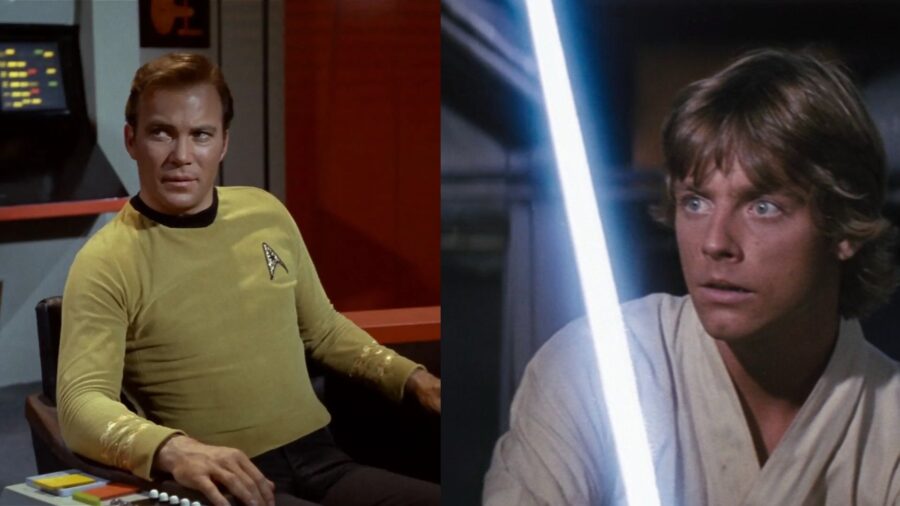
In short, the Star Trek fandom is divided, but one thing unites us all: our love for the greatest sci-fi franchise ever made. We all want the best possible future for Trek, and there’s no reason to think the cash-strapped Paramount won’t do its best to generate money with its biggest franchise. That means nobody is actively sabotaging Trek with a political agenda, but they may yet release enough crappy movies and shows to finish a dying franchise off. All fans can do, then, is hope. After all, Rebellions are built on hope.
Wait, that’s the wrong franchise! But that’s a reminder to every Star Trek fan worried about their franchise: just go look at The Mandalorian and Grogu choking at the box office and realize things could always be worse.
Entertainment
Doctor Who Showrunner Tries To Reassure Fans, Makes Everything Worse
By Chris Snellgrove
| Published

Right now, former Doctor Who showrunner Russell T. Davies seems to have a new full-time gig: sticking his foot into his mouth. Previously, he was revered as the man who brought this franchise back in 2005, turning a show that only older nerds cared about into a youth-friendly, worldwide phenomenon. Eventually, Davies left, and other showrunners (including the excellent Steven Moffat) took the reins. But enthusiasm for the franchise waned when Jodie Whittaker played the Doctor under showrunner Chris Chibnall. To help the show get its groove back, the BBC partnered with Disney and brought Davies back for two more seasons, both of which streamed on Disney+.
Unfortunately, it was a disaster. Disney refused to renew their deal with the BBC, meaning that a third season under Davies was more or less dead. Fans still hoped to see a Christmas special, but the showrunner dashed those hopes recently by hopping on Instagram to confirm that 1) the special, which he never even wrote, was canceled and 2) the BBC had parted ways with him and his production company. This led to widespread news that Doctor Who had been canceled over 20 years after its revival. Now, Davies claimed in a recent interview that the show hadn’t actually been canceled, but his phrasing has angry fans wanting to shove a sonic screwdriver into his mouth.
Getting Angry With The Fans
In an appearance on Gaydio, Russell T. Davies expressed anger at those reporting that Doctor Who has been canceled. “It’s extraordinary to see newspapers, who should know better, saying the show has been canceled,” he said. “It’s the opposite.” He went on to explain that the show is “being put out to tender,” meaning that the BBC will try to find an independent company that is willing to produce the show. By way of example, Davies noted that the show Casualty was previously “a BBC show,” but after being “put out to tender last year,” the show will “be made independently by BBC Studios,” which he noted was “separate to BBC Public Service.”
Wrapping up his thoughts on the matter, he speculated that nobody is going to apply for a tender for Doctor Who for at least a year. “You got to lock it in just to make it financially worthwhile,” a move that he thinks “guarantees years of the program.” He then ended this statement with some of the cattiness that has become his recent trademark: “But no, go ahead and call it canceled, everyone. You’re wrong. You’re literally wrong!”
All Of This Has Happened Before, And It Will Happen Again

So, why are fans irked at these words from the Doctor Who showrunner? For one thing, many are still salty about his recent Instagram post, where he claimed that he had never worked on a Christmas special despite previously saying he did and even teasing elements from a presumably completed script. The great writer effectively wrote himself into a corner, having basically admitted that he was either lying before about having worked on the script or lying now about having never worked on the script. Mostly, though, fans were annoyed at Davies’ pedantry here because what he is describing is a cancellation by another other name.
For example, the last episode of the original Doctor Who series aired back in 1989, after which it was effectively canceled. I say “effectively” because, according to the BBC, the show was never officially canceled. They simply stopped commissioning Doctor Who episodes (not counting the weird 1996 made-for-TV movie) for a period of 16 years. Fans now call these “the wilderness years.” We might have been in the wilderness even longer, but the BBC was so impressed by Russell T. Davies’ pitch that they made him showrunner for the celebrated 2005 Doctor Who revival.
More Who When?

On Gaydio, Davies seemed to revel in snarky pedantry, noting that fans who don’t understand what is currently happening with the franchise “are complaining on devices which have a search engine. Go and look it up.” But Davies is acting like this is just a temporary bump in the road and we’ll see new Doctor Who episodes in just a few years. But there’s no guarantee about that, and the last time the franchise was forced into hiatus, it was the better part of two decades before we got new episodes. Furthermore, while many changes were for the best, it’s worth noting the new show was very, very different from what came before.
Accordingly, Davies’ attempt to reassure fans completely backfired. Along with reminding us that we just don’t understand media like him (the guy who recently ran this franchise into the ground), the former Doctor Who showrunner reminded us that the last time the show was not officially canceled, we didn’t have any new episodes for 16 years, and the show came back completely different from what it was before. Because of that, no amount of snark and pedantry about whether it is officially canceled changes the fact that Doctor Who fans have every reason to be worried about a show they might not see more of for literally decades.

Golden Knights C William Karlsson ruled out for Game 6
Jackson Suber holds one-shot lead at RBC Canadian Open


