
Entertainment
Apple MacBook Pro 14-inch (M4, 2024) review: Windows PCs must feel sick right now

Table of Contents
The 14-inch M4 MacBook Pro has officially entered the chat — and it’s here to remind Windows who’s boss.
For those who haven’t been closely following the PCs vs. MacBooks battle in recent months, Windows laptops began to gain the upper hand with the introduction of the Qualcomm Snapdragon X Elite processor. Machines with this new chip delivered shockingly long battery life and jaw-dropping performance — so much so that they began to eclipse the M3 MacBooks.
But that was then. This is now. The M4 chip is here and its presence is monstrous — it’s a beastly gem that is the pride of Apple, but a scary-fast rival for the Windows world.
The Qualcomm Snapdragon X Elite chip may have sparked whispers of Windows’ comeback, but Apple’s M4 has arrived to make those whispers vanish. This MacBook Pro is everything we hoped for and more — and it’s ready to prove that Windows’ short-lived bragging rights end here.
Apple MacBook Pro (14-inch, M4) price and specs
The 14-inch MacBook Pro in this review costs $1,799 via Apple’s official website and comes with the following specs:
-
10-core CPU
-
10-core GPU
-
16GB of RAM
-
1TB SSD
If that’s too pricey for you, the cheapest configuration has a price tag of $1,599, but you’ll have to downgrade your storage to 512GB of SSD storage.
Apple MacBook Pro (14-inch, M4) design
My 14-inch M4 MacBook Pro comes in Space Black, but it’s not quite black enough, if that makes sense.

Credit: Kimberly Gedeon / Mashable
If you’re hoping this colorway would scream “Batmobile black,” you might be a bit disappointed. But it’s still deep enough to deliver that brooding, refined vibe.
My Space Black M4 MacBook Pro gives off the vibe of a mysterious man in the corner, smoking a cigar and sipping a bitter Old Fashioned — the kind of guy who doesn’t want company, but you can’t help being drawn to him. That said, I wish this hue leaned more toward a true inky black. Under certain lighting, it veers into dark gray territory, leaving me craving an even darker, sexier, more enigmatic finish.
Space Black is a new option for MacBook Pro models with the vanilla M-series chip. Last year, the Space Black colorway was reserved for the M3 Pro and M3 Max configurations — not for the entry-level, vanilla M3 models. However, it looks like Apple is being a little more generous this year. This onyx finish is now available for the base M4 models. Woot! (Last year, I begged Apple to bring Space Black to more Apple products, so this is likely a forecast that my wish may be coming true.)
While this color variant minimizes fingerprints, it doesn’t get rid of them completely. You’ll have to keep a microfiber cloth handy anyway.

Credit: Kimberly Gedeon / Mashable
You can also get the M4 MacBook Pro in Silver.
Other than that, there aren’t any other notable gen-over-gen design changes for the M4 MacBook Pro. And why should there be? It’s just fine the way it is, with Apple’s signature logo on the lid and an island-style keyboard on the deck. The new MacBook Pro continues to feature a 100 percent recycled aluminum enclosure.
Plus, it brings a lot of power in such a portable package (more on that later); I could see this being my new travel companion for sure.
Apple MacBook Pro (14-inch, M4) display
You may be wondering, “Did Apple make any upgrades with the display?” The answer is yes, but they’re minor.

Credit: Kimberly Gedeon / Mashable
Similar to the M3 MacBook Pro, the M4 MacBook Pro sports a 3,024 x 1,964-pixel display that continues to be quite striking to the eye. While watching Netflix’s Time Cut on the new laptop, I was blown away by the vivid, lush colors that brought the early-2000s sci-fi slasher to life. The Ugg boots, Victoria’s Secret PINK tracksuits, and Rollie Sneakers gave me flashbacks of peak Y2K cringe — but thankfully, the display’s stunning visuals made up for the throwback fashion fails.
The M4 MacBook Pro continues to sport a 16:10 aspect ratio, slim bezels, and that controversial notch that gets people in a tizzy. Do I love the notch? No. Will you get over it and forget it’s there? Yes. My only complaint is that the notch should make itself useful and add Face ID to the mix.
The gen-over-gen improvement featured on the M4 MacBook Pro’s display is brightness. Like its predecessor, the M4 MacBook Pro emanates 1,000 nits of sustained brightness for general use as well as 1,600 nits peak brightness for HDR content. However, the difference lies in the brightness offerings for SDR (Standard Dynamic Range). The M3 MacBook Pro delivered SDR content at 600 nits, but the M4 MacBook Pro is now more brilliant, now emanating SDR content at up to 1,000 nits.
There’s also a new nano-texture display option. My review unit doesn’t sport this feature, but I’ve had experience with this panel offering on the iPad Pro as well as the M4 Pro MacBook Pro. Its mission is to ensure that the display remains highly visible, even in challenging lighting situations (e.g., a sun-drenched room).
It holds up impressively well in bright settings, but the trade-off is a slight dip in the vividness and saturation you’d get from the non-nano-texture display.
Apple MacBook Pro (14-inch, M4) ports
You’ll now find three Thunderbolt 4 ports on the MacBook Pro. Compared to its last-generation counterpart, that’s one additional Thunderbolt 4 option for you to play with.

Credit: Kimberly Gedeon / Mashable
The M4 MacBook Pro also sports an HDMI port (supports TVs and 4K displays at up to 240Hz or 8K TVs up to 60Hz), a full-size SDXC card slot, as well as MagSafe 3 charging.
No, the 14-inch M4 MacBook Pro doesn’t come with Thunderbolt 5; you’ll have to upgrade to configurations with M4 Pro and M4 Max for that. As it stands now, the 14-inch M4 MacBook supports up to 40Gb/s of throughput for accessories. (With Thunderbolt 5, however, you can get faster data transfer up to 120Gb/s). The M4 MacBook Pro, in addition to the built-in display, can handle up to two high-res external displays. For example, the M4 MacBook Pro can support two 6K external displays at 60Hz.
This is awesome for anyone who desires a multi-monitor setup. The last-generation 14-inch M3 MacBook Pro could only support one external display at up to 6K at 60Hz. Womp, womp!
Apple MacBook Pro (14-inch, M4) audio
The 14-inch Apple MacBook Pro continues to have angelic audio that sounds like it’s been tuned by a choir of heavenly beings.

Credit: Kimberly Gedeon / Mashable
I listened to “Timeless” by The Weekend and Playboi Carti, and as incredible as my M2 MacBook Air sounds, nothing on the entire planet beats the MacBook Pro’s six-speaker sound system with four force-cancelling woofers and two tweeters.
I’ve been reviewing laptops for several years now, and nothing comes close to what the MacBook Pro has been able to do with sound. “Timeless” sounded so good that it gave me chills — as if the music danced around me in 3D.
Apple MacBook Pro (14-inch, M4) keyboard and trackpad
Apple didn’t change a darn thing about the built-in Magic Keyboard. As a reviewer who has tested countless laptops, I wouldn’t say the MacBook Pro sports the best keyboard (that praise is reserved for the HP OmniBook X), but it’s up there.

Credit: Kimberly Gedeon / Mashable
The keys are spacious and well-placed with a black-and-white theme that provides high contrast for peak visibility. Plus, there’s still Touch ID support, which is always a breeze to setup (unlike Windows PCs).
Still, I can’t quite crown this keyboard as king. While it’s undeniably snappy and clicky, I’ve tested plenty of laptops with a springier feel that gives my fingers a more satisfying launch from letter to letter.
I have no notes for the glass-covered Force Touch trackpad. It’s roomy and has the right balance of smoothness and resistance for highly responsive swiping.
Apple MacBook Pro (14-inch, M4) benchmarks and performance
The M4 chip is a monster that must be haunting Windows PCs’ dreams.

Credit: Kimberly Gedeon / Mashable
Long story short, in the realm of Windows, Qualcomm has been bragging about its energy efficiency and performance numbers, claiming that it’s better than the M3 chip. And according to our testing, Qualcomm was right; it does, indeed, have an edge over M3-based MacBooks.
As such, Qualcomm-based laptops, particularly those packed with Snapdragon X Elite processors, have been enjoying praise from laptops reviewers, like myself, who were blown away by their performance scores.
However, Apple dropped the M4 chip and obliterated Windows laptops in one fell swoop. On Geekbench 6, the MacBook Pro notched a sweet multi-core score of 15,199. This beats our most powerful non-gaming PC laptop, Microsoft Surface Laptop 7, which delivered a score of 14,548 on the same test.
We also tested the MacBook Pro on other benchmarks (higher is better):
-
Cinebench R3 (multi-core) – 13,891
-
Blender GPU score – 1,065
(Just a note: while we don’t yet have competitor scores for Cinebench R3 and Blender, this gives you a look at the MacBook Pro’s own impressive results.)
And hallelujah, the entry-level MacBook Pro now has a starting configuration of 16GB as opposed to 8GB, which means the risk of slowdowns while multitasking has decreased. Feel free to flood Google Chrome with as many tabs as you want.
Apple MacBook Pro (14-inch, M4) webcam
Apple upgraded the webcam from yawn-worthy 1080p to a better-quality 12MP.

Credit: Kimberly Gedeon / Mashable
To test the new webcam, I made two FaceTime calls with my fiancé: one using my M2 MacBook Air with its 1080p webcam and the other using the M4 MacBook Pro with the upgraded 12MP camera. He accurately identified the 12MP webcam. However, he noted that the difference between the two wasn’t dramatic, aside from a slightly sharper image. He observed “less artifacting” on the new camera, which handles varying lighting conditions much better than the 1080p webcam.
Personally, I’m lovin’ the updated camera, which supports Center Stage, a feature that was once limited to newer iPad models and Macs connected to an Apple Studio Display.
What’s Center Stage? It’s a feature designed to automatically keep you centered in the frame, even as you move around during video calls. (This is available on video-conferencing apps like FaceTime and Zoom.)
Whether I swayed to the left or shuffled over to the right, the updated webcam followed me like a loyal dance partner.
The real star of the show, however, is Desk View, which lets the webcam capture a top-down view of whatever’s on your desk. Initially, I thought a second camera might be required to make Desk View work, but it turns out you don’t need one. With just the 12MP camera, I was able to activate Desk View during a FaceTime call. It’s pretty impressive.
Apple MacBook Pro (14-inch, M4) battery life
Apple claims that the MacBook Pro can provide up to 24 hours of video streaming on a single charge.
To test this proclamation, we kicked off our 1080p video rundown with the Tears of Steel film at 50 percent brightness. The 14-inch M4 MacBook Pro didn’t quite reach 24 hours, but it survived for 16 hours and 32 minutes, which is still quite good. That’s nearly 17 hours of battery life.
Is the Apple MacBook Pro (14-inch, M4) worth It?
The 14-inch M4 MacBook Pro basically said, “In your face!” to Windows laptops after they made noise with the Qualcomm Snapdragon X Elite chip this year.
From its impressive battery life to its monstrous M4 chip performance, this machine is built to dominate. But let’s be real — at a starting price of $1,599, it’s an investment that’s not for the faint of heart.
If you’re a creative professional who thrives on serious power in a sleek, portable package, this MacBook Pro is your best friend. But if you’re only using it to browse the web or stream Netflix, you might want to save your cash for a more budget-friendly option. (Perhaps wait for the next-generation MacBook Air.)
For those ready to embrace Apple’s latest powerhouse, though, the M4 MacBook Pro won’t disappoint.
Entertainment
This $43 bundle quietly upgrades your entire PC experience

TL;DR: This rare Microsoft bundle deal gives you a lifetime license to Microsoft Office Professional 2021 for Windows and Windows 11 Pro for only $42.97 (reg. $418.99) through May 17.
$42.97
$418.99
Save $376.02
Looking for an affordable way to make your old PC feel new again? If you don’t have the funds to buy a brand new computer, don’t worry. The Ultimate Microsoft Office Professional 2021 for Windows lifetime license and Windows 11 Pro Bundle is the next best thing, offering your computer a total upgrade for only $42.97 through May 17.
Don’t count out your dusty old PC. This Microsoft bundle is here to give it a total facelift for less than $50. It kicks off with a lifetime license to some of the brand’s most popular tools — Microsoft Office, which you’ll pay for once and enjoy without any subscription fees.
Mashable Deals
You’ll get permanent access to a suite of eight helpful apps with Microsoft Office Professional 2021 for Windows. It includes staples that have been around for decades, like Word, Excel, PowerPoint, and Outlook. You’ll also get newer favorites like Teams, OneNote, Access, and Publisher.
Once you’ve loaded the apps onto your device, you can upgrade your OS to Windows 11 Pro. It’s an operating system made for modern professionals, with tools that support your workflow. Enjoy a more powerful search experience, improved voice typing, a seamless interface, snap layouts, and much more.
You can rest easy knowing Windows 11 Pro takes your cybersecurity seriously. You’ll have biometric logins, encrypted authentication, and advanced antivirus defenses to keep your data secure.
Mashable Deals
Show your PC some love with the Microsoft Office Professional 2021 for Windows and Windows 11 Pro bundle for only $42.97 (reg. $418.99) now until May 17.
StackSocial prices subject to change.
Entertainment
Star Trek’s First Broadcast Episode Was Very Carefully Chosen, Because It Was Boring
By Chris Snellgrove
| Published

These days, Star Trek is a bona fide pop culture phenomenon. But during the development of The Original Series, there was anxiety that the general public wouldn’t really understand Gene Roddenberry’s mashing up Western tropes with a sci-fi setting. Making matters worse was that the original pilot, “The Cage,” had been rejected by NBC for being too brainy. Fortunately, Roddenberry got a chance to shoot another pilot, one which impressed the network enough to order an entire season worth of episodes.
Several episodes of Star Trek: The Original Series had already been shot when the time came for this new show to make its broadcast premiere. The first episode that the general public saw was “The Man Trap,” which featured a shapeshifting monster that was revealed to be an alien salt vampire. This good-but-not-great episode was an odd choice, and it was one that the cast and crew hated. As it turns out, though, this episode was very carefully selected by executives because it served as an inoffensive, relatively straightforward encapsulation of everything Star Trek had to offer.
It’s A Trap!

Most of the information we have about why “The Man Trap” was selected as Star Trek’s first episode comes from the book Inside Star Trek: The Real Story. Within this impressive reference tome, Robert H. Justman and Herbert F. Solow revealed something surprising: NBC had several other episodes to choose from for the premiere, including “The Corbomite Maneuver,” “Charlie X,” “Mudd’s Women,” “Where No Man Has Gone Before,” and “The Naked Time.” All of them had already been shot and were mostly finished, so it was just a matter of figuring out which episode would serve as the best introduction to Star Trek, a heretofore unknown sci-fi series.
“The Man Trap” won out, mostly because the powers that be worried that other episodes would be off-putting to general audiences in some very specific ways. For example, they worried that audiences would find “Charlie X” a story that was “too gentle” because it focused on an adolescent with special powers. This was probably the right call, in retrospect: when Variety gave a negative review of “The Man Trap” (an episode chosen, in part, because of its relative maturity), they declared that Star Trek: The Original Series was “better suited to the Saturday morning kidvid bloc” (ouch!).
A Monster Hit Of An Episode

“The Corbomite Maneuver” was a great potential choice, but this episode’s impressive special effects were still in post-production, and almost all of its action took place on the ship. “Where No Man Has Gone Before” really outlined the premise of the new show, but it was deemed “expository” for general audiences expecting more action and danger. Justman thought “The Naked Time” was a killer introduction to the crew’s personalities, but the network passed, presumably because of how over-the-top (half-naked, swashbuckling Sulu? Oh, my!) that episode gets. “Mudd’s Women,” meanwhile, was deemed too offensive because the plot involved literally selling women to miners.
Through this process of elimination, executives decided that “The Man Trap” was the best intro to Star Trek. It had cool scenes on both the Enterprise and a distant outpost (a strange new world) and featured a straightforward action plot you didn’t have to be a sci-fi aficionado to understand. Finally, it was all about finding and defeating a creepy monster, which offered thrills to audiences of all ages. The network’s choice paid off, and Star Trek: The Original Series became the most popular sci-fi show in television history, even though the cast (including William Shatner and Leonard Nimoy) thought “The Man Trap” was the worst possible episode they could have chosen.

All of this is a keen reminder of how much thought and work went into putting Star Trek’s best foot forward. It might be a reminder that Paramount’s current upper leadership needs, as Starfleet Academy hit the ground running with the worst episodes of Season 1. The show got better after that, but it didn’t matter because the prospective audience had already been driven away. As it turns out, today’s execs need to learn something that the network execs of the ‘60s had learned very well: series succeed when you give the audience what they want to see and not what you want to show!
Entertainment
How A Fantasy Box Office Bomb Lost $200 Million In Theaters, And Suddenly Became A Streaming Hit
By Jonathan Klotz
| Published

For the last decade as streaming has taken off in homes around the world, it’s become possible for films that lost historical amounts of money in theaters to find success, even if it might be the post-Mystery Science Theater 3000 trend of “so bad it’s good.” That’s why a massive flop, for example say, Morbius, and films that slightly missed the mark like The Fall Guy can turn it around and become a streaming success.
What’s even more impressive is the amazing turnaround of 2013’s Jack the Giant Slayer, which lost Legendary Pictures an alleged $200 million, only to end up topping streaming charts in 2025.
The Classic Fairy Tale With A Twist

Everyone knows the story of Jack and the Beanstalk, the classic fairy tale about selling a horse for magic beans and climbing a beanstalk to find a giant living in the clouds. It’s simple, contains multiple morals, and can be easily adjusted to turn Jack into the villain, but Jack the Giant Slayer instead asks, “What if there was no moral, and instead of one giant, there was an entire army of evil giants?” The movie is the classic story, as you’ve never seen it before, and it almost works.
Nicholas Hoult plays Jack, the young man who finds himself trading his horse to a monk in exchange for beans that he can’t allow to get wet, ever. Like the rules in Gremlins, it’s not long before Jack accidentally gets the beans wet and a beanstalk grows under his house with the princess, Isabell (Eleanor Tomlinson), trapped inside as it grows into the sky. All the king’s men gather to rescue the princess, including Lord Roderick (Stanley Tucci), who, thankfully, Jack the Giant Slayer makes obvious is very evil, very quickly.
It’s up to Jack, Isabell, and the loyal Knight, Elmont (Ewan McGregor) to save the kingdom and stop the invasion of giants led by Roderick and the giant two-headed General Fallon (Bill Nighy). If there’s one thing Jack the Giant Slayer does better than every other adaptation, it’s the third act featuring a full-blown war between humans and giants, with a touch of humor and absurdity. Watching a giant toss a windmill like the glaive from Krull is the perfect amount of off-beat to distract from a surprising amount of body horror in both the giant’s designs and Fallon’s ultimate fate.
A Movie For No One
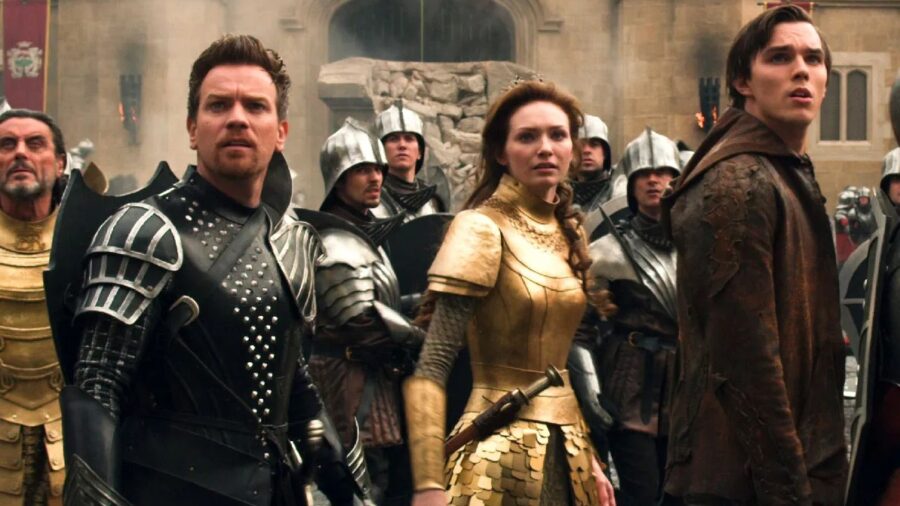
Jack the Giant Slayer looks too good, and the star-studded cast is having way too much fun for it to be a truly bad movie. The problem is that the pacing is off: it takes a little too long to get to the good stuff, then it feels a little too rushed, and though it is a fun adventure, it’s also, like the source material, simplistic. It’s not like the movie wasn’t watched in theaters; it made $197 million worldwide, which would be a great haul except it cost $185 million to make, and that’s not including the extensive marketing campaign.
The push and pull of director Bryan Singer’s vision of a dark take on the fable, complete with actual people-eating on screen, and the sanitized version that hit theaters, which was still too dark for children, since the film is surprisingly rated PG-13, meant it ended up being a film for no one. The Rotten Tomatoes ratings, of 52 percent from critics and 55 percent from the audience, are proof that the final product is not great, but not bad; it’s a movie that will keep you watching for a few hours and then leave no lasting impression. These days, Lionsgate and Sony wish they’d release a movie that is that well-received, as even Jack the Giant Slayer looks like a masterpiece compared to Borderlands or Kraven the Hunter.
Streaming is the perfect home for Jack the Giant Slayer, and 10 years later, it no longer matters that the movie lost hundreds of millions in theaters. It finally gets to stand on its own as a fun, if unremarkable, fantasy adventure.

Which NBA Playoffs Game 1 Loser Is Most Likely To Win Their Series?
Angels activate OF/DH Jorge Soler from four-game suspension


