
Entertainment
When will we know who won the 2024 election?

Less than a week out from election day, as many around the country send in their mail-in ballots or stand in early voter lines, Americans are anxiously hoping to know who will be the next president ASAP.
Many pundits anticipate a quicker turnaround than the last presidential election, perhaps as early as Wednesday morning, but election experts — noting ongoing outcome-driven attacks on the veracity of ballot counting — want to hedge such expectations.
Closer the race, longer the count
“The public perceives election results coming out fairly quickly, on election night or in the days after, but it has always been true that it has taken days or weeks to get official election results,” said Chris Mann, director of research for the Center for Election Innovation and Research, a nonprofit that works with election officials to build stronger confidence in elections. “In order to get the official results, we have to count every single ballot. Making sure that is done properly, correctly, thoroughly, completely, it takes a while, and states have different processes.”
Mann and others urge the public to understand that no two elections are alike, and a lot has been invested into the 2024 election that wasn’t integrated into the 2020 process — this will speed up the count in some states, but that doesn’t mean results will come out immediately. There are three important factors to understanding election results, he explained: First, just how close the result margins turn out to be; second, the technological factors used to tabulate results; and third, the electoral policies in each state.
Of the bunch, said Mann, close margins are the most important factor in establishing a result timeline. An election with close margins requires more ballots be counted before an outcome can confidently be called by media outlets, which is what led to the near 5-day wait in 2020.
Polls, of course, are already making educated guesses about the closeness of results in both the presidential race and other offices across the 50 states. But polls aren’t actually projections about the winners and shouldn’t be taken as such, according to experts. Instead, they try to capture and estimate voter attitudes. Intention, however, is slippery to capture, and voter opinion can change in a matter of minutes. Closer margins obscure these results even further, and may result in even more dedicated ballot counting.
Tech investments speed up counts, but have limits
State-specific technology will also play a key factor in calling a winner. Since 2020, election officials have invested heavily in expanding updated and faster ballot counting machines and processes to speed up the tech’s use. Machine upgrades in states like Wisconsin, for instance, will speed up day-of counting compared to the last go-round.
Mashable Top Stories
“A variety of states, swing states and non-swing states, have invested in technology,” Mann said. “If you ask election officials, or folks who closely observe elections, this election will be the most secure and transparent and well-run because there has been this investment in technology… We will be able to count ballots much faster than we have in almost any previous election across the country.”
Technological innovations are bolstered by human-monitored processes, which can simultaneously speed up and slow down the counting process. And counting can’t begin until ballots are verified, the most time consuming part of the entire tabulation process. Mann points to two important state policies that will determine when counting can take place. The first is whether or not a state allows what is known as “pre-processing,” in which officials validate absentee and mail-in ballots ahead of time to speed up counting.
Earlier this month, the CEIR published a report on the state of early, mail-in voting policies per state, outlining a shift to allow more pre-processing efforts among 43 of the 50 states. Michigan and Nevada, for example, will now participate in pre-processing, with Michigan allowing early voting for the first time in order to speed its reporting up. Notably, Wisconsin and Pennsylvania do not allow pre-processing, and Pennsylvania is expected to lag behind other swing states in reporting an official count.
“Counting ballots takes time, and confusion around perceived delays can open the door to misinformation and unfounded doubts about the integrity of the count,” the organization wrote. “Pre-processing reinforces election integrity and improves administrative efficiency. Beginning to process mail or absentee ballots before election day gives election officials more time to detect, investigate, and address potential errors or irregularities before election day.”
The second state policy at play is the window of acceptance a state has for receiving ballots. States like California, Oregon, and Washington accept ballots postmarked on election day, which means contentious seats down the ballot may not be called for weeks. Federal law gives overseas residents and military members the same allowance, established in the 1980s. Even swift pre-processing may be swamped by day-of or post-election day ballots. “Election officials get a lot of ballots, and you can’t pre-process something you don’t have,” said Mann. “So when the mail truck pulls up to the election office and unloads bags and bags of mail ballots that have just arrived, they again have to go through that whole process, even if they were allowed to process the ones that they had gotten days before, in advance.”
Early voting has become an essential part of the pre-election day build up. Independent organizations like VoteHub attempt to monitor and track the amount of absentee and mail-in voting requests and returns for the public using web data, offering a scope to early voting.
The election is safe, despite claims otherwise
But even with policies that support human or machine help, and a host of data insights, official ballot counting takes time. That time opens up room for voter anxiety and misinformation. From attacks on mail-in ballots to false claims about election technology, voters can anticipate a swell of false partisan claims circulating election day about the veracity of the count. “One thing that’s really important to watch out for is how much of this information is driven by outcome,” said Mann. “These are not principled attacks, but opportunistic attacks driven by outcomes, not about the process.”
Conflicting information may also sow doubt among voters. Mann encourages individuals to visit Vote.gov to get the most accurate information about their state’s electoral process and officials, including how it declares a winner — the website has been revamped since 2020 to include even more resources for voters. Mann also points to CEIR’s interactive guides that explain just how your ballot becomes a vote, what happens after a vote is cast, and how the media covers an election.
Election day will be a blur of unofficial calls based on early polls and conjecture by major political parties, with election officials reassuring the public as much as possible. Media outlets will try to beat each other to the most accurate call, based on a calculation of the gap between candidates and the number of uncounted ballots left. Simultaneously, political leaders on both sides may be eager to urge on more counting, ask to halt the count to call a winner, or participate in a confusing combination of both, as was seen with the 2020 Trump campaign’s scattered ideological stance to mail-in ballot counting.
But one thing is certain: Your vote is secure. “Our elections will not be perfect. There will be power outages, there will be poll workers [who] oversleep and don’t open the polls on time, but they will be as close to perfect as they have ever been,” said Mann. “I’m 100 percent confident that it will be the best election that we have ever had, but it’s also the election that’s been under the most attack.”
Entertainment
The Latest Poster For Avengers: Doomsday Secretly Spoils The Plot

By Chris Snellgrove
| Published

With less than five months left until the film’s release, Marvel has taken their marketing for Avengers: Doomsday to the next level. Right now, fans are mostly focused on the trailer that dropped today, which is no surprise; after all, it’s not every day that you see the reunion of Thor and Steve Rogers or, for that matter, a battle between Shang-Chi and Gambit. Amid all the breathless hype over the trailer, however, a more powerful advertisement is lurking in plain sight. At the same time Marvel launched the trailer, they also released a new Avengers: Doomsday poster.
Compared to that crowded character poster, the new poster is downright subdued. It features Doctor Doom staring at a huge tapestry with a broken world and two characters: a woman and a boy. Some comics fans think this image is Doom and his mother, a character who is eventually damned to Hell. However, other fans are convinced that this is actually an image of Doom’s wife and child; if true, this would effectively ruin the biggest plot twist. How does it do that? If you don’t mind some potential spoilers for this year’s biggest film, just keep reading!
You Can’t Spell “Painting” Without “Pain”

So, let’s start this story in reverse (just don’t let the TVA get me!): why do some fans think the woman in this poster is Doctor Doom’s mother? In the comics, she’s a big deal. To defeat an evil dictator who was ruling her country with an iron fist (an actual fist, not the kung-fu guy), she made a deal with the devil. As usual, the deal went wrong, and she lost control of the powers that she gained from Mephisto. She renounced those powers, got killed, and was then dragged into Hell. To see her again, Doom later mastered magic, visited Mephisto, and conducted an experiment that ruined his own face.
However, all of the lore behind this origin story is too dense to fit into Avengers: Doomsday, a movie which is already crowded with endless character cameos. It seems the movie is taking a different direction, as multiple reports have claimed that the two figures are actually Doom’s wife and child. An unconfirmed leak of the movie’s plot (don’t say I didn’t warn you about spoilers, kids!) claims that Doom actually lost his family to one of the incursions, which is when one reality collides with another. This motivates Doom to learn more about the incursions and to plot his revenge.
A Hero Will Be Broken

Revenge against whom, you ask? According to the leaked plot, Steve Rogers! Reportedly, Loki visits the former Captain America in the past and warns him that the TVA will prune his entire timeline because he’s not supposed to be there. In an act of seeming kindness, Loki brings Cap, Peggy, and their young son to the Fantastic Four’s universe. However, the leak claims that Steve’s presence in this universe somehow triggers an incursion and that Doom disfigured himself and killed his own wife and son trying to stop it. In a shocking twist, Doom reportedly kills Steve’s son in front of the hero in an act of vengeance.
Now, again, all of this comes from a leaked plot summary that hasn’t been confirmed, so all of this could be an Ego-sized bottle of hogwash. But it’s worth noting that the Avengers: Doomsday teasers last year prominently focused on both Captain America and Thor becoming fathers. This potentially adds credence to the idea that this is a film about family and how far someone will go to protect the ones they love. If the leaks are true, this innocuous poster featuring Doctor Doom is spoiling the motivation the villain will have to cross time and space and cross countless moral event horizons along the way.

A movie where costumed vigilantes (like Batman, Spider-Man, and so many more) are driven by the ghosts of family members they lost when they were children? Well, nobody ever accused Marvel of being all that original!
Entertainment
The Best Horror Series Ever Made Is Now Streaming For Free
By Chris Snellgrove
| Published

My absolute favorite kind of movie is the anthology. When you have a collection of short films all rolled into one, it provides the ultimate ROI for the audience. Don’t like one of the stories? You can just thug it out with the short runtime or skip ahead to the next tale. Either way is infinitely preferable to slogging through a two-hour film that started boring you to tears in the first scene. The anthology is much rarer in television, however, because networks and streamers have learned just how attached fans get to the same characters and stories, causing them to run these shows into the ground.
Heroes, Stranger Things, Star Trek: Discovery…what do all of these shows have in common? They were designed to be anthologies that would change things up each season, but their early success meant we were stuck with the same cast for years as the show got worse. Fortunately, true anthology lovers are just a click away from getting their fix. Right now, Tales From the Crypt is streaming for free on Tubi, just waiting to delight all you ghouls and boys. It’s not just the perfect anthology show; it is, in fact, the greatest horror series ever made!
Meet The Cryptkeeper
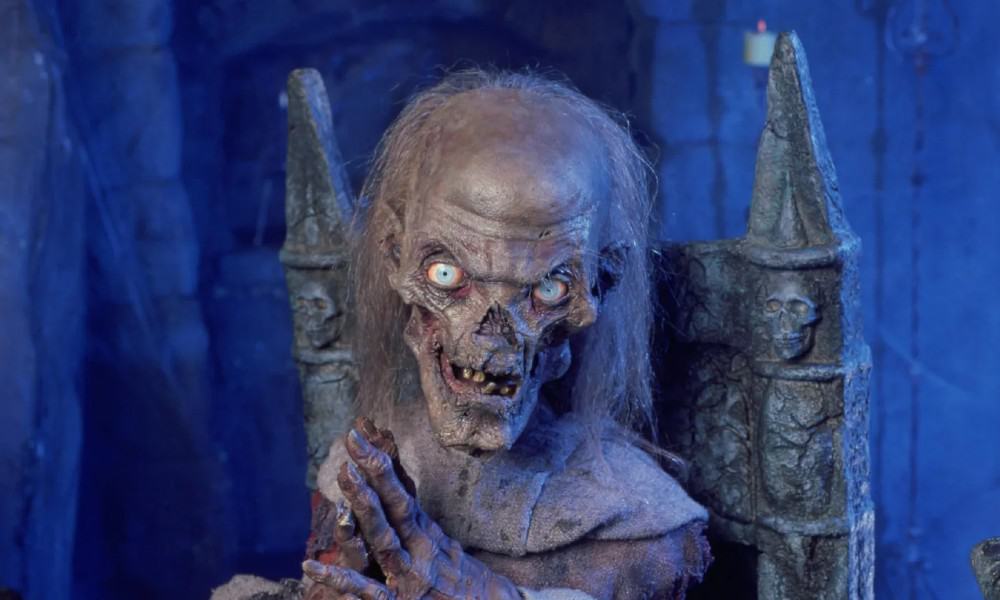
Tales From the Crypt fully embraces its anthology format, with every single episode focusing on different characters and different terrifying tales. What ties all of them together is our host, the Cryptkeeper. He’s a snarky, hilariously mean corpse of a character brought to life by a small army of puppeteers. The show originated on HBO, and its creators embraced the fact that it didn’t have to abide by any of the restrictive standards of network television. As such, episodes were filled to the brim with vulgar language, nudity, sex, and more buckets of blood than you can shake a bodybag at.
Younger horror fans should know that it’s almost impossible to overstate the popularity of Tales From the Crypt and its ghoulish host. Despite all the blood, breasts, and beasts, the show was wildly popular with kids, including my own underage self. Accordingly, it got two spinoffs aimed directly at children: Tales From the Cryptkeeper (a Saturday Morning children’s cartoon) and Secrets of the Cryptkeeper’s Haunted House (a weird gameshow). If that seems odd, this was during the same time that Kenner marketed toys based on Terminator 2 and Aliens directly to kids. What can I say? The ‘90s were weird, man!
Friends In Low Places

One compelling reason to check out Tales From the Crypt is that it had plenty of awesome guest stars, all of whom were happy to do an episode without being tied down to a long contract. Guests included Arnold Schwarzenegger, Brad Pitt, Michael J. Fox, Tom Hanks, and so many more. In most cases, these actors are performing against type, making what happens to them onscreen that much more shocking. Trust me: if you only know actors like Robert Picardo and Wil Wheaton from Star Trek, you’ll never look at them the same way after watching Tales From the Crypt.
For me, though, the single best thing about Tales From the Crypt is the show’s wicked sense of humor. With his relentless puns, wild expressions, and unhinged laughter, the Cryptkeeper sets the tone for a show that has black comedy running through its veins at all times. This adds serious entertainment value and also helps position the show as a light (but filling) bite for horror fans. Not in the mood for elevated horror and don’t have the time for a two-hour psychological thriller? You can always count on Tales From the Crypt to deliver a perfect slice of scary entertainment in under 30 minutes.

There’s not much more to say, especially without spoiling these awesome episodes. Ready to see if this early HBO success story lives up to the hype? Maybe you want to laugh and scream in equal measure, or just write down some weird new puns with which to torment your children? Whatever your reason, the best horror series ever made is just a click away. Tales From the Crypt is currently streaming for free on Tubi, which is arguably the best platform for any boils and ghouls who love a good scare!

TALES FROM THE CRYPT REVIEW SCORE
Entertainment
The Eufy E25 2-in-1 robot vacuum is $400 off at Amazon right now
SAVE 40%: As of July 20, you can get the Eufy E25 robot vacuum-mop combo for $599.99, down from $999.99, at Amazon. That’s a 40% discount or $400 in savings.

$599.99
at Amazon
$999.99
Save $400
As you’ve probably read by now, I have two beagles who love to destroy my floors (particularly right after I’ve cleaned the entire apartment). To keep my sanity intact, I own an arsenal of cleaning supplies, including the Dreame L60 Pro Ultra and the Aero Pro Steam (I call it my “Dreame Team“). But I also know that brand loyalty usually takes a backseat when a really good discount pops up. (Plus, it’s my job.)
Right now, you can get the Eufy E25 robot vacuum-mop combo for $599.99, down from $999.99, at Amazon. That’s a 40% discount or $400 in savings.
Mashable Trend Report
It features 20,000 Pa of suction, empties its own dustbin, and even washes its own mop roller. It also comes equipped with AI obstacle avoidance to dodge everyday clutter (like rogue dog toys), and an extending arm to scrub right up against your baseboards. But, according to some Amazon reviewers, there are a few minor drawbacks, including a louder-than-usual drying cycle and finicky rollers.
Even so, picking a good spot for the base or doing occasional maintenance is a small price to pay to never have to mop your own floors again.

The Xteink X4 Pro could be the tiny e-reader of your dreams
Nationals' potent offense ready to back Miles Mikolas vs. Rockies


