Entertainment
What Battlestar Galactica Did Better Than Star Trek Ever Did
By Chris Snellgrove
| Published


The showrunner for Battlestar Galactica was Ronald D. Moore, who got his start in television by writing for Star Trek: The Next Generation. Accordingly, there have been plenty of comparisons over the years between these two franchises. BSG fans point out that the show handles ongoing stories better than vintage Trek, and its vision of the future is much more realistic. There are no replicators, for example, so Commander Adama and his crew have to deal with scarcity in a way that Picard and Janeway never had to.
Obviously, there are pros and cons to each of these different kinds of sci-fi storytelling. But in making comparisons, fans of both franchises often overlook the best thing that Battlestar Galactica does better than Star Trek. Starting in the Season 1 episode “Litmus,” BSG went out of its way to give even the most minor characters their own compelling identities and backstories. In Star Trek, such characters are relegated to the role of “redshirts” who don’t get to do anything but die in agony, so our heroes can live to warp another day.
Birth Of A Pop Culture Phenomenon
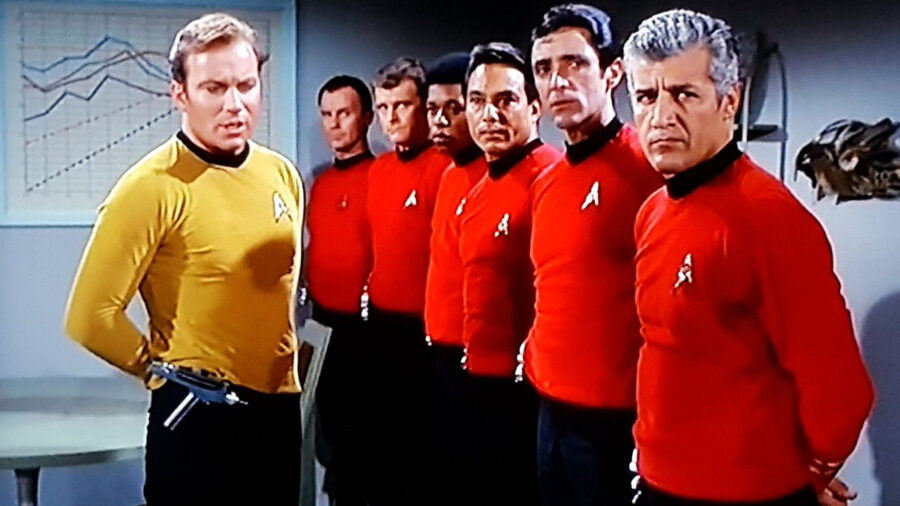
In case this famous sci-fi trope needs an introduction, here goes: in Star Trek: The Original Series, security officers wore red shirts. This helped distinguish them from other divisions: a blue shirt indicated a focus in science or medicine (like with Spock and McCoy), and a gold shirt indicated command (like with Kirk). Whenever our major characters beamed down to a new Away Team mission, they brought along several red-shirted security officers. Unfortunately, these characters were usually doomed to die a grisly fate, leaving our intrepid main characters to figure out what killed their security detail.
Soon enough, “red shirt” entered into the pop culture vernacular as a name for an otherwise disposable character. While the shirt colors changed, this general trend continued into future Star Trek shows. Security officers were often dispatched by the villain of the week, including poor Tasha Yar, who was insta-killed by a villainous oil slick. Eventually, Discovery took the idea of disposable Star Trek characters to the next level by giving us a show where half the people on the bridge were relatively unknown, all the way to the very end.
Make It “No”


How, then, did Ronald D. Moore’s Battlestar Galactica fix this annoyingly persistent Star Trek mistake? Arguably, it all started with “Litmus.” This is the episode where Commander Adama and his crew discover that Cylons can look like human beings. That revelation leads to a tribunal designed to suss out who might have helped the Cylon Doral pull off a recent suicide bombing. Inevitably, the tribunal becomes a witch hunt that accomplishes nothing more than punishing an innocent man so the public has a scapegoat to hate.
A big part of the episode’s drama is that members of the deck crew try to protect Chief Tyrol, who has been secretly having an affair with Boomer. When his absence from his post is noted, these minor crew members come up with different cover stories to explain where he is. Unfortunately, this just makes their boss look more suspicious, and Tyrol calls off the affair after one of his subordinates lies to protect him. He also ends the episode wondering about Boomer’s loyalties, which is a good call. Eventually, she is revealed to be one of the Cylons who has secretly infiltrated humanity.
There Are No Red Shirts Anymore

“Litmus” prominently features some interesting deck hand characters, including Tarn and Socinus. It also prominently features Cally, a future love interest for the Chief. In a Star Trek episode, these deckhands would mostly be redshirts that we hardly ever see again. They would just suffer to protect our lead characters and then quietly shuffle off. This is particularly true of Socinus, who falls on his sword (he is stripped of rank and confined to the brig) to save Tyrol. However, Socinus and everyone else just keep showing up in later episodes, often playing surprisingly pivotal roles in various plots.
This is effectively a mission statement from former Star Trek writer Ronald D. Moore: there are no disposable characters in Battlestar Galactica. This isn’t a show about a handful of charismatic leads. Rather, everyone in this series is important, just as every remnant of humanity that survived the Cylon-led genocide is important. It’s a bold storytelling strategy that rewards careful viewing, all while building out this fantastic fictional world. Now, be honest: isn’t that a lot better than watching some rando in a red shirt get eaten by a salt monster?