
Entertainment
Walton Goggins' R-Rated Hulu Thriller Is Unfairly Overlooked 1980s Nostalgia

By TeeJay Small
| Published

Every once in a while, I find myself trolling Hulu for weird, obscure movies that might scratch my niche interests. This is how I’ve come across such underrated hits as Self Reliance, The Death of Stalin, and an obscure little indie film called Shrek 2. Last week, I was surprised to stumble upon The Luckiest Man In America, which released in 2024 with a stacked cast, an exciting premise, and a top-tier trailer.
A Game Show With A Stacked Cast

Somehow, this film must have completely missed my radar upon release, but The Luckiest Man in America has all the makings of a movie I’d love to watch. Paul Walter Hauser appears in the main role, as real-life game show contestant and down-on-his-luck ice cream vendor Michael Larson.
After essentially scamming his way into a slot on the show Press Your Luck, Larson attempts to take home the biggest game show payday anyone has ever seen. Along the way, the cast and crew of Press Your Luck panic at the idea of losing tens of thousands on a single episode, prompting them to sabotage Larson’s game.

The Luckiest Man in America feels like a game of cat and mouse, a fever dream, and a little piece of Americana all rolled into one. The tension rises throughout the narrative perfectly, all while rarely leaving the set of the game show.
Larson’s shady behavior keeps you on your toes the entire time, and PWH’s performance is one of his best. The supporting cast of The Luckiest Man in America includes a suite of character actors who all knock it out of the park as well, including Walton Goggins, Shamier Anderson, Johnny Knoxville, and Game of Thrones‘ Maisie Williams.
Decades In The Making

The Luckiest Man in America was written and directed by a relatively unknown filmmaker named Samir Oliveros. Apparently, a draft of the script had been floating around since the late 1990s, with Bill Murray originally attached to take on the leading role. While that sounds like it might have been a really fun take on the material, I’m actually glad this project spent a quarter of a century in development hell. Personally, I don’t think anyone else could have brought this story to life quite like this team, and I definitely think the varnish of 80s nostalgia plays better today than it would have in the year 2000.
My only gripe with the movie is that it ends pretty abruptly. I was along for the ride on this one, and I would have fully enjoyed it if the film had gone on for hours. Still, like a prolific game show performance, all great things must come to an end. If you’re interested in checking out this oddball thriller, be sure to stream The Luckiest Man in America on Hulu today.


The Luckiest Man in America SCORE
Entertainment
How A Sci-Fi Series Defied Cancelation To Become A Netflix Streaming Hit
By Jonathan Klotz
| Published

The Netflix Effect was coined to explain how a show explodes in popularity after it is added to the streaming service. Breaking Bad was the first show to benefit, but there’s one throwback sci-fi series that became so popular, it was saved from cancellation thanks to streaming.
Manifest, a sci-fi supernatural mystery box series that debuted in 2019, years after Lost came to an end, was canceled by NBC after Season 3, while it was the hottest show on Netflix. Thankfully, the streamer stepped forward, bought the show, and gave the cast and crew an opportunity to finish the story, resulting in one of the very few mystery box shows to have a satisfying ending.
From Relationship Drama To Supernatural Drama

Manifest ended up being perfect for Netflix’s binge model thanks to its sluggish start that, as with other sci-fi mystery box shows, kept raising questions but provided no answers. The series begins with a plane, but pulling from The Langoliers instead of Lost, when it lands, those on board realize that they’ve been “missing” for the last five years. Turbulence is the only clue that something was wrong, but it soon becomes clear that something happened when passengers start experiencing visions of the future, “Callings,” that come with a massive headache, brief sickness, and a general sense of unease that only adds to the mystery of what’s going on.
For the first few episodes, Manifest focuses on the passengers dealing with their changed lives, from NYPD Detective Michaela, who learns her fiancé married her best friend while she was “dead,” while her niece and nephew turn into the older and younger siblings, respectively, thanks to the missing five years, and its the weakest part of the Netflix series, but don’t worry, it gets better. Michaela (Melissa Roxburgh) and Ben Stone (Josh Dallas) are the main characters in the first few episodes, but the show expands its cast and its premise as it goes along. Later seasons add in a young woman who was thought to be a witch after her experience on Flight 838, Angelina (played by The Americans Holly Taylor) and Zeke (Matt Long), who wasn’t a passenger on the flight, but had a similar time-lost experience after a snowstorm, and bizarrely, also experiences “Callings.”
Manifest Tells A Complete Story
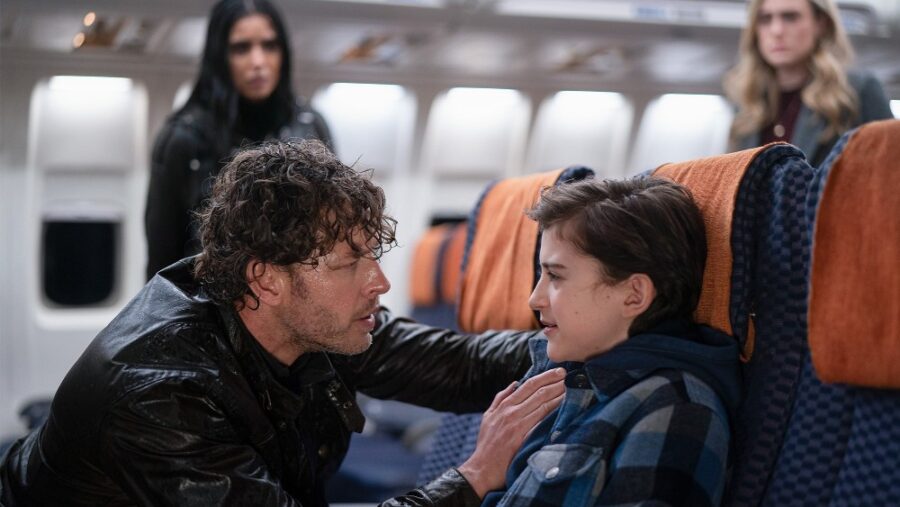
The mystery is why to watch Manifest, so it’s best to go into the Netflix hit as blind as possible. Rest assured that there’s a reason behind the visions, what happened to Flight 838 is explained, and by the time the credits roll on the series finale, you’ll realize this is the show Lost should have been. Ironically, the cancellation was the best thing to happen to the series and is what stopped it from becoming another Surface, Invasion, Jericho, Revolution, The Event, or any of the seemingly endless Lost knock-offs.
A definitive endpoint, one final season, forced the writers to wrap everything up, which was close to the series’ original timeline, unlike what happened with Lost, which was renewed beyond its natural endpoint. Telling a tight story, with a beginning, middle, and end, is one of the reasons Babylon 5 holds up over its sci-fi contemporaries, and that’s why Manifest is now the perfect sci-fi series to binge on Netflix. Do yourself a favor, and avoid all the spoilers, don’t wander into any Reddit discussion about the plot, and set aside some time to appreciate the best sci-fi mystery series of the decade.
Entertainment
Margot Robbie's R-Rated Expose Will Permanently Change Your View Of Reality
By TeeJay Small
| Published

Born in the late 1990s, I’ve spent my entire life hearing the name “Tonya Harding” used as a punchline. I never had much awareness of who she was, but based on some old Simpsons jokes and a few misplaced rap lyrics, I always thought she was a skater who busted her opponent’s kneecaps on the ice in a fit of passion, right in front of a packed crowd. That is, until last week, when I finally sat down to watch Craig Gillespie’s 2017 biopic I, Tonya.
For the uninitiated, I, Tonya tells the true story of Tonya Harding (Margot Robbie), with a little bit of creative license for story purposes. The film takes the viewer from Tonya’s years as a child figure skating prodigy, through her relationship with her abusive mother (Allison Janney) and later her abusive boyfriend (Sebastian Stan), and eventually to her Olympic skating dreams. Through it all, we see how Tonya was mistreated by those closest to her and by the Olympic committee, which viewed her as too unmarketable to home audiences.

Over several years, the budding athlete is forced to change everything about herself to get ahead. She marries her abusive boyfriend just so she can present a more family-forward image, she changes her accent so she won’t be perceived as ‘white trash’, and she adjusts her management team to be as cutthroat and unforgiving as possible.
Tonya even managed to become the first female figure skater to complete two triple Axel jumps in a competition. I don’t know much about skating, but it looked pretty impressive in the movie, as I watched from the comfort of my couch, covered in popcorn kernels.

Once she qualifies for the 1994 Olympics, the narrative kicks into slightly familiar territory. We learn that Tonya, along with many of her peers, routinely receives death threats before going out on the ice. When her husband, Jeff, suspects that the threats are coming from Tonya’s friend, Nancy Kerrigan, he suggests sending a few threats of their own, just to rattle her performance. Jeff outsources the job to his eccentric buddy Shawn (Paul Walter Hauser), who outsources it to someone else, and by the time this game of telephone reaches Nancy, the job ceases to be a threat and becomes a violent attack.
If you believe Tonya Harding’s account of the events (and thus the movie’s telling of how it all went down), she had no idea any of this was happening. The way she relays it, Tonya thought someone was dropping a letter in Nancy’s mailbox. Instead, Nancy was beaten with a baton, leaving her unable to compete in a national competition, which, ironically, fast-tracked her to the Olympic team.

Kerrigan ultimately took home the silver medal for her performance at the 1994 Olympics, while an emotionally rattled Tonya placed eighth. Upon returning home, Harding is barred from competing in any competitive figure skating event for the rest of her life.
Since she has structured her entire existence around the sport, Tonya sees this as a death sentence and begs for jail time, to no avail. Truthfully, I had no idea that an organization could even make a ruling like that in the first place.

Before I watched I, Tonya, I had only ever heard this woman’s name alongside those of O.J. Simpson, Aaron Hernandez, and Oscar Pistorius. It goes to show just how strong the media narrative was at the time that she could be banned from her livelihood and turned into a punchline for decades to come.
The film does an impeccable job of humanizing Tonya and making her more sympathetic, as long as you believe her account of what happened. Even if you don’t believe her, it’s still a hell of a story, and one I’m glad I finally got around to checking out.
If you’re interested in watching I, Tonya, the film is currently streaming for free on Tubi.
Entertainment
Star Trek: Voyager's Best Special Effect Was Almost A Disappointment
By Chris Snellgrove
| Published

Star Trek: Voyager had plenty of special effects, but arguably none were more impressive than when the ship landed on a planet in the Season 2 premiere episode “The Thirty-Sevens.” This was a first for the franchise, bringing to life one of Gene Roddenberry’s ideas that he had previously considered too expensive to show onscreen. However, this effect was almost a disappointment thanks to behind-the-scenes production issues, including improperly designed landing struts and a CGI model that was just too small.
This particular Voyager special effect was one the team had been dreaming of for a long time. Franchise graphic designer Michael Okuda previously recommended to exec producer Rick Berman that their ship should be able to land as a way to distinguish it from what came before.

Accordingly, Rick Sternbach had developed several possible ship designs with landing capability, and he ensured that the finished design featured small hatches on the bottom hull to house landing equipment. It was only after designing those struts, however, that producers realized that the ship’s “legs” looked far too thin to support its body.
The shot of Voyager landing on a planet in “The 37’s” was meant to be a big, show-stopping special effect, and producers were understandably concerned that viewers would be disappointed if it looked like the ship always skipped leg day. In the grand tradition of television, they decided to fix this problem in post-production.

They fixed it by placing rock outcroppings and other ground features strategically around Voyager as it landed. Go back and watch the episode, and you’ll see how they effectively obscured audiences’ view of those teeny landing struts.
However, that wasn’t the only problem with Voyager’s fancy special effect. The show’s digital artists had accidentally made the CGI model of the ship too tiny. This annoyed visual effects supervisor Ronald B. Moore (not to be confused with Trek writer and Battlestar Galactica reboot showrunner Ronald D. Moore), who was disappointed by the landing effect because “the scale of the Voyager on the ground was incorrect.” However, he didn’t feel that audiences would necessarily notice “because there’s nothing really to relate it to; the people are in the foreground, the ship’s in the background, and we kinda kept it that way.”

For longtime Star Trek fans, this Voyager moment was more than just another special effect; it was also the realization of a decades-old dream that began with Gene Roddenberry. The franchise creator had originally dreamed of having the Enterprise regularly land on planets in The Original Series, but he soon realized just how expensive it would be to have the ship land somewhere new each week. This is how the transporter was born, as it allowed Captain Kirk and his erstwhile crew to quickly visit somewhere new and then head back to the ship via a much cheaper “beam me up” special effect.
Voyager’s producers came to the same conclusion that Roddenberry did, which is why the show mostly stuck to the transporter special effect rather than constantly having the ship land. Nonetheless, it landed several more times after “The Thirty-Sevens,” and producers had a much easier time bringing this ambitious effect to life on their subsequent attempts.

They did so despite the ship’s CGI model being too small, which arguably proves that size really doesn’t matter in the 24th century. We wouldn’t recommend telling that to Captain Janeway about her morning coffee cup sizes, though, unless you want her to kill you quicker than she killed Tuvix!

How A Sci-Fi Series Defied Cancelation To Become A Netflix Streaming Hit
LinkedIn’s CEO is moving on; please hold your tearful video tributes


