
Tech
Tiny startup Arcee AI built a 400B-parameter open source LLM from scratch to best Meta’s Llama
Many in the industry think the winners of the AI model market have already been decided: Big Tech will own it (Google, Meta, Microsoft, a bit of Amazon) along with their model makers of choice, largely OpenAI and Anthropic.
But tiny 30-person startup Arcee AI disagrees. The company just released a truly and permanently open (Apache license) general-purpose, foundation model called Trinity, and Arcee claims that at 400B parameters, it is among the largest open source foundation models ever trained and released by a U.S. company.
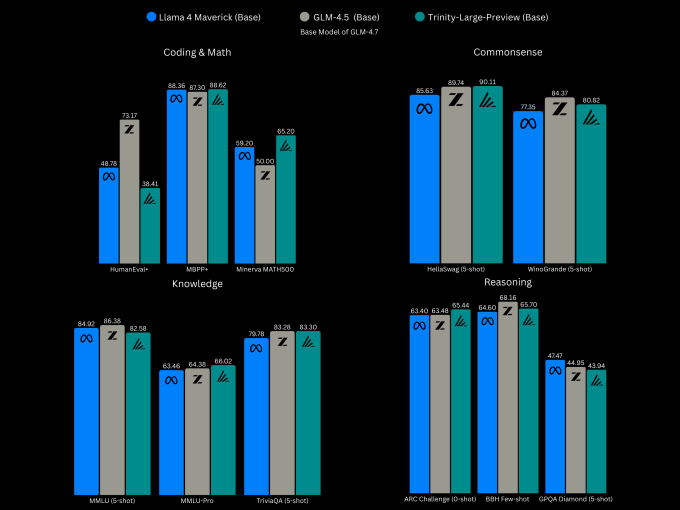
Arcee says Trinity compares to Meta’s Llama 4 Maverick 400B, and Z.ai’s GLM-4.5, a high-performing open source model from China’s Tsinghua University, according to benchmark tests conducted using base models (very little post-training).

Like other state-of-the-art (SOTA) models, Trinity is geared for coding and multi-step processes like agents. Still, despite its size, it’s not a true SOTA competitor yet because it currently supports only text.
More modes are in the works — a vision model is currently in development, and a speech-to-text version is on the roadmap, CTO Lucas Atkins told TechCrunch (pictured above, on the left). In comparison, Meta’s Llama 4 Maverick is already multi-modal, supporting text and images.
But before adding more AI modes to its roster, Arcee says, it wanted a base LLM that would impress its main target customers: developers and academics. The team particularly wants to woo U.S. companies of all sizes away from choosing open models from China.
“Ultimately, the winners of this game, and the only way to really win over the usage, is to have the best open-weight model,” Atkins said. “To win the hearts and minds of developers, you have to give them the best.”
Techcrunch event
San Francisco
|
October 13-15, 2026
The benchmarks show that the Trinity base model, currently in preview while more post-training takes place, is largely holding its own and, in some cases, slightly besting Llama on tests of coding and math, common sense, knowledge, and reasoning.
The progress Arcee has made so far to become a competitive AI Lab is impressive. The large Trinity model follows two previous small models released in December: the 26B-parameter Trinity Mini, a fully post-trained reasoning model for tasks ranging from web apps to agents, and the 6B-parameter Trinity Nano, an experimental model designed to push the boundaries of models that are tiny yet chatty.
The kicker is, Arcee trained them all in six months for $20 million total, using 2,048 Nvidia Blackwell B300 GPUs. This out of the roughly $50 million the company has raised so far, said founder and CEO Mark McQuade (pictured above, on the right).
That kind of cash was “a lot for us,” said Atkins, who led the model-building effort. Still, he acknowledged that it pales in comparison to how much bigger labs are spending right now.
The six-month timeline “was very calculated,” said Atkins, whose career before LLMs involved building voice agents for cars. “We are a younger startup that’s extremely hungry. We have a tremendous amount of talent and bright young researchers who, when given the opportunity to spend this amount of money and train a model of this size, we trusted that they’d rise to the occasion. And they certainly did, with many sleepless nights, many long hours.”
McQuade, previously an early employee at open source model marketplace Hugging Face, says Arcee didn’t start out wanting to become a new U.S. AI lab: The company was originally doing model customization for large enterprise clients like SK Telecom.
“We were only doing post-training. So we would take the great work of others: We would take a Llama model, we would take a Mistral model, we would take a Qwen model that was open source, and we would post-train it to make it better” for a company’s intended use, he said, including doing the reinforcement learning.
But as their client list grew, Atkins said, the need for their own model was becoming a necessity, and McQuade was worried about relying on other companies. At the same time, many of the best open models were coming from China, which U.S. enterprises were leery of, or were barred from using.
It was a nerve-wracking decision. “I think there’s less than 20 companies in the world that have ever pre-trained and released their own model” at the size and level that Arcee was gunning for, McQuade said.
The company started small at first, trying its hand at a tiny, 4.5B model created in partnership with training company DatologyAI. The project’s success then encouraged bigger endeavors.
But if the U.S. already has Llama, why does it need another open weight model? Atkins says by choosing the open source Apache license, the startup is committed to always keeping its models open. This comes after Meta CEO Mark Zuckerberg last year indicated his company might not always make all of its most advanced models open source.
“Llama can be looked at as not truly open source as it uses a Meta-controlled license with commercial and usage caveats,” he says. This has caused some open source organizations to claim that Llama isn’t open source compliant at all.
“Arcee exists because the U.S. needs a permanently open, Apache-licensed, frontier-grade alternative that can actually compete at today’s frontier,” McQuade said.
All Trinity models, large and small, can be downloaded for free. The largest version will be released in three flavors. Trinity Large Preview is a lightly post-trained instruct model, meaning it’s been trained to follow human instructions, not just predict the next word, which gears it for general chat usage. Trinity Large Base is the base model without post-training.
Then we have TrueBase, a model with any instruct data or post training so enterprises or researchers that want to customize it won’t have to unroll any data, rules, or assumptions.
Arcee AI will eventually offer a hosted version of its general-release model for, it says, competitive API pricing. That release is up to six weeks away as the startup continues to improve the model’s reasoning training.
API pricing for Trinity Mini is $0.045 / $0.15, and there is a rate-limited free tier available, too. Meanwhile, the company still sells post-training and customization options.
Tech
ElevenLabs lists BlackRock, Jamie Foxx, and Eva Longoria as new investors

Voice AI company ElevenLabs revealed new investors that are part of its $500 million Series D fundraise, which was first announced in February. The additions include institutions such as BlackRock, Wellington, D.E. Shaw, and Schroders; enterprises like Nvidia, Salesforce Ventures, Santander, KPN, and Deutsche Telekom; and individual investors such as Jamie Foxx, Eva Longoria, and Squid Game creator Hwang Dong-hyuk.
The startup also noted that it surpassed $500 million in ARR (annual recurring revenue), after ending last year with nearly $350 million in ARR. The company’s co-founder and CEO, Mati Staniszewski, said last month that ElevenLabs added $100 million in net new ARR in Q1 2026, ending the quarter at roughly $450 million in ARR.
The company has also accelerated its valuation rapidly, growing from $6.6 billion last September to $11 billion this February.
“Voice is the highest-stakes channel for any customer interaction, and the bar for quality, latency, and security is extremely high. ElevenLabs is not just a category leader – it is becoming a foundational enabler of Deutsche Telekom’s broader Industrial AI vision. From voice-as-a-service to multilingual automation and in-network AI agents, we believe the company is uniquely positioned to reshape how businesses interact with customers across all channels,” Karine Peters, managing director at Deutsche Telekom’s venture arm T.Capital, said in a statement.
In the past quarter, the voice AI company has signed enterprise contracts with the likes of Deutsche Telekom, Revolut, and Klarna.
ElevenLabs said that, besides the fundraising, it also closed a $100 million tender, a second in roughly six months after the company issued one last September. Staniszewski said in a blog post that the company will give an opportunity to retail investors to invest in ElevenLabs through Robinhood Ventures, but didn’t provide details about the program.
Staniszewski noted that consumers won’t trust systems that sound robotic or “interact strangely” and emphasized the importance of building “human-level AI voice models.” Last month, the company acquired the team from Polish voice AI startup Papla to bolster its research team.
When you purchase through links in our articles, we may earn a small commission. This doesn’t affect our editorial independence.
Tech
Kaspersky suspects Chinese hackers planted a backdoor into Daemon Tools in ‘widespread’ attack
Security researchers at Kaspersky say they have identified a malicious backdoor planted in the popular and long-running Windows disc imaging software, Daemon Tools.
The Russian cybersecurity company said on Tuesday that data collected from computers around the world running the Kaspersky antivirus software shows a “widespread” attack is under way, targeting thousands of Windows computers running Daemon Tools.
The hackers, whom Kaspersky has linked to a Chinese-language speaking group based on an analysis of the malware, used the backdoor in Daemon Tools to plant additional malware on a dozen computers across the retail, scientific and manufacturing sectors, as well as government systems. Kaspersky said the hacking of these specific computers implied a “targeted” effort.
The company said the targeted organizations are located in Russia, Belarus, and Thailand.
Kaspersky said the backdoor was first detected on April 8.
Kaspersky said it had contacted Disc Soft, the company that maintains Daemon Tools, but did not say if the developer responded or took action. Kaspersky said the supply chain attack is “still active,” suggesting that the hackers can still plant malware on thousands of computers running the disc imaging software.
This is the latest in a string of so-called “supply chain” attacks that have targeted developers of popular software in recent months. Hackers are increasingly taking aim at the accounts of developers who work on widely used code and software, and abusing that access to push malicious code to anyone who relies on the software. This approach lets the hackers break into a large number of computers at once when their malicious code is delivered as a software update.
Earlier this year, hackers associated with the Chinese government hijacked the popular text editing software Notepad++ to deliver malware to a number of organizations with interests in East Asia. Security researchers also warned of another attack last month targeting users who visited the website of CPUID, which makes the popular HWMonitor and CPU-Z tools.
TechCrunch downloaded the Windows installer from Daemon Tools’ website, and the file appeared to contain the backdoor when we checked it with the online malware scanner service VirusTotal.
It’s not known if the macOS version of Daemon Tools was compromised, or if other apps made by Disc Soft are affected.
When contacted for comment, a Disc Soft representative said they are “aware of the report and are currently investigating the situation.”
“Our team is treating this matter with the highest priority and is actively working to assess and address the issue. At this stage, we are not in a position to confirm specific details referenced in the report. However, we are taking all necessary steps to remediate any potential risks and to ensure the security of our users,” the representative said.
Do you know more about the cyberattack targeting Daemon Tools users? Did you receive an antivirus alert saying you were affected? We want to hear from you. To contact this reporter securely, reach out via Signal username zackwhittaker.1337.
When you purchase through links in our articles, we may earn a small commission. This doesn’t affect our editorial independence.
Tech
Etsy launches its app within ChatGPT as it continues its AI push
Etsy announced Tuesday the launch of its native app within ChatGPT, opening up a new way for shoppers to explore its catalog of over 100 million listings.
The new experience is designed to move beyond the limitations of traditional keyword queries. Instead of typing something like “wooden coffee table,” then scrolling and adjusting filters, users can now express what they’re looking for in natural language. For instance, “Help me find a Mother’s Day gift under $100 for my mom who loves gardening.”
Now live in beta, the feature allows users to tag @Etsy directly within a prompt. From there, the Etsy app in ChatGPT surfaces relevant product listings that users can browse, compare, and click through to Etsy for additional details or purchase.
This isn’t Etsy’s first experiment inside ChatGPT. Back in September, Etsy became an early partner in ChatGPT’s Instant Checkout integration, which let users buy products directly inside the chat interface. However, the initiative ended in March, suggesting it didn’t perform as OpenAI had hoped. It was reported that Etsy didn’t see a large volume of sales from the integration, leading Etsy to start building a native app within ChatGPT instead.
Alongside this launch, Etsy also revealed it’s testing a beta conversational search experience within its platform, specifically geared toward helping users find gifts. The gift assistant acts as a personal shopper, offering a guided, conversational way to discover ideas, narrow down preferences, and surface relevant products.

This builds on Etsy’s broader AI push, which includes an AI-powered discovery experience featuring curated collections and a suite of seller tools, including a tool that helps generate product titles and descriptions, as well as a writing assistant to help draft messages to buyers. In 2024, Etsy introduced a new “Designed” label to identify AI content, part of an effort to increase transparency as AI-generated artwork becomes more prevalent on the platform.
The news of a ChatGPT integration comes a week after Etsy reported its Q1 2026 earnings, surpassing revenue expectations with $631 million, and marketplace gross merchandise sales were up 6% year over year. Notably, active buyers increased for the first time in two years to 86.6 million. Etsy also touted 5.6 million active sellers on the platform.
In February, the company announced it was selling Depop to eBay for $1.2 billion in cash, a move aimed at doubling down on its core marketplace.
Etsy joins a growing list of companies building native apps within ChatGPT, including Angi, SeatGeek, Tubi, and Wix. Developers have been able to build apps within the chatbot since October.
When you purchase through links in our articles, we may earn a small commission. This doesn’t affect our editorial independence.

Pennsylvania is suing Character.AI for allegedly practicing medicine without a license
How to watch Bayern Munich vs. PSG online for free


