
Entertainment
These Forgotten Star Trek Episodes Tried To Warn Us About AI Slop

By Chris Snellgrove
| Published

One of the most weirdly persistent debates of the modern world is over whether AI can create art. Sure, you can type a prompt into ChatGPT or any number of AI platforms and have a unique image within seconds. But while the image is technically unique, it’s not exactly original. The AI was trained on every image it could get its grubby little gears on, so you never get a truly one-of-a-kind image. Instead, you get a mishmash of one or more artists’ styles that the AI bot helpfully masses off as completely original art.
The debate over the matter is so fierce because the two sides are so diametrically opposed. AI bros claim that this technology effectively democratizes art, making it possible for anyone to share their vision with the world. Traditional artists, meanwhile, claim that art has always been democratic and that AI is just a soulless alternative to learning how to draw. While ChatGPT and other generative AI platforms are relatively new, this debate stretches back decades, and in two forgotten episodes of Star Trek: The Next Generation, the android officer Data reminds us of the limits of AI art.
To Prompt Or Not To Prompt

One such example came from the episode “The Defector,” which begins with Data and Captain Picard acting out Shakespeare’s Henry V on the holodeck. After Data gives a surprisingly solid performance, Picard compliments the android’s acting. However, Data demurs and basically admits that his acting was an amalgamation of other performers who have played this role. He tells Picard, “I plan to study the performances of Olivier, Branagh, Shapiro, [and] Kullnark.” The captain replies that while Shakespeare is perfect “to learn about the human condition…you must discover it through your own performance, not by imitating others.”
This episode first aired in 1990, but Picard’s dialogue fits right in with our modern AI debate. Data, fittingly enough, is doing what artificial intelligence always does: mashing together the work of several different artists. It looks like an original performance at first, which is why Picard applauds. But after finding out what Data did, he chides the android for just mashing a few other performances together and calling it a day. After all, he will never develop as an artist if he doesn’t take the time to develop his own style instead of copying everyone’s homework.
Picard Has Entered The Chat

This obviously reflects our modern discourse about generative AI. As an avid Shakespeare fan, Picard understands that what made those earlier actors so great was that they found ways to put their own spin on Henry V. If those performers hadn’t, in turn, just tried to copy others, then acting becomes functionally meaningless.
The conversation about Data creating art actually echoes another conversation in the earlier episode “The Ensigns of Command.” When Picard tells the android that his recent violin performance “shows feeling,” Data corrects him. “Strictly speaking, sir, it is not my playing. It is a precise imitation of the techniques of Jascha Heifetz and Trenka Bronken.” Picard insists that Data created something original because he successfully combined two very different performances. Reluctantly, Data takes the compliment, telling his commanding officer that “I have learned to be creative…when necessary.”
At this point, AI bros might think that Captain Picard is on their side. After all, he argues that by choosing to combine two wildly different musicians, Data is actually synthesizing something new, which is akin to “prompt engineers” feeding a bunch of contrary ideas into ChatGPT and hoping for the best. The key difference, though, is that Data still had to bust out the violin and successfully perform this composition himself. Picard considers Data an artist because the android actually makes art. So-called prompt engineers aren’t even doing that; they are simply asking the computer to make something cool and then taking the credit.
Computer: End Program
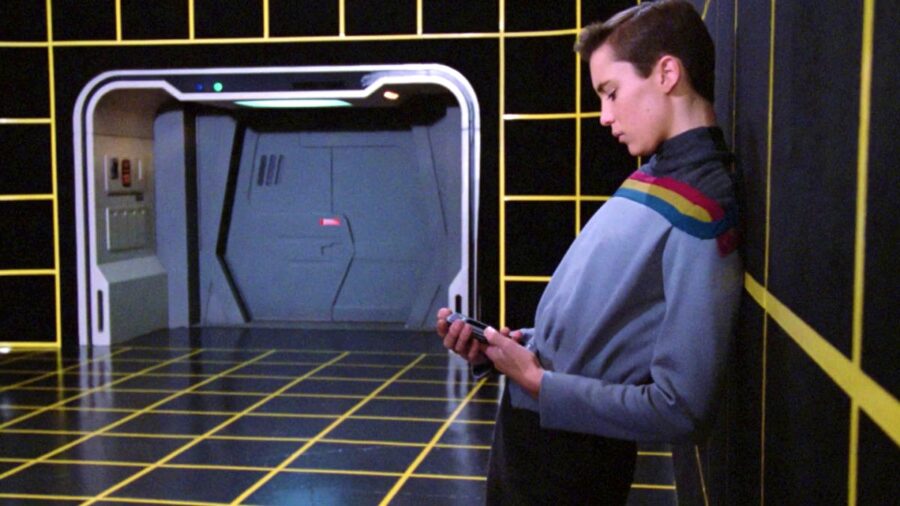
To keep our Star Trek framing, think of it this way: simply telling a computer to draw a picture is a bit like an Enterprise crewman telling the holodeck to create an exotic vista. Obviously, it takes some level of thought to generate an idea and tell it to the ship’s computer. But the crew doesn’t have to program anything or render anything because the Enterprise does all of the hard work for them. That’s why, in the far-flung future of the 24th century, nobody calls themselves an artist for barking a sentence or two at the computer when they get bored.
Unfortunately, the world is far less enlightened here in the 21st century. The laziest people in the world are typing one sentence into a glorified search engine and treating the resulting aesthetic abomination as a startlingly brilliant and original piece of art. Even wilder, they get grumpy when you don’t treat them like serious artists who spent a lifetime perfecting their craft. As it turns out, both now and in the future, there’s one thing that AI can’t generate: the approval from others that these tech bros so desperately need!
Entertainment
NASA video shows how much ground a Mars rover has covered, literally
When NASA makes a new timelapse video, it’s not for reminiscence or clout chasing on the Internet.
The U.S. space agency recently pulled together images from Curiosity, one of its two robotic rovers on Mars, for a scientific purpose. The two-minute video provides a quick succession of clips spanning six years of exploration at Gale Crater. Each image shows the rover ambling over crumbling lithic landscapes as it slowly climbs Mount Sharp, which rises three miles above the basin floor.
The montage isn’t just an intriguing look back on the mission, but a tool for the rover’s science team. Using views from Curiosity’s right navigation camera, mounted on its head, the researchers analyze the sand grains shifting on the rover’s deck.
You can watch the Martian dust churn in the rover’s treads in the Instagram post below. (The Lenny Kravitz soundtrack, though not for science, certainly adds to the appeal.)
“Distinguishing between sand jostled by each drive and wind gusts can provide new information about seasonal changes in the atmosphere,” the agency said.
Curiosity took these images between Jan. 2, 2020, and March 8, but the rover’s journey began long before that. After eight months and 352 million miles flying through space, the rover landed on Mars on Aug. 5, 2012. Its mission: Find out if this smaller neighboring world ever had conditions to support living creatures.
Mashable Light Speed
NASA’s question was answered rather quickly. Within a year, the rover had drilled a rock sample from a long-gone lakebed and confirmed the region had the right chemistry for habitation in its ancient past, as well as potential nutrients for microorganisms.
Since then, the rover has continued to study the alien environment using its internal chemistry lab. A recently published study revealed the rover detected 21 different organic molecules in a small rock sample, the largest set found on the Red Planet so far. Among the findings, Curiosity discovered preserved complex carbon material. Life could have produced them, though NASA can’t say for sure, as chemical reactions between water and rock could also create these molecules.
As scientists monitor the shifting sand for clues about Mars’ seasonal changes, engineers keep a close eye on how that dust and debris put wear and tear on the vehicle. Almost since the beginning of the journey, the team has noticed sharp rocks in the terrain ravaging Curiosity’s wheels, even causing punctures.
Before the rover’s sibling launched, NASA went back to the drawing board. Engineers built Perseverance with hardier wheels made from thicker aluminum. Each wheel is powered by its own motor and can turn in a full circle, allowing it to dodge and swerve around hazards more easily.

Engineers inspect damage to Curiosity’s wheels on Mars on April 18, 2016.
Credit: NASA / JPL-Caltech / MSSS
But to help the elder rover, NASA has problem-solved alternative techniques, such as driving in reverse. Software engineers also provided upgrades that gave Curiosity’s team more control over individual wheel speeds to reduce the force of jagged rocky surfaces. Those efforts have kept the rover trucking, which has traveled 23 miles on Mars.
Wheel damage isn’t the only concern in the harsh conditions on Mars. Many a mission has succumbed to the effects of blustery Martian winds, which kick up dust that then settles on solar panels.
Such was the fate of Curiosity and Perseverance‘s predecessors, Spirit and Opportunity, who died from dust choking their vital power sources.
Entertainment
Smutty Netflix Movie Has Women Dating Hairy Beasts For Kink And Comedy
By Chris Snellgrove
| Updated

I’m married to an amazing gal with a passion for literature. Not just any literature, but romantic literature, often of the smutty variety. Through her, I discovered the Monster Romance genre, which is exactly what it sounds like.
Some women like to fantasize about bad boys; about hooking up with a monstrous man with the deliciously dangerous thought, “I can fix him.” Other women want to cut out the literal middle man and simply get with the monster. There’s now a growing number of monstrous erotica books and even films, including Guillermo del Toro’s hilariously horny Frankenstein.
When I first saw the trailer for Your Monster, I thought it was going to be a straightforward adult picture. You know: watching the cute gal from Scream (Melissa Barrera) get with a fuzzy hunk straight out of DeviantArt. To my surprise, though, this was less 50 Shades of Grey Fur and more like Black Swan meets Beauty and the Beast. One part romantic drama, one part psychological thriller, and one part creature feature comedy horror, Your Monster is one of the most original films of the last decade. If you want to experience the ultimate intersection of kink and comedy, you’re in luck: Your Monster is now streaming on Netflix.
Babes, Beasts, And Boinking

Your Monster is about an actor (played by Melissa Barrera) whose life is falling apart. Shortly after she is diagnosed with cancer, she is dumped by her playwright boyfriend (played by Edmund Donovan). Moving back into her childhood home, she discovers there is a literal Monster (played by Tommy Dewey) living in her old closet. The two form a bond that eventually turns romantic, but the sick actor is still pining for her old boyfriend and her old life. But when she discovers he is now directing the play she helped him develop and has given the role written for her to another woman, our protagonist’s entire life begins to unravel.
Despite what the title and even the cover of Your Monster imply, there isn’t that much explicit monster intimacy in this movie. Instead, the movie explores some crunchy philosophical questions, like “what does it mean to actually be a Monster?” The fuzzy guy in our hero’s closet is beastly on the inside, but he proves himself to be a well-spoken, highly cultured gentleman over time. Meanwhile, our protagonist’s former boyfriend has the face of a man, but he makes a number of decisions (like breaking up with his girlfriend after her cancer diagnosis and icing her out of the play she helped write) that are downright monstrous.
The Drama, The Trauma

The movie plays with this concept in different ways, all of which lead to a jaw-droppingly weird climax. Without spoiling the bonkers ending, I’ll just say that Your Monster increasingly explores the idea that people are not divided into a strict binary of, say, monstrousness and humanity. Everybody has both a noble spirit and an inner savage, constantly at war with one another for dominance. The movie’s thesis is that this is a form of psychological self-defense: if we aren’t willing to act like a monster towards those who hurt us, the film says, we will never escape the cycle of pain caused by our abusers.
Your Monster is a powerhouse creative effort from Caroline Lindy, who wrote and directed the film. Previously, she was mostly known for movie shorts, including provocative titles such as Aspirational Slut. Previously, she directed a short called Your Monster, and the film of the same name is a larger and more ambitious version of that same basic story. The 2024 Your Monster is Lindy’s feature film debut, and it’s very impressive: on Rotten Tomatoes, it has a 79 percent critical score and an 85 percent critical score. With her ability to weave such an original concept into such a startlingly cohesive meditation on love and romance, Lindy clearly has an awesome career ahead of her.
Monstrous Chemistry

In addition to its rockstar director, Your Monster had a secret weapon: the chemistry between its two leads. Melissa Barerra and Tommy Dewey are incredibly believable as the world’s oddest couple: she’s all vulnerability masking intense inner strength, and he’s all soft boy support hidden behind a veneer of outward ferocity. Each of them wears a kind of mask when dealing with the rest of the world, and like in all great relationships, they are able to take the masks off when they are with each other. As an added bonus, each is a very funny actor, and the characters’ weird, dark humor forms the beating heart of the most unconventional relationship in cinematic history.
Thanks to the Star Wars Sequel Trilogy (looking at you, The Last Jedi), moviegoers are understandably worried when they hear how a film “subverts our expectations.” However, it’s true (all of it!): the best thing about Your Monster is how it subverts your every expectation for the better. I expected plenty of boinking beasties and instead got an emotional roller coaster of a film that made me laugh and cry, usually at the same time. All of this culminates in a shocking final scene that will haunt me (in the best possible ways) until the day I head towards that big cineplex in the sky.

Fortunately, you don’t have to head to the Cineplex to experience Your Monster. Heck, you don’t even need to head into your dusty childhood closet. All you have to do is stream it on Netflix to experience three different kinds of films (romance, horror, and comedy) jammed into one furry package. If nothing else, it’s worth watching this quirky episode to discover the definitive answer to TikTok’s most-debated topic: why women would rather be alone in the woods with a bear than a strange man. Why do they all “choose the bear?” Just watch Your Monster, and you’ll never ask again!

Entertainment
Netflix Has Emma Stone's New Rated-R Sci-Fi Movie, It'll Turn You Inside Out
By TeeJay Small
| Published

If you’re into weird, trippy movies with complex characters, twisted conspiracies, and some overarching sci-fi elements, you’re probably already a fan of Greek filmmaker Yorgos Lanthimos. Lanthimos’ oeuvre includes The Lobster, The Killing of a Sacred Deer, and Kinds of Kindness, just to name a few. While each of these films offers a mind-bending adventure, none has turned my head inside out quite like his latest, Bugonia, now streaming on Netflix.
Bugonia stars Emma Stone as a ruthless CEO of a massive pharmaceutical conglomerate. Fresh off a slew of bad press for suppressing workers’ rights, Stone’s Michelle Fuller goes above and beyond to present the image of a caring, easygoing boss. She encourages her employees to take time for their mental health and leave early, while subtly implying that doing so would mean risking their jobs. She’s your run-of-the-mill billionaire monster.

As Fuller goes about her daily routine, we are introduced to conspiracy theorist Teddy Gatz, played expertly by Breaking Bad‘s Jesse Plemons, and his cousin Don, portrayed by newcomer Aidan Delbis. Teddy, like many real-life viewers at home, is a disenfranchised wage worker who has fallen down a deep rabbit hole of online alien conspiracies. He has come to believe that a race of alien creatures has assimilated into Earth’s population, disguised themselves as corporate elites, and subjugated the world through a series of telepathic commands.
Bugonia really picks up when Teddy and Don kidnap and imprison Michelle in their basement, believing her to be a member of the alien race. Based on information they’ve collected in insulated internet chatrooms, the duo shave her head, chain her up, and slather her entire body with antihistamine lotion. They believe these measures will prevent the CEO from utilizing her mind-control powers or contacting her alien mothership for backup.

From there, most of Bugonia centers on Michelle as she attempts to escape from her captors by any means necessary. She tries to enlighten the kidnappers with logic and deprogram their conspiracy-addled minds. She even tries leaning into the conspiracy and promising that she’ll bring them into contact with her alien superiors if they let her go. The whole time, Teddy and Don are taking measures to prevent themselves from being manipulated by Michelle, by chemically sterilizing themselves and taking prescription drugs against label instructions.
Bugonia is an absolute wild ride from start to finish, and one that I simply couldn’t pry my eyes away from. Everything from Emma Stone’s spectacular leading performance to the quirky, bizarre writing to the occasional mind-bending twist kept me on the edge of my seat, constantly questioning the film’s reality. By my estimation, it’s the perfect conspiracy movie for a post-Epstein list world, where even the most twisted conspiracies don’t seem as ridiculous as they did five or ten years ago.

If you get the chance to catch Bugonia on Netflix, don’t miss it. Just be sure to throw away everything you think you know before going in, or you just might find yourself manipulated by a race of malevolent alien overlords.

After late rally, Royals bid for rare road sweep of Mariners
White Sox pursue sixth straight victory, sweep of Padres


