
Entertainment
The Surprising Reason Star Trek Killed A Beloved Character For A Second Time

By Chris Snellgrove
| Updated

“Yesterday’s Enterprise” isn’t just a great episode of The Next Generation; it’s arguably in the running for the best Star Trek episode ever made. The story takes our characters to a much darker place than they have ever been before, all while emphasizing the need to fight for a better universe. As the cherry on top, the writers used the timey-wimey nature of this episode to bring back a beloved character who had died back in Season 1: Tasha Yar, who lost her life fighting an evil oil slick named Armus. In the altered reality of “Yesterday’s Enterprise,” that never happened, and Yar was very much alive.
Unfortunately, that didn’t last very long. The Tasha of this universe decides to travel back in time, leading the crew of the Enterprise-C on a suicide mission into the past. She succeeds in restoring reality, but this ultimately comes at the expense of her own life. At the time, it seemed shocking that Star Trek: The Next Generation had brought a popular character back just to kill her off again. Why did they do that? According to one of the show’s greatest writers, they wanted to give Tasha Yar a “heroic sacrifice” and make up for the crappy way she died in the first season.
Yar Trek: The Next Generation
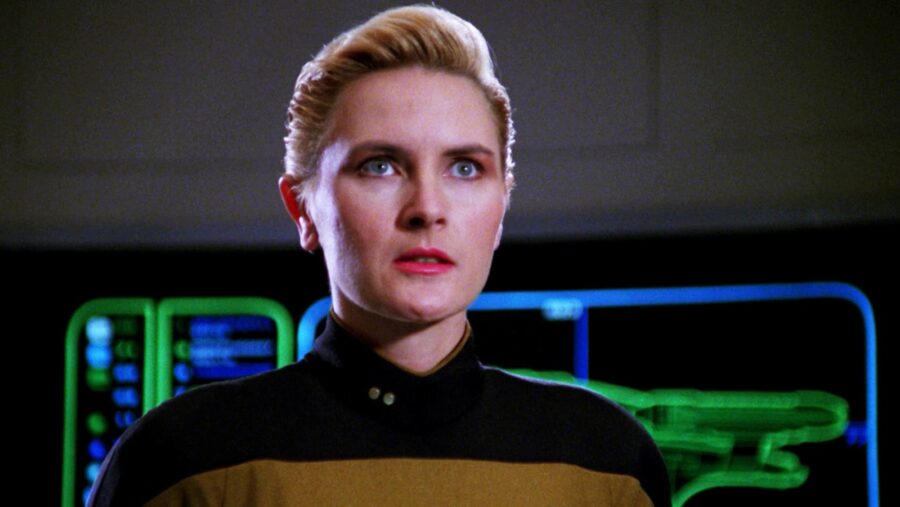
The plot of “Yesterday’s Enterprise” is that when the Enterprise-C travels forward in time instead of getting destroyed, it alters history for the worse. The Federation is now losing a bitter war with the Klingons. Thanks to information from Guinan, Captain Picard authorizes a risky plan to send the Enterprise-C back in time, where it was destined to be destroyed while defending a Klingon outpost. He hopes that this will restore the timeline, saving countless lives from pointless slaughter. Ironically, this plan involves sacrificing someone who should already be dead: Tasha Yar, who leads the Enterprise-C back into the past after its captain is killed.
For audiences watching this Star Trek: The Next Generation episode at home, seeing Denise Crosby’s Tasha Yar on the screen again was a very pleasant surprise. This character had died in the Season 1 episode “Skin of Evil,” fighting a living oil slick named Armus. It was sudden and unexpected, and she died the same ignominious kind of death as the various redshirts of The Original Series. Her death added tension to the show, of course; if a main character could suddenly be killed off, then nobody was safe. Still, many thought it would have been better if Tasha Yar’s death had a bit more meaning to it.
“A Chance To Kill Her Right“

Interestingly, this included the TNG writers who were hired after Season 1. Ronald D. Moore, the veteran Trek writer who went on to create the Battlestar Galactica reboot, described the writing staff’s motivation for bringing Yar back in “Yesterday’s Enterprise.” On the Season 4 DVD special features, he claimed, “We brought Denise back to kill off Tasha Yar a second time. It was a great opportunity to send the character off in a big heroic sacrifice because nobody was really happy with the way she left the series in the first season.” Continuing, he said, “Nobody on the show really liked it, the fans didn’t like it, I’m not sure even she really liked it. So ‘Yesterday’s Enterprise’ was a chance to kill her right.”
Fortunately, Moore and the other writers succeeded in this task. Tasha Yar died to save billions of lives throughout the galaxy by restoring reality and ending a pointless war. “Yesterday’s Enterprise” implied that the Enterprise-C would be destroyed as soon as it returned to the past, killing everyone on board. Later, the two-part episode “Redemption” clarified that the attacking Romulans took a handful of prisoners, including Tasha Yar. Later, she was betrayed by her own half-Romulan child and killed. That child was Sela, who grew up to be one of the scariest threats Picard and the Enterprise-D crew would ever face.
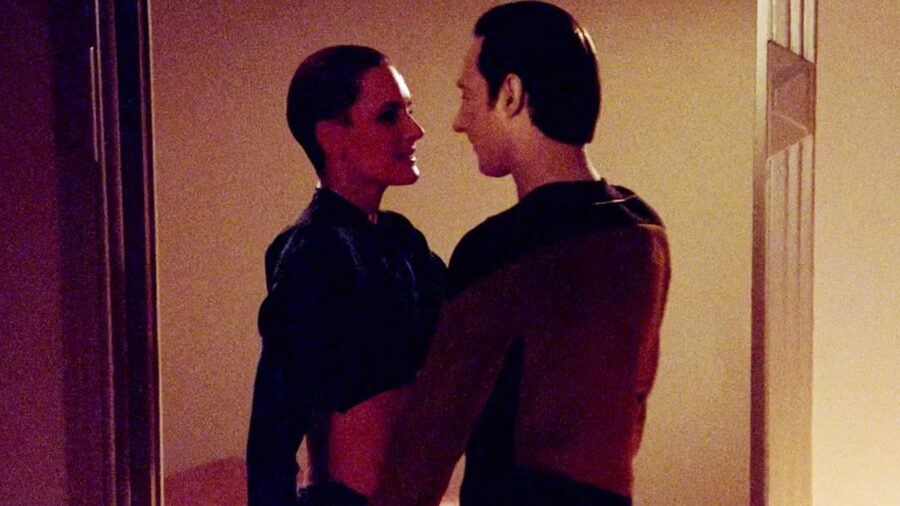
Arguably, “Redemption” ruined Tasha Yar’s act of self-sacrifice. Sure, she still saved an entire reality, but instead of dying in battle, she died at the hands of the evil aliens who captured and violated her. However, one person who had no problem with this retcon was Denise Crosby, who now had another reason to return to the show that she had left back in Season 1. Of course, it’s fair to say her character was having more fun in that first season. Instead of saving the galaxy or forcibly bearing Romulan kids, she was cozying up to a drunken android and performing a job much more rewarding than security chief: Data entry.
Entertainment
AI just disproved a major math problem. A mathematician explains.
While the rest of the world was watching the World Cup on Sunday evening, mathematician Levent Alpöge casually announced on X that he had used Anthropic’s Fable 5 to disprove the Jacobian conjecture.
This Tweet is currently unavailable. It might be loading or has been removed.
The Jacobian conjecture is a long-standing open problem in algebraic geometry that’s bedeviled highly accomplished mathematicians for almost 90 years. It was included in “Smale’s problems,” a list of unresolved math problems put forward by mathematician Stephen Smale in 1998.
But that proved no obstacle for Fable 5, Anthropic’s latest frontier AI model. (You may remember Fable 5 as the public version of Claude Mythos Preview, the AI model that Anthropic says has such advanced cybersecurity capabilities that it was too dangerous for public release.)
Alpöge is part of Harvard’s Society of Fellows, and his Linkedin profile notes an affiliation with Anthropic. We’ve reached out to Anthropic with questions about Alpöge’s work.
Meanwhile, for those of us who don’t understand polynomial functions from n-dimensional space, the question is: Does this represent a major breakthrough in artificial intelligence, or mathematics, or neither?
“This did not cause me to update my priors about what AI can and can’t do,” professor and mathematician Andrew Blumberg told Mashable. “This is exactly the kind of thing I would expect AI to be able to do. If there was a counterexample that was concise and easy to state that people haven’t found because it’s a pain to search through all this stuff, AI will find it.”
Blumberg, who has a joint appointment in mathematics and computer science at Columbia University, is involved in the First Proof project, an effort to test the capabilities of frontier large language models in solving research-level mathematics. So, it’s safe to say he understands mathematics and AI better than most of us.
Mashable Light Speed
‘You want to learn something from the answer’
Providing a counterexample to the Jacobian conjecture is still a significant achievement for AI in mathematics, Blumberg notes. But he also says there’s a big difference between providing a positive proof for a major math problem and providing a single counterexample that disproves it. Here’s the metaphor Blumberg used to explain.
“Suppose that Moses came down from the mountain with tablets, and on the tablet was written, ‘Cancer can be cured.’ Would you care? You don’t just want the answer to the question. You want to learn something from the answer. And the reason Smale thought this problem was important is because he thought that if we solved it, we would understand more things about the about the way nature is structured.”
In other words, Blumberg says, “this counterexample tells us essentially nothing. It’s just, you know, there are a lot of polynomials, and it’s hard for people to check them all, but it’s not hard for machines.”
The Jacobian conjecture isn’t the only math problem AI has tackled in recent months. OpenAI announced in May an “internal model” had disproved the Erdős unit distance conjecture, a central conjecture in discrete geometry.
However, in that case, the result was more productive, Blumberg says. That’s because OpenAI didn’t just provide a counterexample — but a disproof of the problem itself.
“The disproof there already has led to interesting things because experts in the area unpacked what was going on in the disproof and then used it to do other things,” Blumberg says.
And that’s not necessarily the case with the Jacobian conjecture counterexample, he adds — while conceding he’s not expert enough to see if there’s something special about the structure of the counterexample that we can learn from. “But it’s not in and of itself interesting.”
Disclosure: Ziff Davis, Mashable’s parent company, in April 2025 filed a lawsuit against OpenAI, alleging it infringed Ziff Davis copyrights in training and operating its AI systems.
Entertainment
macOS 27 Beta has a secret Siri AI interface. How to try it.
You’ve waited long enough for Apple’s relaunch of Siri as an AI assistant, and now you can finally try out the Siri AI beta for iOS. But, psst, don’t tell anyone, but there’s even more Siri AI for you to try out with a secret Siri AI interface on Mac.
A Reddit user on the r/MacOSBeta subreddit has discovered a “hidden lightweight UI” for Siri AI in the macOS 27 Golden Gate beta. This feature basically provides users with an array of AI tools, presented in a pop-up menu whenever text is highlighted.
The Siri AI pop-up interface includes AI tools such as Rewrite, Proofread, “How does this sound?,” and “Edit with Siri.” There are also menu options for summarization and providing bullet points from the selected text.
Siri AI can also provide a selection of specific tools dependent on the context of what’s selected. For example, highlighting a phone number provides a pop-up to “Add to contacts” or when selecting an address the pop-up offers an “Open in Maps” option. There are tools for creating calendar events, composing messages and emails, and tracking flights and packages as well.
Why is the feature hidden? Well, as MacRumors points out, the Siri AI interface in macOS 27 developer beta 3 and public beta 1 is simply an unfinished product. Certain features don’t yet work how they’re supposed to. Some options don’t work at all. Clearly, Apple has yet to make it available because it’s simply not ready.
Mashable Light Speed
However, Reddit users say there is a way to turn the interface on in the macOS Golden Gate Beta. According to Redditor pdfu, if users running the macOS 27 beta simply need to open up the Terminal and input a few lines of code.
Please note: We do not recommend running terminal instructions or changing important OS files unless you fully understand what you’re doing. We have not tested these terminal instructions, so proceed at your own risk.
sudo mkdir -p /Library/Preferences/FeatureFlags/Domain && sudo defaults write /Library/Preferences/FeatureFlags/Domain/WritingTools LightweightUI_macOS -dict Enabled -bool true
After that, the Reddit threat instructs users to restart their computer and the Siri AI interface will be enabled.
If you’ve had enough of the unfinished interface, you can turn it back off by once again opening Terminal and the following input:
sudo defaults write /Library/Preferences/FeatureFlags/Domain/WritingTools LightweightUI_macOS -dict Enabled -bool false
It’s unclear if the Siri AI interface will launch with the official version of the new macOS. However, it’s certainly interesting to see Apple further brand its Siri AI relaunch as an all-in-one AI tool across the company’s products.
Entertainment
X-Men ‘97 Just Secretly Connected Itself To The Raunchiest Marvel Movies
By Chris Snellgrove
| Updated

As a longtime Marvel fan, one of my favorite things about X-Men ‘97 is how many fun Easter eggs are stuffed into every single episode. Sometimes, these are winking references to earlier episodes. More often than not, they are connections to the comics and to the larger Marvel universe. Of course, these references are often of the blink-and-you’ll-miss-them variety. Because of this, you sometimes need to be as fast as Quicksilver on the remote control if you want to catch every wacky bit of trivia that pops up onscreen.
That was certainly the case with the recent episode “Weapon X, Lies, and DVDs.” This episode follows up on an earlier Animated Series episode (“Weapon X, Lies, and Video Tape”) and has Wolverine and a team of oddballs discovering major secrets about Weapon X. It’s an episode filled with some jaw-droppingly weird X-Men lore, including an appearance from everyone’s favorite xenomorph knock-offs, the Brood. However, that’s not the weirdest thing about this terrifying tale. The episode provides a list of characters attached to the Weapon X program, and if you pause at the right moment, you’ll see names from the raunchiest, bloodiest Marvel movies ever made: Deadpool and Logan!
The Ultimate In ’90s Media Technology

In Marvel Comics, it’s revealed that Weapon X wasn’t actually the name of the program. Instead, it was the Weapon Plus program, and Wolverine was referred to as “Weapon X” because he was the tenth experiment created by the program (X is the Roman numeral for 10). Incidentally, Weapon I was Captain America, who was turned into the world’s greatest soldier through an experimental super-serum. Later, the project switched to experimenting on mutants, with the goal of creating weaponized warriors who would be easy to control. There have been many characters experimented on or otherwise connected to the program, which is why so many names appear in “Weapon X, Lies, and DVD.”
The episode doesn’t get into the full tangled history of the program, which is consistently referred to as Weapon X. However, the characters do find test subject data on DVDs, all of which are helpfully labeled with the name of the person who was experimented on. One set of DVDs is very easy to view, and the other appears for only a brief moment. With the help of the pause button, though, you can identify some major names. This includes Bucky Barnes, better known to MCU fans as the Winter Soldier. It also includes characters who have only appeared in the comics, including the creepy villain, John Sublime.
The X-Men Get Raunchy

Unsurprisingly, Wolverine and his crew from this episode (including Maverick, Garrison Kane, Sabertooth, and Lady Deathstrike) all appear on the DVDs, as do other characters from Wolverine’s past, including Silver Fox. But for fans of the live-action movies, the most notable names that appear in the episode are Ajax and Deadpool (the villain and hero, respectively, of the first Deadpool movie) and X-23, who appeared in both Logan and Deadpool & Wolverine. Amusingly enough, this effectively connects the (mostly) family-friendly X-Men ‘97 with some of the raunchiest and most vulgar Marvel movies ever made!
Deadpool effectively paved the way for modern, R-rated superhero movies with a film that combined over-the-top ultraviolence and hilariously crass dialogue. It was also unapologetically raunchy, with a naughty Morena Baccarin sex scene that likely made the pre-cancerous Wade Wilson wish that his booty had a healing factor. Logan, meanwhile, was more serious but no less brutal, connecting X-23 (who was created for the kids’ show X-Men: Evolution) to a violent and heartbreaking film where we bid farewell to both Logan and Professor X. Now, that same character (who made a fan-favorite return in the wonderfully offensive Deadpool & Wolverine) is permanently tied to X-Men ‘97.

Does that mean we’re likely to see X-23 onscreen? Not really: even if X-Men ‘97 runs for several more seasons, there are so many ‘80s, ‘90s, and early ‘00s stories to adapt before the writers would ever get to her story. Deadpool might be likelier to appear: after all, he appeared in X-Men: The Animated Series via things like flashbacks and Morph transformations, and Morph continues to take on this appearance in X-Men ‘97. Is all of this leading up to a proper appearance from the Merc With a Mouth? Maybe. Somehow, though, I think Jean Grey will be too busy fighting Apocalypse to help Deadpool properly celebrate International Women’s Day!

Blue Jays look to take advantage of skidding Rays, improve position in standings
Phillies have room for improvement going into series against Dodgers


