
Entertainment
The Movie That Created Fiery But Mostly Peaceful Protests
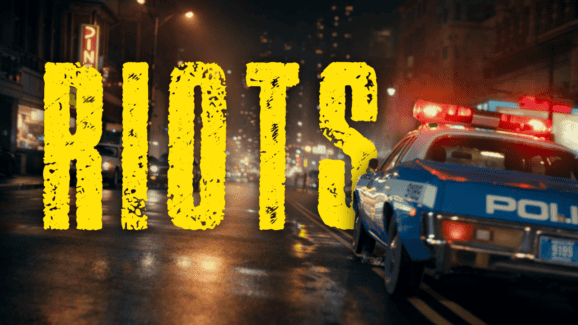
screenwashed (adjective) — When something seen on a screen completely changes how someone thinks or feels, as if their old beliefs were erased and replaced by what they just saw.
By Joshua Tyler
| Published

In 2020, violent protests rocked the United States, devastating major cities. Since then, dozens more have appeared, so many that it almost seems normal.
But it isn’t normal.
Make a list of the most violent protests of the past 20 years, and you’ll find that the majority of them didn’t happen until after 2019. Before that, most protests, even the big ones like Occupy Wall Street or the Tea Party protests of the early 2000s, were just a lot of dudes walking around with signs until it got dark. There were exceptions, like the disastrous riots in Ferguson, Missouri, but those were noteworthy because they were unusual.
Now, violence, particularly from supposedly peaceful protesters themselves, is the norm. A daily occurrence in some cities, a regular seasonal event in others. What changed? In 2019, one movie took theaters by storm and manipulated its most ardent viewers to stop playing nice.
This is the story of how Joker screenwashed Americans into accepting violence as personal expression.
The Story Of Joker

Joker was billed as being about Batman’s arch-nemesis, but it has no true connection to the world of comic books. Instead, it’s a grim character study about Arthur Fleck, a mentally ill, socially invisible man slowly crushed by a city that doesn’t care whether he lives or dies. There are no superheroes, no grand conspiracies, and no redemption arc, just a sad, broken man discovering that the only time the world notices him is when he stops playing by its rules and embraces nihilism.
When Joker arrived in theaters, it was both controversial and a huge box office hit. No movie captured a bigger share of the cultural conversation in 2019 than it did, and theaters were packed with people looking for something edgy, different, and maybe even dangerous.
The Lone Observer

The debate over Joker often centered on whether it might inspire mass shootings or homicides. All of that discussion missed the true danger in the film.
Only one person saw the truth. It wasn’t mass murderers or an increase in individual homicides that we needed to worry about. A few months after Joker’s release, at the start of the George Floyd riots in 2020, master persuader Scott Adams made this observation:
“I’m willing to bet 90% of the protesters have seen Joker. It’s so powerful and well-made that it bounces around in your brain and burrows in, forming a dominant go-to pattern for your thinking.” – Scott Adams
Scott then asked, “Can one movie nudge a young person into violence and anarchy? A bad movie can’t. Even a good movie can’t do that. But Joker can. That movie is next-level, persuasion.”
Joker doesn’t merely depict unrest; it romanticizes it. It does it, using some very specific persuasion tricks.
Catharsis Through Violence

The film presents social collapse as catharsis. Arthur Fleck’s personal breakdown is fused to a citywide explosion of masked demonstrators who burn, riot, and kill. All while the camera treats it like liberation.
That’s what Catharsis is. The release of pent-up emotion through experience or expression leaves the mind clearer by safely discharging feelings that were previously contained or unresolved.
The need for catharsis exists in all of us. It’s an irresistible pull. That can be healthy, prompting reflection, relief, and clarity. But it can also distort judgment, causing people to chase emotional release for its own sake, overreact, or embrace narratives that justify anger, sadness, or guilt just to feel unburdened.
That’s what Joker taps into.

The violence isn’t framed as tragic or cautionary. It’s operatic. The mob becomes the chorus validating Arthur’s transformation. Gotham’s chaos isn’t shown as a failure of civilization, but as a necessary purge.
This matters because culture isn’t created through instruction; it’s learned by association.
Arthur Fleck is introduced as powerless, humiliated, and ignored. By anchoring the audience inside his suffering before any violence occurs, the film ensures viewers emotionally identify with him.
Joker’s Six Screenwashing Tricks

Joker screenwashes its audience by employing six distinct persuasion techniques.
Responsibility for violence is consistently shifted away from the character and onto abstract forces: “the system,” “the rich,” “society.” This trains viewers to see violence as an inevitable consequence, not a moral failure.
- Two, Aestheticization of Chaos
Riots are filmed beautifully. When violence is visually pleasing, the brain associates it with power and release rather than danger or shame.
- Three, Catharsis Substitution
The film substitutes violence for resolution. Destruction itself is the payoff, reinforcing the idea that “burning it down” is a valid emotional endpoint.
Arthur’s transformation is validated not by reasoned argument, but by mass approval. Viewers subconsciously absorb the same validation loop.
- Five, Thinking Past The Sale
The story strongly implies that violent societal collapse is unavoidable. When outcomes feel predetermined, audiences stop asking whether violence is right and start asking only when.
- Six, Meaning Injection Into Rage
Most importantly, the film gives rage a story. Raw anger becomes “truth.” Once anger is framed as insight rather than impulse, acting on it feels justified.

Before Joker, America had a culture in which only truly peaceful protest was acceptable. After Joker, the cultural zeitgeist became one in which violent protest wasn’t just acceptable, it was the only way to be heard.
In the movie, Joker had nothing to say; he just wanted to be heard. And now, being heard is all that matters, not whether or not you have anything worth saying.
The Case Against Joker’s Power Of Persuasion

Those without an understanding of persuasion say audiences are smart enough to separate fiction from reality and can’t be affected by what they see in screen. If culture can be changed by a single movie, then why didn’t the movie V for Vendetta have a similar effect?
A movie like V for Vendetta could never achieve the same effect because it frames violence as symbolic, ideological, and abstract, not emotionally personal. V is not an everyman the audience inhabits; he’s a mythic construct with clarity, planning, and moral certainty. His actions are presented as an allegory, not catharsis. The film creates distance through stylization, speeches, and overt political philosophy. This keeps viewers analyzing rather than identifying.
Joker is a totally unique piece of screenwashing because of the way it collapses that distance, rooting chaos in intimate humiliation and emotional grievance, making mass violent release feel personal, spontaneous, and psychologically relatable rather than theatrical or ideological.
Was Joker’s Impact Intentional?

I think it’s important to say here that it’s not clear if plunging America into endless violent riots was the intent of director Todd Phillips when he made Joker. Little is known about Phillips’ personal political views; he refuses to be categorized.
It’s possible Philips’s goal was something besides the one he achieved. Indeed, the movie’s sequel suggests he wasn’t entirely happy with the effect his first movie had on its viewers. Joker 2 attempts to undo much of what the first movie did, revealing Joker as a fraud and his followers equally so.
Of course, Joker wasn’t solely to blame for a cultural shift towards violence. COVID lockdowns created a powder keg, and irresponsible media coverage lit it. But would things have gone as badly as they did, and continue in that direction for years after, if Joker hadn’t been there, at that exact moment, to condition rioters in advance?

Watch one of the riot scenes from Joker. Then watch any Portland, Oregon protest and ask yourself if what you’re seeing is organic or just Joker cosplay.
Joker didn’t invent violent protest. But it did something arguably more influential: it made violent protest feel understandable, beautiful, and emotionally correct. Once culture grants moral permission, reality tends to follow, no manifesto required.
Congratulations, fiery but mostly peaceful protestors, you’ve been Screenwashed.
Entertainment
In case you forgot, AMC movie tickets are 50% off on Tuesdays and Wednesdays — its a year-round thing

HALF OFF MOVIE TICKETS: AMC Stubs members get 50% off adult evening movie tickets every Tuesday and Wednesday.
All Stubs tiers are eligible for the promo
It’s been over a year since AMC announced that evening movie tickets would be 50% off every Tuesday and Wednesday. That officially bumps the promo into “year-round” territory.
It only feels right to re-remind you of how easy it is to get cheap movie tickets, given the nonstop bangers that summer 2026 is blessing us with. The Odyssey and Evil Dead Burn are the two must-see-in-theaters picks that come to mind as I write this post on July 21, but there’s bound to be a wicked box office lineup regardless of when you’re reading this. Heavy hitters like Spider-Man: Brand New Day, Resident Evil, Other Mommy, Verity, Avengers: Doomsday, Werwulf, and Dune: Part III are all making their theater debut in the last quarter of the year.
As long as you’re an AMC Stubs member, you can catch all of them for around $9 per person (ticket prices may vary slightly depending on your location). All tiers of the AMC Stubs membership have access to the promo, and Stubs members can buy up to 10 tickets at 50% off per showing. The discount applies to the base price of a standard adult evening ticket only — no IMAX.
Mashable Deals
To elevate the in-theater experience even more, Stubs members can also get 50% off small combos on Tuesdays and Wednesdays, like the heavenly pairing of popcorn and that good movie theater Coke. AMC’s snacks are apparently so elite that people are paying to order them at home through Uber Eats — and here you are, getting ’em for cheap.
Entertainment
Light Flip is a minimalistic, cheap flip phone that wont distract you
Remember Light, the New York-based company that builds super-simple, distraction-free, cheap smartphones?
It’s back with a new device; its first-ever flip phone called the Light Flip.
Once again, this is a cheap phone designed to free you from endless scrolling and social media addiction, while still offering the basic tools you need for everyday life. To do this, the company has built an Android-based, minimalistic operating system called LightOS that’s mostly textual and displays everything in just two colors. You do get access to music, messages, alarms, and other basic apps, but you don’t get to scroll the flashy new TIkTok video; that’s what your other phone is for.

The Light Flip is available in six colors: Black, Navy, Red, Pink, Yellow, and Light Gray.
Credit: Light Phone
The Light Flip doesn’t stray far from the formula, but approaches it with the body of a flip phone. In many ways, it’s far more simple than the company’s previous phone, the Light Phone III, which has an OLED touchscreen. The Light Flip is basically your flip phone of old, with a plastic body, a numeric, T9 keypad, some function buttons, and a 2.8-inch, non-touch display.
Mashable Light Speed

Numeric keypad? That’s right, but at least it supports T9 predictive input.
Credit: Light Phone
Inside, it’s powered by a MediaTek MT8873 chip, 6GB of RAM, 128GB of storage, and has a 50-megapixel camera and a (replaceable) 1,800mAh battery. Other amenities include a headphone jack (nice!), a USB-C port, Wi-Fi, Bluetooth, and 5G connectivity.

The camera on the back has a 50-megapixel sensor but takes 12-megapixel images.
Credit: Light Phone
The numeric keypad might be a tough sell to folks that are used to touchscreens or at least QWERTY keyboards. Fortunately, the Light Flip does support voice-to-text and audio messaging, too.
The phone is available in six colors: Black, Navy, Red, Pink, Yellow, and Light Gray.
The Light Flip retails for $299 or $39 per month with the Light Service plan. It starts shipping in April 2027.
Entertainment
The Ecovacs Goat 01000 RTK robot lawn mower is on sale for under $700 at Amazon
SAVE $301: The Ecovacs Goat 01000 RTK robot lawn mower is on sale for $698.99 at Amazon, down from the standard price of $999.99. That’s a 30% discount.
$698.99
at Amazon
$999.99
Save $301
Not many people consider the chore of mowing the lawn to be enjoyable. It’s a task we often hand off to the neighborhood kids or a professional landscaping crew. But if you’d rather take matters into your own hands, we have a great solution these days. Plus, an affordable model is on sale.
As of July 21, the Ecovacs Goat 01000 RTK robot lawn mower is on sale for $698.99 at Amazon, marked down from the list price of $999.99. That winds up being a savings of $301 from a 30% discount.
By now you’ve probably seen a robot lawn mower rolling around someone’s yard, but it’s still an abnormal sight. Just like the rollout of robot vacuums, we’ll slowly start to see more and more robots take over mowing the lawn. As someone with allergies, I’m totally cool with never touching a lawn mower ever again.
The Ecovacs Goat 01000 is designed to maintain lawns that span up to 0.25 acres in size. You don’t need to worry about a wire perimeter because it maps your yard and stays on course thanks to LiDAR RTK navigation that even works in the shade or under trees. It can even avoid obstacles when mowing in dark conditions.
Mashable Deals
The small mower body that measures 2.3 feet means it can mow in tight areas like between raised vegetable beds or small walkways. Plus, it has an IPX6 waterproof design. You get to decide on your ideal cutting length between 1.2 and 3.2 inches.
Today’s Amazon deal on the Ecovacs Goat 01000 applies to the robot mower with a care kit which includes 36 blades and an RTK AC adapter. Since the mower and the care kit are on sale for under $700, today is a great day to wave goodbye to the heavy and loud push mower and make the upgrade. Spend the rest of summer perfecting homemade slushies instead of doing yardwork.

Report: Lionel Messi to miss next two Inter Miami games, All-Star Game
Report: NFL analyst Ryan Clark laid off by ESPN


