
Entertainment
The Movie That Created Fiery But Mostly Peaceful Protests

screenwashed (adjective) — When something seen on a screen completely changes how someone thinks or feels, as if their old beliefs were erased and replaced by what they just saw.
By Joshua Tyler
| Published

In 2020, violent protests rocked the United States, devastating major cities. Since then, dozens more have appeared, so many that it almost seems normal.
But it isn’t normal.
Make a list of the most violent protests of the past 20 years, and you’ll find that the majority of them didn’t happen until after 2019. Before that, most protests, even the big ones like Occupy Wall Street or the Tea Party protests of the early 2000s, were just a lot of dudes walking around with signs until it got dark. There were exceptions, like the disastrous riots in Ferguson, Missouri, but those were noteworthy because they were unusual.
Now, violence, particularly from supposedly peaceful protesters themselves, is the norm. A daily occurrence in some cities, a regular seasonal event in others. What changed? In 2019, one movie took theaters by storm and manipulated its most ardent viewers to stop playing nice.
This is the story of how Joker screenwashed Americans into accepting violence as personal expression.
The Story Of Joker

Joker was billed as being about Batman’s arch-nemesis, but it has no true connection to the world of comic books. Instead, it’s a grim character study about Arthur Fleck, a mentally ill, socially invisible man slowly crushed by a city that doesn’t care whether he lives or dies. There are no superheroes, no grand conspiracies, and no redemption arc, just a sad, broken man discovering that the only time the world notices him is when he stops playing by its rules and embraces nihilism.
When Joker arrived in theaters, it was both controversial and a huge box office hit. No movie captured a bigger share of the cultural conversation in 2019 than it did, and theaters were packed with people looking for something edgy, different, and maybe even dangerous.
The Lone Observer

The debate over Joker often centered on whether it might inspire mass shootings or homicides. All of that discussion missed the true danger in the film.
Only one person saw the truth. It wasn’t mass murderers or an increase in individual homicides that we needed to worry about. A few months after Joker’s release, at the start of the George Floyd riots in 2020, master persuader Scott Adams made this observation:
“I’m willing to bet 90% of the protesters have seen Joker. It’s so powerful and well-made that it bounces around in your brain and burrows in, forming a dominant go-to pattern for your thinking.” – Scott Adams
Scott then asked, “Can one movie nudge a young person into violence and anarchy? A bad movie can’t. Even a good movie can’t do that. But Joker can. That movie is next-level, persuasion.”
Joker doesn’t merely depict unrest; it romanticizes it. It does it, using some very specific persuasion tricks.
Catharsis Through Violence

The film presents social collapse as catharsis. Arthur Fleck’s personal breakdown is fused to a citywide explosion of masked demonstrators who burn, riot, and kill. All while the camera treats it like liberation.
That’s what Catharsis is. The release of pent-up emotion through experience or expression leaves the mind clearer by safely discharging feelings that were previously contained or unresolved.
The need for catharsis exists in all of us. It’s an irresistible pull. That can be healthy, prompting reflection, relief, and clarity. But it can also distort judgment, causing people to chase emotional release for its own sake, overreact, or embrace narratives that justify anger, sadness, or guilt just to feel unburdened.
That’s what Joker taps into.

The violence isn’t framed as tragic or cautionary. It’s operatic. The mob becomes the chorus validating Arthur’s transformation. Gotham’s chaos isn’t shown as a failure of civilization, but as a necessary purge.
This matters because culture isn’t created through instruction; it’s learned by association.
Arthur Fleck is introduced as powerless, humiliated, and ignored. By anchoring the audience inside his suffering before any violence occurs, the film ensures viewers emotionally identify with him.
Joker’s Six Screenwashing Tricks

Joker screenwashes its audience by employing six distinct persuasion techniques.
Responsibility for violence is consistently shifted away from the character and onto abstract forces: “the system,” “the rich,” “society.” This trains viewers to see violence as an inevitable consequence, not a moral failure.
- Two, Aestheticization of Chaos
Riots are filmed beautifully. When violence is visually pleasing, the brain associates it with power and release rather than danger or shame.
- Three, Catharsis Substitution
The film substitutes violence for resolution. Destruction itself is the payoff, reinforcing the idea that “burning it down” is a valid emotional endpoint.
Arthur’s transformation is validated not by reasoned argument, but by mass approval. Viewers subconsciously absorb the same validation loop.
- Five, Thinking Past The Sale
The story strongly implies that violent societal collapse is unavoidable. When outcomes feel predetermined, audiences stop asking whether violence is right and start asking only when.
- Six, Meaning Injection Into Rage
Most importantly, the film gives rage a story. Raw anger becomes “truth.” Once anger is framed as insight rather than impulse, acting on it feels justified.

Before Joker, America had a culture in which only truly peaceful protest was acceptable. After Joker, the cultural zeitgeist became one in which violent protest wasn’t just acceptable, it was the only way to be heard.
In the movie, Joker had nothing to say; he just wanted to be heard. And now, being heard is all that matters, not whether or not you have anything worth saying.
The Case Against Joker’s Power Of Persuasion

Those without an understanding of persuasion say audiences are smart enough to separate fiction from reality and can’t be affected by what they see in screen. If culture can be changed by a single movie, then why didn’t the movie V for Vendetta have a similar effect?
A movie like V for Vendetta could never achieve the same effect because it frames violence as symbolic, ideological, and abstract, not emotionally personal. V is not an everyman the audience inhabits; he’s a mythic construct with clarity, planning, and moral certainty. His actions are presented as an allegory, not catharsis. The film creates distance through stylization, speeches, and overt political philosophy. This keeps viewers analyzing rather than identifying.
Joker is a totally unique piece of screenwashing because of the way it collapses that distance, rooting chaos in intimate humiliation and emotional grievance, making mass violent release feel personal, spontaneous, and psychologically relatable rather than theatrical or ideological.
Was Joker’s Impact Intentional?

I think it’s important to say here that it’s not clear if plunging America into endless violent riots was the intent of director Todd Phillips when he made Joker. Little is known about Phillips’ personal political views; he refuses to be categorized.
It’s possible Philips’s goal was something besides the one he achieved. Indeed, the movie’s sequel suggests he wasn’t entirely happy with the effect his first movie had on its viewers. Joker 2 attempts to undo much of what the first movie did, revealing Joker as a fraud and his followers equally so.
Of course, Joker wasn’t solely to blame for a cultural shift towards violence. COVID lockdowns created a powder keg, and irresponsible media coverage lit it. But would things have gone as badly as they did, and continue in that direction for years after, if Joker hadn’t been there, at that exact moment, to condition rioters in advance?

Watch one of the riot scenes from Joker. Then watch any Portland, Oregon protest and ask yourself if what you’re seeing is organic or just Joker cosplay.
Joker didn’t invent violent protest. But it did something arguably more influential: it made violent protest feel understandable, beautiful, and emotionally correct. Once culture grants moral permission, reality tends to follow, no manifesto required.
Congratulations, fiery but mostly peaceful protestors, you’ve been Screenwashed.
Entertainment
Starfleet Academy's Star Trek: DS9 Tribute Was An Insult To Avery Brooks, Violated His Wishes
By Chris Snellgrove
| Published

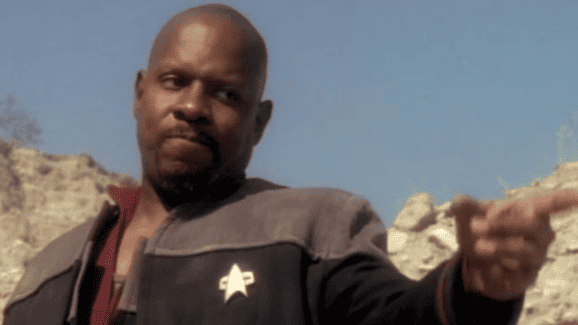
Starfleet Academy recently aired an episode (“Series Acclimation Mil”) dedicated to Deep Space Nine, one that sought to definitively explain what happened to Captain Benjamin Sisko. The episode served shockingly well as a tribute to this iconic Trek show and Avery Brooks, the legendary performer who originally brought Sisko to life. However, what most fans don’t realize is that a major plot point of this episode goes against the wishes Brooks explicitly expressed over 30 years ago.
In the Deep Space Nine series finale, Sisko tackles Gul Dukat, sending both of them on a lethal fall into Bajor’s Fire Caves; however, Sisko is saved from death by the Prophets, who bring him to live with them inside the wormhole. The show was originally going to leave it completely ambiguous as to whether Sisko would ever return, but at Avery Brooks’ insistence, the writers added Sisko promising that he would eventually come back. Starfleet Academy (beware spoilers, cadets!) confirmed that Sisko never returned, though, meaning that the episode dedicated to Brooks’ character just completely ignored his final request for Sisko.
From Man To Prophet
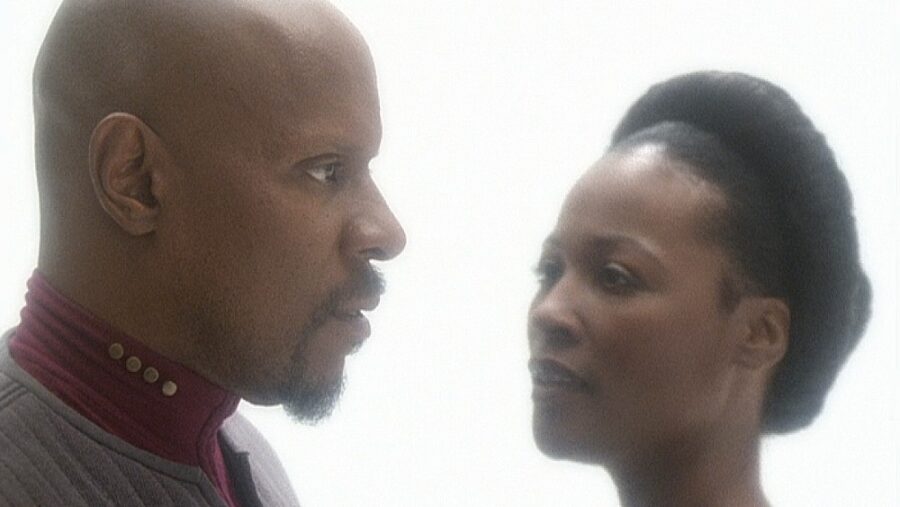
Some important context: towards the end of Deep Space Nine, Captain Sisko had married Kasidy Yates, and they conceived a child shortly before his final mission. Originally, the writers of the DS9 episode “What You Leave Behind” wanted to make it clear that Sisko would become a full-time Prophet in the wormhole and that he would never get to see his family ever again. This was meant to pay off a previous warning from his Prophet mother that if Sisko were to marry Yates, he “would know nothing but sorrow.”
Accordingly, they shot a final scene with Sisko and Yates where he told her he would never return; however, Avery Brooks soon told Deep Space Nine showrunner Ira Steven Behr that he didn’t like the scene because he didn’t like his character being a Black man who leaves his pregnant Black wife to raise their child alone, feeling like this had negative cultural connotations.
At Brooks’ request, the writers gave Sisko an iconic response to his wife asking when he would return: “It’s hard to say. Maybe a year, maybe yesterday. But I will be back.” To this, a faithful Kasidy Yates gave her hopeful response: “And I will be waiting.”
The Mystery Of Sisko’s Fate

While Deep Space Nine was set in the 24th century, Starfleet Academy (itself a Discovery spinoff) takes place in the 32nd century. When the holographic cadet SAM investigates the mystery of Sisko’s disappearance, she verifies that, according to Starfleet records, Sisko never actually returned at any point in the last 800 years. Eventually, she even talks to Jake Sisko (who may be an interactive hologram, a visiting Prophet, or something else altogether), and he confirms that while his father was metaphorically “always there,” Sisko never returned in a corporeal form.
In this way, Starfleet Academy ultimately ignored Avery Brooks’ final wishes concerning his character. The writers retroactively confirmed that Sisko did, indeed, leave his son, his wife, and his unborn child behind forever to become a full-time Prophet. Admittedly, the writers didn’t have much of a choice (Brooks is fully retired from acting and has zero interest in returning to Trek), but it’s notably weird that the episode intended to honor Sisko as a character was built on dishonoring the wishes of his actor.
Did Jake Sisko Keep Lying For 800 Years?

Of course, the truth might not be that cut and dry: there’s a chance that Sisko really did return and Starfleet never found out about it. Unless he or Kasidy Yates told somebody, how would anybody actually know? The Prophets could theoretically return him with an entirely new face, allowing him to walk around Bajor and around the entire galaxy without being recognized.
If this happened, then Jake likely knew about it and chose not to reveal the truth to anyone. This includes SAM, which might be why (despite their rapport) he seems cagey about discussing anything tangible about his father, a man who “never really left us.” This is couched as a metaphor, but what if Sisko really did return to his family and never left again?
It’s fitting, somehow, that Star Trek fans must decide for themselves what happened to Benjamin Sisko: did he remain a Prophet forever or secretly return to his family as promised? What you believe happened to this iconic character is ultimately a matter of personal faith. What could be more fitting for a Star Trek character who became the immortal savior of an entire alien race?
Entertainment
Best Super Bowl movie trailers: See the best trailers of 2026

The Super Bowl isn’t just about touchdowns — it’s also Hollywood’s most expensive movie night.
As millions tune in for Super Bowl 2026, studios seize the moment to unveil new trailers, betting that nothing sells a blockbuster quite like debuting it in the middle of America’s biggest TV event.
So, what can we expect during this year’s Big Game? Movie fans are in for a stacked lineup of first looks and TV spots. According to Variety, Disney is putting all its weight behind The Mandalorian and Grogu, which already has a teaser in theaters now and is slated to bring Star Wars back to the Super Bowl stage once again.
Steven Spielberg’s Disclosure Day and animated tentpoles like The Super Mario Galaxy Movie and Minions 3 are all reported to have new footage during the broadcast.
Horror fans should be on the lookout for Scream 7, and it appears Lionsgate has spent on a pre-game ad spot for the Michael Jackson biopic, Michael. Beyond these, rumors are swirling about other potential Super Bowl weekend appearances by Pixar films Toy Story 5 and Hoppers, though nothing is yet guaranteed.
Yoshi faces off against a T. rex in The Super Mario Galaxy Movie
All Super Mario fans know that Yoshi is small but mighty. Case in point: the latest TV spot for The Super Mario Galaxy Movie, which features Yoshi going toe to toe with a giant T. rex.
It’s the Minions vs. a very bad bunny in Minions & Monsters
Gen Z’s favorite little freaks (aka the Minions) are back to cause even more chaos in Minions & Monsters. This time: They’re summoning monsters because why not! There’s a cute little green guy, a scary-looking blue guy, and one very bad bunny (not to be confused with the Bad Bunny). Oh, and there’s a Blackpink needle drop! How you like that?
Mashable Top Stories
Brad Pitt is Cliff Booth…again!
Did the world need a sequel to Quentin Tarantino’s Once Upon a Time in Hollywood? No, not really. But are we getting one anyway? Absolutely. Brad Pitt reprises his standout role as Hollywood stuntman Cliff Booth in Netflix’s The Adventures of Cliff Booth, coming to the streamer sometime soon. It looks like it’s going to be a wild ride.
Let The Mandalorian and Grogu show you the way
Baby Yoda Grogu is back, and he’s on the big screen. The Mandalorian and Grogu is set to release in theaters over Memorial Day Weekend, on May 22.
‘The Mandalorian and Grogu’ trailer: Pedro Pascal and Baby Yoda head for high-stakes space adventure
Steven Spielberg returns to original sci-fi with Disclosure Day
Steven Spielberg returns with the original sci-fi event film, Disclosure Day, which imagines a world on the verge of undeniable proof that humans are not alone in the universe — and the fear that comes with it.
Ghostface is back in Scream 7
Sidney Prescott (Neve Campbell) thought she’d finally escaped her past, but when a new Ghostface killer strikes her quiet town and targets her daughter (Isabel May), the nightmare begins again. In Scream 7, Sidney is pulled back into the horror she knows all too well.
Will she end the bloodshed once and for all? We’ll have to find out when the film hits theaters later this month.
Supergirl reveals Krypto as a puppy and also Krypton
DC has cleverly prepped a Krypto-forward Supergirl trailer to air during the Puppy Bowl. You also get a glimpse at Krypton, but we know what you’re all here for.
Project Hail Mary gets a final look
Project Hail Mary, a Ryan Gosling-led sci-fi movie based on a 2021 best-selling novel, dropped an extended trailer. In the preview, we see Gosling’s Ryland Grace bonding with a rocky-looking Alien (named Rocky) as they attempt to save their respective worlds.
We’ll be updating this with all of the latest trailers, so be sure to check back throughout the night.
Topics
Super Bowl
Trailers
Entertainment
Super Bowl 2026 Gatorade shower color: What it was and why people want to know
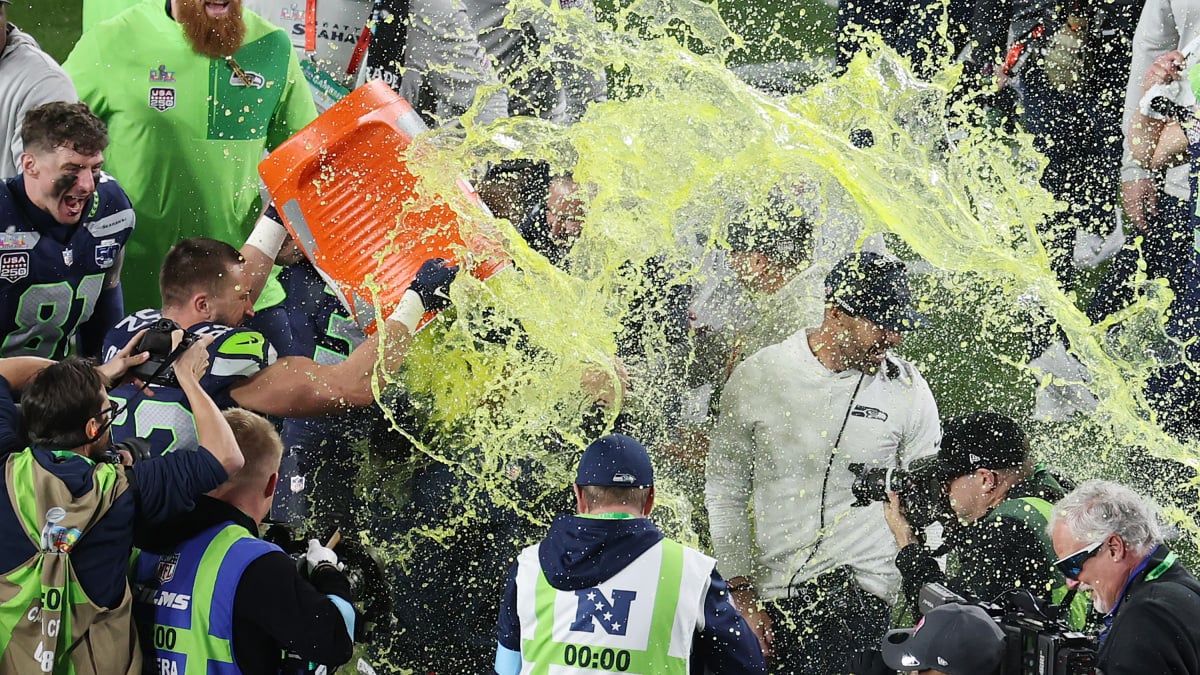
The Super Bowl is built on tradition. Cracking open a beer, demolishing a plate of wings with friends, filling out Super Bowl Squares, and at this point, betting on the color of the Gatorade shower.
Thanks to the widespread legalization of sports betting and the explosion of prop bets in the U.S., you can now wager on just about anything. Over the past few years, one of the strangest traditions to become fully normalized is betting on the postgame Gatorade dunk, when the winning team douses its head coach in the fluorescent sports drink.
You can currently place wagers on events far more serious than a locker-room celebration, including ongoing global conflicts. Against that backdrop, guessing the color of a sugary sports drink feels almost quaint. Last year, the winning color was yellow at +250 odds, even though purple was the favorite at +175, according to DraftKings via the New York Post.
Mashable Trend Report
Odds vary depending on where you place your bet. On Polymarket, blue currently has the most money behind it, while over at BetMGM, orange is favored at +225, with yellow, green/lime, and blue all trailing closely behind at +260.
This Tweet is currently unavailable. It might be loading or has been removed.
The winner is a back-to-back champ
Sorry, blue bettors, but for the second year in a row, yellow came out on top. The winning Gatorade color once again defied expectations, even though it felt inevitable to anyone closely tracking the odds.
That said, a handful of fans were annoyed by how the result was revealed. Instead of waiting until the final whistle, the broadcast tipped its hand earlier than expected, effectively spoiling the prop bet before the game had officially ended.
This Tweet is currently unavailable. It might be loading or has been removed.
This Tweet is currently unavailable. It might be loading or has been removed.
This Tweet is currently unavailable. It might be loading or has been removed.
This Tweet is currently unavailable. It might be loading or has been removed.


Bennett Stirtz excels as Iowa knocks off Northwestern

Ilia Malinin powers US past Japan to team figure skating gold in Milan


