
Entertainment
The Most Ambitious Spinoff In TV History Is Now Streaming Free

By Chris Snellgrove
| Published

Most television spinoffs are, by definition, very similar to the original show. For example, Star Trek: The Next Generation gave us new characters and a new ship, but it still had all the fundamentals of The Original Series: an intrepid crew seeking out new life and exploring strange new worlds.
Meanwhile, Law & Order: Special Victims Unit and the other countless spinoffs of Law & Order retain the original show’s killer combination of police investigative work and courtroom drama. The logic behind this is, of course, that you shouldn’t rock the boat too much with a new spinoff, and it should deliver the formulaic comfort food that audiences crave.

And then there’s Angel (1999), the spinoff of Buffy the Vampire Slayer. While the original show was about a happy-go-lucky group of young people fighting both external and internal demons, Angel was a grim neo-noir centered on a centuries-old vampire with a soul.
If that’s not bold enough, this show reinvented itself almost every season, keeping its most fervent fans on their toes. For this and many more reasons, this decades-old show remains the most ambitious spinoff in television history.
Angels and Demons

Angel was introduced in Season 1 of Buffy the Vampire Slayer, and he quickly became a fan-favorite character. Not only did audiences dig looking at hunky David Boreanaz, but they ate up the premise that he was a tortured vampire with a soul who inexplicably fell in love with a vampire slayer. Star-crossed lovers with a supernatural twist, the Buffy/Angel pairing would (for better or for worse) go on to inspire literature ranging from Twilight to A Court of Thrones and Roses. Sadly, their union wasn’t meant to be, and at the end of Buffy’s third season, Angel left Sunnydale to hang a shingle in Los Angeles.
He becomes a private detective seeking to “help the helpless,” and he is soon joined by Buffy’s former frenemy, Cordelia. The spinoff’s cast changes over time, introducing brand-new characters like Charles Gun and Winifred Burkle along with returning character (and former Watcher) Wesley Wyndham Price. While the faces and locations changed over time, one thing remained the same: Angel continued to expand everything we know about the beloved universe of Buffy. The final season completely changed things up, giving our heroes the keys to an evil law firm they hope to redeem with the help of Spike, who is inexplicably alive again after his heroic death in the final episode of Buffy.
New Enemies, New Allies

Ironically, Angel’s greatest strength is that it’s almost completely different from Buffy the Vampire Slayer. Sure, there are some familiar elements, including colorful characters and quirky, Whedon-esque dialogue. But the show takes its tonal cues from its title character: while Buffy was as silly and quippy as its titular Slayer (Season 6 notwithstanding), Angel is as dark and brooding as its titular vampire.
Additionally, doing the right thing always comes at a price in Angel. Sure, your favorite characters save the city and save the world, but this often comes at the cost of their souls and even their lives.
While Buffy the Vampire Slayer notoriously has an ultra-depressing, ultra-edgy sixth season, Angel evenly spreads its existential despair throughout the entire series. That’s why the show isn’t for everyone: if you’re expecting something as bright, happy, and funny as Buffy, you’re going to be disappointed.
However, if your vampire tastes are a little darker (more like Nosferatu than Dracula: Dead and Loving It), you’ll likely appreciate this more mature take on supernatural storytelling. It helps, of course, if you’re a big fan of neo-noir. Even if you don’t care that much for the deep Buffyverse lore, you can enjoy the show for its episodic, mystery-of-the-week stories.
Call Your Friends And Watch It Together

Without giving too much away (seriously, you need to watch this show for yourself), part of what makes Angel unique in television history is its constant reinvention. There are multiple cast shake-ups, and the show goes from being a small-time detective procedural to morality play to family reunion to bonkers legal drama. This can admittedly be off-putting if you prefer static TV shows. Personally, I really enjoyed the fact that, quite literally, I had no idea where this show was going to go from its humble beginnings to its unhinged finale.
While the rest of the cast is great (I particularly enjoyed Alexis Denisof and the late, great Andy Hallett), Angel only works because of David Boreanaz. He has gone on to headline multiple successful shows, but Angel remains his best work. Boreanaz doesn’t have the most range as an actor, but he is pitch-perfect as a vampire with a soul: he broods with the best of them, he’s a convincing action star, and he has charisma to spare. He’s absolutely compelling in this role, and Angel remains proof that Boreanaz can be (with the right material) one of the most captivating leading actors in television.
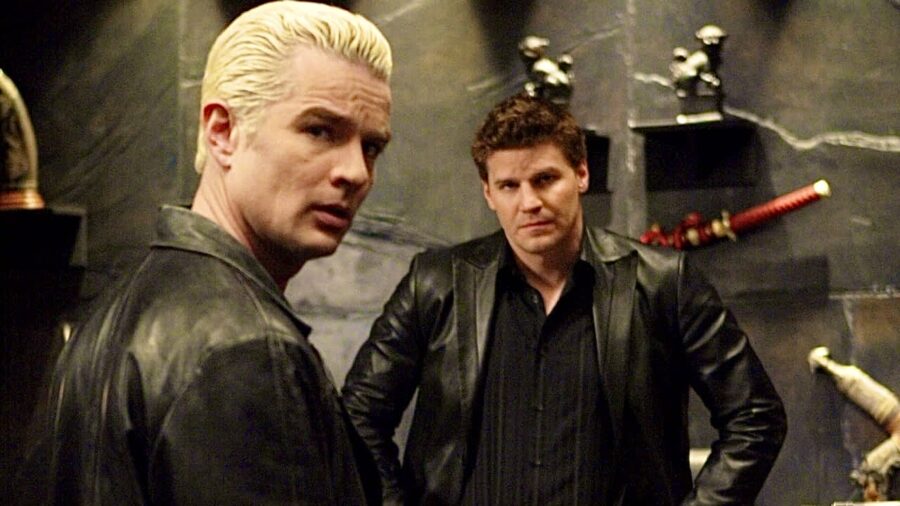
Obviously, Angel isn’t for everyone, especially if you want something more in the vein of Buffy’s earlier seasons. But it remains the most ambitious spinoff in TV history, fleshing out the borders of this universe while stretching the boundaries of genre storytelling.

Fortunately, you don’t have to give up your soul to experience this show for yourself. Angel is currently streaming for free on Tubi, meaning you’re just one click away from watching the coolest, creepiest, and absolute craziest show on television. With this vampiric masterpiece, the storytelling stakes (pun full and bloody well intended) have never been higher!

Entertainment
NYT Strands hints, answers for May 10, 2026
Today’s NYT Strands hints are easy if you have good eyes.
Strands, the New York Times‘ elevated word-search game, requires the player to perform a twist on the classic word search. Words can be made from linked letters — up, down, left, right, or diagonal, but words can also change direction, resulting in quirky shapes and patterns. Every single letter in the grid will be part of an answer. There’s always a theme linking every solution, along with the “spangram,” a special, word or phrase that sums up that day’s theme, and spans the entire grid horizontally or vertically.
By providing an opaque hint and not providing the word list, Strands creates a brain-teasing game that takes a little longer to play than its other games, like Wordle and Connections.
If you’re feeling stuck or just don’t have 10 or more minutes to figure out today’s puzzle, we’ve got all the NYT Strands hints for today’s puzzle you need to progress at your preferred pace.
NYT Strands hint for today’s theme: We all saw it
The words are related to clarity.
Mashable Top Stories
Mashable 101 Fan Fave: Vote for your favorite creators today
Today’s NYT Strands theme plainly explained
These words describe lucidity.
NYT Strands spangram hint: Is it vertical or horizontal?
Today’s NYT Strands spangram is vertical.
NYT Strands spangram answer today
Today’s spangram is Clear Cut.
NYT Strands word list for May 10
-
Overt
-
Obvious
-
Blatant
-
Clear Cut
-
Flagrant
-
Brazen
-
Glaring
Looking for other daily online games? Mashable’s Games page has more hints, and if you’re looking for more puzzles, Mashable’s got games now!
Check out our games hub for Mahjong, Sudoku, free crossword, and more.
Not the day you’re after? Here’s the solution to yesterday’s Strands.
Entertainment
Netflix's ‘90s Alien Action Movie Is Secretly The Most Successful Propaganda Film Of All Time
By Chris Snellgrove
| Published

“Propaganda” is one of the dirtiest words in Hollywood. Regardless of how they vote, most prefer their movies to be free of any overt political messaging. After all, we get enough of that from our hellish 24-hour news cycle; why would we want to see it on the big screen?
However, some of the most beloved films of the 20th and 21st centuries have secretly served as propaganda. Top Gun is basically one long advertisement for the Navy, which is presented as our only defense against international attackers. Michael Bay’s first Transformers movie is also propaganda, presenting the Army as our main line of defense against enemies both domestic and very, very foreign.
Interestingly, the most successful propaganda film ever made came out in the ‘90s, and it rallied the country together like never before. I’m talking about Independence Day, the rollicking action adventure that had Will Smith punching an alien (maybe it said something about his wife?) and Jeff Goldblum hacking UFOs. Oh, and it had Bill Pullman rallying the entire world together with a speech that had audiences around the world cheering at the screen. The whole thing is so infectiously cool that it’s easy to overlook the obvious: that, from the ground up, this movie is all about how America deserves to rule the entire world.
America (F*ck Yeah!)

Why is Independence Day propaganda, exactly? The most obvious reason is its focus on military might as the only real solution for driving away alien invaders. This isn’t sci-fi like Star Trek, where everything can be solved with peace and diplomacy. It’s not even like Star Wars, in which a coalition of humans and aliens overthrows a fascist Empire. No, this is about how the only solutions to extraterrestrial invasion come in the form of bullets and missiles. Oh, and technology: amid the high-flying internet explosion of the ‘90s, Independence Day posits that a little vibe coding from a quirked-up, military-aligned scientist can instantly overcome the most advanced civilization humanity has ever encountered.
Given the name of the film, it’s no surprise that Independence Day centers on this military supremacy around America. Not in an exclusionary way, of course: characters don’t badmouth other countries, and the film doesn’t portray other nations in a negative light. Instead, it simply situates the United States as integral to the survival and prosperity of the rest of the world. In this light, directly dunking on other countries is unnecessary because the film makes it clear that when the very survival of humanity is at stake, the world will be saved by American weapons, American technology, and gloriously stubborn American gumption.
The Cold War Gets Hot

It’s easy to forget, but Independence Day came out very soon after the Cold War finally ended. That gives the rah-rah propaganda messaging its own special verve, of course. The United States had just effectively defeated its only real existential threat since the end of World War II. Who else, then, could possibly save all of humanity from the deadliest threat since the Soviet Union? Lest that subtlety be lost on viewers, Independence Day drapes itself in flags and patriotic speeches to drive home America’s nascent noblesse oblige: the obligation to use our position as the only dominant world power for good, not evil.
That leads to the obvious question: Independence Day may be blatant American propaganda, but is that an inherently bad thing? Not really. Sure, such cinematic propaganda always runs the risk of glorifying amoral politicians who destroy countless lives while excusing half a century of questionable American interventions and adventurism. But that’s not really the primary thrust of Independence Day. The film arguably serves as a direct extension of the American dream, glorifying the very best the country has to offer. America does not represent a dangerous and nefarious world police in this film; rather, it represents a country that can’t be tamed and will always rise to the occasion in the face of tyranny.
Welcome To Earth

In retrospect, it’s easy for cynics to chalk this up to the pie-in-the-sky idealism of the ‘90s, and that may very well be true. But these days, the heroes of Independence Day are more aspirational and inspirational than ever before. America is bitterly divided along political lines, with people fighting endless culture wars against their fellow countrymen over the stupidest subjects imaginable. It may be simplistic, but Independence Day is a reminder that when the states are truly united, America is unstoppable. If a little bit of celluloid propaganda can help us make our actual future more like the fictional past, a bit of blockbuster propaganda is a small price to pay.
Do you want to experience just how fun propaganda can be? Stoke your own patriotic fervor, or maybe just watch Will Smith punching someone other than Chris Rock? Good news, space cadets: the dream of the ‘90s is alive, right here in your living room. Independence Day is currently streaming on Netflix, and trust me: it’s just as intoxicatingly fun and deliriously dumb as you remember. It may be the most successful propaganda movie ever made, but it’s also an action-packed, weirdly hilarious thrill ride that will instantly appeal to your inner alien lover. Come for the UFOs and stay for the alien autopsy.
If you want your own anal probe, though, don’t look at me; go ask your partner nicely. Just don’t be surprised if she says “Welcome to Earth” when she does it!
Entertainment
How The 80s Raunchiest Sci-Fi Became The 90s Hottest Cable Series
By Jonathan Klotz
| Updated

John Hughes redefined the teen comedy from the sex romps of Porky’s to the more grounded and realistic Pretty in Pink, Sixteen Candles, and The Breakfast Club. In 1985, during the middle of this run, he also wrote and directed Weird Science, a film that was pure wish fulfillment.
There’s still a high school, and a pair of social outcasts, but there’s also an absolute smokeshow of a computer program with the ability to alter reality, designed from the smallest piece of code to be the perfect woman. Not only was it a hit, but a decade later, the USA Network took the premise and ran with it to make Weird Science, the series, which ran for a mind-boggling 5 seasons and 88 episodes.
She Blinded Me With Science

Both the film and the series center on high school slackers Gary (Brat Packer Anthony Michael Hall in the original and John Mallory Asher in the series) and Wyatt (Ilan Mitchell-Smith in the film, Michael Manasseri in the series), trying to cut every corner possible thanks to Lisa, the artificial woman who, for all intents and purposes, operates like a Genie. The basic episode has one of the two making a wish, turning the school into a party school complete with pizza in class, becoming rock stars, time-traveling to deal with a bully, or turning Wyatt’s brother into an infant.
There’s nothing deep about Weird Science. It’s lighthearted, campy fun, and if you’re wondering why this managed to stay on the air for five seasons, it’s because they somehow found the perfect replacement for the movie’s Kelly LeBrock: Vanessa Angel. No one cares about Wyatt and Gary. Weird Science is all about the stacked brunette front and center in every piece of promotional material, every commercial, and every episode. Angel’s take on Lisa was a little goofier than LeBrock’s, but at the end of the day, she was usually the one who ended up solving the problem.
From Runner-Up To The Reason Everyone Watched

Vanessa Angel found the most success in her career on Weird Science bringing Lisa to life. Taking over for Kelly LeBrock’s iconic portrayal should have been a recipe for disaster, but it worked. Angel’s career in Hollywood was filled with missed opportunities for major roles, first as the original Xena to Lucy Lawless, losing out due to a horribly timed illness, then as the second choice for Seven of Nine behind Jeri Ryan, and finally, as Anise/Freya on Stargate SG-1 when the producers wanted a sexy new female cast member to catch the Seven of Nine wave. Turns out, they already had Amanda Tapping, and her role was cut after only three appearances.
Weird Science was obviously aimed at a young audience with plotlines that would feel at home a decade later on a Disney Channel original. You can only imagine the fun that the writer’s room had trying to come up with the most insane plotlines possible. The combination of a hot woman and two (or more) inept guys has been the foundation for countless comedies over the decades. Turning the woman into a wish-granting computer program didn’t alter the formula in the slightest. It worked for I Dream Of Jeannie in the 60s, it worked for Weird Science in the 90s, and if Hollywood ever makes another sitcom, it’ll work again.
Weird Science is streaming for free on The Roku Channel.

Dodgers' Justin Wrobleski eager to keep rolling vs. Braves
Fernando Tatis Jr., Padres seek to secure split with Cardinals


