
Entertainment
The Klingons Are All In Hell Now, And Paramount Just Sent Them There
By Joshua Tyler
| Published

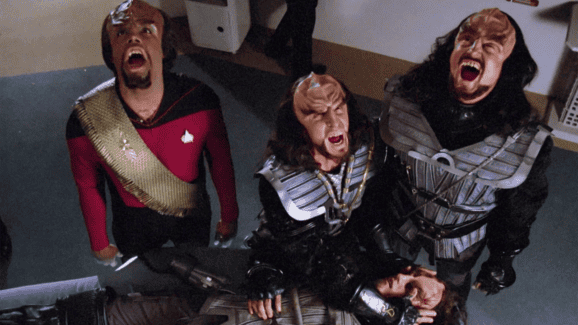
The fourth episode of Star Trek: Starfleet Academy dropped a bombshell revelation: The Klingon homeworld has been destroyed in an accident, and nearly all the Klingons are dead. Fans of the series and the Klingons in particular will know this means that not only are the Klingons dead, they’ve also been sent to hell.
Klingons Believe In A Very Specific Afterlife
As established over decades of developing this alien race, particularly through the eyes of Worf (who has been in more Star Trek episodes than any other character), the Klingons have a very specific set of beliefs around the concept of death. For Klingons, death is a test, not an ending. What matters isn’t that you die, but how.

Klingons who die well end up in their afterlife, a place called Sto-Vo-Kor. Only those who die with honor, ideally as warriors, are welcomed into the great hall to fight, feast, and sing with Kahless (a name Starfleet Academy pronounces like it’s being said by a strangled fish) and the honored dead.
A Klingon who dies in some other way goes to Gre’thor. Gre’thor is the Klingon underworld, ruled by Fek’lhr, a demonic figure who punishes the dishonored. It is a place of eternal suffering, where cowardice, betrayal, or an unworthy death is paid for forever.
In other words, if you don’t die as a warrior, you go to Klingon hell. You know what’s not dying as a warrior? Dying in a stupid accident where your planet blows up.
An Accidental Death Is The Most Horrible Thing You Can Do To A Klingon
The worst thing that could ever happen to the Klingons, worse than anything you could ever possibly imagine, is the entire race being wiped out by an accident. And that’s what Star Trek: Starfleet Academy just did to nearly every single Klingon in existence.

For Klingons, it’s a fate so horrific that had they known about it in advance, the entire race would have likely mass-suicided rather than allow their descendants to face this insulting and terrible dishonor. That’s not hyperbole; in situations like this, Klingons usually do the Hegh’bat ritual, which is basically assisted suicide.
In Klingon belief, intent matters more than the act itself. Rituals like Hegh’bat are considered honorable deaths when the warrior’s continued existence would bring dishonor. And creating descendants who will dishonor the entire Klingon race definitely qualifies. Worf, Martok, Kor, and every other Klingon who has ever lived would have definitely taken the Hegh’bat to avoid this fate for their race.
Klingons Aren’t The Only Ones In Hell

None of the writers of shows like Star Trek: Deep Space Nine or Star Trek: Enterprise would have ever done something like this to the Klingons. They wouldn’t have done it because they understood the complex lore behind the race of aliens they’d created. Further, they’d know that details like this are the main reason the Klingons are so uniquely beloved and also sometimes hated, among all of the many Trek creations.
The writers (assuming it’s not just ChatGPT) of Starfleet Academy not only don’t care about these things, they don’t know them. Which means the Klingons aren’t the only ones in hell now, so is every Star Trek fan who’s been watching and loving the franchise for more than five minutes.
How Star Trek Fans Can Give Klingons The Honorable Death They Deserve

While watching “Vox in Excelso”, the Starfleet Academy episode where the Klingons are sent to eternal torment off-camera, I made a decision in their memory. I will do what they were not allowed to do, and end my lifelong Star Trek relationship, with honor.
Halfway through the episode, I exited Starfleet Academy on my Paramount+ app, deleted it from my television, and unsubscribed from the network. You can do the same. Do it for Worf. For Martok. For Kor. For Koloth. For Kang. For crazy-eyed Gowron. For Dax. For Grilka and the House of Quark!
It’s better to die as a warrior than live as a slop eater.
Entertainment
Wordle today: Answer, hints for April 19, 2026

Today’s Wordle answer should be easy to solve if you can never sit down.
If you just want to be told today’s word, you can jump to the bottom of this article for today’s Wordle solution revealed. But if you’d rather solve it yourself, keep reading for some clues, tips, and strategies to assist you.
Where did Wordle come from?
Originally created by engineer Josh Wardle as a gift for his partner, Wordle rapidly spread to become an international phenomenon, with thousands of people around the globe playing every day. Alternate Wordle versions created by fans also sprang up, including battle royale Squabble, music identification game Heardle, and variations like Dordle and Quordle that make you guess multiple words at once.
Wordle eventually became so popular that it was purchased by the New York Times, and TikTok creators even livestream themselves playing.
What’s the best Wordle starting word?
The best Wordle starting word is the one that speaks to you. But if you prefer to be strategic in your approach, we have a few ideas to help you pick a word that might help you find the solution faster. One tip is to select a word that includes at least two different vowels, plus some common consonants like S, T, R, or N.
What happened to the Wordle archive?
The entire archive of past Wordle puzzles was originally available for anyone to enjoy whenever they felt like it, but it was later taken down, with the website’s creator stating it was done at the request of the New York Times. However, the New York Times then rolled out its own Wordle Archive, available only to NYT Games subscribers.
Is Wordle getting harder?
It might feel like Wordle is getting harder, but it actually isn’t any more difficult than when it first began. You can turn on Wordle‘s Hard Mode if you’re after more of a challenge, though.
Here’s a subtle hint for today’s Wordle answer:
To rise.
Mashable Top Stories
Does today’s Wordle answer have a double letter?
There are no recurring letters.
Mashable 101 Fan Fave: Nominate your favorite creators today
Today’s Wordle is a 5-letter word that starts with…
Today’s Wordle starts with the letter T.
The Wordle answer today is…
Get your last guesses in now, because it’s your final chance to solve today’s Wordle before we reveal the solution.
Drumroll please!
The solution to today’s Wordle is…
STAND
Don’t feel down if you didn’t manage to guess it this time. There will be a new Wordle for you to stretch your brain with tomorrow, and we’ll be back again to guide you with more helpful hints. Are you also playing NYT Strands? See hints and answers for today’s Strands.
Reporting by Chance Townsend, Caitlin Welsh, Sam Haysom, Amanda Yeo, Shannon Connellan, Cecily Mauran, Mike Pearl, and Adam Rosenberg contributed to this article.
If you’re looking for more puzzles, Mashable’s got games now! Check out our games hub for Mahjong, Sudoku, free crossword, and more.
Not the day you’re after? Here’s the solution to yesterday’s Wordle.
Entertainment
Hurdle hints and answers for April 19, 2026
If you like playing daily word games like Wordle, then Hurdle is a great game to add to your routine.
There are five rounds to the game. The first round sees you trying to guess the word, with correct, misplaced, and incorrect letters shown in each guess. If you guess the correct answer, it’ll take you to the next hurdle, providing the answer to the last hurdle as your first guess. This can give you several clues or none, depending on the words. For the final hurdle, every correct answer from previous hurdles is shown, with correct and misplaced letters clearly shown.
An important note is that the number of times a letter is highlighted from previous guesses does necessarily indicate the number of times that letter appears in the final hurdle.
Mashable 101 Fan Fave: Nominate your favorite creators today
If you find yourself stuck at any step of today’s Hurdle, don’t worry! We have you covered.
Hurdle Word 1 hint
The edge.
Hurdle Word 1 answer
BRINK
Mashable Top Stories
Hurdle Word 2 hint
Moody.
Hurdle Word 2 Answer
POUTY
Mashable 101 Fan Fave: Nominate your favorite creators today
Hurdle Word 3 hint
America’s bird.
Hurdle Word 3 answer
EAGLE
Hurdle Word 4 hint
A platform.
Hurdle Word 4 answer
FORUM
Final Hurdle hint
Cheapskate.
Hurdle Word 5 answer
MISER
If you’re looking for more puzzles, Mashable’s got games now! Check out our games hub for Mahjong, Sudoku, free crossword, and more.
Entertainment
Star Trek’s Most Ambitious Villain Helped Create The Franchise’s Most Complex Hero
By Chris Snellgrove
| Published

When Star Trek: Voyager first came out, the most fascinating character was the Doctor. While Robert Picardo’s performance was superb, it’s fair to say this character was mostly fascinating on a conceptual level. We had seen things like hypercompetent Starfleet captains and exotic aliens before, but what we hadn’t seen was a fully holographic chief medical officer. Voyager’s Emergency Medical Hologram seemed like the perfect embodiment of the Star Trek ethos. He’s a technological strange new world and new life, all rolled into one.
However, what casual audiences didn’t realize is that the Doctor wasn’t completely unique. Long before Picardo’s character ever sawed bones in the Delta Quadrant, Captain Picard dealt with another extraordinary hologram: Moriarty, the brilliant foe of the famous investigator Sherlock Holmes. Over on The Next Generation, Geordi LaForge accidentally created this villain as a sentient hologram when he asked the holodeck to create a challenge worthy of the android Data. Later, Star Trek: Voyager executive producer Jeri Taylor revealed that, in-universe, the holographic Doctor was created because Starfleet took advantage of the same accidental breakthrough that created Moriarty!

It all started in “Elementary, My Dear Data,” the Next Generation episode in which the titular android and Geordi LaForge recreated Sherlock Holmes’ adventures on the holodeck. Thanks to his positronic brain and his encyclopedic knowledge of Sir Arthur Conan Doyle’s Holmes novels, Data is able to easily solve every mystery that is thrown at him. That’s when Geordi makes a seemingly simple request. He asks the Enterprise computer to develop a holodeck foe that could actually defeat Data, one of the smartest beings in the entire galaxy.
The computer obliges and creates a sentient version of Moriarty, Sherlock Holmes’ greatest foe. Following Geordi’s instructions, the Enterprise computer included much of Data’s vast programming, which resulted in the holographic character becoming self-aware. Moriarty ended up threatening the Enterprise on two different occasions, and Picard eventually got rid of him by trapping the unknowing villain in a simulation where he thought he had left the holodeck and could explore the stars. This was meant to be a happy ending for Moriarty, but in the show’s typically bleak fashion, Star Trek: Picard later showed us a different, more hostile version of this character created by a malevolent Section 31 AI.
How A Villain Created A Hero

What does all of this have to do with Robert Picardo’s holographic Doctor on Star Trek: Voyager? Elementary, my dear reader! Very early in Voyager’s development (the show didn’t even have a name yet), executive producer Jeri Taylor was inspired by Moriarty to create a new character. As reported in A Vision of the Future-Star Trek: Voyager, Taylor wrote down notes for a holographic doctor “who, like Moriarty, has ‘awareness’ of himself as a holodeck fiction. He longs for the time when he can walk free of the Holodeck.”
A few days later, she wrote down additional notes that contain a startling bit of Star Trek lore. “The Holo-Doctor represents a new, state-of-the-art technology which has capitalized on the serendipitous incident which created Moriarty, and has programmed a holographic character which has self-awareness of his situation and limitations.” While Moriarty is name-dropped on Voyager a couple of times, the show never mentioned what Taylor’s notes seem to confirm: that Lewis Zimmerman could never have created the Emergency Medical Hologram program if not for Geordi LaForge accidentally creating Moriarty on the holodeck.
From Villain To Leading Man?

If that’s not strange enough, there was a period of time when Voyager’s producers were considering making Moriarty a mainstay character on the show. As reported in Star Trek–Where No One Has Gone Before, Taylor’s notes mentioned that “everyone agreed that was a little too broad, and we couldn’t figure out why anyone would take him along.” After dismissing the idea, they decided “that having a holographic doctor with the full consciousness of being a hologram might be fun, and we’d never done anything like that before, except for Moriarty.”
There you have it, gentle reader. Without the character of Moriarty on Star Trek: The Next Generation, we’d never have the Doctor on Voyager. In this way, Trek’s most ambitious villain helped create the franchise’s most complex hero. Thanks to Jeri Taylor’s notes, we also know that, in-universe, Lewis Zimmerman would never have been able to create the Doctor if not for Geordi accidentally creating a sentient Moriarty so Data could have fun. In retrospect, this does make Zimmerman’s arrogance that much weirder. After all, he has a lot of attitude for someone who owes his entire career to the two biggest book nerds in the galaxy!

Matt Boldy, Wild make big statement, rout Stars in series opener
Gavin Williams fans 11 in gem as Guardians stifle O's


