
Entertainment
The Infamous 85-Minute Star Wars Cut That Fixed The Franchise, Made By That 70s Show Star

By Henry Hards
| Published
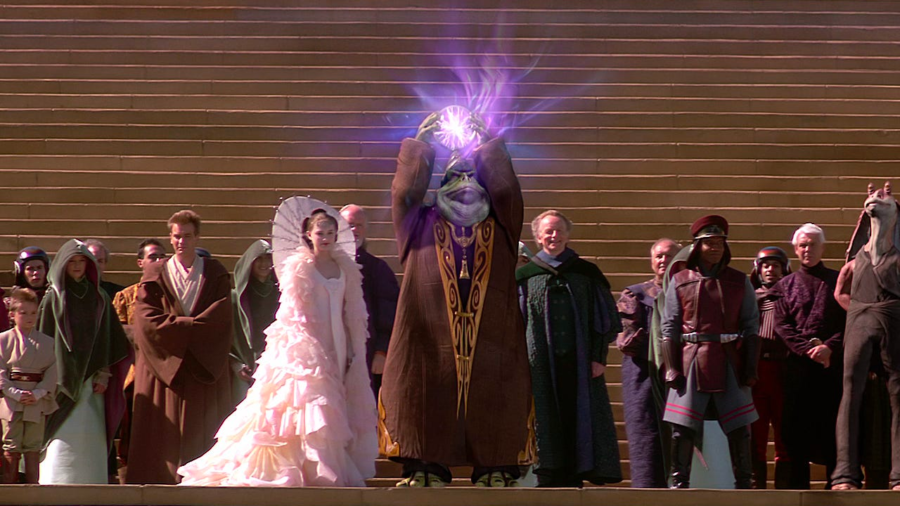
Often, when fans say they could have done a better job than someone perceived to have ruined the object of their devotion, it’s just a lot of hot air. Just fans being fans without any real way (or ability) to back up the claims at all.
Unless, of course, that fan is That 70s Show‘s Topher Grace, who in 2012 made major waves when he actually showed something that few have tried to pull off. He made an 85-minute recut of the Star Wars prequels.
Topher Grace re-edited George Lucas’ three prequel films (which run a collective 418 minutes) into one coherent feature-length film. And it’s good.

In addition to slashing the running time (and making those cuts while still maintaining a coherent storyline), Grace shifted and refocused things a little from the prequels we know and argue over. Gone are all the pod racing, unnecessary exposition, and obnoxious CGI characters that clutter Star Wars: Episode I – The Phantom Menace. Instead, Grace begins his film with the end of that one: with the final showdown between Obi-Wan, Qui-Gon, and Darth Maul.
It’s hilarious to think that most of The Phantom Menace could effectively be eliminated without causing any real confusion in the overall story. Not a great look for George Lucas and company, but it does speak to the problems fans had with the first prequel when it originally hit theaters.
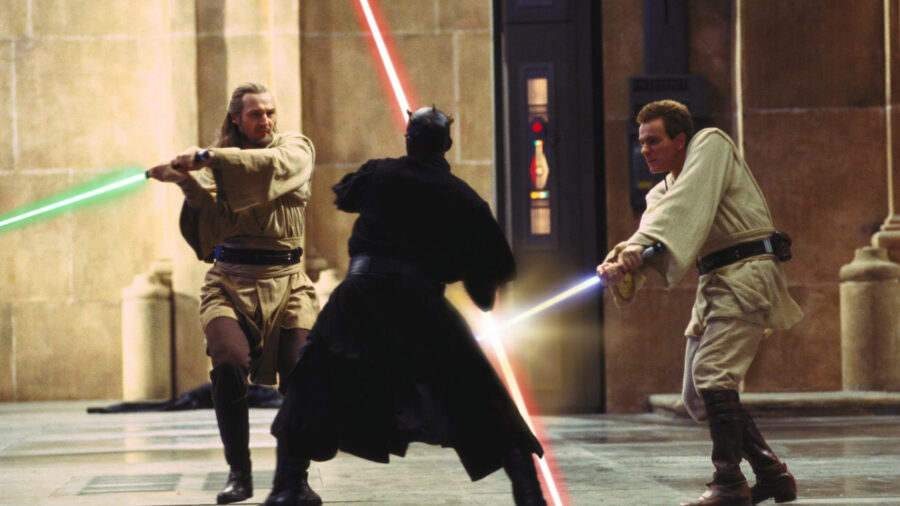
Topher Grace kept much of the action from the Lucas films but eliminated any lightsaber battles unless they were relevant to the actual storylines he emphasizes. Those are largely about the Anakin-Padme relationship and Obi-Wan’s search for the individuals trying to assassinate politicians.
Scenes like the one where Padme brings Anakin home to meet her family, which were deleted from Lucas’ films, but shed light on characters and relationships, are reinstated. In this way, Grace extracted relevant pieces of the story that could find their way into the original final cut.

Grace provides a smooth transition to the original trilogy by ending his film with an image of the menacing Darth Vader, sans that much-maligned “Nooo!
This is yet another example of less is more, especially when it comes to Star Wars. True fans already understand the depth of the pain here; it didn’t need to be hammered home in such an obvious (and kind of silly) way.
Of course, it’s not without its drawbacks. Cutting over 300 minutes from a series will leave a few holes and move things at a pace that might feel strange to those familiar with the originals. However, according to those few who have ever been allowed to see it, Grace’s film is thematically tight, action-packed, and enjoyable.
Topher Grace’s cut, first completed in 2012, went on to inspire others to take up the Star Wars editing mantle in the years that followed. Topher Grace even helped produce and splice a 5-minute cut of the entire franchise, trailer-style, that brings in elements from nearly every Star Wars production having to do with the original timeline and characters.
His 5-minute cut beautifully encapsulates the franchise’s central ethos while also setting the stage for movies like Solo, Rogue One, and, of course, the other timeline movies.
Unfortunately, Topher Grace’s 85-minute Star Wars cut won’t be coming to a big or small screen near you soon (or ever). Disney would never allow it.
Topher Grace doesn’t plan to hold any more public screenings or distribute the film, even though thousands of Star Wars fans would probably jump at the chance to see the prequels without Jar Jar Binks. He’s probably too afraid of being sued by Disney.
Entertainment
400K MagSafe power banks recalled after fatal fire, the 10th power bank recall in a year
The U.S. Consumer Product Safety Commission (CPSC) and Casely reannounced a power bank recall this April after a fire linked to the device fatally injured a user. This is the tenth power bank recall in the United States in the last 12 months, and Anker recalled 1.5 million power banks in 2025.
The recall affects an estimated 429,200 Casely 5,000-mAh MagSafe Power Pods (Model E33A), which were originally recalled in 2025. The MagSafe power banks need to be completely replaced.

Back of Casely power banks.
Credit: CPSC
Affected customers should stop using the portable power banks immediately. They can also contact Casely to receive a free replacement.
“The recalled lithium-ion battery in the power banks can overheat and ignite, posing risk of serious injury or death from fire and burn hazards to consumers,” the CPSC stated on its recall website.
Mashable Light Speed
The Brooklyn-based company is reannouncing the recall after receiving 51 reports of the lithium-ion battery overheating, expanding, and/or catching fire while charging smartphones, “resulting in six minor burn injuries.”
However, in the past year, the CPSC says 28 more reports have been made, including explosions that caused a serious accident on an airplane and one death.
In August 2024, a 75-year-old woman from New Jersey, was charging her cell phone with the power bank on her lap when it caught on fire and exploded. The victim suffered second and third degree burns and later passed away from complications from her injuries. In February 2026, a 47-year-old woman was charging her cell phone with the power bank on an airplane when it caught on fire and exploded, resulting in the victim suffering first degree burns.
How to check your Casely Power Pod
Worried you may own one of the 429,000 recalled power banks? It’s easy to check if your device is included in the recall.
On the back of the device, look for the device’s model number, as show in a picture provided by the CPSC. If the model number reads “E33A,” then stop using the device immediately.

Look for the model number.
Credit: CPSC
More information on requesting a replacement power bank is available on the CPSC and Casely recall websites.
Entertainment
The new Dyson Supersonic Travel is the cheapest Supersonic yet
Table of Contents
Nearly three years ago, I asked if the (then) $429 Dyson Supersonic was still worth the price of entry.
These days, with the Supersonic line having expanded, the standard model having increased in price to $449.99, and the most expensive version of the hair dryer topping out at $549.99, it’s a question that feels even more apt.
The good news? If you’re not super into the idea of spending about $500 for a hair dryer, Dyson just announced the Dyson Supersonic Travel, a $299.99 model of its famous hair tool. In addition to its lower price point, it comes with more travel-friendly proportions and features.
As someone who’s personally tested Supersonics (and their many dupes), I took a closer look at the latest Dyson beauty launch to gather everything you need to know.
The design differences of the Dyson Supersonic Travel
In short, the Supersonic Travel is the standard Supersonic but smaller. According to Dyson, that comes out to exactly 32 percent smaller and 25 percent lighter than the OG Supersonic. In other words, it’s 0.7 pounds to the standard Supersonic’s 1.8 pounds, and 8.7 inches tall to the larger model’s 10 inches.
Mashable Trend Report
This model also comes with one attachment, the styling concentrator, a la the now-discontinued Dyson Supersonic Origin (which ran for $399.99). For comparison, the $449.99 Supersonic comes with three attachments: a styling concentrator, diffuser, and wide-tooth comb. For all five attachments, you’ll have to shell out $549.99.

The Supersonic Travel is compatible with all original and Supersonic Nural attachments.
Credit: Dyson
The same attachments can be used between the Travel, original, and Supersonic Nural dryers. This means opting for the Travel could technically save you some money — individual attachments range from $19.99 to $44.99. If you only use a styling concentrator and diffuser, for instance, the total cost of a Travel dryer with the extra attachment purchase would come out to $344.98, making it still over $100 cheaper than the three-attachment original Supersonic.
The Supersonic Travel is more versatile in some ways, and less so in others
Functionality-wise, the Supersonic Travel is a slightly different product from the other Supersonics in the line. It has anywhere from 1,000 to 1,220 watts of power and an airflow speed of 11.6 liters per second, compared to the 1,600 watts and 13.3 liters per second of the standard Supersonic. In other words, the bigger dryer is slightly more powerful, so it wouldn’t be unreasonable to expect longer dry times.
The standard Supersonic and Supersonic Nural also feature four heats and three air speeds, where the Supersonic Travel features three heats and two air speeds.
The best noise-cancelling headphones for flying: 8 picks to improve your travel experience
That said, the Supersonic Travel has universal voltage compatibility, so it can be used from 100 to 240 volts, whereas the other Supersonics are locked into 120 volt compatibility.
In terms of its portability, it’s also worth noting the Supersonic Travel weighs the same as the Supersonic r, a professional grade hair dryer (priced as such at $549.99) that’s become more popular due in part to being lightweight and easy to maneuver.
Where to buy the Dyson Supersonic Travel
The Dyson Supersonic Travel is available for $299.99 at Dyson’s website, Amazon, and Best Buy. If you buy at the former, you will receive a complimentary $59.99 travel bag along with the hair dryer.
Entertainment
The gorgeous yet budget-friendly Samsung QN70F Neo QLED TV is the cheapest its ever been
SAVE $300: As of April 21, you can get the Samsung 55-inch QN70F Neo QLED 4K TV for only $597.99 instead of $897.99 at Amazon. That’s 33% in savings and the lowest price on record.
$597.99
at Amazon
$897.99
Save $300
We’re in peak sports season, y’all. Besides the action of the Stanley Cup playoffs and NBA playoffs, there’s a fresh MLB season taking shape. If your TV is looking dull or lagging, it’s a prime time to upgrade — especially since you can find some epic deals on 2025 models.
As of April 21, the Samsung 55-inch QN70F Neo QLED 4K TV is on sale at Amazon for only $597.99. That’s 33% or $300 off its current list price, as well as its lowest price to date.
As Mashable’s TV expert Leah Stodart explains, “Neo QLED is really just Samsung’s proprietary term for QLED paired with Mini LED.” So, the QN70F features a panel of quantum dots over a bunch of tiny LED bulbs instead of a basic LED panel. The result? A stunning display with impressive color accuracy, deep blacks, and spectacular contrast. All the little details will look good no matter the lighting conditions in your room.
This TV uses an NQ4 AI Gen2 processor to upscale content and enhance the quality of anything you’re watching. So even those old episodes of Friends will look more impressive on the QN70F. And thanks to a 144Hz variable refresh rate, gaming and sports will look noticeably smoother and less laggy than your old set.
Mashable Deals
If an upgrade is in order, but you don’t want to spend a ton of money, the Samsung QN70F Neo QLED 4K TV is an excellent value at full price. At $300 off, it’s a steal.

400K MagSafe power banks recalled after fatal fire, the 10th power bank recall in a year
The new Dyson Supersonic Travel is the cheapest Supersonic yet


