
Entertainment
The Boys Goes All-In On Politics For Season 5, And Activates Super-Raunchy Mode

By Chris Snellgrove
| Updated

Since it began in 2019, The Boys (which adapts the demented Garth Ennis comic of the same name) has done an excellent job of skewering franchises like the MCU and the DCU. Long before the term “superhero fatigue” entered the public lexicon, this show revealed the problems inherent in movies and shows focusing on tights and flights. In short, the show’s thesis is that obsessing over superheroes is infantile, revealing a desire to let someone powerful control us rather than take responsibility for our own messy lives.
Of course, “messy” is how many fans described Season 4 of the show, one which focused more on horrific spectacle than subversive comedy. Fortunately, the fifth and final season kicked off with a bang, effectively resetting its creative focus even as it breathes new life into characters that have grown old and stale.

Not every joke hits its mark, of course, and not every character change is for the best. Plus, if you hated the show’s increasingly political bent, you’ll despise how Season 5 goes all in on political allegory. But if you have loved The Boys since the beginning, you’ll enjoy this final season premiere that returns to form and easily sticks its superhero landing.
The Inevitable Time Jump
Season 5 of The Boys rejuvenates the show through the oldest television trick in the book: the inevitable time jump. Taking place one year after Season 4, the premiere finds our titular heroes in some very dire straits.

Hughie, Frenchie, and Mother’s Milk have been captured and placed in an internment camp overseen by murderous supes. Miko has been deported, while Starlight carries on a one-woman rebellion against Homelander’s hegemony. Butcher has largely lain low, but he comes out of hiding and gets the gang back together when he learns that his buddies in the internment camp are about to be executed.
For the most part, this time skip works very well: it showcases how Butcher has disappeared even deeper into the all-consuming rage that drives him while illustrating how Starlight has increasingly become like Butcher, one moral compromise at a time.

That compromise and Hughie’s interment trauma (including regularly seeing camp friends beaten and blown apart) threatens to put a wedge between the two young lovebirds. Plus, the jump makes it easier to accept that Homelander has become even more deranged, ready to imprison or outright kill anyone who so much as makes fun of him on social media.
Arguably, the most surprising effect of the time jump is that the mute and murderous Miko has learned how to talk. This becomes an unexpected source of humor, as she does a hilariously weird job of expressing her thoughts and basically has no filter (“listening to you talk makes me want to kill myself”). The change adds some much-needed levity to certain scenes, but it undeniably changes her character for the worse. Instead of being a silent assassin with the soul of a poet, she’s now a TikTok-obsessed girly-girl, albeit one with a healing factor that even Deadpool would envy.
Getting The Band Back Together

While The Boys has always skewered the conventions of superhero media, the show is often at its best when it leans into tried and true tropes. The Season 5 premiere episode “Fifteen Inches of Sheer Dynamite” effectively blends together two beloved storytelling tropes: a prison break and a “getting the band back together” story.
They blend together very well, as Butcher getting his old team back together helps restore their old dynamic while illustrating how much each character has changed. Meanwhile, the jailbreak provides a great climax filled with unexpected moments, including the tragic redemption of the show’s earliest villain.

If this sounds a little too by the numbers, don’t worry: the second Season 5 episode, “Teenage Kix,” takes the story in some very unexpected directions while cranking The Boys’ gross-out humor up to 11. This episode reveals a Catwoman-like character that has her own litterbox and a rocky superhero who has turned into a man-mountain thanks to nonstop wanking.
On a more sober note, this episode also features the return of Soldier Boy. His presence threatens Homelander’s delicate psychological state while ramping up the existential threats facing our favorite antiheroes.
Are The Boys Truly Back In Town?

It’s an open secret that Season 4 of The Boys was a low point of the series. If you’re someone who was disappointed by that season, you are likely curious as to whether or not Season 5 has fully turned the ship around. The honest answer? It’s really too soon to tell.
The first two episodes are quite solid and easily on par with the best that the fourth season had to offer. However, with six episodes left to go, there is still time for the show to (as Butcher might say) make a bollocks of things.

As a fan of The Boys from its days as an ultraviolent comic book, though, I’m cautiously optimistic for this fifth and final season. The actors are clearly bringing their A game: Antony Starr has never been more quietly menacing as Homelander, and Karl Urban has never been so loudly dangerous as Butcher.
These first two episodes are just foreplay for the final showdown between these two, with some strong hints that Butcher may ultimately prove more dangerous than any of the evil superheroes he puts down. Will Season 5 ultimately end The Boys on a high note or just devolve into the raunchiest train wreck in all of streaming?

Either way, true believers, I’ve bought the ticket, and I’m more than ready to take the ride.

Entertainment
Cordless power tool deals are already live at Amazon before Prime Day starts
Best early Prime Day deals on cordless power tools:


Summer is the ideal time to tackle home DIY projects. The paint will dry quicker, there’s more hours of daylight, and maybe some friends around to help out. If you have a list of home and yard projects to take care of this summer, make sure you have the necessary tools. Nothing sidelines a weekend project quite like realizing you need to run to the hardware store.
Lucky for us, early Amazon Prime Day deals already have great discounts on cordless power tools. Of course, we expect to see more as we get closer to the June 23 official start of the sale. But for now, here are the top deals worth shopping.
Best DeWalt deal
$169
at Amazon
$249
Save $80
Why we like it
Perfect for anyone building a new tool collection, the DeWalt 20V MAX Cordless Drill and Impact Driver Combo Kit is on sale for $80 off before Prime Day. The kit comes with the 20V compact drill/driver, 20V impact driver, two 20V batteries, a battery charger, and a durable carrying case. Both tools have a built-in LED light so you’ll get a better view for optimal accuracy. The comfort grip with ergonomic design is also a major plus.
Best Craftsman deal
$299
at Amazon
$369
Save $70
Why we like it
Packing in seven tools, the Craftsman V20 Power Tool Combo Kit is an upgraded starter pack. It comes with a drill/driver, oscillating tool, impact driver, grinder, reciprocating saw, circular saw, and even more. You also get two 20V batteries and a battery charger.
Before Prime Day kicks off, the Craftsman Power Tool Combo Kit is on sale for $229, down from the normal price of $369.
Mashable Deals
Best Hoto deal
$79.99
at Amazon
$99.99
Save $20
Why we like it
Hoto makes some excellent cordless tools that are useful to have around any home, even if you’re not taking on DIY projects soon. The Hoto SNAPBLOQ S-A01 3.7V Electric Screwdriver is the perfect example given that it comes with 56 bits to cover every possible scenario. It also has three torque settings and an LED light. Use it to repair your glasses or sunglasses, get access to tiny screws in a watch or your laptop, while still having access to more standard bits.
Hoto says you’ll get about 60 minutes of runtime before the cordless electric screwdriver needs to recharge its 800 mAh battery.
More cordless tool deals to shop before Prime Day
Entertainment
The Decade's Funniest Sci-Fi Series Is Finally Complete On Netflix
By Jonathan Klotz
| Published

Comedy is hard to do right. Science fiction is hard to do right. A sci-fi comedy is nearly impossible. That’s what makes Resident Alien one of the best series of the decade. It’s a funny, well-written sci-fi comedy allowed to tell a complete story from beginning to end. After originally airing on SyFy, the series went to Netflix, and now, the final season has arrived for you to easily binge Alan Tudyk’s greatest performance.
The Perfect Role For Alan Tudyk

Tuidyk plays “Harry Vanderspeigle,” or rather, the alien with a name humans can’t pronounce, impersonating the town doctor (also played by Alan Tudyk in flashbacks), whom he accidentally killed when landing in Patience, Colorado. Harry learns medicine by watching Law & Order, and slowly picks up on human emotions, customs, and social cues as the series goes on, all to further his mission to exterminate the human race. Early on, he realizes that a young boy, Judah, can see his true alien form. He tries to exterminate the witness, but fails, and ends up befriending him instead. Be a different series if the bone saw had worked.
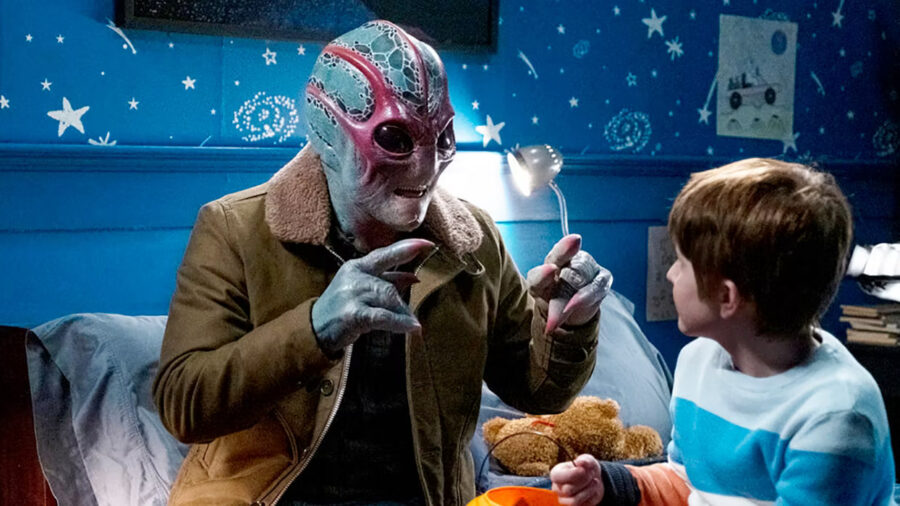
The first few episodes have the other residents of Patience playing the straight man to Harry’s quasi-murderous antics, before Resident Alien finds its groove and settles in. As the seasons go on, Harry finds an ally in Judah’s mom, Asta (Sara Tomko), and a new enemy when the government moves into Patience, which, as with Stranger Things, is represented by Linda Hamilton as a no-nonsense extraterrestrial hunting General. Hamilton isn’t the only sci-fi cameo. Resident Alien is filled with familiar names and faces having the time of their life on the show.
Alan Tudyk’s Firefly co-stars, Nathan Fillion and Jewel Staite, turn up as a telepathic octopus and an FBI Agent respectively. Clancy Brown, Terry O’Quinn, George Takei, and Stephen Root all drop by while behind the camera, Star Trek Voyager’s Robert Duncan McNeill is often directing the big episode of the season. When the star of the show is one of the most beloved performers in Hollywood, it’s easy to get everyone to show up.
Resident Alien Is The Decade’s Best Sci-Fi Series

Resident Alien is an absolute blast of a series. It’s a throwback to the old SyFy slate of Eureka and Warehouse 13, and the only show this decade to nail that vibe. It took a while to catch on. Season 1 flew under the radar with barely a million viewers for each episode. Once it was available on streaming, it became a social media hit, and viewership boomed. Now that it’s complete on Netflix, expect it to again experience a new surge in popularity.
There’s a lesson to be learned here by studios about producing original sci-fi, or well, almost original, since it does adapt the comic book series by Peter Hogan and Steven Parkhouse, and then giving them room to grow, develop, and find their audience. Too often, sci-fi shows are canceled after one season before anyone even knows how great it is. Resident Alien did everything right, barely survived for four seasons, and is now going to be your new favorite series
Entertainment
The best early Prime Day air fryer deals you can shop right now
Best early Prime Day air fryer deals at a glance:


Prime Day is almost here — and Amazon isn’t waiting for the official start to roll out discounts. This year’s sale kicks off on June 23, but early deals on small kitchen appliances are already live, and air fryers are among the standouts.
Whether you’re after a compact basket-style fryer for weeknight meals or a larger oven model that can roast a whole chicken, brands like Ninja, Instant Pot, and Chefman are already seeing price cuts. Here are the best early Prime Day air fryer deals worth grabbing now.
Mashable Trend Report
Best mini air fryer deal

$64.99
at Amazon
$129.99
Save $65.00
Why we like it
If you live alone, like making apps or quick side dishes, or just want an air fryer that won’t take up your entire counter, the Instant Pot Vortex Plus 6-in-1 Mini Air Fryer (4QT) is on sale for $64.99 at Amazon, down from $129.99. This little air fryer can bake, roast, broil, dehydrate, reheat, and air fry small meals in minutes. Just press the preset button, and it does the rest.
Best large air fryer deal

$89.99
at Amazon
$149.99
Save $60.00
Why we like it
For households with more mouths to feed, the Chefman XL 6-in-1 Air Fryer (14QT) can make family-sized meals in no time. (There’s also a Hi-Fry button for those who prefer an extra crispy finish.) It comes with three removable wire racks, a rotisserie spit, a fetch tool to remove the rotisserie, and a dip tray/baking pan. And right now, you can get it for $89.99 — the lowest price we’ve tracked on this model to date!
More air fryer deals
Topics
Kitchen
Air Fryers

Cordless power tool deals are already live at Amazon before Prime Day starts
SoFi workers reach agreement to avoid strike ahead of World Cup


