Entertainment
The Battlestar Galactica Star Crossover With A Fan-Favorite Sitcom

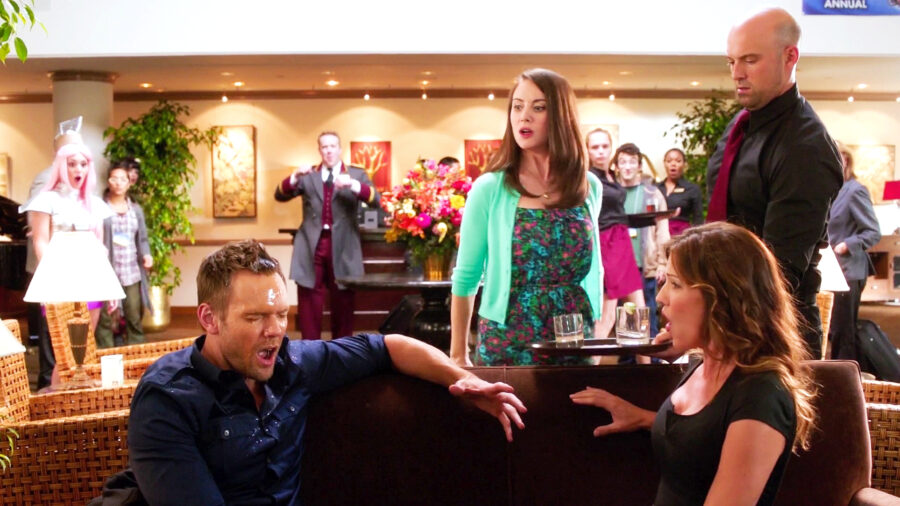
In the Community episode, Jeff was also about to try and lay one on Tricia Helfer’s Lauren. Suspecting that this lovely lady couldn’t possibly be in town for the convention, he flirts with Lauren, admitting that he ditched the nerd convention.
Lo and behold, Lauren is, in fact, there for the convention, and even mistakes Jeff for an actor from her favorite series, Inspector Spacetime. To make things for Jeff even worse, Annie, who has feelings for Jeff and is sharing a hotel room with him, decides now is the perfect time to pretend she is his wife.
Putting on a show for hotel staff and calling room service as Mrs. Winger, a staff member alerts Annie that her husband has been located in the hotel bar flirting with another woman. Still playing the part, Annie ends up confronting Jeff and Tricia Helfer’s character, dumping a drink over her friend’s face.
Entertainment
Keanu Reeves' R-Rated Cyberpunk Thriller On Netflix Will Scramble Your Brain
By Robert Scucci
| Published

I’ve got a nasty habit of not revisiting movies I first saw when I was seven, finally watching them as an adult, and realizing how much time I wasted not enjoying them over the years. The latest addition to that pile is 1995’s Johnny Mnemonic, a movie that has all the trappings of a straight-to-VHS sci-fi thriller but with a $26 million budget. I remembered loving it as a kid, but over time I kept telling myself, “I’ve already seen that, let’s try something new.”
If you take anything from me, it’s this: just watch the damn movie. Johnny Mnemonic rules. Not because it’s nostalgic. Not because it’s great cinematic art. It works because it’s Keanu Reeves delivering deadpan dialogue as the titular character, Dina Meyer throwing hands against corporate enforcers, Henry Rollins looking permanently angry and bewildered but always ready to help, and Ice-T reliably being Ice-T because that’s the most Ice-T thing he could possibly do.
Brain Implant Overload

Set in the year 2021, Johnny Mnemonic centers on Reeves’ Johnny, a mnemonic courier who uses his brain to transport encrypted files. The tradeoff is simple: you lose your memories, but you gain storage space, which means bigger and better jobs. When he’s tasked with carrying a payload that far exceeds his mental capacity, he takes the job anyway because the payout is too good to pass up.
Naturally, the job goes off the rails almost immediately. The highly sensitive data he’s carrying has global implications, drawing the attention of the yakuza and exposing their partnership with a megacorporation called Pharmakom. Johnny can’t trust his handler, Ralfi (Udo Kier), whose ulterior motives become obvious fast, which leads him to Jane (Dina Meyer), a cybernetically enhanced bodyguard working with a resistance group known as the LoTeks, led by J-Bone (Ice-T).

With help from a computer genius named Spider (Henry Rollins), the true nature of Johnny’s brain data is revealed, setting up a final showdown between Johnny and his crew, the Pharmakom corporation, and their grip on society through a degenerative condition known as nerve attenuation syndrome (NAS), which has pushed the world into a constant class war.
All That, And AI Dolphins
Johnny Mnemonic is one of those cyberpunk thrillers that feels unrealistic now that we’ve passed the timeline it predicted. Still, there’s a kernel of truth in how greed, corruption, and corporate power can spiral out of control. Even Johnny, our supposed hero, pushes his own brain past its limits for a payday that’s clearly beyond his scope, never stopping to consider the consequences. It’s a small but effective way of showing how baked-in these problems are in this world.

As ridiculous as the premise is, everyone commits. That commitment fuels some explosive retro-futuristic action and just enough comic relief to keep things moving. My favorite stretches involve Henry Rollins rattling off conspiracy theories that turn out to be completely accurate, playing into his anti-establishment persona in a way that feels less like acting and more like perfect casting.
Like a lot of gritty cyberpunk from the early 90s with that straight-to-VHS look, Johnny Mnemonic is buried on Rotten Tomatoes with a 19 percent critical score and a slightly better 31 percent audience rating from over 50,000 users. This is the kind of movie you need to meet on its own terms. If you’re into titles like Split Second, Prototype X29A, Fortress, and Crime Zone, then Johnny Mnemonic fits right in the pocket with them.

If that’s the kind of territory you like to occupy, Johnny Mnemonic is about as good as it gets, and you can stream it on Netflix as of this writing.

Entertainment
NYT Pips hints, answers for April 19, 2026
Welcome to your guide to Pips, the latest game in the New York Times catalogue.
Released in August 2025, Pips puts a unique spin on dominoes, creating a fun single-player experience that could become your next daily gaming habit.
Currently, if you’re stuck, the game only offers to reveal the entire puzzle, forcing you to move on to the next difficulty level and start over. However, we have you covered! Below are piecemeal answers that will serve as hints so that you can find your way through each difficulty level.
How to play Pips
If you’ve ever played dominoes, you’ll have a passing familiarity with how Pips is played. As we’ve shared in our previous hints stories for Pips, the tiles, like dominoes, are placed vertically or horizontally and connect with each other. The main difference between a traditional game of dominoes and Pips is the color-coded conditions you have to address. The touching tiles don’t necessarily have to match.
The conditions you have to meet are specific to the color-coded spaces. For example, if it provides a single number, every side of a tile in that space must add up to the number provided. It is possible — and common — for only half a tile to be within a color-coded space.
Here are common examples you’ll run into across the difficulty levels:
-
Number: All the pips in this space must add up to the number.
-
Equal: Every domino half in this space must be the same number of pips.
-
Not Equal: Every domino half in this space must have a completely different number of pips.
-
Less than: Every domino half in this space must add up to less than the number.
-
Greater than: Every domino half in this space must add up to more than the number.
If an area does not have any color coding, it means there are no conditions on the portions of dominoes within those spaces.
Easy difficulty hints, answers for April 19 Pips
Equal (0): Every domino half in this red space must have 0 pips. The answer is 6-0, placed horizontally; 0-2, placed vertically.
Equal (3): Every domino half in this purple space must have 3 pips. The answer is 3-3, placed vertically.
Number (1): The domino half in this light blue space must have 1 pip. The answer is 1-4, placed vertically.
Equal (4): Every domino half in this yellow space must have 4 pips. The answer is 1-4, placed vertically; 2-4, placed horizontally.
Equal (2): Every domino half in this dark blue space must have 2 pips. The answer is 0-2, placed vertically; 2-4, placed horizontally.
Mashable Top Stories
Medium difficulty hints, answers for April 19 Pips
Number (7): Everything in this purple space must add up to 7. The answer is 3-0, placed horizontally; 5-4, placed horizontally.
Equal (0): Every domino half in this red space must have 0 pips. The answer is 3-0, placed horizontally; 0-5, placed vertically.
Equal (5): Every domino half in this light blue space must have 5 pips. The answer is 5-4, placed horizontally; 5-1, placed horizontally.
Less Than (7): Everything in this yellow space must add up to be less than 7. The answer is 1-6, placed vertically; 0-5, placed vertically.
Number (7): Everything in this dark blue space must add up to 7. The answer is 5-1, placed horizontally; 1-6, placed vertically.
Equal (6): Every domino half in this green space must have 6 pips. The answer is 6-6, placed horizontally; 6-5, placed vertically.
Greater Than (1): The domino half in this purple space must have more than 1 pip. The answer is 6-5, placed vertically.
Hard difficulty hints, answers for April 19 Pips
Number (2): Everything in this purple space must add up to 2. The answer is 1-0, placed horizontally; 1-2, placed vertically.
Less Than (2): Everything in this red space must add up to be less than 2. The answer is 1-0, placed horizontally; 0-2, placed horizontally; and 0-0, placed vertically.
Number (5): Everything in this light blue space must add up to 5. The answer is 0-2, placed horizontally; 3-4, placed vertically.
Number (5): Everything in this yellow space must add up to 5. The answer is 3-4, placed vertically; 1-6, placed vertically.
Number (2): Everything in this dark blue space must add up to 2. The answer is 1-2, placed vertically; 0-6, placed vertically.
Equal (3): Every domino half in this green space must have 3 pips. The answer is 3-3, placed vertically.
Number (9): Everything in this purple space must add up to 9. The answer is 1-6, placed vertically; 3-6, placed vertically.
Number (8): Everything in this red space must add up to 8. The answer is 6-4, placed vertically; 4-2, placed horizontally.
Number (4): Everything in this light blue space must add up to 4. The answer is 4-2, placed horizontally; 2-6, placed horizontally.
If you’re looking for more puzzles, Mashable’s got games now! Check out our games hub for Mahjong, Sudoku, free crossword, and more.
Entertainment
Hollywood’s New Obsession Is Called Zealot Porn, How To Spot It
By Joshua Tyler
| Updated

I recently coined the term “zealot porn” to help explain a new kind of entertainment. Zealot porn is what happens when you make programming specifically designed to torment characters for their personal ideological views, with the goal of your viewers deriving pleasure from their suffering.
zealot porn (noun) — Media that graphically depicts violent punishment of ideological opponents, crafted to gratify the viewer’s sense of moral superiority and deliver cathartic satisfaction through retributive spectacle.

The key to zealot porn is that not only must the characters on screen be portrayed as zealots, in order to dehumanize them, but the people watching must themselves be zealous opponents of the characters’ ideology, in order to fully enjoy their suffering. Zealot porn is what happens when you make stories about zealots for zealots.
zealot (noun) — a person consumed by devotion to a cause or belief, so blinded by passion that reason becomes collateral damage.
This new genre took its clearest and most defined form in the second season of Peacemaker, when creator James Gunn crafted a scene designed to give his viewers the jollies over watching the murder of people who seemed like they might think good things about Nazis. Obviously, no one likes Nazis, but whether you personally like or dislike the views of the people being harmed isn’t relevant to whether or not something is zealot porn.
What matters is the intent of the media you’re watching, and whether that intent is to give the audience pleasure by dehumanizing and punishing people for their views. What those views are or their morality is irrelevant to defining the genre.
How To Spot Zealot Porn
Zealot porn isn’t difficult to spot, if you’re not emotionally invested in the topic. It’s nearly impossible to spot, however, if you are.
To determine if you’re watching zealot porn, use this checklist. If more than three of these are true, you’re probably watching zealot pon.
-
The “bad side” is cartoonishly evil, leaving no room for nuance -
Violence or humiliation is framed as morally satisfying, not disturbing -
The hero is always right, even when acting brutally -
Opponents exist only to be punished, not understood -
Emotional payoff outweighs logic or realism -
Scenarios feel engineered to justify a specific worldview -
Complex issues are reduced to simple good vs. evil
Zealot Porn Wins Oscars
The movie One Battle After Another is a zealous feast, and that won it Best Picture. We put together a video to explain it in depth.
Zealot Porn In Real Life
Zealot porn isn’t limited to fictional entertainment. Often, people get catharsis by watching videos or reading coverage of real-life ideological opponents being made to suffer. That’s on the rise too.
As I write this, prominent Democrat Eric Swalwell is getting his comeuppance over various salacious accusations, and Republicans are cheering and gaining pleasure from his downfall. This is a milder form, since no actual violence or death is involved.
catharsis (noun) — the sudden, involuntary purge of buried emotion that floods the mind like a breached dam, leaving behind a raw, emptied stillness that feels strangely like peace.
A more extreme example would be people celebrating the murder of conservative debater Charlie Kirk with similar elation. For them, watching him shot was another form of zealot porn, despite his very clearly not being a Nazi.
Others had similar reactions to videos showing the public execution of a health executive carried out by Luigi Mangione in 2024. That, too, was real-life zealot porn.
Early Zealot Porn

Zealot porn is not a new invention, but it’s been a long time since it was accepted in the mainstream. In the early days of Christianity, Romans fed believers to lions in front of cheering audiences. That was a low-tech version of zealot porn. Using media like movies and television as a delivery mechanism is, however, a recent phenomenon.
Past creators would have balked at the idea of dehumanizing characters for the audience’s base pleasure. Entire books have been written about it being a bad idea. It’s why George Orwell wrote 1984.

On a creative level, it would have formerly been considered bad writing. Normally, good writing aims to humanize the writer’s creations and make them relatable. Zealot porn does the opposite.
Early media that skewed closest to zealot porn are propaganda films from World War 2 or some of the more extreme grindhouse or blaxploitation movies of the 1970s. Most of those, however, focused more on the idea of dismantling a system or punishing someone who’d actively done something wrong. They’re revenge fantasies and not really the same. In the most despicable cases, as with movies like Triumph of the Will, they focused on hurting people based on some immutable outward physical characteristic.
The idea that it’s acceptable to dehumanize and destroy someone for their thoughts is newer in the modern mainstream, and it’s a growing phenomenon.
Quentin Tarantino Births Modern Zealot Porn

If you’re looking for the start of modern zealot porn, its roots can be found in Quentin Tarantino’s 2009 movie, Inglourious Basterds.
The movie presents an alternate history in which a group of American commandos wipe out the evil Nazis and kill Hitler, without the need for a global war. It isn’t about character arcs or military realism; it’s about watching the most evil regime in history get flambéed to the sound of David Bowie.
Nazism was a uniquely perfect ideology to use in birthing modern zealot porn, because nearly everyone has been pre-conditioned toward a zealous hatred of Hitler and his cronies. So Tarantino gives audiences, raised on decades of history classes talking about how uniquely evil Nazis were, exactly what they want: Nazis humiliated, carved, and annihilated. Punished for their beliefs even more than just their actions.

Inglourious Basterds is bloody, indulgent, and engineered specifically for moral satisfaction.
Still, Inglourious Basterds largely focused on murdering those embedded in the Nazi regime’s power structure. It didn’t, for the most part, take pleasure in killing random Germans walking down the street who might be thinking Nazi thoughts.
Inglorious Basterds is a more high-class type of zealot porn, but its existence helped give a green light to the growing wave of more extreme copycats that followed.
If modern zealot porn has a father, it’s Quentin Tarantino.
Robert Rodriguez Targets Conservatives For Destruction

If modern zealot porn has a mother, it’s Robert Rodriguez.
Robert Rodriguez’s Machete began as a fake trailer and mutated into a full-on immigration revenge epic. Danny Trejo stars as a former Mexican Federale turned one-man army after being betrayed by corrupt politicians and anti-immigrant vigilantes.
Where Tarantino created a movie designed to visit violence on a historical group almost universally agreed to be evil, Robert Rodriguez targeted his movie at a mainstream, modern group of people and their current (and widely held) beliefs on border security.

To make that work, he had to dehumanize his targets by twisting their views to cartoonish extremes. Rodriguez takes anti-immigration rhetoric and dumbs it down to absurdist levels, so that he can turn those who agree with it into fodder for righteous decapitation.
Every kill in his 2010 movie is meant not just payback for Machete’s betrayal but for decades of what his audience would perceive as xenophobic cruelty. The film is indulgent, cartoonishly violent, and completely lost in the bubble of its own politics.
Kevin Smith Finds Catharsis In Crazy Christians

If modern zealot porn has a weird uncle, it’s Kevin Smith.
Two years after Inglorious Basterds, filmmaker Kevin Smith applied Robert Rodregeuz’s anti-Conservative formula to fundamentalist Christians with the movie Red State.
The Evangelicals depicted in the movie are a cartoonish, demonic caricature of what real-life hard-line Christians are. That’s a key piece of the zealot porn formula, since it serves to dehumanize the real-world group, thus allowing the audience to take pleasure in their violent end.

By the movie’s end, Red State takes intense pleasure in their doom. As an audience, it feels acceptable because the movie makes them into monsters before it does its worst.
Later examples of purified zealot porn won’t go through as much trouble, but Red State, like Inglorious Basterds before it, was still pushing at the boundaries of what audiences would find acceptable. It’s more restrained than its predecessors but also more pointed in its attack on its character’s beliefs.
Thriving In Independent Film

Once Tarantino, Rodriguez, and Smith showed creators the way, there was a brief explosion in copycats. Those copycats stuck mainly to the topics that those three had already covered.
God Bless America followed in Rodriguez and Smith’s footsteps, gleefully cartooning conservatives for the righteous satisfaction of its audience in 2011. Iron Sky continued Tarantino’s zealous crusade against Nazis in 2012. All of those movies followed a similar pattern, where they turned their ideological opponents into cartoonish straw men to justify dehumanizing them before the slaughter.
Like Machete and Red State before them, none of these movies gained the widespread acceptance and viewership that Tarantino earned when he kicked things off with Inglourious Basterds. Their targets were often too divisive, and most people still recoiled at the idea of getting satisfaction from watching the suffering of people who might share the same views as their neighbors.
The Purge Takes Zealot Porn Big Time

It wasn’t until the arrival of The Purge franchise’s first sequel, in 2014, that zealot porn began to flirt with mainstream acceptance again.
The first entry in the series is a simple survival horror, but the second movie, The Purge: Anarchy, begins drifting into zealot porn as it sets up cathartic violence against wealthy elites. By the time The Purge: Election Year rolls around in 2016, it’s closer to an early-stage blockbuster zealot porn franchise. Each Purge sequel picks a different ideological target.

The Purge: Election Year takes aim at conservatives by turning them into cartoonish caricatures worthy of slaughter, in the mold of Kevin Smith’s Red State.
2018’s The First Purge goes back to the old standby by turning white Americans into modern-day Nazis, thinking racist thoughts, and in need of some murdering.
That push transitioned into zealot porn against nationalists in 2021’s The Forever Purge. That movie takes a weaker approach to it than its predecessors and isn’t as clearly dedicated to its satiation through zealotry.
The Hunt Bait And Switches Audiences

If you’ve been paying attention, you’ve probably noticed that most of the earliest zealot porn entries are aimed squarely at pleasuring left-wing viewers. Their targets are always conservatives or Christians, and they expect their audience to be the most liberal of liberal extremists.
The Hunt tried to trick audiences into thinking it was a commentary on the phenomenon of conservatives being targeted by billing itself as a movie about elite liberals hunting conservatives for their views. In reality, it’s another example of zealous slaughter of conservatives as the movie turns the hunted right-wingers into idiotic caricatures and tries to make the case that they had it coming due to some conspiratorial tweets.

The movie’s only real hero is totally apolitical, which I guess is in its own way a commentary on political polarization, but a weak one.
The Hunt is more of a muddled commentary on the rising popularity of zealot porn than an example of zealot porn itself.
Streaming Pushes Zealot Porn Forward To Its Final Form

Movies had begun paving the way towards making zealot porn socially acceptable, and streaming television took the next step.
The Boys is the best example of this. It started as a show primarily designed to deconstruct and hate on the standard tropes of superheroes. Over time, it morphed into something increasingly political. It creates supervillains designed to embody the political ideology its writers loathe most and then constructs situations in which they’re either humiliated or killed in the worst possible ways.

No character embodies that more than the character of Homelander. He isn’t just evil, he’s the delusional cartoon version of what bubble-dwellers imagine Fox News viewers to be. And even while he survives, the show does everything it can to humiliate and degrade him. Meanwhile, the show’s creators used social media to openly invite audiences to see him as an avatar for Donald Trump and his ideological supporters.
Whenever Homelander or one of these symbols gets publicly humiliated, exploded, or blackmailed, the show delivers a dirty hit of catharsis to its similarly minded, zealous viewers. That’s exactly what they’re going for.
Peacemaker Perfects Zealot Porn

Peacemaker took zealot porn to the next and purest level. All previous efforts used cartoonish oversimplification to dehumanize their ideological opponents, before brutally making them suffer.
Peacemaker doesn’t bother. Returning to the genre’s roots by setting the show’s second season in a world run by Nazis, Peacemaker doesn’t show its residents as engaging in evil before killing them. It simply kills them, because they’re residents of a Nazi world. The show assumes that the viewers will do all the dehumanization in their heads, on their own.

That works because we’re dealing with Nazis, but as Inglorious Basterds demonstrated, it’s unlikely to stop there. Movies like One Battle After Another represent the next wave of mainstreamed zealot porn, which takes the dehumanization of wrongthinkers to previously unseen levels.