
Entertainment
That wild Scarpetta ending, explained

After eight time-jumping, case-blending episodes, Scarpetta ends with a bang. Well, more of a bludgeon.
The Prime Video series based on Patricia Cornwell‘s books — namely, the first Dr. Kay Scarpetta book, Postmortem (1990), and Autopsy (2021) — finishes up its first season with some answers, but then leaves major question marks and red herrings flapping about in the air.
Let’s get into what happened, what Scarpetta (Nicole Kidman/Rosy McEwen) found out, and what burning questions we have for Season 2 (which Amazon has confirmed is coming). Obviously, spoilers ahead.
Who is killed in Scarpetta?

Nicole Kidman as Scarpetta.
Credit: Connie Chornuk / Prime
Scarpetta could have really given us more information about the murder victims.
In 2026, there are two women murdered: Gwen Hainey, biomedical engineer at Thor Labs, who was selling U.S. biotech secrets to Russia, and runner Cammie Ramada, whose death was ruled as “accidental” despite being anything but.
In 1998, there are five women murdered: ER surgeon Lori Petersen’s killing begins the series, after the murders of Cecile Tyler, Brenda Steppe, and Patty Lewis. Then, journalist Abby Turnbull’s (Sosie Bacon) sister, Hannah, is also murdered.
Who is the killer in Scarpetta?

Jake Cannavale as Pete Marino, Rosy McEwen as Dr. Kay Scarpetta.
Credit: Connie Chornuk / Prime
There are two killers in Scarpetta, one in the past and one in the present.
1998 killer: Roy McCorkle
Through glittery government soap and emergency call records, ’90s Scarpetta figured out the identity of the serial killer she, homicide detective Pete Marino (Jake Cannavale), and FBI profiler Benton Wesley (Hunter Parrish) had been investigating. The killer is Roy McCorkle (Martin De Boer), a local 911 dispatcher who had chosen his victims based on their voices.
2026 killer: August Ryan
In the present, the murderer is revealed to be a copycat. Officer August Ryan, the braces-wearing cop Scarpetta has worked with since the ’90s murders, is the killer of Gwen Hainey and Cammie Ramada.
Scarpetta first meets Officer Ryan at the murder scene of Lori Peterson in Berkley Heights in 1998. “I was never the first on a scene before, of a grisly murder,” he tells her, visibly affected by the violence. This murder ignited Ryan’s penchant for violence but his traumatic past also played a part (more on that below). Later, at the scene of McCorkle’s death, Ryan calls him a “murdering bastard,” and scorns “what he did to those women,” despite those being actions he will repeat 28 years later.
In 2026, Ryan is the first person Scarpetta talks to at the crime scene where Gwen Hainey is found in episode 1. Ryan leads Scarpetta to the victim, pretending to have just encountered the scene he created. Ryan then meets Scarpetta and Marino at the condo where Gwen Hainey was attacked — he even smugly declares that he “found” the murder weapon and reports that Matt Peterson’s fingerprints are all over it (Lori Peterson’s husband, the main suspect of the 1998 murders), which sends Scarpetta and Marino off course. In episode 4, Ryan does it again, leading medical examiner Dr. Debbie Kaminsky (Ashley Shelton) to Cammie Ramada’s body, a crime scene he also created.
Motive? “I did it to impress just the right gal,” Ryan says in the finale, referring to Scarpetta herself.
What’s with the 3D-printed organ business?
In Scarpetta, Thor Labs is a tech company that 3D prints human organs. And though the storyline goes off on a tangent with dead astronauts, the most important thing is that the company links the murder victims in 2026.
Mashable Top Stories
Gwen Hainey and Cammie Ramada both bear skin grafts, pieces of biosynthetic skin made by Thor Labs. Remember, Hainey was a biomedical engineer there, working on the Thor Orbiter Project (3D printing human organs in space). In the finale, Scarpetta receives a call from Officer Blaise Fruge (Tiya Sircar) saying there was a third person in Thor’s skin test group, but Fruge is cut off before naming them.
“That’s how he met them,” Fruge says. “They were in the same group.”
That person? August Ryan, who, as a child, burned his arm on a train track the night he witnessed his uncle committing sexual assault. Presumably, Ryan was after a skin graft. As to the pennies? Ryan’s uncle distracted him with a penny during his crime, one the kid was trying to retrieve from the hot track when he was burned; pennies were left at the murder sites of Gwen Hainey and Cammie Ramada, and Scarpetta finds a penny on her dining room table.
What’s the deal with Maggie and Reddy?
Maggie Cutbush (Stephanie Faracy/Georgia King) spends the present-day storyline basically being a creep and an anti-feminist pain in the ass, but there’s more going on here than meets the eye.
In the ’90s, Maggie was appointed Scarpetta’s assistant when her computer was hacked for information about the Peterson case. Scarpetta wrongfully accused Maggie and fired her. However, the culprit was Dr. Elvin Reddy (Alex Klein), Scarpetta’s professional rival, who also tampered with evidence to discredit Kay.
Now, Dr. Reddy is a piece of work. He wanted Scarpetta’s job of Virginia’s chief medical examiner back in the ’90s, so always had a chip on his shoulder. Reddy hires Maggie as his own assistant, and the show suggests an abuse of power and sexual harassment. In episode 4, Scarpetta looks into Cammie Ramada’s death, ruled as “undetermined” by medical examiner Kaminsky. But Scarpetta finds out that Reddy (chief medical examiner by this point) had shown up at the autopsy with a bunch of FBI agents (the crime scene goes across federal and district lines) and essentially bullied Kaminsky to rule Cammie Ramada’s death an accident.
In the present, Maggie is deployed again as a “direct line” between Scarpetta’s office and Reddy, now health commissioner (and Scarpetta’s boss). Importantly, Reddy and Maggie know Scarpetta’s secret: She killed McCorkle in self-defense in the ’90s — and Marino covered it up for her. Scarpetta did the autopsy, then lied about the findings, but notably, Reddy came into the morgue and indicated he knew there was more to the killer’s death than Marino’s bullets.
In the finale, Maggie flips the script telling Scarpetta she has proof to bring their dodgy boss down. “Pick a crime,” she says. “I’ll get you everything you need to nail the bastard. Leave me out of it, and I’ll leave you out of it.”
What’s going on with Benton Wesley?

Simon Baker as Benton Wesley.
Credit: Connie Chornuk / Prime
Scarpetta’s cardboard husband, Benton Wesley, has dark secrets. We know he left his wife and kids for Kay, and is having an affair with his FBI cybercrime partner Sierra Patron (Anna Diop). We also know he had a traumatic childhood involving neurodivergence and reading disturbing material before his career as a serial killer profiler.
In the finale, Scarpetta tracks Wesley to his definitely illegal interrogation truck at home using Find My Friends, and he warns her to stop investigating Gwen Hainey and Cammie Ramada “before it’s too late” without elaborating. He’s also sent hacker Jinx Slater (Luke Jones) to jail for his girlfriend Gwen Hainey’s murder, presumably to keep the FBI’s Thor Orbiter investigation under wraps.
However, during the scene, Wesley gets…creepy, saying he has some “strange behaviours” and that “there are some creatures that I enjoy to watch suffer,” which seems like he’s about to confess to his “real self” being real dark. We all saw him watch that fly die in pain, and we won’t forget his creepy childhood lair in the basement. But then he simply asks for a divorce. What a fake-out.
Is Matt Peterson actually innocent?
Matt Peterson (Graham Phillips/Anson Mount), the husband of Lori Peterson, appears to be Scarpetta‘s red herring. He’s the guy Marino (Bobby Cannavale) suspected and punched, who runs a cultish grief farm (where Lucy inexplicably ends up in the finale — girl, wyd). But is he actually as innocent as he seems? Sure, he just happened to meet Gwen Hainey in a bar trying to bring his wife back to life with 3D-printed organs. But in episode 1, when a young Marino is interviewing a young Peterson, the suspect mentions one of the first things he noticed meeting Lori in college was her “contralto” voice. “Stopped me in my tracks,” he says. “Its actual tone was perfection.” Marino counters, asking, “You notice a thing like that, huh?” How did McCorkle choose his victims? Their voices. Still a red herring?
Who “killed” Janet?

Ariana DeBose as Lucy Farinelli-Watson.
Credit: Connie Chornuk / Prime
Both Kay and Dorothy (Jamie Lee Curtis) say they didn’t “kill” Janet, the AI version of Lucy’s (Ariana DeBose) wife that she’s been talking to daily since her real death, but she’s sure one of them did it. So, was it one of them? Or was it, say, Blaise Fruge, who wanted to exact a little bit of revenge on her lover for walking out during their argument about Blaise losing her job thanks to Lucy’s “joy ride” to The Orchard? Or perhaps Janet did find a code back door to walk out of…
Don’t miss out on our latest stories: Add Mashable as a trusted news source in Google.
Who’s at the door?
In the final moments of Scarpetta, we see that Kay has absolutely baseball-batted Ryan to death. Then, someone arrives at the door, sees everything, and Scarpetta’s reaction is one of pure shock: “Oh no.”
Who could it be? Is it Lucy coming home from her grief session? Is it Marino coming back to declare his feelings? Is it Fruge, following her partner Ryan’s whereabouts? Or is it someone we haven’t met yet?
Scarpetta is now streaming on Prime Video.
Entertainment
Beloved Always Sunny Character Announces Long-Awaited Return
By TeeJay Small
| Published

FX’s It’s Always Sunny In Philadelphia is widely considered to be one of the greatest television comedies of all time. Even though the screwball series began with a rag-tag crew of misfit twenty-somethings who could barely light a soundstage, the show has evolved to have some of the most jaw-dropping moments on television. While it’s been a blast watching the gang lie, cheat, steal, and double cross each other for the past 17 seasons, most fans agree that the show’s biggest draw is its growing rogues gallery of bystanders.
These wacky side characters, most of whom appear significantly worse for wear with each passing appearance on the show, include street urchin Rickety Cricket, Ben the soldier, and the bizarre, incestuous family known as the McPoyle clan. Thanks to a post from Guillermo del Toro on X, we now know that one of the most iconic McPoyles is coming back for Always Sunny‘s 18th season. The character, known as Pappy McPoyle, is a family patriarch, proud bird owner, and occasional eyeball snatcher, who last appeared on the show’s 11th season.
The Pap Is Back!

In case you missed it, legendary filmmaker and three-time Oscar winner Guillermo del Toro is the decorated thespian responsible for bringing Pappy McPoyle to life. You might not recognize him under the billowing beard, Gandalf-length white hair, and dirt that covers his entire face. As the story goes, del Toro first raised the possibility of doing a cameo appearance in Always Sunny while he was working with series star and co-creator Charlie Day on the 2013 film Pacific Rim. As they discussed the role, the Oscar-winner became committed to the idea of playing the most depraved and disgusting character the Sunny crew could conjure, and Pappy was born.
To date, Pappy has made his way onto It’s Always Sunny In Philadelphia just twice, though he’s made a big impact on fans even with his limited screen time. He first showed up disheveled and ornery during the events of season 8’s “The Maureen Ponderosa Wedding Massacre,” and later took the witness stand in season 11’s “McPoyle vs. Ponderosa: The Trial of the Century.” According to the show’s lore, the entire McPoyle crew sprang forth from his mighty loins, along with one unnamed McPoyle who attempted to devour him upon birth. Fear not, intrepid viewer: Pappy ate him first.
Over A Decade In The Making

Last time we saw Pappy McPoyle, he was sicking his Pocono swallow on a courtroom full of unsuspecting people, and demanding that the bird snatch the eyeball of everyone’s favorite Harvard-educated lawyer. The interaction concluded with sweeping pandemonium, leaving fans unsure if Pappy was arrested by the court bailiff, or if he slinked off into the night, content to feast upon his freshly-snatched peeper under the cover of darkness. It’s been over 10 years since that episode aired, so we’ll have a lot of catching up to do once Always Sunny‘s 18th season finally arrives.
Guillermo del Toro’s social media post is quite cryptic. It doesn’t provide much direct information, other than an overt confirmation that Pappy McPoyle will return. For now, we’ll just have to wait for new episodes of It’s Always Sunny In Philadelphia to release in order to find out where he’s been, where he’s headed, and what avian horrors await under his hat.
Entertainment
Winona Ryder's Raunchy, R-Rated 80s Comedy Still Shocks Audiences Today
By Chris Snellgrove
| Published

Old-timers love to wax philosophic about the good old days of cinema and how modern Hollywood just can’t create anything quite like the hit movies of yesteryear. A frequent theme of these complaints is that certain subjects have become taboo, which is why we no longer get R-rated comedies filled with nudity and transgressive humor. Most of the time, these gripes are overblown. While there are still plenty of transgressive movies out there, studio execs prefer to play it safe with big celebrity films for fear of scaring off the audience.
Back in 1988, though, we got Heathers, a star-studded film that could absolutely never be made today. That’s because this black comedy explores some of the most taboo subjects modern audiences can imagine, including school shootings and teen suicide, and it does so in the funniest possible way. If you’re ready for the most mean-spirited, hilarious movie of the ‘80s, then it’s time to grab your favorite flavor of corn nuts and stream Heathers for free on Tubi.
The ’80s Are Sexier Than Ever

The premise of Heathers is that the high school of a sleepy Ohio suburb is ruled with an iron fist by three popular and ruthless students: the titular Heathers. New girl Veronica desperately wants to join their clique, but her priorities seem to change when she meets a brooding and mysterious transfer student. When he helps her with a prank that turns out to be deadly, it’s soon clear that nobody’s lives will ever be the same.
The young cast of Heathers has some titanic talent, including the late, great Kim Walker (best known outside this film for Say Anything) as the ruthless leader of the Heathers, a shark trawling her high school for prey. That would-be prey includes a character played by ‘80s icon Winona Ryder (best known for Little Women) and a fellow Heather played by ‘90s icon Shannon Doherty (best known for Beverly Hills, 90210). But the real star of this black comedy is Christian Slater (best known for Very Bad Things), who does his best Jack Nicholson impression while creating one of the most compelling villains in cinematic history.
The Film That Blew Critics Away

Even though it was a critical darling (more on this very soon), Heathers was a box office bomb upon release, earning a paltry $1.1 million against its modest budget of $3 million. However, it quickly gained a cult following on home video, and this eventually led to two very different follow-up projects. The first was a short-lived television series that only got 10 episodes, while the second was an immensely successful Broadway musical, which can currently be streamed for free (check it out, it’s weirdly good!) on The Roku Channel.
When Heathers came out, it hit the critical world with all the impact of a bomb blast. On Rotten Tomatoes, it has a 95 percent, with critics praising the film for its dark humor, cynical characters, and subversive plot line. They also noted that this movie was a serious game-changer, one that left a permanent mark on every teen comedy that followed in Heathers’ bloody footsteps.
Heads Up, Hollywood: There’s A New Sheriff In Town

Heathers is one of those black comedies that never pulls any punches, and the film is that much stronger for it. It’s a movie where two characters make an accidental murder look like a suicide, and they keep doing so to cut out the worst of the student body like a cancer.
That’s already bleak enough, but the cherry on top is that the idiotic high school leaders assume this is part of a nationwide problem where youngsters view suicide as trendy. In a modern age where influencers can’t even say the word “suicide,” the movie’s in-universe song lyrics “Teenage suicide/ Don’t do it!” are transgressively funnier than ever before.

In the wrong writer’s hands, the ghoulish plot would be as dead as our main characters’ growing number of victims. But the script by first-time screenwriter Daniel Waters (he would go on to write such ‘90s bangers as Batman Returns and Demolition Man) will keep you laughing, even when the subject material is something you’re never supposed to laugh at. Heck, this is a film that dares to transform topics as taboo as school shootings into just another macabre punchline.
You’ll Definitely Preach About This Movie

It helps that Waters has such a solid handle on writing for young characters, and he does a pitch-perfect job of transforming the fictional Heathers high school into something universally recognizable. You might not have had to deal with a literal group of Heathers growing up, but every high school has their imperious, “too cool for school” cliques, just as every high school has a quirky new kid who tries to look like a mysterious rebel. High school is all about trying different identities on for size, and Heathers is shockingly adept at comedically navigating the gap between how we appear today and what we hope to look like tomorrow.
Of course, this tight script would be nothing without killer performances from actors like Christian Slater, who is at his charismatic best as a new kid out to make his daddy issues everyone else’s problem. Winona Ryder, meanwhile, is perfect as an ingenue who can’t decide whether she wants to join the elites of her high school, or take the time to discover what she really wants (which may or may not involve the cute new boy who keeps causing trouble). But the biggest revelation of this film is the late, great Kim Walker, whose Heather Chandler character is the perfect embodiment of sarcasm, style, and sex appeal (not to mention corn nuts).
Punch It In


With lines like “f*ck me gently with a chainsaw,” Heathers established itself as one of the greatest black comedies ever made. Will you enjoy watching this ‘80s classic, or will it leave you wanting to kill this film and make it look like an accident? The only way to find out is to grab your remote (preferably with a Big Gulp Slurpee from 7-Eleven in your other hand) and stream Heathers for free on Tubi.
Entertainment
X-Files Turned Greatest Natural Mystery Into Legendary Episode
By Jonathan Klotz
| Published

During The X-Files’ historic run, Mulder and Scully tackled mysteries both large (aliens) and small (Was Scully’s old partner really possessed?), leading to the Season 6 episode, “Triangle,” where Mulder finds himself trapped in the Bermuda Triangle. It was only in the last decade that the mystery of the Bermuda Triangle started to vanish from pop culture.
Once on the same level as quicksand as far as Gen X and Millennials were concerned, the area between Florida’s east coast, Bermuda, and Puerto Rico has been the site of countless lost ships, planes, and mysterious sightings. The “Devil’s Triangle” was the perfect setting for a standalone episode, and “Triangle” turned out to be one of the best of the series.
The Monster Of The Week Is The Bermuda Triangle

Agent Mulder (David Duchovny) is stuck on a raft out in the ocean when the Queen Anne ocean liner picks him up. This would be a good thing except it’s 1998, and the Queen Anne vanished within the Bermuda Triangle in 1939. Mulder quickly realizes that he’s the one who went back in time after German officers, led by a man who looks exactly like the Smoking Man (William B. Davis), comes on board, and a radio broadcasts the start of World War II.
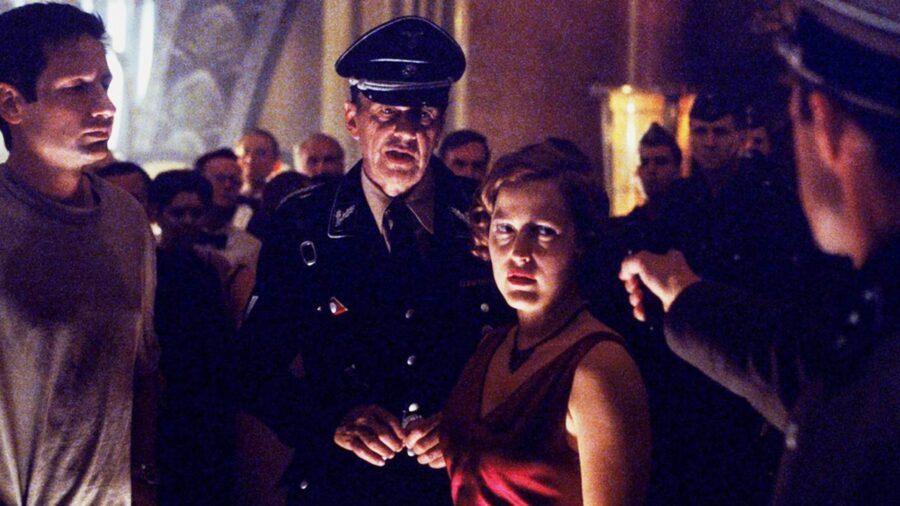
The Germans are searching for “Thor’s Hammer,” one of the Allies’ secret weapons, which Mulder helpfully corrects by explaining that “Thor’s Hammer” is a person, not a weapon. During his interrogation, a past version of Scully (Gillian Anderson), or at least a woman who looks exactly like her, steps forward to put an end to it. This sets off a chase sequence shot to look a single-take thanks to some carefully timed edits that ties together both the 1939 Queen Anne with the 1998 version.
While Mulder is with Not-Scully in the past, present Scully and the Lone Gunmen are exploring the present ship, which mysteriously turns up in the middle of the ocean with not a single soul on board. In a split screen, viewers watch the past on the left and the present on the right as they all go down the same hall, and then pass each other, alternating the perspective. It’s a fun effect, but it’s what comes next that got The X-Files fans all excited.
The X-Files Sort Of Gave Fans What They Wanted

After years of teasing and buildup, Mulder kissed Scully. Well, Not Scully, right before he jumps overboard in 1939. In 1998, he wakes up and confesses his love to Scully, who blows him off. Every single fan of The X-Files had been waiting for the kiss, and in “Triangle” it finally happened, sort of. It was a genius way for creator/director/writer Chris Carter to give fans the moment they wanted without impacting the series’ established arc.
“Triangle” was purposely designed by Carter not to tease fans for another year, but as a challenge to himself to use as little film roll as possible. The long tracking shots were inspired by Alfred Hitchcock’s Rope, and the dual time narrative came from The Twilight Zone episode, “An Occurrence at Owl Creek Bridge.” Put together, and “Triangle” looks like nothing that came before or after.

The X-Files would go on to pair Mulder and Scully together as a romantic couple, finally paying off the year’s worth of fanfictions and pleading from the fans. Thanks to the technical first kiss, and the inventive storyline that was a little bit time loop and a little bit Wizard of Oz, “Triangle” remains a fan favorite to this day. Few shows can say that one of their best episodes came six seasons in, but then again, few shows were as revolutionary as The X-Files.

Oklahoma in desperation mode for SEC tourney clash vs. Texas A&M
Back among Big East's best, Villanova takes on Georgetown


