
Entertainment
Stream Genre-Defining Action Franchise On Hulu Before Upcoming Spinoff

By Robert Scucci
| Published

If you haven’t yet worked your way through the John Wick franchise, but need some excitement in your life before the upcoming Ballerina spinoff movie sees its June 6, 2025 release, then you can blast your way through the first four films on Hulu faster than you can say “Baba Yaga.” Starting with one man’s quest for revenge before quickly snowballing into the convoluted politics of the High Table council that runs the world, the John Wick franchise is celebrated as the best of its kind for its high body count, nuanced storytelling, elaborate worldbuilding, and meticulously choreographed action sequences. If that’s not enough to get your motor going, it’s also worth noting that John Wick once killed three men in a bar with a pencil.
It Starts With A Dog

The John Wick universe slowly builds on itself, starting with such a painfully simplistic premise that you’ll first wonder how it grew into a billion-dollar franchise. With each installment more complex than the one that precedes it, you’re taken on a wild journey that starts with a man avenging his dog that ends up traversing continents as the politics of the High Table become increasingly convoluted but nonetheless operate like a well-oiled machine. Unlike other action franchises that can never fully recreate the lightning in a bottle that was captured with the first installment, the John Wick universe has proven that if you slowly fold in the lore without ever fully showing what’s going on behind the curtain, then the sequels will be successful.
After all, John Wick: Chapter 4 is the highest-grossing film in the franchise (over $440 million in box office receipts, worldwide), and considered to be one of the greatest action movies of all time.
Why It Works
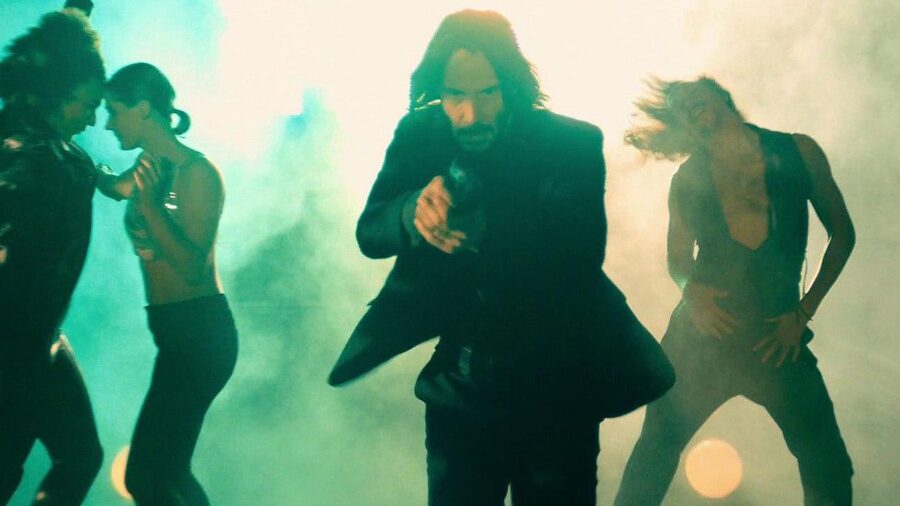
Known for their over-the-top action sequences that have unthinkably high body counts, every film in the John Wick franchise is an adrenaline rush from start to finish, and Keanu Reeves never seems to phone it in with his portrayal of the eponymous character. Even after he’s been beaten into submission, Reeves still manages to request “Guns. Lots of Guns.” while making a cheeky reference to the Matrix franchise when John Wick: Chapter 3 – Parabellum begins to heat up.
Guided by the owner of the Continental Hotel, Winston Scott (Ian McShane), and his concierge, Charon (Lance Reddick), John Wick, through “sheer f*cking will” always manages to stay one step ahead of the powers that be. As the John Wick film franchise expands, we’re introduced to Laurence Fishburne’s Bowery King, who isn’t afraid to play against the rules.
Continues to Build


At its heart, the John Wick franchise focuses on one man’s journey for peace as he returns to the life of crime he abandoned when given no other choice after a dog gifted to him from his deceased wife is murdered, and his car is stolen. From this launching point, the seedy politics of a criminal underworld are slowly exposed, making you wonder how deep everything really goes. After four films, The Continental spinoff prequel series, and the upcoming Ballerina film, which will take place between the events witnessed in Chapter 3 – Parabellum and Chapter 4, there’s no sign that the John Wick franchise will be letting up any time soon, and future film installments are in varying stages of production at the time of this writing.
Presently, you can stream John Wick and its sequels with an active Hulu subscription (Chapter 4 will require the STARZ add-on).
Entertainment
Mike Flanagans Carrie gets its first trailer ahead of Oct. release

Horror’s favorite It girl is getting her television series debut, with the first trailer now out for Mike Flanagan’s (The Haunting of Hill House) adaptation of Stephen King’s Carrie.
The eight-episode miniseries follows Carrie White as she endures bullying at school and abuse at home from her fanatically religious mother, Margaret — all while discovering she has telekinetic powers. As the trailer shows, Flanagan’s version drags King’s 1974 novel into the present day, trading its original setting for a story steeped in social media and viral humiliation. The 2013 film adaptation made a similar leap into modern times, so here’s hoping this take sticks the landing.
It’s worth noting that technically, this isn’t Carrie‘s first trip to TV. A 2002 television movie, directed by David Carson and written by Hannibal‘s Bryan Fuller, starred Angela Bettis (Girl, Interrupted) in the title role — though Flanagan’s series marks the story’s first full episodic adaptation.
Summer H. Howell leads the new cast as Carrie White, alongside Samantha Sloyan as Margaret, Siena Agudong as Sue Snell, and Matthew Lillard as Principal Grayle, with Alison Thornton, Thalia Dudek, Amber Midthunder, Josie Totah, Arthur Conti, and Joel Oulette rounding out the ensemble. Flanagan serves as writer, showrunner, and director on four of the eight episodes.
Carrie premieres on Prime Video October 7.
Entertainment
Ryan Gosling to star in MCUs Ghost Rider film
After years of rumors and on-again, off-again flirtation between Ryan Gosling (Project Hail Mary, Barbie) and the Marvel Cinematic Universe, it’s now confirmed: the actor will play Johnny Blaze, aka Ghost Rider, in an upcoming film.
This Tweet is currently unavailable. It might be loading or has been removed.
For those unfamiliar with the character, Ghost Rider is the demonic alter ego of stuntman Johnny Blaze, who strikes a deal to sell his soul to the demon Mephisto in order to save his father’s life. Blaze’s soul is then bonded to Zarathos, the Spirit of Vengeance, transforming him into a leather-jacketed, motorcycle-riding, flame-skulled avenger. Thus, Blaze is forced to punish the wicked and evil whenever Mephisto needs him to.
Marvel Studios President Kevin Feige introduced Gosling to a packed Hall H at San Diego Comic-Con to roaring applause. The titular film will be directed by Shawn Levy, who previously helmed Deadpool & Wolverine, and is slated for release in 2028. It marks the first film adaptation of the supernatural antihero since 2007’s Ghost Rider, starring Nicolas Cage, and its 2012 sequel, Ghost Rider: Spirit of Vengeance.
Mashable Top Stories
On the television side, Gabriel Luna played the Robbie Reyes variant of Ghost Rider in the fourth season of Agents of S.H.I.E.L.D. That appearance was meant to lead into a solo spin-off slated for 2020, but a “creative impasse” in late 2019 led to the project’s cancellation.
Gosling and Levy are already collaborators. The two are currently working together on Star Wars: Starfighter, due out in May 2027, and reportedly spent downtime on that set trading ideas for a Ghost Rider film.
Alongside the reveal of Gosling at Hall H, Feige also announced Black Panther III as a part of the MCU’s 2028 slate. The film will star David Jonsson (Alien: Romulus, Industry) as the titular Black Panther, aka T’Challa II. The last we saw of T’Challa II was his introduction as a small boy in Wakanda Forever, revealed to be the son of Chadwick Bosman’s T’Challa with Nakia (Lupita Nyong’o).
Not much is known about the plot for Ghost Rider, but given the character’s ties to Mephisto, it won’t be a surprise to see Sacha Baron Cohen reprise the role from Ironheart.
Entertainment
Get lifetime ad blocking for up to 9 devices for $11
TL;DR: Protect up to nine devices with the AdGuard Family Plan Lifetime Subscription for $11 (reg. $169.99) through July 26 at 11:59 p.m. PT.
It doesn’t matter if your household has two devices or 20, keeping everyone’s online activity protected can quickly become complicated. The AdGuard Family Plan simplifies things by covering up to nine devices with a single lifetime subscription. Through July 26 at 11:59 p.m. PT, new users can get it for $11 (reg. $169.99).
The Family Plan is designed specifically for households rather than individual users. In addition to blocking intrusive ads across supported devices, it helps reduce online tracking, warns about phishing sites, and adds another layer of protection against malware. That means fewer distractions while browsing and more peace of mind when the whole family is online.
Mashable Deals
One great feature is the parental controls. Parents can restrict access to inappropriate or adult content while still giving kids access to the sites and apps they know and love. Combined with privacy protection that helps hide browsing activity from trackers, the plan focuses on creating a safer online experience for everyone using the family’s devices.
The Family Plan works across desktop and mobile platforms, making it easy to protect laptops, phones, and tablets under a single subscription. Since it’s a lifetime plan, you won’t have to worry about monthly renewals or annual subscription costs after the initial purchase.
This offer is available to new users only, it covers up to nine devices, and you have to redeem your code within 30 days of purchase.
Mashable Deals
If you’re looking for an easy way to protect multiple devices without juggling separate subscriptions, the AdGuard Family Plan Lifetime Subscription is price-dropped to $11 (reg. $169.99) through July 26 at 11:59 p.m. PT.
StackSocial prices subject to change.

Caitlin Clark Shines After Barack Obama's Message Before WNBA All-Star Game
Drew Rasmussen, Rays blank Guardians to complete series sweep


