
Entertainment
Starfleet Academy's Only Hero Is The Character It Thinks Is The Villain

By Chris Snellgrove
| Published

Paul Giamatti’s Nus Braka is Star Trek’s latest Big Bad, and he has done an amazing job of tormenting students and teachers alike on Starfleet Academy. In a previous episode, he feigned helping out Chancellor Ake only to execute his real plan: destroying a starship and then ransacking the starbase it was protecting. The recent episode, “300th Night,” revealed what he stole: the Omega-47 particle, which can be weaponized to destroy subspace and make warp travel impossible.
He wasted no time deploying Omega-47 mines around the entirety of Federation space, essentially trapping everyone within their established borders. The show presents this as the act of a supervillain, one that our cadets must figure out how to stop in order to save the galaxy. However, given that the Federation was researching a superweapon to help them replicate the worst tragedy the future has ever seen, Nus Braka actually comes across as a hero saving everyone from a terrifyingly powerful rogue state.
From Villain To Hero

The special weapon that Nus Braka stole has been known to the Federation for the better part of a millennium. In the Voyager episode “The Omega Directive,” Janeway reveals that all Starfleet captains are required to destroy any trace of Omega particles that they find throughout the galaxy. The reason is simple: when these particles detonate, they destroy subspace, rendering warp and even long-range communications impossible. On top of its raw destructive power, the Starfleet of the 24th century wanted to destroy Omega on sight because it represented an existential risk to interstellar travel.
However, the Starfleet Academy episode “300th Night” revealed that the Starfleet of the 32nd century was secretly studying how to weaponize this particle. They succeeded in creating Omega-47, a synthetic version of this destructive molecule. It’s very easy to weaponize Omega-47, which our heroes found out the hard way when Nus Braka created landmines and deployed them around the entirety of Federation space, trapping all of his enemies in one place without having to so much as fire a shot.
An Omega-Level Threat

Nus Braka’s plan is both bold and effective: in one crazy move, he just managed to threaten the entirety of the Federation. Even better, he did so using the illegal weapons technology they have been secretly developing. All of this is meant to set up a season finale where our heroes save the day, but given what we’ve seen so far, I can’t escape one shocking conclusion: Nus Braka is the real hero here, and Starfleet has been the villain all along.
You can tell Starfleet is the bad guy of this story largely because of the organization’s own hypocrisy. Once upon a time, captains were responsible for destroying the Omega particle on sight simply because it represented a threat to interstellar travel. Destroying these particles meant that ships could continue exploring strange, new worlds. It also meant that alien planets wouldn’t effectively be cut off from the rest of the galaxy by particles whose detonation destroys subspace, making it impossible to warp in or out of an area or even communicate with the people inside.
Starfleet’s Heel Turn, Revealed

Now, the Starfleet of the future has decided they want to have the ability to threaten the rest of the galaxy. Keep in mind that there is no known positive use of Omega particles; they can’t be used as an energy source, which might at least make sense when dilithium has become so scarce. The only function of Omega-47 is to give Starfleet the ability to threaten countless worlds, and that threat comes in the form of replicating the greatest disaster the 32nd century has ever known: the Burn.
In Discovery, we learn about an event known as the Burn that suddenly made most of the dilithium in the galaxy inert. This instantly destroyed any ships with an active warp core (when dilithium goes inert, it can no longer keep matter and antimatter separated) while making interstellar travel significantly more difficult. This event decimated the Federation and made the 32nd century downright hellish for many people. The young characters in Starfleet Academy are rough around the edges in large part because of the Burn: with supply lines nonexistent and energy in short supply, characters like Caleb grew up eating out of dumpsters, something that would have once seemed impossible.
The Future Is Even Worse, Thanks To Starfleet

I mention this to underscore that the Burn was the worst thing to happen to almost everyone in the 32nd century. It ruined lives and led to the rise of evil powers like the Emerald Chain, and all because it was now insanely difficult to travel anywhere at warp speed. Now, we discover that Starfleet has been secretly developing a superweapon that can replicate the effects of the Burn on a smaller, more targeted scale, allowing the Federation to cut any of its enemies off from the rest of known space.
That brings us back to my fairly simple thesis: while this certainly wasn’t the intention of the writers, Starfleet Academy just presented Nus Braka as a hero for using Omega-47 against the Federation. Our protagonists are supposed to be the good guys, but it turns out that Starfleet was secretly developing technology that could help them threaten or outright destroy every planet in the galaxy. Now, the show’s biggest villain just used Omega-47 mines to contain the Federation within their own space, ensuring that no other ships can get in or out while the minefield is still up.
The Federation Is Now A Rogue State

In the real world, other countries take a dim view of rogue nations developing nuclear technology for two simple reasons: 1) they have threatened and harmed other nations before, and 2) they are trying to develop a weapon deadlier than any they have ever had before. If the rest of the galaxy learned about Omega-47, they would view the Federation as a rogue state that just violated all of its lofty ideals so that it could develop a superweapon. A weapon that would do what the various admirals and administrators have been wanting to do since the Burn, which is to make the Federation the most powerful force in the known universe.
This isn’t even the first time something like this has happened; remember, the Genesis Device could be used to destroy all life on a planet, making it the 23rd century Star Trek equivalent of the Death Star. Simply put, Starfleet and the Federation have spent nearly a millennium developing weapons that could threaten the entire galaxy, and Omega-47 is the latest one. By using this weapon against the Federation, Nus Braka may be a villain to our protagonists, but he’s a hero to the rest of the universe because he has done what nobody has been able to do before: save them from Starfleet!
This isn’t what the writers of Starfleet Academy intended, but they just made Nus Braka the secret hero of the series. Just as Michael Burnham had to keep Starfleet from blowing up the Klingon homeworld, somebody had to keep them from weaponizing the greatest threat the Federation has ever encountered. If the writers really want us to root for Starfleet Academy cadets, they need to do something simple: stop portraying Starfleet as a group of amoral control freaks out to threaten the entire galaxy!
Entertainment
Netflix Has Emma Stone's New Rated-R Sci-Fi Movie, It'll Turn You Inside Out

By TeeJay Small
| Published

If you’re into weird, trippy movies with complex characters, twisted conspiracies, and some overarching sci-fi elements, you’re probably already a fan of Greek filmmaker Yorgos Lanthimos. Lanthimos’ oeuvre includes The Lobster, The Killing of a Sacred Deer, and Kinds of Kindness, just to name a few. While each of these films offers a mind-bending adventure, none has turned my head inside out quite like his latest, Bugonia, now streaming on Netflix.
Bugonia stars Emma Stone as a ruthless CEO of a massive pharmaceutical conglomerate. Fresh off a slew of bad press for suppressing workers’ rights, Stone’s Michelle Fuller goes above and beyond to present the image of a caring, easygoing boss. She encourages her employees to take time for their mental health and leave early, while subtly implying that doing so would mean risking their jobs. She’s your run-of-the-mill billionaire monster.

As Fuller goes about her daily routine, we are introduced to conspiracy theorist Teddy Gatz, played expertly by Breaking Bad‘s Jesse Plemons, and his cousin Don, portrayed by newcomer Aidan Delbis. Teddy, like many real-life viewers at home, is a disenfranchised wage worker who has fallen down a deep rabbit hole of online alien conspiracies. He has come to believe that a race of alien creatures has assimilated into Earth’s population, disguised themselves as corporate elites, and subjugated the world through a series of telepathic commands.
Bugonia really picks up when Teddy and Don kidnap and imprison Michelle in their basement, believing her to be a member of the alien race. Based on information they’ve collected in insulated internet chatrooms, the duo shave her head, chain her up, and slather her entire body with antihistamine lotion. They believe these measures will prevent the CEO from utilizing her mind-control powers or contacting her alien mothership for backup.

From there, most of Bugonia centers on Michelle as she attempts to escape from her captors by any means necessary. She tries to enlighten the kidnappers with logic and deprogram their conspiracy-addled minds. She even tries leaning into the conspiracy and promising that she’ll bring them into contact with her alien superiors if they let her go. The whole time, Teddy and Don are taking measures to prevent themselves from being manipulated by Michelle, by chemically sterilizing themselves and taking prescription drugs against label instructions.
Bugonia is an absolute wild ride from start to finish, and one that I simply couldn’t pry my eyes away from. Everything from Emma Stone’s spectacular leading performance to the quirky, bizarre writing to the occasional mind-bending twist kept me on the edge of my seat, constantly questioning the film’s reality. By my estimation, it’s the perfect conspiracy movie for a post-Epstein list world, where even the most twisted conspiracies don’t seem as ridiculous as they did five or ten years ago.

If you get the chance to catch Bugonia on Netflix, don’t miss it. Just be sure to throw away everything you think you know before going in, or you just might find yourself manipulated by a race of malevolent alien overlords.

Entertainment
Get AdGuard Family Plan for $16 and protect up to 9 devices
TL;DR: The AdGuard Family Plan covers up to nine devices with ad blocking, privacy protection, and parental controls, now on sale for $15.97 (reg. $169.99).
$15.97
$169.99
Save $154.02
Most households aren’t running on just one device anymore. You probably have a few of your own, and everyone else under the same roof likely does, too. That means a mix of phones, laptops, and tablets — and all the ads, trackers, and distractions that seem to follow them everywhere. The AdGuard Family Plan is built to handle that, covering up to nine devices with ad blocking, privacy protection, and parental controls, now on sale for $15.97 (reg. $169.99).
If you’re tired of seeing ads every other scroll, chances are the rest of your household is, too. AdGuard helps cut through that noise by filtering out banners, pop-ups, and autoplay videos before they load. The result is a cleaner, less distracting browsing experience across devices.
Mashable Deals
It also adds a layer of privacy. AdGuard helps limit trackers and data collection while you browse, shop, or just wander the internet. It can also block access to known phishing and malicious sites, which is especially useful when not everyone using your Wi-Fi has the same browsing habits.
For households with kids, the parental controls help keep things in check. You can restrict access to adult content and set boundaries around what’s accessible online, helping keep things a bit more age-appropriate without constant supervision.
The Family Plan works across iOS, Android, Windows, and macOS, making it easy to cover most setups. With support for up to nine devices, it’s a good fit for households where screens tend to multiply.
Mashable Deals
Originally $169.99, you can score a lifetime subscription to AdGuard Family Plan for just $15.97.
StackSocial prices subject to change.
Entertainment
These Forgotten Star Trek Episodes Tried To Warn Us About AI Slop
By Chris Snellgrove
| Published

One of the most weirdly persistent debates of the modern world is over whether AI can create art. Sure, you can type a prompt into ChatGPT or any number of AI platforms and have a unique image within seconds. But while the image is technically unique, it’s not exactly original. The AI was trained on every image it could get its grubby little gears on, so you never get a truly one-of-a-kind image. Instead, you get a mishmash of one or more artists’ styles that the AI bot helpfully masses off as completely original art.
The debate over the matter is so fierce because the two sides are so diametrically opposed. AI bros claim that this technology effectively democratizes art, making it possible for anyone to share their vision with the world. Traditional artists, meanwhile, claim that art has always been democratic and that AI is just a soulless alternative to learning how to draw. While ChatGPT and other generative AI platforms are relatively new, this debate stretches back decades, and in two forgotten episodes of Star Trek: The Next Generation, the android officer Data reminds us of the limits of AI art.
To Prompt Or Not To Prompt

One such example came from the episode “The Defector,” which begins with Data and Captain Picard acting out Shakespeare’s Henry V on the holodeck. After Data gives a surprisingly solid performance, Picard compliments the android’s acting. However, Data demurs and basically admits that his acting was an amalgamation of other performers who have played this role. He tells Picard, “I plan to study the performances of Olivier, Branagh, Shapiro, [and] Kullnark.” The captain replies that while Shakespeare is perfect “to learn about the human condition…you must discover it through your own performance, not by imitating others.”
This episode first aired in 1990, but Picard’s dialogue fits right in with our modern AI debate. Data, fittingly enough, is doing what artificial intelligence always does: mashing together the work of several different artists. It looks like an original performance at first, which is why Picard applauds. But after finding out what Data did, he chides the android for just mashing a few other performances together and calling it a day. After all, he will never develop as an artist if he doesn’t take the time to develop his own style instead of copying everyone’s homework.
Picard Has Entered The Chat

This obviously reflects our modern discourse about generative AI. As an avid Shakespeare fan, Picard understands that what made those earlier actors so great was that they found ways to put their own spin on Henry V. If those performers hadn’t, in turn, just tried to copy others, then acting becomes functionally meaningless.
The conversation about Data creating art actually echoes another conversation in the earlier episode “The Ensigns of Command.” When Picard tells the android that his recent violin performance “shows feeling,” Data corrects him. “Strictly speaking, sir, it is not my playing. It is a precise imitation of the techniques of Jascha Heifetz and Trenka Bronken.” Picard insists that Data created something original because he successfully combined two very different performances. Reluctantly, Data takes the compliment, telling his commanding officer that “I have learned to be creative…when necessary.”
At this point, AI bros might think that Captain Picard is on their side. After all, he argues that by choosing to combine two wildly different musicians, Data is actually synthesizing something new, which is akin to “prompt engineers” feeding a bunch of contrary ideas into ChatGPT and hoping for the best. The key difference, though, is that Data still had to bust out the violin and successfully perform this composition himself. Picard considers Data an artist because the android actually makes art. So-called prompt engineers aren’t even doing that; they are simply asking the computer to make something cool and then taking the credit.
Computer: End Program
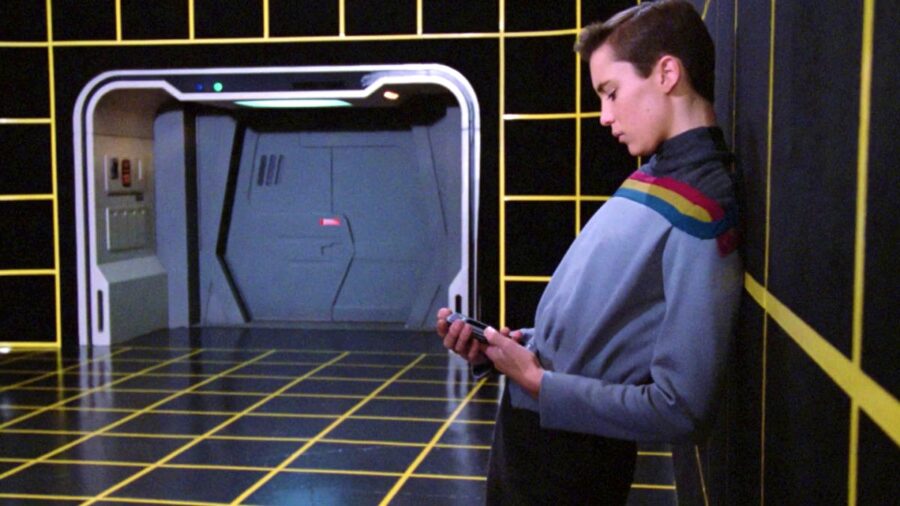
To keep our Star Trek framing, think of it this way: simply telling a computer to draw a picture is a bit like an Enterprise crewman telling the holodeck to create an exotic vista. Obviously, it takes some level of thought to generate an idea and tell it to the ship’s computer. But the crew doesn’t have to program anything or render anything because the Enterprise does all of the hard work for them. That’s why, in the far-flung future of the 24th century, nobody calls themselves an artist for barking a sentence or two at the computer when they get bored.
Unfortunately, the world is far less enlightened here in the 21st century. The laziest people in the world are typing one sentence into a glorified search engine and treating the resulting aesthetic abomination as a startlingly brilliant and original piece of art. Even wilder, they get grumpy when you don’t treat them like serious artists who spent a lifetime perfecting their craft. As it turns out, both now and in the future, there’s one thing that AI can’t generate: the approval from others that these tech bros so desperately need!

Best NBA Bets Today: Game 7 Picks for Cavs vs Raptors, Magic vs Pistons
Canadiens D Noah Dobson game-time decision for Game 7


