
Entertainment
Solar Opposites Season 5 Gives Fans Long-Awaited Marriage


Terry and Korvo are newlyweds in season 5 of Solar Opposites as they attempt to adapt to their new planet. Playing on a popular sitcom trope, the two have opposing opinions on everything, from food to pollution, but they are attracted to each other despite their differences.
Getting hitched in the Valentine’s Day episode last season, the newlyweds are adventuring on a new planet at the start of Solar Opposites Season 5.
In order to fit in with their new society, Terry (Thomas Middleditch), Korvo (Dan Stevens), Yumyulak (Sean Giambrone), and Jesse (Mary Mack) must attempt to be less “extra”.
However, when the Solar Opposites Season 5 family can’t keep their shenanigans under wraps, fitting in proves to be beyond their abilities, and they accidentally discover an omniscient alien overlord who controls the whole planet.
Korvo saves Terry from hurt feelings, demonstrating his true love for Terry, and satisfying the ongoing sitcom relationship fulfillment parable.
While Terry and Korvo have been in some kind of relationship for several seasons now, making it official has ushered in a new era of plotlines.
While Terry and Korvo have been in some kind of relationship for several seasons now, making it official has ushered in a new era of plotlines. Honeymooning and family values, alien style, are the order of the day for the Solar Opposites Season 5 clan.
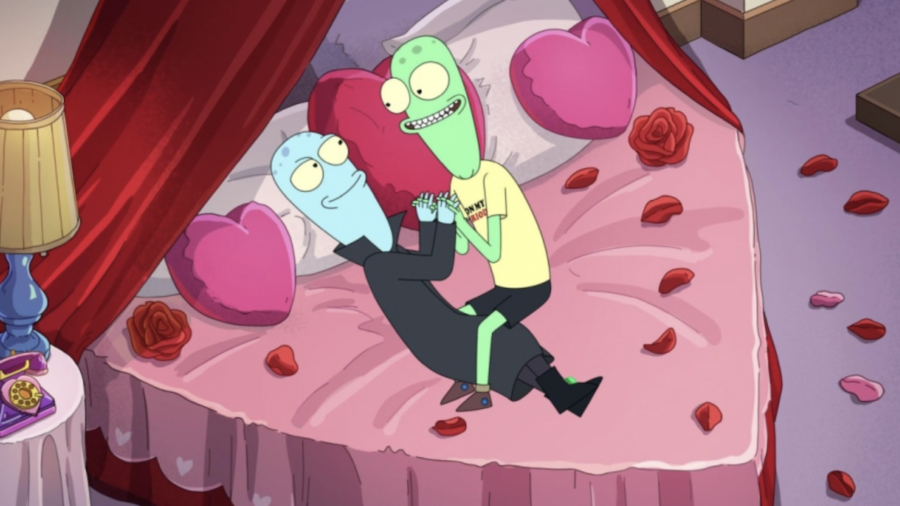
Poking fun at human relationships by clumsily attempting to act one out makes the Terry and Korvo romance one of the best running jokes on the show.
In Season 5, the Solar Opposites kids are bundled onto the family values bandwagon to teach them about sex education. They have to take care of their bag of sugar, just like any student learning about taking care of babies would, but their bag is a nightmare-inducing sugar baby that comes to life.
Terry and Korvo develop their communication skills while taking their honeymoon a little too seriously.
The struggle to conform to expectations and the urge to subordinate everything else to their relationships plagues the alien kids as much as the adults.
Terry and Korvo develop their communication skills while taking their honeymoon a little too seriously. The Solar Opposites couple finally gets to take some time for themselves in Season 5 but can’t resist taking the fun to a whole new level, leaving a swath of destruction in their wake.
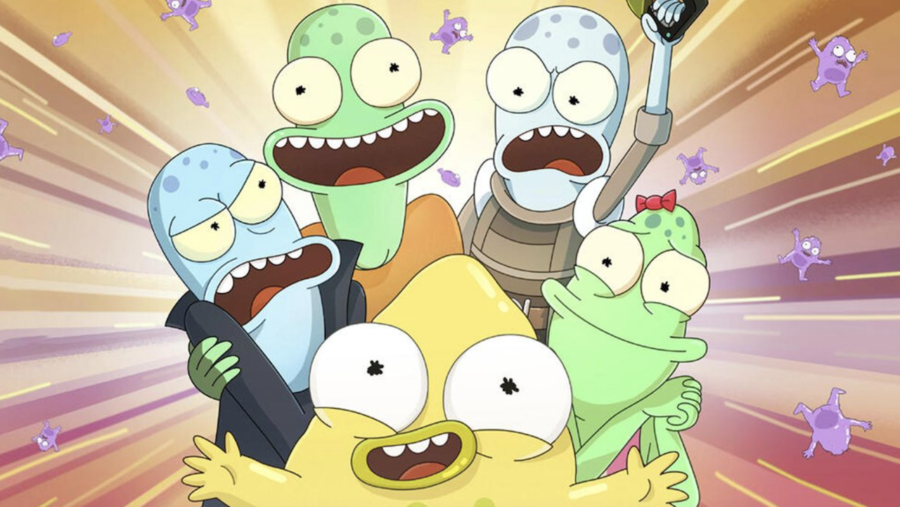
Putting their new marriage, as well as the fate of Earth, to the test, the Solar Opposites clan levels up their commitment to each other at all costs.
In oddball alien fashion, Terry and Korvo reach into the depths of their beings to improve their communication and reassert their passion for each other. They tackle their first fight, their first relationship insecurities, and their first interplanetary annihilation near-miss in Solar Opposites Season 5. Terry and Korvo discover that being married doesn’t make you any better at life, but it can sometimes get you free stuff.
Settling in as a couple, Terry and Korvo also have to contend with the mundane details of life that any married couple would on Solar Opposites Season 5. Trips to the big box hardware store for DIY projects, discovering their interests diverge, and trying out friendships post-marriage are just a few of the highlights of Terry and Korvo’s developing relationship.
Their clumsy attempts to encourage each other in their pursuits and support each other’s hobbies are a relatable allegory for our human failings in relationships.
Entertainment
Raunchy, R-Rated 80s Sci-Fi Comedy Is Impossible To Categorize, So Of Course It’s On Tubi

By Robert Scucci
| Published

If you want to be humbled by decades worth of unhinged creativity that somehow slipped past your radar, I strongly advise firing up Tubi at least once a week. This is not a paid ad, but if you can get me in contact with the head of programming over there, I’d love to send them an Edible Arrangement for never failing to entertain me with hidden gems like 2010’s Beyond the Black Rainbow, and unhinged sci-fi horror comedy neo-noir mystery thrillers like 1986’s Eat and Run. If that sounds like a mouthful, wait until you hear what this punisher is about.
This movie only showcases a handful of recurring gags, and they’re all run into the ground. The primary antagonist is a 400-pound humanoid alien who only eats Italian people. Our hero is a hapless detective who narrates his life out loud in hard-boiled private dick fashion. His boss is always snacking and yelling, and he’s dating a judge with a habit of releasing dangerous criminals from prison, noticing the uptick in murders, and failing to connect the dots. It all plays out like a second-rate Police Squad, but it’s still charming despite its shortcomings.
This Guy’s A Fool For Gabagool!

Eat and Run keeps things simple, and it’s best not to think about it too much while watching. When morbidly obese Murray Creature (R.L. Ryan) inexplicably arrives on Earth, he immediately takes to hitchhiking. He gets picked up by an Italian merchant, who he then eats. We never actually see Murray eating, though. He smiles, reveals his pointy teeth, the camera zooms in on his face, then on his victim’s, and it cuts to him spitting out what’s left, usually shirt buttons.
Meanwhile, Detective Mickey McSorely (Ron Silver), who compulsively narrates his life in real time, is getting chewed out by his Captain (John J. Fleming). The Captain, no matter the time of day, is always pigging out at his desk, and this gag escalates throughout the film. First he’s digging into ice cream cake, and by the end he’s berating a delivery boy for bringing a six-layer cake when he clearly asked for a seven layer cake.

When dozens of Italian men from competing crime families go missing, Mickey takes the case, eventually leading him to Murray, though he can never catch him in the act. He sets up elaborate sting operations in between romantic rendezvous with Judge Cheryl Cohen (Sharon Schlarth), whose record on the bench is questionable at best, and who constantly excuses herself after sex so she can take matters of self gratification into her own hands. Mickey, the great detective that he is, remains completely oblivious to his shortcomings on this front.
When our Italian-eating antagonist is finally caught and cross-examined, his lawyer has him dress like a Boy Scout to appear innocent. This only complicates things further when he’s granted bail and his buffet-style rampage continues, and becomes smitten with Cheryl.
This Shouldn’t Be A Movie

The above scenarios are stretched to absurdity in Eat and Run, repeating the same bits over and over, escalating just enough each time until the film reaches its climax. It reminds me of most SNL-based movies that do the exact same thing. Think 1994’s It’s Pat, but instead of endless jokes about androgyny, it’s about a fat guy eating mobsters.
While it sounds like I hated Eat and Run, I actually had a good time with it. At 85 minutes, it feels like writer-director Christopher Hart was padding the runtime to reach feature length by overworking the gags, but I can’t help but wonder how much better it would be if trimmed down to sitcom-episode length, or even a series of recurring skits.

I’ve always been a sucker for neo-noir narration, so every time Mickey narrates, only for the camera to pull back and reveal he’s been talking out loud in a room full of people, I let out a hearty chuckle. It’s stupid, but relatable. The number of times I think I’m thinking to myself while puttering around the house, only for my family to ask what the hell I’m talking about, is high enough that I felt seen.
Eat and Run is totally stupid, built on a razor-thin premise, and runs its gags into the ground before the first act is over. It’s also really funny, not because those things make it funny on their own, but because the humor somehow loops back around and works anyway.


As of this writing, Eat and Run is streaming for free on Tubi.
Entertainment
How A U.S. President Killed One Of The Best TV Doctors
By TeeJay Small
| Published

Every now and again I sit down with a few friends and revisit my all-time favorite medical drama, House. If you haven’t seen the show, you’ve definitely heard of it from memes, internet references, or Family Guy cutaway gags. The show is as chaotic and off-the-wall as it gets, highlighting a different medical mystery each week as the titular Dr. House dishes out his trademark blend of wit, wisdom, and medical malpractice. Though the show is infinitely watchable for its narrative and character work, there’s one episode that can only be understood through the lens of behind-the-scenes events.
The episode in question is season five’s “Simple Explanation.” In this episode, the character Dr. Lawrence Kutner, played by Kal Penn, is found dead in his apartment of an apparent suicide. House and his staff at the hospital’s diagnostics department are perplexed by this, since Kutner never showed any signs of depression or suicidal ideation before. The gang then investigates Kutner’s apartment, leaving them with very few answers.

As the episode unfolds, it becomes clear that Kutner really did choose to end his own life, proving that there are some mysteries that cannot be solved, even by the world’s greatest detectives. While House and the others eventually move on from the mystery, the real-life truth is a bit more complicated. In fact, some could even say that Lawrence Kutner was murdered by none other than President Barack Obama.
How Barack Obama Killed Lawrence Kutner

Let’s rewind just a little bit. Barack Obama took office as the 44th president back in January of 2009, and quickly began staffing his administration with a variety of hip, young faces. As part of a larger push to appeal to Asian-American and Pacific Islander communities, Obama created the role of Associate Director of Public Engagement. His team then reached out to several prominent Asian-American citizens, including screen actor Kal Penn.
Penn took the role at the White House, and subsequently had to be written out of House with more haste than the average departure. He officially joined the staff in April of 2009, right around the same time that “Simple Explanation” aired. While in office, Penn served as a mouthpiece for Asian-American communities and helped perform outreach for the administration’s Affordable Care Act. He is also said to have assisted with the DREAM Act, as well as the repeal of “Don’t Ask, Don’t Tell.”
Fans Have Not Forgiven

Kutner was a fan-favorite character in House, and a frequent source of optimism in a sea of sardonic, nihilistic characters. As you can imagine, some fans took his loss pretty hard. To this day, there are running gags online that Obama killed Kutner, prompting a plethora of sarcastic “Thanks, Obama” replies in the comments section. Kal Penn continued his acting career in bit parts while working at the White House, and even returned to the show via flashbacks and hallucinations for the series finale. Ironically, he even portrayed a White House staffer on the series Designated Survivor in 2016, as Obama’s tenure was coming to a close.
So, if you’re ever watching House with your grandchildren in the year 2077, long after the memory of this behind-the-scenes factoid has faded from public memory, you can be sure to let them in on this bizarre turn of events. As it turns out, Kutner didn’t show suicidal tendencies because he was never depressed. He was just a young, happy doctor, killed in the prime of his life, so that an actor could serve his country in a more hands-on capacity than getting high and going to White Castle.
Entertainment
Jake Gyllenhaal's R-Rated Netflix Thriller Is A Dangerous Display Of Rage Beyond The Grave
By Robert Scucci
| Published

As a lifelong musician, there’s a certain kind of peer that I absolutely despise: the self-important artist. You know the type, the people who walk around like their farts don’t smell because they think they’re God’s gift to mankind. Once the work day is done, they pour their heart and soul into their creations, and those creations become the essence of their being. And in their minds, that essence is the most important thing in the world.
While I’m probably being cynical when I say it’s all just performative posturing, I spent enough of my formative years around this type of person to understand exactly where 2019’s Velvet Buzzsaw is coming from.

In this movie, the most stuck-up, clout-chasing, back-handed, stab-you-in-the-back-if-they-can-get-the-upper-hand types get their comeuppance when they start dealing with the work of a newly deceased, completely unknown artist. He leaves behind a treasure trove of mixed-media masterpieces that were never meant to be seen. In fact, he explicitly instructed that his art be destroyed. Instead, it goes up for sale, and everybody who comes into contact with it dies a gruesome death.
Now, I’m not one to incite or encourage violence, but since we’re dealing with a supernatural thriller packed with some of the most unlikeable, pretentious, insufferable gasbags known to man, it’s beyond satisfying to watch them violate this dead man’s wishes and get what’s coming to them.
“All Art Is Dangerous”

Velvet Buzzsaw takes place in a Miami-based art gallery where a bunch of cosmo-drinking artists and critics gather just to hear themselves talk. Among them is Morf Vandewalt (Jake Gyllenhaal), a critic known for his scathing reviews and melodramatic flair, who’s having second thoughts about his relationship with his boyfriend Ed (Sedale Threatt Jr.). He starts developing feelings for Josephina (Zawe Ashton), who works for ruthless gallery owner Rhodora Haze (Rene Russo), who unironically says things like “all art is dangerous” and verbally abuses anyone who crosses her path.
Rhodora moves units with eight-figure price tags, so her ego makes sense in context, but you can tell right away she’s a rough hang.

When Josephina returns home to LA, she finds her upstairs neighbor, Vetril Dease (Alan Mandell), dead outside his apartment, with no signs of foul play. His apartment is filled floor to ceiling with morbid artwork that immediately entrances anyone who sees it. Constantly on the receiving end of Rhodora’s criticism, Josephina collects the pieces so Morf and Rhodora can appraise them and possibly put them on the market, giving her clout in an industry that’s ready to chew her up and spit her out.
They quickly realize Dease isn’t a known artist. The work is authentic and original, but there’s no frame of reference for anything he created.

It doesn’t take long for art patrons to start foaming at the mouth over these pieces, including curator Gretchen (Toni Collette), washed-up artist Piers (John Malkovich), and rising star Damrish (Daveed Diggs). The most enthralled is Bryson (Billy Magnussen), the gallery’s installer, who’s bitter that nobody values his artistic input despite his talent, since his job is literally hanging other people’s work instead of showcasing his own.
While transporting some of Dease’s pieces, Bryson gets attacked and killed by the paintings. He’s lit on fire and then pulled into a painting depicting rabid monkeys at an abandoned gas station that flickers to life just for him right as he passes by. Shortly after, people start dropping like flies. The only connection, though nobody realizes it at first, is Dease.

Since everyone is only looking out for themselves in this cutthroat industry, communication isn’t exactly their strong suit. But Morf, after digging into Dease’s past, uncovers enough disturbing information to confirm what’s happening. His art, once released into the world, is cursed.
The Downside To Graverobbing That Nobody Really Talks About
Every character in Velvet Buzzsaw wants to be great, so much so that they have zero issue robbing a dead man of his work, distributing it everywhere, realizing people are dying because of it, and still focusing on whether they can keep moving units.

When Morf tells Rhodora he plans to expose everything, she immediately starts blowing up phones, trying to sell off the pieces before the story breaks. Josephina, who kicked off the entire chain reaction, only cares about how Dease’s work benefits her. His body was probably still warm when she started making calls.
Most importantly, these tryhards are doing everything they can to maintain the mystique and value of Dease’s work, without caring about the fallout. Aside from Morf, who’s still annoying but at least somewhat likable, every character in Velvet Buzzsaw is completely irredeemable. The fun comes from watching them slowly realize they’ve curated something they can’t control. Something that’s coming for them.

When art becomes a commodity and the highest bidders are morally bankrupt, it’s only a matter of time before their behavior catches up with them. In Velvet Buzzsaw, that moment comes when they decide to rob an elderly man of his life’s work without even attempting to contact anyone who might be connected to him. It never even crosses their minds, but Dease gets the last laugh as everyone tied to his creations is taken out in increasingly brutal fashion.
Velvet Buzzsaw, streaming exclusively on Netflix, is billed as a satirical supernatural horror comedy, and it earns that description. Most of the appeal comes from its dry, morbid sense of humor. The best way to watch this movie is after spending time in an art gallery and overhearing the kinds of conversations people have. Once you’ve had your fill of pretentiousness and white wine spritzers, watching it all burn to the ground is half the fun.


Teen's match-winner keeps New England rolling, Atlanta sliding
Raunchy, R-Rated 80s Sci-Fi Comedy Is Impossible To Categorize, So Of Course It’s On Tubi


