
Entertainment
Sexy Sci-Fi Blockbuster On Netflix Reveals Which Of Your Friends Are Psychos

By Chris Snellgrove
| Published

When Passengers came out in 2016, it caused a relatively minor blip on the pop culture radar. The movie starred two different Marvel icons, Chris Pratt and Jennifer Lawrence, so there was plenty of hype before the movie premiered. While it made okay money at the box office, it was a critical bomb (a freaking 30 percent on Rotten Tomatoes!) that almost everybody hated. That’s because it was a sci-fi movie without any real action, adventure, or exploration. Of course, the studio couldn’t market Passengers for what it really is: a horror movie where Chris Pratt’s penis is the monster trying to kill you.
Well, not you, personally, but Jennifer Lawrence. You see, this is a film where Pratt’s character wakes up 90 years early on a sleeper ship. As his loneliness mounts, he eventually awakens Lawrence’s character early. He’s just hoping for companionship, but he doesn’t seem to realize the moral ickiness of dooming someone else to crippling, soul-crushing isolation. Because of this, Passengers (now streaming on Netflix) makes for a pretty terrible sci-fi movie. However, it’s weirdly perfect to show other people for exactly one reason: how they react to Pratt’s decision to wake up Lawrence early reveals whether or not you can actually trust your friends and family!
Creepers Gonna Creep

The idea of using Passengers as a Rorschach test for friends is important to me because I did it completely by accident. Years ago, I was discussing this film with a younger friend who had previously made the bold choice to move in with an older woman and become a father figure to her three children (I promise, this factoid will be important later). My buddy claimed that the decision made by Pratt’s character was understandable; after all, the character was so lonely and depressed that he contemplated suicide. However, I maintained that waking Lawrence’s character up early was both manipulative and cruel, effectively dooming someone else to a life of depression and isolation.
Our debate over Passengers effectively became a debate over empathy. My friend empathized with Pratt’s character and imagined how he would feel about going the rest of his life without human interaction. To my buddy, waking up a woman for companionship was an understandable act of desperation. Meanwhile, I empathized with Lawrence’s character, arguing that I’d hate to be the one forced into a life of isolation because someone couldn’t keep it in their pants. Months after our debate, my friend got a new job far away, and his girlfriend drove him hundreds of miles, where they actively planned to buy a house together. A happy ending, right?
A Movie That Rewards Bad Choices

Nah. He fell for a girl at his new gig less than a week after moving and dumped the woman (the one with three kids who saw him as a father figure) he had been dating for years. When it happened, my first thought was our argument over Passengers. As it turns out, he really was like Pratt’s character at the end of the day: someone who would screw over anyone if he simply got lonely and horny enough.
Now, the internet is filled with countless different ideas for testing those in your life with weird scenarios. This includes everything from nonsensical stuff (“would you still love me if I was a worm?”) to weirdly controversial stuff (“do you choose the bear or the man?”). However, most of these hypotheticals are a very stupid way of learning anything useful about my friends and family. But the scenario in Passengers is so meaty and compelling that it’s like an ethics word problem brought to life. For Pratt’s character, the question is whether he’s justified in waking up Jennifer Lawrence’s character because he is on the verge of suicide.
An Argument That Makes You Wanna Scream

To me, Pratt is not justified. Sure, I felt bad for the guy, but he’s making a deliberate choice to inflict his own misery on someone else. That’d be bad enough if he had just woken up another man so he’d have someone to bro out with, making himself the only human contact the other guy would ever have. However, he deliberately wakes up somebody that he found attractive in hopes of them having sex. It’s textbook manipulation and, spoilers, they do end up hooking up. The movie presents this as a happy ending, but this is the It’s Always Sunny “because of the implication” thing played out to its darkest extreme.
Anyway, my buddy who so passionately defended Pratt’s character? Soon afterward, he ended up making his own selfish decision in the name of getting some strange, destroying an existing relationship he had spent the better part of a decade developing. Basically, Passengers revealed something dark about this dude’s personality, and it didn’t take him long to prove his character. Want to figure out which of your own friends and family you can actually trust? Then grab the remote and brace yourself because Passengers is currently streaming on Netflix.
Entertainment
How the electronic World Cup ball is already impacting games
The official World Cup ball now has something in common with a phone, a smartwatch, and nearly every other piece of modern tech: it needs to be charged.
Adidas’ Trionda, the match ball being used at the 2026 World Cup, is more than just a four-panel soccer ball with a red, green, and blue design meant to nod to the United States, Mexico, and Canada. It is also a connected device. Inside the ball is a small motion sensor that tracks its movement hundreds of times per second and sends data to the VAR room in real time.
This Tweet is currently unavailable. It might be loading or has been removed.
That may sound like a strange detail for a sport still built around feet, grass, bodies, and instinct. But during Sweden’s win over Tunisia, the ball already proved its worth, as the internal sensor helped decide whether a record-setting goal should count.
In the 84th minute of Sweden’s win over Tunisia on Sunday, June 14, midfielder Mattias Svanberg came off the bench and scored with his first touch, just 12 seconds after entering the match. The goal would make him the fastest substitute ever to score at a World Cup, but it was initially ruled out for offside.
Mashable Trend Report
This Tweet is currently unavailable. It might be loading or has been removed.
The review came down to one hard-to-see detail: whether Sweden forward Alexander Isak had made a slight touch on the ball before it reached Svanberg. If he had not touched it, Svanberg would remain offside. If he had, the phase of play would reset, and the goal could count.
According to an ESPN VAR review of the incident, officials used Adidas’ connected ball tracking technology to determine that Isak had indeed made contact. The touch was so slight that it was difficult, if not impossible, to judge clearly with the naked eye…but the sensor registered it. VAR overturned the original offside decision. Svanberg’s record-setting goal stood.
Connected ball technology is not new to the World Cup. Adidas first used a sensor-equipped match ball at the 2022 World Cup in Qatar. For 2026, the technology has been updated, though, with a side-mounted 500Hz chip inside one of Trionda’s four panels, allowing the ball to send real-time, three-dimensional movement and touch data to VAR.
In a World Cup increasingly shaped by technology, the smallest touch can now be enough to make history.
Entertainment
This is your last chance to get the Aiper Scuba X1 cordless pool robot for $550 off
SAVE 37%: As of June 19, you can get the Aiper Scuba X1 for $949.99, down from $1,499.99 at Amazon. That’s a 37% discount or $550 savings.

$949.99
at Amazon
$1,499.99
Save $550
It’s nearly Prime Day, and Amazon’s sneaking in little discounts here and there to keep us interested. From robot vacuums to kitchen appliances to TVs and headphones, we’re already seeing some impressive price cuts, but the outdoor and backyard gear is getting some of the most practical markdowns.
Right now, you can get the Aiper Scuba X1 cordless pool robot for $949.99 at Amazon, down from $1,499.99. That’s a 37% discount or $550 savings. It’s also the lowest price we’ve tracked for this model. But you’d better hurry: Amazon’s got a clock running on this one, and it’s almost over.
Mashable Trend Report
Prime Day is almost here: We found 50+ early deals already live on Apple, Sony, and Lego favorites
This little robot runs for 185 minutes on a single charge. Instead of drifting around aimlessly, it uses smart navigation to map out your pool and dodge obstacles on its own. When it’s done, just pop it onto the included wireless charging dock.
As for the actual cleaning, its dual jets clear out everything from fine sand to stray pebbles, while the filtration system catches the tiny debris you can’t even see. It also scrubs along the horizontal waterline to get rid of scum buildup. Essentially, it handles all the real manual labor so you don’t have to.
Entertainment
Star Trek’s Original Opening Was So Bad It Never Made It To Air
By Chris Snellgrove
| Published

One of the first signs that Star Trek: The Original Series had become a pop culture phenomenon was the success of its theme song. People who barely even knew what the show was about could hum its iconic opening tune. Equally famous was William Shatner’s monologue describing the mission of the starship Enterprise: to explore strange new worlds, to seek out new life and new civilizations. To boldly go where no man had gone before! The whole thing felt like pure television magic. It wasn’t magic, though: a lot of work went into this intro, including earlier attempts most fans have never seen.
Before the final version of the Original Series opening (“final” being relative, since it was tweaked slightly for Season 2 and again for Season 3), there was a completely different opening. This was attached to the version of “Where No One Has Gone Before” (Trek’s second pilot episode) that Gene Roddenberry showed to NBC executives. They were pleased with what they saw and gave this seminal sci-fi show the green light. Once they did, one of the first things Roddenberry set out to do was to create a new intro. That’s a good thing, because the intro that never made it to air is one of the worst things in the entire franchise!
An Intro Straight Out Of The Mirror Universe
When you watch this unaired Star Trek: The Original Series title sequence, the first thing you’ll notice is how spooky it is. The show did not yet have its iconic, soaring score that hinted at all the high adventure our heroes would encounter on the final frontier. Instead, we get a mostly muted score, one that makes way for William Shatner’s very different narration. The music only really comes to life when the words “Star Trek” pop up onscreen. Even then, it sounds less triumphant and more like something you’d hear when one of the Red Shirts was busy getting himself killed on an exotic alien planet.
This version of the show’s intro sequence is relatively short. Once the narration ends, we get the title of the show and the words “Starring William Shatner.” After that, it jumps right into the opening of the episode. The whole thing is just over a minute long, which is slightly longer than the final intro we ended up with (which lasts for about 49 seconds). Ironically, though, this unaired intro feels much longer because of the muted, ominous music and the somewhat plodding nature of Shatner’s narration.
William Shatner’s Narration Was Completely Different

What does Captain Kirk say in this unaired intro? “Enterprise log, Captain James Kirk commanding. We are leaving that vast cloud of stars and planets which we call our galaxy. Behind us, Earth, Mars, Venus, even our sun, are specks of dust,” he says. “The question: What is out there in the black void beyond? Until now, our mission has been that of space law regulation, contact with Earth colonies, and investigation of alien life. But now, a new task: A probe out into where no man has gone before.”
For Star Trek lorehounds, this is a lot to process. For one thing, this narration seems to conflate leaving the solar system with leaving the galaxy. While Star Trek has gotten fuzzy about things like galactic barriers and galactic centers, every single show and movie takes place firmly within our own galaxy, so that part of Shatner’s unused narration is pure nonsense. The rest of it is fascinating (as Spock might say) from a canon perspective because it implies that Starfleet has, up to this point, mostly played the role of space police who occasionally investigate aliens. Now, he says, they are tasked with exploring the final frontier.
Does This Intro Fit With The Current Canon?
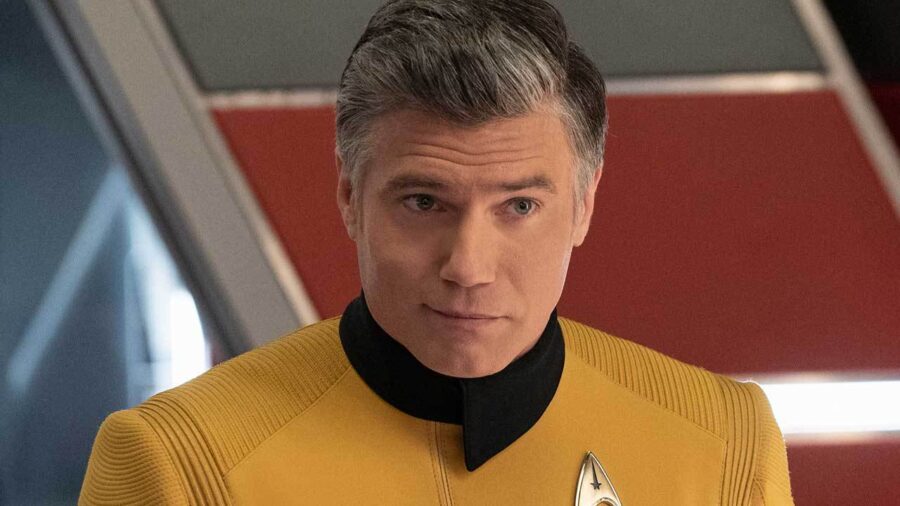
Interestingly, this contradicts parts of later franchise lore while lining up with other parts. For example, Star Trek: Enterprise takes place about a century before The Original Series, and it portrays Captain Archer making first contact, discovering strange new life, and generally going where no man had gone before; all of this would contradict this original narration. But it does line up with Discovery emphasizing that Pike and other captains of Constitution-class ships were charged with deep space exploration, something Starfleet considered more important than staying home and playing cowboy.
All of this makes the unaired intro to Star Trek: The Original Series a fascinating part of franchise history. It’s also, surprisingly enough, part of national history, as Gene Roddenberry was invited to submit this, Trek’s first pilot, and other production materials to the Smithsonian Air and Space Museum. He did so back in 1967 and, in prime Roddenberry tradition, made a big show of it to make himself and his new series look better. A bit of shameless self-promotion? Sure. But Roddenberry certainly deserved a victory lap for creating something that truly went where no TV show had gone before!

Cubs test recent turnaround against streaking Blue Jays
How the electronic World Cup ball is already impacting games


