
Entertainment
Samsung Wide Fold design revealed in leaked images

Samsung‘s upcoming foldable phones have been revealed in a leak again, but this leak is different, because it comes directly from Samsung.
Android Authority dug through Samsung’s new One UI 9 software and discovered images of Samsung Galaxy Z Fold 8, as well as the entirely new foldable phone which will probably be called Samsung Wide Fold.
Don’t expect photographs; the images are just simple graphics, but they do tell us a lot about these new phones. In particular, the Samsung Wide Fold looks significantly wider than the Samsung Galaxy Z Fold 8, which looks really skinny in comparison.

That’s a large cover display.
Credit: Samsung/Android Authority
The images also reveal that the Galaxy Z Fold 8 will have a triple rear camera, while the Wide Fold will only have a dual camera on the back.

Hello, skinny.
Credit: Samsung/Android Authority
The designs are in line with previous leaks, renders, and mockups, including the dummy units that surfaced in late April.
Mashable Light Speed
Samsung’s Wide Fold is widely (no pun intended) expected to clash with Apple’s rumored, upcoming foldable iPhone, which will likely have a similar, wide design. This design might make the phone feel a little clunkier in the hand, but should pay off when you unfold it, as you’ll get something akin to a small tablet.
As for the Galaxy Z Fold 8, it looks more or less unchanged compared to its predecessor, the Galaxy Z Fold 7.
The rumored specs for the Samsung Wide Fold include a dual, 200/50-megapixel camera, a 10-megapixel selfie camera, a 5.4-inch cover display, a 7.6-inch foldable display, a Snapdragon 8 Elite Gen 5 chip, and 12/16GB of RAM.
The Galaxy Z Fold 8 will probably have similar specs as the Z Fold 7, but it should get a larger, 5,000mAh battery, as well as 45W charging.
Samsung is likely to unveil its new foldable phones in July.
Entertainment
Mashable will send the best deals directly to your phone daily — how to sign up for free
Mashable Deals
I spend a lot of time trawling through the depths of the online world to find deals that are genuinely worth your time and money. And no, I’m not talking about those heavily discounted products that have actually been stuck at that “low price” for months. I’m talking about limited-time discounts on the products that I’d actually recommend to a friend.
That’s the aim of the game for Mashable’s team of shopping experts. We’re constantly scanning leading retailers like Amazon, Walmart, and Best Buy to bring you new opportunities to save your precious cash. But we’re not satisfied with the current state of affairs. We don’t want you to miss a thing, and that’s why we landed on the Mashable Deals text group.
Become a subscriber of the Mashable Deals text group and I’ll send you the very best deals directly to your phone. You don’t need to pay anything to get access to these deals. Simply sign up above and you’ll be the first to know about huge savings on MacBooks, limited-time discounts on AirPods, price cuts on items under $50, and all of those other deals that drop throughout the week.
I’ll send a Deal of the Day most days. During major shopping events like Prime Day and Black Friday, we may bump this up to a couple of sends per day. But that’s only if we come across multiple offers that are truly worth the send. If we track down a bunch of impressively low prices during a busy shopping event, we’ll drop those in a single text.
We’re not going to spam you. The daily deals that we send to the Mashable Deals text group will have been researched and assessed by the team with the same level of care that we dedicate to the rest of our shopping content.
Mashable Deals
Signing up for the Mashable Deals text group is quick, safe, and totally free. You can also opt out anytime you like. I hope you give it a try.
Entertainment
Mads Mikkelsen Steals Dogs and Jumps Out of Moving Cars in Unrated New Black Comedy
By Chris Sawin
| Published

The Last Viking has an opening and an ending that feels like a hand-painted fairy tale revolving around a Viking clan where everyone remains equal; young and old, fat and skinny, ugly or beautiful – everyone is treated the same. But one day, during a battle, a young Viking loses one of his arms.
In comparison to everyone else, he feels ugly and less than everyone else. His father, the chieftain, witnessed this and ordered every male in the clan, toddler, adult, or elderly, and everything in between, to chop off one of their arms. Part of it was to help his son feel better, but it was also to keep the clan equal among themselves.

In the present day, Anker (Nikolaj Lie Kaas) has just committed robbery and murdered someone in the process. He takes a duffel bag full of money and locks it in a locker. He instructs his brother, Manfred (Mads Mikkelsen), to swallow the key and retrieve the bag only once everything has died down. He then gives Manfred specific instructions to bury the bag in a designated place near their mother’s house.
Anker is sentenced to 15 years in prison. Once he gets out, Manfred refers to himself as John W. Lennon and has no memory of where he buried the loot. As Manfred is going through something irregular, Anker is forced to help him in some capacity so he can be well enough to remember where the money is.
Life After The Heist

Written and directed by Anders Thomas Jensen (Riders of Justice, Men and Chicken), The Last Viking is a crime drama with some dark comedy thrown in for good measure. Manfred flips out whenever someone still calls him Manfred. He’s been stealing the neighbor’s dogs and stabbing their sister, Freja (Bodil Jorgensen), in the thigh because she didn’t call him John. Manfred also likes to jump out of moving cars, and he threatens to kill himself by shoving a fondue fork in his head. Both he and Anker have terrible tempers, as well.
The film follows Anker as he tries to shake some sense into Manfred. He wants his money so he can get away from his brother forever. Manfred has experienced some sort of severe trauma that has resulted in him having dissociative identity disorder. While we all exist as one identity in one reality, Manfred has several personalities that exist in different realities. They find this out after Manfred is committed to a psych ward.

Manfred’s psychologist, Lothar (Lars Brygmann), who is obsessed with IKEA, believes that, since Manfred believes he is one of The Beatles, he needs to unite with others who share his condition and believe they are the other Beatles. Once united, they can play Beatles songs together and, hopefully, regain some sense of normalcy.
Lothar tracks down a mute who believes he’s Ringo and Anton (Peter During), who has more than 40 personalities, including Bjorn from ABBA, Heinrich Himmler, and Paul McCartney and George Harrison. Anker and Manfred’s mother’s house is now owned by a couple who rent it out as an Airbnb; a former hand model named Margrethe (Sofie Grabol) and her much older husband, Werner (Soren Malling). Werner has been trying to write and illustrate a children’s book for the past five years, but has never finished it.

Lastly, there’s Flemming (Nicolas Bro), the flat owner and maintenance man to the flat Anker, Manfred, and Freja live in. Flemming wants all of the money that Anker has been hiding. He was paid before Anker went to prison, but he spent it all and now wants whatever is left. He basically hunts Anker the entire film and has a nasty streak despite his calm demeanor.
Drama And Trauma With A Side Of Humor
Anders Thomas Jensen makes this eclectic cast of characters feel necessary in the grand scheme of things. The Last Viking may centrally be about Anker and Manfred, but the way the story incorporates everyone else is extraordinary. There is humor in the film, but the drama and trauma keep your interest. Why Manfred decided to change his name and why Anker can’t remember certain things about his past is explained, and it’s devastating.

There’s a broken mentality to every character in the film, but the concept of either feeling less broken or being a bit more whole as a group is explored in The Last Viking. Every question you might have, like how the film’s title factors into the story, is explored to meaningful satisfaction. The one issue is that I wish the humor hit harder. For a film that is so serious, the comedy is extremely subtle and lighthearted. Maybe devoting more of the film to humor would have taken away from the overall story, which is already so well-connected and has a solid conclusion.
The Last Viking is stupidly sentimental and surprisingly sweet. It’s a film about a bunch of individuals who are completely and totally dysfunctional on their own but somewhat functional together.


The Last Viking hits theaters and digital/on-demand on May 29.
Entertainment
What Battlestar Galactica Did Better Than Star Trek Ever Did
By Chris Snellgrove
| Published

The showrunner for Battlestar Galactica was Ronald D. Moore, who got his start in television by writing for Star Trek: The Next Generation. Accordingly, there have been plenty of comparisons over the years between these two franchises. BSG fans point out that the show handles ongoing stories better than vintage Trek, and its vision of the future is much more realistic. There are no replicators, for example, so Commander Adama and his crew have to deal with scarcity in a way that Picard and Janeway never had to.
Obviously, there are pros and cons to each of these different kinds of sci-fi storytelling. But in making comparisons, fans of both franchises often overlook the best thing that Battlestar Galactica does better than Star Trek. Starting in the Season 1 episode “Litmus,” BSG went out of its way to give even the most minor characters their own compelling identities and backstories. In Star Trek, such characters are relegated to the role of “redshirts” who don’t get to do anything but die in agony, so our heroes can live to warp another day.
Birth Of A Pop Culture Phenomenon
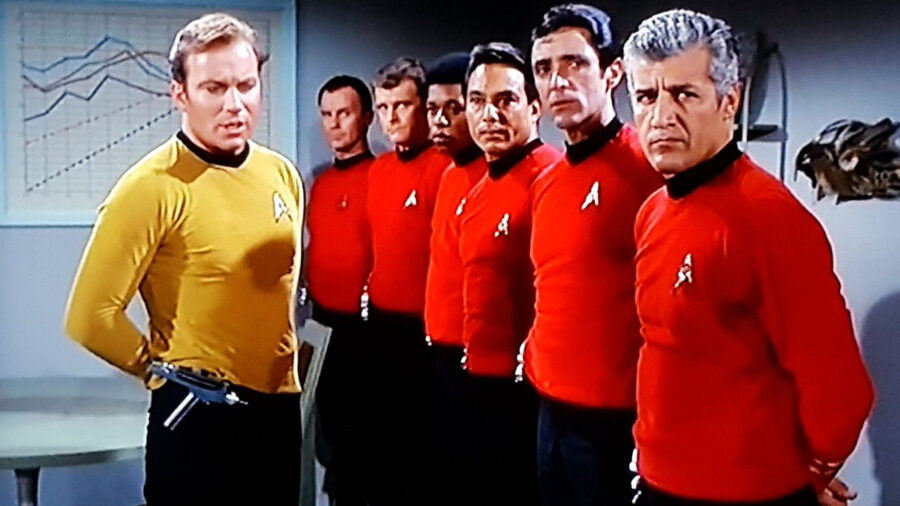
In case this famous sci-fi trope needs an introduction, here goes: in Star Trek: The Original Series, security officers wore red shirts. This helped distinguish them from other divisions: a blue shirt indicated a focus in science or medicine (like with Spock and McCoy), and a gold shirt indicated command (like with Kirk). Whenever our major characters beamed down to a new Away Team mission, they brought along several red-shirted security officers. Unfortunately, these characters were usually doomed to die a grisly fate, leaving our intrepid main characters to figure out what killed their security detail.
Soon enough, “red shirt” entered into the pop culture vernacular as a name for an otherwise disposable character. While the shirt colors changed, this general trend continued into future Star Trek shows. Security officers were often dispatched by the villain of the week, including poor Tasha Yar, who was insta-killed by a villainous oil slick. Eventually, Discovery took the idea of disposable Star Trek characters to the next level by giving us a show where half the people on the bridge were relatively unknown, all the way to the very end.
Make It “No”

How, then, did Ronald D. Moore’s Battlestar Galactica fix this annoyingly persistent Star Trek mistake? Arguably, it all started with “Litmus.” This is the episode where Commander Adama and his crew discover that Cylons can look like human beings. That revelation leads to a tribunal designed to suss out who might have helped the Cylon Doral pull off a recent suicide bombing. Inevitably, the tribunal becomes a witch hunt that accomplishes nothing more than punishing an innocent man so the public has a scapegoat to hate.
A big part of the episode’s drama is that members of the deck crew try to protect Chief Tyrol, who has been secretly having an affair with Boomer. When his absence from his post is noted, these minor crew members come up with different cover stories to explain where he is. Unfortunately, this just makes their boss look more suspicious, and Tyrol calls off the affair after one of his subordinates lies to protect him. He also ends the episode wondering about Boomer’s loyalties, which is a good call. Eventually, she is revealed to be one of the Cylons who has secretly infiltrated humanity.
There Are No Red Shirts Anymore

“Litmus” prominently features some interesting deck hand characters, including Tarn and Socinus. It also prominently features Cally, a future love interest for the Chief. In a Star Trek episode, these deckhands would mostly be redshirts that we hardly ever see again. They would just suffer to protect our lead characters and then quietly shuffle off. This is particularly true of Socinus, who falls on his sword (he is stripped of rank and confined to the brig) to save Tyrol. However, Socinus and everyone else just keep showing up in later episodes, often playing surprisingly pivotal roles in various plots.
This is effectively a mission statement from former Star Trek writer Ronald D. Moore: there are no disposable characters in Battlestar Galactica. This isn’t a show about a handful of charismatic leads. Rather, everyone in this series is important, just as every remnant of humanity that survived the Cylon-led genocide is important. It’s a bold storytelling strategy that rewards careful viewing, all while building out this fantastic fictional world. Now, be honest: isn’t that a lot better than watching some rando in a red shirt get eaten by a salt monster?

Mashable will send the best deals directly to your phone daily — how to sign up for free
After an 0-5 start, Marlins DFA right-hander Chris Paddack


