
Entertainment
Paramount Just Used AI To Ruin Star Trek's Best Character

By Chris Snellgrove
| Published
As a franchise set in the far future, you might expect Star Trek to make some definitive, sweeping statements about the use of AI. However, various shows and movies have presented this technology as something of a double-edged sword. In Star Trek, AI powers the ship’s computers and holodecks, and it helps bring the beloved android officer Data to life. But AI is also responsible for numerous existential threats to the entire galaxy, including everything from evil androids like Lore to weapons of mass destruction like the Planet Killer and Control. Star Trek is ultimately very wishy-washy about this technology, presenting it as both a game-changer and a life-taker.
In the real world, the good of AI is quite outweighed by the bad. Sure, it can help you write emails and generate images, but it’s also being used by massive corporations to cut corners and give paying customers cheap slop, all so some rich exec doesn’t have to pay some poor, overworked creative. Now, Star Trek has officially become part of the problem. Recently, Paramount seemingly used AI to create a thumbnail of William Shatner for Paramount+, and it created the stupidest-looking image in Trek history. Unfortunately, this is now the inevitable future of the franchise: a studio phoning in even the most basic creative efforts, all to please a fandom that is quietly dying.
Meet AI Slop Captain Kirk

This story begins with the worst streaming service ever created: Paramount+. Like all streamers, this platform provides thumbnails for various movies. Normally, this is just a still from the film. For example, when you scroll down to Star Trek VI: The Undiscovered Country, you might see an image of James Doohan giving his best thousand-yard stare. If you scroll to Star Trek III: The Search For Spock, you might see that melty-faced weirdo that Dr. McCoy tries to hitch a ride with. However, when fans recently scrolled to Star Trek II: The Wrath of Khan, they saw an insanely ugly image of William Shatner that was seemingly created by AI.
The image features Shatner staring into the camera with a relatively sedate look on his face. He is wearing a suit and tie, which is properly absurd. Not only does Admiral Kirk never wear this suit in The Wrath of Khan, but the only time he wore anything remotely like this was when he donned a pinstripe gangster suit in the Original Series cheesefest episode “A Piece of the Action.” The most notable thing about this thumbnail on Paramount + is that one of Shatner’s eyes has a weird red glow around it. The whole thing is surreal and looks like what would happen if the Borg decided to assimilate Don Draper.
Garbage In, Garbage Out

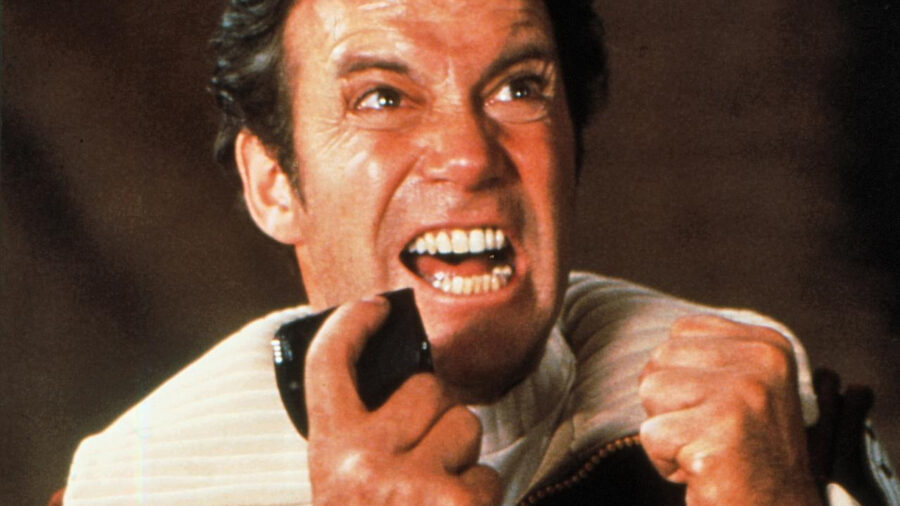
So, what the heck happened here? On Bluesky, Ryan Estrada seemingly cracked the case. The image of Shatner’s face mostly does come from The Wrath of Khan. It’s from the scene where Kirk completes a retinal scan before accessing classified information on Project Genesis. In the movie, this is an extreme close-up of Kirk’s face, one that cuts off his chin and almost everything above his eyes. The shot works well in the movie, but it would look absolutely terrible as a streaming thumbnail. Estrada’s theory (and one I certainly agree with) is that Paramount fed the movie image to a generative AI and asked it to flesh out the rest of his body.
However, the AI took more than a few liberties with Shatner’s character. It basically ruined the actor’s hairline (something previously only God could do), making Kirk look like a slicked-down Wall Street broker. It put him in a business suit for completely unknown reasons, making the image look instantly out of place as a Star Trek thumbnail. Most bizarrely, it didn’t remove the red light from the reticle scan, making Kirk look like he’s got the galaxy’s worst case of red eye (maybe the waste extraction department was slacking). As ugly as it is, though, the worst thing about this AI slop is how damn lazy it is.
AI Slop: The Future Of Star Trek

Star Trek is currently celebrating its 60th anniversary, and Paramount is hoping to revive the entire franchise with a brand new movie. But why would anyone want to watch a film by the same creatively bankrupt people who had to use AI to make a freakin’ thumbnail? These execs are stewards of the coolest sci-fi IP ever created, but they couldn’t be bothered to simply take a suitable screencap from The Wrath of Khan. Sadly, this AI screw-up is an indictment of what Star Trek has become: lazy slop made by lazier creatives who hope you’re too stupid to care about how bad this franchise has become.
They’re wrong, obviously, and Paramount is about to learn a very bitter lesson: the only thing they can’t gin up in AI is fans who actually care about Star Trek anymore!
Entertainment
Samsungs 32-inch Odyssey G5 QHD gaming monitor has dropped to a record low price on Amazon
TL;DR: Amazon has slashed the price of the Samsung 32-inch Odyssey G5 (G50F) QHD gaming monitor to $219.99, $130 off its original $349.99 price; that’s its lowest price with the retailer ever, and it still offers a 1440p gaming display with a 180Hz refresh rate.
$219.99
at Amazon
$349.99
Save $130
With the rise of OLED and 4K gaming monitors, HD and QHD models are getting more affordable than ever — and you can now score $130 off a top-tier 32-inch unit from Samsung.
As of June 3, the Samsung 32-inch Odyssey G5 (G50F) QHD gaming monitor is on sale at Amazon for only $219.99, down 37% from its usual list price, and is sold and shipped by Amazon directly. With that $130 drop, this gaming monitor is now at its lowest Amazon price ever, as confirmed by price-tracking site camelcamelcamel.
For this massively lower price, the G50F offers QHD 2560 x 1440 resolution, similar to standard HD but with 1.7 times the pixel density for a fuller display, without making the more expensive jump to 4K. Whether you’re catching up on RPGs like Crimson Desert or linear action-adventures like 007: First Light, everything will still be sharper and pleasing to the eyes.
For lovers of fast-paced multiplayer games like Fortnite, the fast IPS panel also brings a 178-degree viewing angle to help keep the picture clear, while the 180Hz refresh rate and 1ms GtG response time keep gameplay both buttery smooth and far more responsive
Mashable Deals
Despite not being 4K, the Odyssey G5’s display still includes HDR10 for brighter highlights and deeper-looking shadows. Plus, the included AMD FreeSync and NVIDIA G-Sync compatibility helps keep any visuals intact by reducing screen tearing as much as possible.
On the off chance you’re open to diving into 4K, LG’s 32-inch OLED UltraGear monitor has been cut to just under $800 on Amazon, too.
For a model that’s a bit smaller, the 27-inch, 1440p LG OLED UltraGear gaming monitor is now only $500, down nearly half.
Mashable Deals
If you’re also a Pokémon TCG fan, although currently not available on Amazon, the newly announced Pitch Black expansion — Booster Packs, ETBs, Display Boxes, and Booster Bundles — is available to preorder at TCGplayer.
Want to learn more about getting the best out of your tech? Sign up for Mashable’s Top Stories and Deals newsletters today.
Entertainment
The New Star Wars Movie Just Made History In The Worst Possible Way
By Chris Snellgrove
| Published
Disney originally intended for The Mandalorian and Grogu to be a crowd-pleasing movie that would bring the fandom together. After all, this was the first Star Wars film since 2019, and one that brings the most popular franchise characters from Disney+ to the big screen. Unfortunately, it didn’t take long before everything started falling apart. The movie got dragged by critics and had a worse opening weekend than Solo, making this the lowest-ever opening for a live-action Star Wars movie. After that poor opening, Disney had just one hope: that The Mandalorian and Grogu would get such positive word-of-mouth that the second weekend would bring in more money than the first weekend.
That’s exactly what happened with Obsession, making it the first horror movie of the millennium to earn more in its second weekend. As for Disney, it looks like the studio should have bought a One Wish Willow and made a wish. Right now, The Mandalorian and Grogu’s box office is set to drop at least 69 percent in its second weekend, which will be the biggest drop in Star Wars history (previously, Solo was the biggest loser with a 65 percent drop). Even worse, this latest movie set in a galaxy far, far away is likely to get blown away at the box office by Backrooms, another tiny horror movie with barely any marketing.
This Is Where The Fun Begins
Why is the second weekend box office for a film so important? Basically, it helps fans and filmmakers alike estimate how much money a movie will make before it leaves theaters. Outliers like Obsession notwithstanding, movies almost always lose money in their second weekend; therefore, it’s not a question of if the box office drops than how much the box office drops. A smaller drop indicates that a movie has legs and will likely make a major profit. A major drop, however, indicates that a movie won’t be nearly as profitable and will likely end up on digital and streaming that much sooner.
Right now, Deadline reports that The Mandalorian and Grogu will have a box office drop of at least 69 percent for its second weekend. That’s especially bleak for the franchise, as Star Wars films were once considered reliable, billion-dollar blockbusters (yes, even The Last Jedi and The Rise of Skywalker). The poor box office performance of Solo: A Star Wars Story forced Disney to pivot and turn multiple intended film projects (like solo movies for Boba Fett and Obi-Wan Kenobi) into Disney+ TV shows. The studio knew things would be bad when Solo’s box office dropped 65 percent in its second weekend. Therefore, Mandalorian and Grogu’s 69 percent drop is absolutely devastating.
They’ve Got A Bad Feeling About This

In a vacuum (including the cold vacuum of space), The Mandalorian and Grogu’s box office failure would be very embarrassing for Disney. However, it’s almost impossible to avoid comparing this sci-fi film’s failure to the inexplicable success of the two major horror films it’s currently sharing a multiplex with. You see, Disney reportedly spent almost $100 million domestically to market its latest Star Wars movie. Meanwhile, Backrooms reportedly had a marketing budget of a little over $10 million, and it’s likely to beat The Mandalorian and Grogu’s box office this weekend. The House of Mouse spent 10x more and may ultimately lose its top spot at the box office to a low-budget horror movie.
Speaking of low budgets, Obsession was made for under a million dollars, and it’s currently earned over $108 million. What’s the secret with these horror films? Obsession director Curry Barker and Backrooms director Kane Parsons both got their start on YouTube, where they achieved a mass following before setting out to make major motion pictures. YouTube taught both filmmakers how to make the most of a limited budget, and they are now utilizing those skills to make horror movie history. As for Star Wars, its producers are spending a small fortune to budget an aggressively disappointing movie to an increasingly shrinking number of fans.
Help Me, Indie Filmmakers: You’re My Only Hope

There’s a bitter lesson in all of this for Disney: ever since they took control of the Star Wars franchise, they have been pissing away the goodwill of the most loyal sci-fi audience in movie history. The Sequel Trilogy was a disappointing bust, and the TV shows on Disney+ have been very hit or miss. Plus, producers used their popular platform to absolutely ruin the magic of this franchise. Star Wars no longer feels special; it’s just more crappy streaming content you put on while you’re doing the dishes. After more than a decade of creative mismanagement, Disney has driven away countless fans through one sh*tty movie and even sh*ttier show after another.
The fandom will never completely die out, of course, and loyalists whose walls are lined with action figures will always support new Star Wars films. But there are only so many loyalists left, and the dwindling numbers for The Mandalorian and Grogu prove that there aren’t enough fans to turn these movies into blockbusters like A New Hope, The Empire Strikes Back, or even The Phantom Menace. The only way forward for the franchise is to hire young filmmakers with a distinct creative vision. But that won’t happen because talented directors focused on their own IPs have done what the Star Wars fandom cannot: left their favorite childhood toys firmly in the past.
Entertainment
The big question LGBTQ daters are asking, according to Hinge
It’s Pride Month, and although LGBTQ daters are queer all year, the spotlight is on them this June. As such, Hinge just published its annual D.A.T.E. (Data, Advice, Trends, and Expertise) Report to lay out what dating is currently like for today’s queer singles.
The title of this year’s report is “Clarity Builds Chemistry,” and it discusses the uncertainty young LGBTQ daters feel. (Not surprising, considering the amount of uncertainty in the world at large right now, that it’d distill into individuals’ personal lives.)
In its Jan. 2026 survey of over 31,000 global respondents, Hinge found that more LGBTQ daters feel a lot or great uncertainty about the world than heterosexual daters (76 to 52 percent, respectively), but they can also find uncertainty helpful. Seventy-four percent of LGBTQ daters say uncertainty helps them understand what they’re looking for in relationships. Uncertainty contributes to these daters identifying dealbreakers, clarifying their preferences, and identifying what feels right vs. wrong.
Hookup apps for everyone
AdultFriendFinder
—
readers’ pick for casual connections
Tinder
—
top pick for finding hookups
Hinge
—
popular choice for regular meetups
Products available for purchase through affiliate links. If you buy something through links on our site, Mashable may earn an affiliate commission.
Community also helps LGBTQ daters. Hinge found that queer daters are asking, “Would I bring this persona around my friends?” rather than, “What are we?” This might be because of the importance of chosen family for young LGBTQ people.
As such, queer daters are 33 percent more likely than straight daters to say it matters that their friends like the person they’re dating (this rises to 37 percent for trans daters). They’re also 20 percent more likely to want to check whether a potential partner fits with their friend circle. In a world of uncertainty, having a solid support system is crucial.
Mashable Trend Report
Hinge found that consistency also puts LGBTQ daters at ease in their uncertain world: 86 percent said consistent communication from someone they’re starting to date makes them feel less anxious. Seventy-eight percent said making clear plans also makes them feel less anxious (compared to 56 percent of heterosexual daters).
PDA in an early relationship helps over half (65 percent) of LGBTQ daters feel more secure, but they’re 50 percent more likely than straight daters to hesitate to show affection on the first date because they feel unsafe in their surroundings. Hinge’s love and connection expert, Moe Ari Brown, wrote that, “You don’t have to share the same comfort level to have a great date: staying present and responsive turns a potential point of tension into a moment of real connection.”
“Asking one another what kinds of affection feel good in public — and which feel better in private — keeps PDA grounded in reassurance,” Brown continued.
And forget the timelines. More LGBTQ daters, especially bisexual daters (76 percent and 83 percent), focus on slowly building a connection with someone rather than moving on a certain timeline than straight daters (64 percent). Overall, LGBTQ daters are also more likely to say that settling down isn’t a step, but a mindset.
The findings are in contrast to Hinge’s Nov. 2025 D.A.T.E. report, which was all about communication and AI. Less than a year later, daters — especially LGBTQ ones — are more focused on clarity, whether that’s in public displays of affection, or private affirmations.

Jose Ramirez hits 3 doubles to guide Guardians over Yankees
Reds rally late, walk off with 10-inning win over Royals


