
Entertainment
Olympic Sharpshooter Is Becoming An Assassin


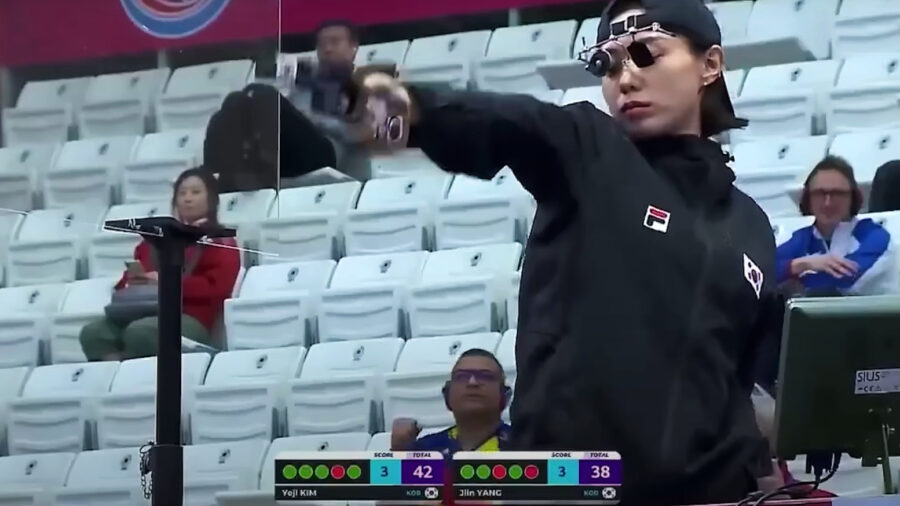
After scoring thousands of fans thanks to her cool style and unwavering confidence at the 2024 Paris Olympics, one South Korean sharpshooter is ready to take aim at her step in her career and become an assassin. Okay, Kim Ye-Ji won’t actually be clocking in as a literal assassin, but the 32-year-old Danyang, South Korea native, who won the silver medal in the women’s 10-meter air pistol in July, will be playing an assassin in the upcoming multinational short-form series Crush.
See her in a quick teaser for the upcoming series below.
In a short teaser trailer added to Asia Lab’s YouTube channel, Anushka Sen can be seen reprising her role from Asia as she attempts to aim a pistol at an unknown target. After a few seconds, Kim Ye-Ji, leaning into her cold, calm, and collected assassin demeanor, casually walks up to Anushka Sen and adjusts her shooting stance, straightens her arms, and improves her aim, all while remaining as stoic and confident as ever.
While exact plot details are still under wraps, it appears as if Kim Ye-Ji will play a well-seasoned assassin who will act as a mentor of sorts, offering her wisdom and showcasing her obvious skills around a gun.
“Kim Ye-ji’s casting as a global Korean assassin was a natural choice given her precision and performance at the Olympics, particularly her shooting skills.”
Lee Jung-sub
Kim Ye-Ji will portray her assassin character alongside Indian actor, Anushka Sen, with additional cast announcements expected to come at a later date. Crush is described as an action series that will see characters hailing from all over Asia engaging in dynamic and explosive storylines that all share an overarching theme. The short-form series will be directed by Korean filmmaker Lee Jung-sub, who also serves as the CEO of Asia Lab, a content production company that highlights travel products through collaborations with influential and viral Asian stars.
During the 2024 Paris Olympics, Kim Ye-Ji created an enormous amount of buzz thanks to her seemingly one-of-a-kind style and icy demeanor, which inspired fans to refer to her as an assassin or even a Terminator.
The Kim Ye-Ji assassin series will act as a spin-off to Lee Jung-sub’s original movie, Asia, which was inspired by the “Stop Asian Hate” movement, following the stories of people who are forced to confront racial hatred and discrimination all throughout the globe. The film included actors from several Asian countries, including Korean actor Jang Yoon-young, Thai actor Pakorn Chatborrirak, Indian actor Anushka Sen, and Malaysian singer Daiyan Trisha.
According to Lee Jung-sub, the decision to cast Kim Ye-ji was heavily influenced by the Olympian’s rising popularity and her ability to handle a weapon. “Kim Ye-ji’s casting as a global Korean assassin was a natural choice given her precision and performance at the Olympics, particularly her shooting skills,” Lee Jung-sub told NBC News. “The moment I saw that, I was convinced we had to cast her as the killer. It brings unparalleled credibility to the character.”
Crush is described as an action series that will see characters hailing from all over Asia engaging in dynamic and explosive storylines that all share an overarching theme.
During the 2024 Paris Olympics, Kim Ye-Ji created an enormous amount of buzz thanks to her seemingly one-of-a-kind style and icy demeanor, which inspired fans to refer to her as an assassin or even a Terminator.
During the Olympic women’s 10-meter air pistol competition, Kim Ye-Ji sported a pair of futuristic glasses that are designed to help a sharpshooter’s aim by equipping a blinder over one eye, eliminating the need for the shooter to focus on manually keeping the eye closed. To help keep her hair out of her face, Kim Ye-Ji opted to go with a casual ball cap in addition to her trendy-looking glasses, adding to her viral assassin persona.
For now, it remains unclear if Kim Ye-Ji’s assassin character will be wearing the Olympian’s now iconic glasses and ball cap combo in Crush. But regardless of her attire, there is a good chance that she’ll look cool no matter what.
Source: NBC News
Entertainment
We spent 12 months testing red light masks: Here are 6 that gave us real results (and 2 to skip)

How to choose a red light face mask: Look at wavelength first
There are some ways to tell that a red light face mask won’t be effective before you buy it and use it for a few months.
Wavelength is the first factor anyone will tell you to consider. You want to find products that emit light within the therapeutic window, or the range of wavelengths that can be effective when treating common skin conditions. There is now an abundance of evidence that specific wavelengths of red light can be effective for:
-
Reduction of fine lines, dark circles, and crow’s feet
-
Improving skin texture
-
Fighting wrinkles
-
Boosting collagen production
-
Reducing inflammation and redness
To be effective, the light coming from the mask must penetrate different layers of your skin. There are optimal wavelengths for each type of light a face mask emits, and any reputable brand will put their mask’s wavelengths front and center in the listing. These carefully chosen ranges are strong enough to penetrate your skin, but gentle enough to avoid over-activating delicate face skin.
Red light does its work in the middle layer (dermis) of your skin, requiring wavelengths between 630 and 633 nm to reach past the top layer. There, red light stimulates cells to produce rejuvenating proteins like collagen and elastin, evening out surface redness, and preventing scarring or post-pimple red spots.

The Shark CryoGlow’s Better Aging routine combines red and near-infrared light.
Credit: Leah Stodart / Mashable

The Shark CryoGlow’s Skin Clearing routine uses a special sequence of red, near-infrared, and blue light.
Credit: Leah Stodart / Mashable
Most red light masks also use near-infrared red light therapy, which requires longer wavelengths to travel further than regular red light. Near-infrared light between 830 and 850 nm reaches into tissue under the dermis to further stimulate cell turnover, firm skin, and heal deep-seated spots or stubborn dark circles.
What about blue light therapy?
Blue light is often used to target acne, and some of the best red light masks use a combination of blue and red light therapy.
Blue light operates on the top layer (epidermis) of your skin, so its ideal wavelength is shorter than either red light standard. Blue light at 415nm has an antimicrobial effect, ideally killing the bacteria that cause acne before a breakout starts. If hellbent bacterial acne makes it past the blue light phase — or if you’re also dealing with hormonal or cystic acne not caused by bacteria — red light swoops in to neutralize inflammation and speed up the healing process.
The thing is, most mainstream LED face masks hit those wavelength marks. So, how do you choose between masks if their wavelength numbers are all the same?
The importance of irradiance
Irradiance is another major element that determines whether or not a red light mask actually works. While wavelength refers to the length the light can travel, irradiance refers to the amount of light energy that’s actually reaching your skin per session (not just the intensity of light being generated at the bulb). If wavelength numbers are correct but irradiance is low, the mask will still be kind of a dud.

Bulb placement is one of the key factors we considered in our test.
Credit: Leah Stodart / Mashable

Comfort is another key factor, as consistent use is key to results.
Credit: Miller Kern / Mashable
Irradiance is officially expressed as milliwatts per square centimeter. The optimal irradiance range for a red light face mask is pretty wide (anywhere between 30 and 100 mW/cm²), though many brands don’t directly provide that number.
Most brands do note the length of each session, which is one way to quickly gauge irradiance without getting into calculations. Dr. Mamina Turegano sums it up best on her YouTube account: “Higher irradiance means more effective energy delivery per minute of use.” Longer sessions don’t automatically mean that results will be more powerful — a mask with sessions that last for less than 10 minutes has higher irradiance than a mask with sessions that last for 20 to 30 minutes. Since a mask with lower irradiance needs to sit on your face for longer, you might be less likely to keep up with wearing it.
Are bulb count and bulb placement a big deal?
The number of bulbs and the placement of bulbs inside the mask can also impact efficacy, especially if you’re expecting results on a specific area of your face. Masks with more bulbs packed evenly across the face will provide more even coverage across every inch of your face than masks with more sporadically-placed bulbs.
Some masks also provide more light sources overall by emitting both red and blue light simultaneously from every single bulb, like the Shark CryoGlow. This would be a better option for full-face acne prevention than masks with blue and red LEDs only concentrated in certain spots, like the Dr. Dennis Gross DRx SpectraLite.
What red light masks worked for us?
Of course, you probably didn’t come here for a science lesson. You want to find the best red light masks Mashable’s testers used and loved.
After trying out 11 different products, we ultimately found six that we can recommend. These masks delivered visible results for our product testers.
Remember: Consistency is essential for the best results (or any results)with LED face masks. You’ll need to wear your mask consistently for at least 1-2 months.
Entertainment
Free iPhone deal: T-Mobile is giving away the Apple iPhone 17 for free — how to qualify
TL;DR: The iPhone 17 and iPhone 17 Pro are available for free right now with T-Mobile. Here’s how to qualify for this limited-time offer.
Free when you trade in your eligible phone on an Experience More or Experience Beyond plan..
Free when you switch to T-Mobile and bring your number on an Experience Beyond plan.
Samsung has been the center of attention this week, and that’s totally fair. It’s not every week that a major brand drops three new foldables smartphones, two smartwatches, and smart glasses. But can we hold some space for Apple?
Apple prices are bumping in the face of RAMageddon, but you can still secure a special offer on iPhones from T-Mobile. This popular mobile carrier has just dropped a fresh batch of free iPhone deals on the latest handsets:
-
Apple iPhone 17 — free when you trade in your eligible phone on an Experience More or Experience Beyond plan.
-
Apple iPhone 17 Pro — free when you switch to T-Mobile and bring your number on an Experience Beyond plan (no trade-in needed).
Needless to say, T-Mobile isn’t handing over a new iPhone without some strings attached. The retail cost of your new phone is offset by 24 consecutive monthly bill credits. Your monthly statement will show a standard charge for financing the phone, which is immediately balanced out by an equal credit.
What exactly does this mean? You’re signing up for a 24-month commitment with the network, and any unpaid balance on the phone’s retail value will become due immediately if you decide to cancel your service, switch to another carrier, or upgrade to the iPhone 18 before the end of your deal.
You will also need to pay standard upfront taxes and a one-time $35 activation fee, but that’s a small price to pay for the latest iPhone.
Mashable Deals
We get that at this point, it’s tempting to wait for the next batch of iPhones to be announced. According to our rumor tracker, Apple is “widely expected to launch a new lineup of iPhones later this year, including the iPhone 18 Pro, 18 Pro Max, and the rumored iPhone Ultra, the company’s first-ever foldable.” That’s exciting news for iPhone fanatics, but with prices on the rise, this could be the last example of mobile carriers offering new phones for free.
Get the Apple iPhone 17 for free this weekend with T-Mobile.
Entertainment
Star Trek Just Proposed Nuking Migrants To Solve Mass Migration Problems
By Joshua Tyler
| Updated

Star Trek: Strange New Worlds beamed in for a fourth season this week, and avoided the jokey premises that hamstrung the previous season, for at least one episode. Instead, in this first episode titled “Valles Marineris,” it took on the hot topic of mass migration by sending the Enterprise back in time to deal with the consequences of an invasive species sucking up resources.
The Enterprise arrives 65 million years in the past to find an extra planet in our solar system. It’s ruled by a race of intelligent insects who use mass migration to invade planets. That extra planet and its inhabitants aren’t the only surprise. The planet Mars is not a dead world in the past. It’s vibrant, alive, and run by technologically advanced Martians.

Meanwhile, Earth is still a place of volcanoes and dinosaurs. At one point, the Enterprise’s genetically enhanced security chief saves the day by punching a velociraptor.
The insectoids intentionally crashed a ship into Mars and “fed” on their world. Then the Martian commander hammers the situation home by saying, “That’s why your discussions of cultures, of science, although kind and hopeful, are not relevant.”
When Pike says, “There may be other ways to deal with them,” the Martian commander responds by pointing out that many thought the same on her world. “As they talked, we died,” she says. The Martians were only able to stop the insects by ripping a hole in their own planet, killing all the invading settlers and also two million of their own people.

On Earth, Enterprise’s crew discovers a crashed insectoid colony ship. Everyone aboard was killed, but our heroes learn the insects were trying to land and feed on Earth, presumably to do the same thing they did to Mars. The Enterprise away team voices sympathy for the dead creatures, with Lieutenant Ortegas voicing, “They may be different from us, but they wanted to survive too.” Meanwhile, Lieutenant Commander Noonien-Singh acknowledges the reality of the situation, “If they were settlers, I’m not sure if I should feel sad or relieved.”
Captain Pike quickly realizes the truth. If this insectoid race is allowed to send “settlers” to Earth, humanity’s future home planet, they’ll suck up all the resources and wipe out our entire future. To save the human race from dangerous mass migration, Pike allows the Martians to blow up the insectoid planet and genocide the race of resource-consuming migrants.

The parallels to the real world are hard to miss. The episode goes out of its way to portray the insectoids not so much as invading armies but as migrants whose unwanted arrival consumes resources. The Martians deliberately refer to them as feeding on their planet, to hit home the point that the main issue is their resource consumption. The crashed ship on Earth is referred to as a ship of settlers, not soldiers.
Mars has already been devastated by the process, and Earth is next. Stripped of the science-fiction setting, the episode clearly explores questions of mass migration, resource competition, demographic change, and whether a civilization has the right to prevent an influx it believes threatens its long-term survival.
“Valles Marineris” was written by Akiva Goldsman and Henry Alonso Myers. It’s worth noting that Myers wrote some of the best and most thoughtful episodes in the show’s first season and none of the worst episodes of its subsequent seasons. He was also a driving force behind the gone-but-not-forgotten spy series Chuck from the 2010s and the 2016 show The Magicians.

In telling this story, Strange New Worlds did what Star Trek has always done, and what the best science fiction usually does, by engaging with a real-world problem and clearly restating it in a way that lets the audience reason out the best response.
Reasoncraft Is Honest Persuasion
This approach, while persuasive, is not propaganda, which is dishonest persuasion done through manipulation. There’s nothing dishonest in what Strange New Worlds is doing. It’s persuasion through logical thinking. There’s never really been a clear word for this type of up-front screenwashing before, so I’ve come up with one.
This is Reasoncraft. Reasoncraft is persuasion through openly stated reasons and honest exploration, rather than manipulation.

Even at its lowest point, Star Trek has always stuck with reasoncraft as its form of persuasion. It’s fundamental to the franchise, and it’s part of why shows like Starfleet Academy are so bad.
Reasoncraft Results In Bad Writing For Bad Ideas, And Good Writing For Good Ideas
When a piece of entertainment uses reasoncraft to make good arguments, the result is often good writing. When reasoncraft is used to make bad arguments, the result is bad writing that makes no sense.
This turned Starfleet Academy into one of the worst shows in television history. It’s also why the previous Strange New Worlds season was so reviled. The stories they told in season 3 were nonsense because the arguments they were making were also nonsense. This season 4 episode of Strange New Worlds, while not perfect, is at least a step up from those season 3 lows. It’s a step up because it takes on hard questions, considers them honestly, and then follows those honest answers to their logical, unflinching conclusion.

Reasoncraft is also why a show like Star Trek: Deep Space Nine is so good. Because when that series tackled a complex issue and used reasoncraft, they followed it through to its logical conclusion, even if that conclusion didn’t always fit with their personal ideology. That willingness to follow the story where reason takes it, even if that conflicts with the beliefs of the show’s writers, is something modern Star Trek has often been unwilling to do.
It’s why people with bad ideas resort to propaganda. Dishonesty is the only way to screenwash others into believing something stupid without also creating an entertainment product that plays out like something written on the side of a bathtub with a water crayon.

Another Tiger possibly on trade block, Casey Mize, faces Royals
We spent 12 months testing red light masks: Here are 6 that gave us real results (and 2 to skip)


