
Tech
Nvidia CEO pushes back against report that his company’s $100B OpenAI investment has stalled
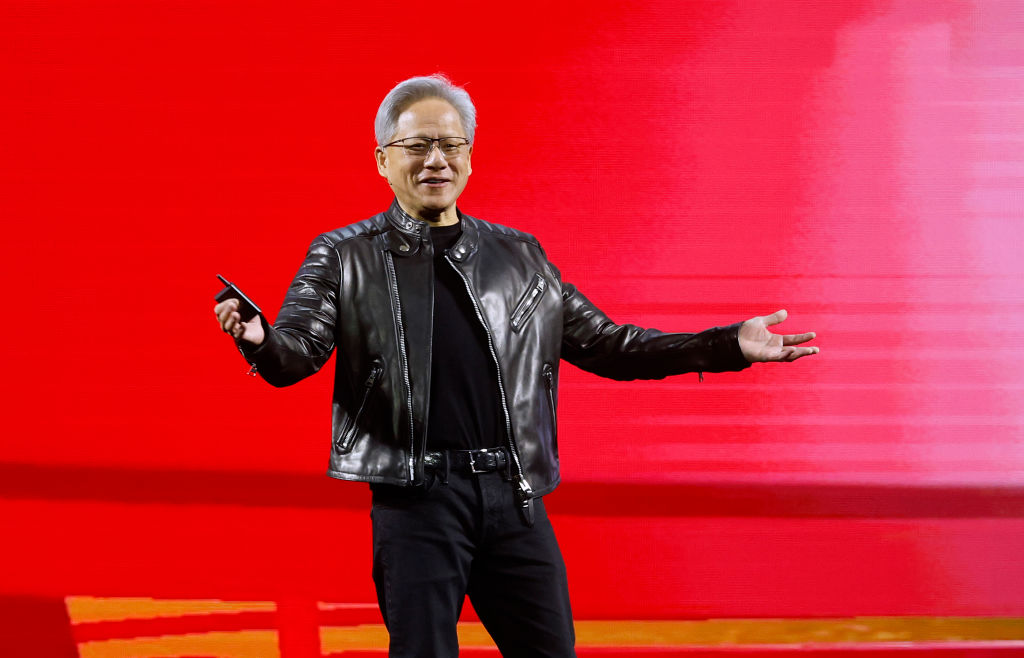
Nvidia CEO Jensen Huang said Saturday that a recent report of friction between his company and OpenAI was “nonsense.”
Huang’s comments came after The Wall Street Journal published a story late Friday claiming that Nvidia was looking to scale back its investment in OpenAI. The two companies announced a plan in September in which Nvidia would invest up to $100 billion in OpenAI and also build 10 gigawatts of computing infrastructure for the AI company.
However, the WSJ said Huang has begun emphasizing that the deal is nonbinding, and that he’s also privately criticized OpenAI’s business strategy and expressed concerns about competitors like Anthropic and Google.
In addition, the WSJ reported that the two companies are rethinking their relationship — though that doesn’t mean cutting things off entirely, with recent discussions reportedly focusing on an equity investment of a mere tens of billions of dollars from Nvidia.
An OpenAI spokesperson told the WSJ that the companies are “actively working through the details of our partnership,” adding that Nvidia “has underpinned our breakthroughs from the start, powers our systems today, and will remain central as we scale what comes next.”
According to Bloomberg, reporters asked Huang about the report during a visit to Taipei. In response, he insisted that Nvidia will “definitely participate” in OpenAI’s latest funding round “because it’s such a good investment.”
“We will invest a great deal of money,” Huang said. “I believe in OpenAI. The work that they do is incredible. They’re one of the most consequential companies of our time.”
Techcrunch event
Boston, MA
|
June 23, 2026
He apparently declined to specify how much Nvidia would be investing, instead saying, “Let [OpenAI CEO Sam Altman] announce how much he’s going to raise — it’s for him to decide.”
The WSJ reported in December that OpenAI is looking to raise a $100 billion funding round, while The New York Times said this week that Nvidia, Amazon, Microsoft, and SoftBank are all discussing potential investments.
Tech
Google turns Chrome into an AI co-worker for the workplace

As part of its slate of Google Cloud Next announcements on Wednesday, the company shared plans to bring “auto browse” agentic capabilities to Chrome users in the enterprise, along with enhanced security measures.
With auto browse, Chrome users can take advantage of Gemini to understand the live context in their open browser tabs, and then use the AI to handle various tasks like booking travel, inputting data, scheduling meetings, and others related to web-based work.

Google suggests the tool could be used for things like inputting information in the company’s preferred CRM system based on content in a Google Doc, comparing vendor pricing across tabs, summarizing a candidate’s portfolio before an interview, pulling key data from a competitor’s product page, and more.
The company notes that its workflows will still require a “human in the loop,” meaning that the user will have to manually review and confirm the AI’s input before any final action takes place.
However, the idea is to help speed up these types of more tedious tasks to free up people to focus on what Google refers to as more “strategic work.”

This is the larger promise from AI advocates: that you’ll get your time back by using this new technology. But in practice, studies have shown that AI isn’t reducing work — it’s intensifying it. It remains to be seen how this will play out at the enterprise level as AI becomes a standard part of the workflow. Presumably, that could mean managers will expect that people can get more tasks done in less time.
Google says the new feature will initially be available to Workspace users in the U.S., as a part of Google’s push to infuse its AI into one of its most-used apps in the workplace, the web browser nearly everyone uses. It can be enabled via a policy, and Google states that an organization’s prompts won’t be used to train its AI models. (A disclosure that is increasingly necessary these days, given that Meta is even using its own employees’ keystrokes to train its AI.)
Like the consumer-facing version of the feature, Workspace users will be able to save their most common workflows for later use. These “Skills,” as they’re called, can be pulled up by either typing a forward slash (” / “) or by clicking the plus sign to access the needed Skill.
In addition to the infusion of AI into Chrome, Google is touting its ability to detect unsanctioned AI tools in the workplace via Chrome Enterprise Premium. Now, it’s expanding those capabilities to help IT teams look for compromised browser extensions or other AI services — specifically “anomalous agent activity.”
Google is correct to position this as a security feature, but it has another advantage, too. The tech giant is essentially leveraging corporate IT to shut down any other AI agents that could be taking root in the enterprise world organically. Years ago, this was how many web services established themselves in the workplace, amid an employee-driven “Enterprise 2.0” rush to adopt new technology like cloud storage, collaborative docs, or file sharing.
This new feature, which Google somewhat ominously dubs “Shadow IT risk detection,” will give IT teams visibility into the usage of both sanctioned and unsanctioned GenAI and SaaS sites across their organization.

IT teams will also receive a “Gemini Summary” of the Chrome Enterprise release notes and other AI-powered suggestions. This will surface critical changes, new policies, and upcoming deprecations, along with recommendations about things like configuring new settings or reviewing managed browsers.
The company also announced an expanded partnership with Okta to secure the agentic workplace with added features to reduce session hijacking and other protections. It’s also upgrading its security controls for extensions and introducing Microsoft Information Protection (MIP) integration to help organizations enforce consistent security policies.
When you purchase through links in our articles, we may earn a small commission. This doesn’t affect our editorial independence.
Tech
Google Cloud launches two new AI chips to compete with Nvidia
Google Cloud on Wednesday announced that its eighth generation of custom-built AI chips, or tensor processing units (TPUs), will be split in two. One chip, named the TPU 8t, will be geared for model training and another, the TPU 8i, is aimed at inference.
Inference is the ongoing usage of models, aka what happens after users submit prompts.
As you might expect, the company touts some impressive performance specs for these new TPUs compared to the previous generations: up to 3x faster AI model training, 80% better performance per dollar, and the ability to get 1 million+ TPUs to work together in a single cluster. The upshot should be a lot more compute for a lot less energy — and cost to customers — than previous versions. It calls these chips TPUs, not GPUs, because its custom low-power chips were originally named Tensor.
But Google’s chips are not a full frontal assault on Nvidia’s future, at least not yet. Like the other giant cloud providers, including Microsoft and Amazon, Google is using these chips to supplement the Nvidia-based systems it offers in its infrastructure. It is not flat-out replacing Nvidia. In fact, Google promises its cloud will have Nvidia’s latest chip, Vera Rubin, available later this year.
One day the hyperscalers building their own AI chips (which includes Amazon, Microsoft, and Google) may grow to need Nvidia less, as enterprises move their AI needs to their clouds and port their apps to these chips.
Still, as things stand today, it’s not profitable to bet against Nvidia. As notable chip market analyst Patrick Moorhead jokingly posted on X, he had predicted that Google’s TPU could be bad news for Nvidia (and Intel) back in 2016 when the search giant launched its first one. Nvidia is now a nearly $5 trillion market cap company, meaning that prediction didn’t exactly hold up to the test of time.
If all goes according to Nvidia’s plan, Google’s growth as an AI cloud provider would result in more business for the chip maker not less, even if many a workload runs on Google’s chips.
Techcrunch event
San Francisco, CA
|
October 13-15, 2026
In fact, Google also says it has agreed to work with Nvidia to engineer computer networking that allows Nvidia-based systems to perform even more efficiently in its cloud. In particular, the two tech giants are working to beef up the software-based networking tech called Falcon, which Google created and open sourced in 2023 under the godfather of all open source data center hardware organizations, the Open Compute Project.
When you purchase through links in our articles, we may earn a small commission. This doesn’t affect our editorial independence.
Tech
From the stage to the future: Where are Startup Battlefield’s alumni now?
Some of the most consequential companies in tech history didn’t launch with a splashy fundraising announcement. They started with a pitch. Dropbox demoed to a room of skeptics. Cloudflare took the stage before most people understood what edge networking meant. Discord was a scrappy game developer called Hammer & Chisel. Mint, Trello, Forethought, N26 — all of them passed through the same crucible: TechCrunch Startup Battlefield.
That’s not a coincidence. Battlefield isn’t just a competition. It’s a launchpad, and the numbers back it up. More than 1,700 companies have competed on the Battlefield stage. Together, they’ve raised $32 billion in total funding and generated over 250 exits — including acquisitions by Microsoft, Google, Yahoo, Salesforce, Twitter, Uber, and Amazon. The Startup Battlefield network runs so deep that alumni have even acquired each other: Dropbox acquired fellow Startup Battlefield alum DocSend in 2021. For thousands of founders, it’s become a defining milestone — not just a pitch competition, but the moment the world started paying attention.
We wanted to show you what happens after the confetti falls. We checked in with some of our recent alumni, many of whom have sat down with us on Build Mode: The Founder Survival Guide, TechCrunch’s podcast for founders at every stage. Here’s what they’ve been building, in their own words.
About Build Mode
Each season goes deep on a different chapter of startup life. Season 1 covered go-to-market. Season 2 — out now — is all about building your team. And mark your calendars: Season 3 drops in June, tackling the most requested topic we’ve ever gotten: fundraising.
Subscribe now so you don’t miss it.
The champions and runners-up
From military logistics to Startup Battlefield 2025 champion
Kevin Damoa, founder of Glīd — 2025 winner
Kevin Damoa didn’t come from Sand Hill Road. He came from military logistics — a background that turned out to be ideal training for building under pressure, with constrained resources and real stakes. Damoa’s path to the Startup Battlefield 2025 championship is the kind of origin story that makes you reconsider where the next generation of great founders is actually coming from.
Techcrunch event
San Francisco, CA
|
October 13-15, 2026
→ Listen to Kevin’s Build Mode episode
From the Startup Battlefield stage to the International Space Station
Capella Kerst, founder and CEO of geCKo Materials — 2024 runner-up
Capella Kerst didn’t set out to reinvent adhesion. She set out to solve a problem that has stumped engineers for decades: How do you make things stick — reliably, repeatedly, and without residue — in the most extreme environments imaginable? geCKo Materials, spun out of Stanford, has developed gecko-inspired adhesive technology with applications ranging from manufacturing floors to, quite literally, the International Space Station.
Kerst’s Startup Battlefield moment was a signal to the market that the science was ready for the world. What’s happened since is proof that runner-up isn’t a consolation prize — it’s a credential. Hear how she got there:
→ Listen to Capella’s Build Mode episode
How Forethought AI found product-market fit — before it was obvious
Deon Nicholas, co-founder of Forethought AI — 2018 winner (acquired by Zendesk)
Few Startup Battlefield stories have a more complete arc than Forethought AI. Deon Nicholas took the stage with a conviction that AI could fundamentally transform customer support — before that was an obvious bet. Before the term sheets and the headlines, there was a pitch and a thesis. Forethought was recently acquired by Zendesk — the latest example of what the Startup Battlefield stage can set in motion. His Build Mode episode is essential listening, and a perfect primer for Season 3’s deep dive on fundraising.
→ Listen to Deon’s Build Mode episode
Top 20 finalist stories
The danger of fundraising before finding product-market fit
David Park, founder of Narada
Raising before product-market fit doesn’t speed things up — it speeds up your mistakes. Park doesn’t sugarcoat the lessons.
→ Listen to David’s Build Mode episode
Using AI to hire for compatibility, not just skill
Sarah Lucena, founder and CEO of Mappa
Skills get people in the door. Compatibility determines whether they stay. Lucena is using AI to fix the part of hiring nobody talks about.
→ Listen to Sarah’s Build Mode episode
These founders competed on the Startup Battlefield and sat down with us on Build Mode to tell their story. All worth a listen.
Anna Sun of Nowadays and Hala Jalwan and Alessio Tresanti of Rivio — On what happens when a startup becomes a family business, and the community that forms around Startup Battlefield. → Listen
Kyle Rudolph and Jon Walburg, co-founders of Alltroo — On why your network is your first go-to-market strategy. → Listen
Jas Schembri-Stothart of Luna and Andre Peart of Untapped Solutions — On reaching the markets everyone else ignores and building for underserved communities without the typical growth playbook. → Listen
The milestone is real
Every generation of Startup Battlefield alumni adds a new chapter to the same story. But behind every one of those data points is a founder who made a bet on themselves — publicly, in front of people who were paying attention. The stage matters. The community lasts. The milestone is real.
Applications for Startup Battlefield 2026 are open. If you’re building something that deserves a stage, this is yours.
Know a founder who’s ready for the spotlight? Investors, operators, and fellow founders can nominate companies directly.
Not ready to apply yet? Build Mode is where we meet you. Season 2 is live now. Season 3 — all about fundraising — drops this summer.
When you purchase through links in our articles, we may earn a small commission. This doesn’t affect our editorial independence.

Behind Mark Vientos' clutch hit, Mets edge Twins, snap 12-game skid
Google turns Chrome into an AI co-worker for the workplace


