
Entertainment
Netflix's New Plan To Totally Take Over A Formally Independent Media Space
By Robert Scucci
| Published

It’s official. Last Podcast on the Left is coming to Netflix. I first heard the news on Wednesday, January 21 during the weekly Side Stories episode, when series host Marcus Parks announced that the true crime comedy podcast would be showing up on Netflix feeds by the end of the month. In this case, the long-running series is part of a licensing play, meaning the video episodes from the back catalog will simply be available to stream on Netflix for subscribers, while regular listeners can continue using Spotify or their podcast apps as usual.
In other words, if you don’t have Netflix, you can still tune in week after week to listen to Last Podcast on the Left. But if you’re a diehard Netflix junkie, you can now catch the show there without changing your media consumption habits.

While this is great news for Marcus Parks, Henry Zebrowski, and Ed Larson, it also points to a much larger shift in the media landscape as we move further into 2026. That shift is Netflix making a serious push to dominate the podcast space.
Last Podcast On The Left Reaching A Wider Audience
Hosted by Marcus Parks, Henry Zebrowski, and Ed Larson, Last Podcast on the Left is a true-crime and comedy podcast covering everything from serial killers and alien invasions to government conspiracies and just about any other macabre subject imaginable. The series debuted in 2011, clocked in over 1,100 episodes, and has only continued to grow in popularity over the years.

I’ve always gravitated toward the “Heavy Hitter” series, where they spend multiple episodes unpacking the lives and crimes of figures like BTK, Ted Bundy, Jeffrey Dahmer, John Wayne Gacy, and Aileen Wuornos. That said, the show has been a part of my weekly listening routine for over a decade at this point, and I’m glad to see what started out as a bootstraped project continue to flourish. If you have a dark sense of humor and enjoy learning about the worst people and events in history while three dudes work out their shtick through exhaustive research, it’s hard to beat. I’m hopeful this Netflix deal helps the show reach a wider audience without compromising its integrity or legacy.
Licensing Existing Properties Vs Netflix Originals
Personally, I breathed a sigh of relief when Marcus Parks clarified that Last Podcast on the Left’s involvement with Netflix was strictly a licensing arrangement. It’s still the same show, just using Netflix’s infrastructure and reach to capture a new audience. Alongside that, the group has also hinted at additional projects that will land on the streaming platform in the coming months, which should broaden their scope as podcasters, media personalities, and content creators. It feels like a rare win-win kind of situation, especially since ownership of the show was not transferred in the process.

On a much broader scale, Netflix plans to go hard on podcasts in 2026 by partnering with Spotify, iHeartMedia, and Barstool Sports as a way to distribute already existing shows to the streaming sector. On the flip side, this also means Netflix is beginning to produce its own podcasts to fill their ever-growing content slate. As of this writing, Bridgerton: The Official Podcast will operate as a companion piece to the hit series and is scheduled to debut on January 29, 2026.
Beyond that, it’s still unclear what original podcast concepts not tied to already existing IPs will look like, especially when filtered through committee decisions and the kind of focus-group feedback Netflix productions are known for. Netflix has already announced The Pete Davidson Show, and The White House with Michael Irvin recently saw its debut, but it feels inevitable that scripted podcasts are probably coming next. If that happens, I’m genuinely curious about how Netflix plans to hold the attention of distracted viewers who may not be listening to a word anyone is saying.
Entertainment
Star Trek’s Greatest Writers Thought The Best Episode Would Be A Disaster

By Chris Snellgrove
| Updated

One of the most fascinating things about insanely talented writers is that they are typically overly critical of their greatest works. Sometimes, this is because they lack confidence in themselves and worry that everything (no matter how successful) could always be better. Other times, it’s simply because they were writing under a tight deadline and became convinced they could have done better if they only had more time. This actually happened to some of the greatest writers of Star Trek: The Next Generation when they were working on one of the show’s best episodes: “Yesterday’s Enterprise.”
These days, fans look back on this episode as a defining episode of the series, one that demonstrated how much potential TNG really had. At the time, though, the writers (including future Deep Space Nine showrunner Ira Steven Behr and future Battlestar Galactica showrunner Ronald D. Moore) feared that the episode would be a disaster because they had to work over Thanksgiving and turn a completed script in by the end of the weekend. However, the sheer quality of the episode proved one thing once and for all: if there’s anything these guys can do, it’s work well under pressure!
Star Trek Into Darkness (Literally)
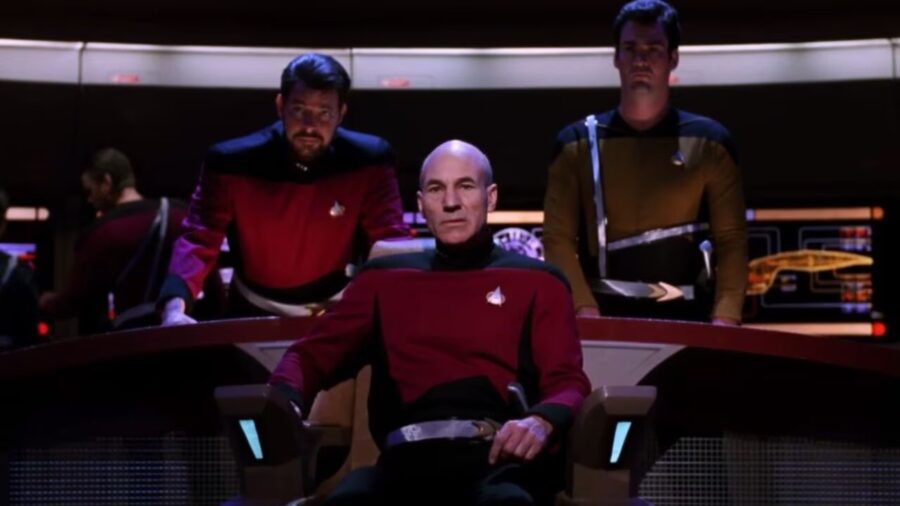
Why did the writers for “Yesterday’s Enterprise” have to work on the episode over Thanksgiving? This had everything to do with the episode’s special guest stars, Denise Crosby and Whoopi Goldberg. Crosby’s character had been killed off back in Season 1, so she was busy with other projects during filming for Season 3. Meanwhile, Goldberg was a big-deal movie star who only appeared on Star Trek because she loved the franchise so much. The episode was originally going to be written after Christmas, but to accommodate both actors’ schedules, the writers had to suddenly have a completed script by the end of Thanksgiving weekend.
According to the reference book The Making of Yesterday’s Enterprise, Ira Steven Behr said that the writers (which included himself, Ronald D. Moore, Hans Beimler, and Richard Manning) were understandably grumpy about having to work over a holiday weekend. In order to get the episode done under the deadline, each writer was given a different portion of the script to handle. For example, Moore was the main guy handling the romance between Tasha Yar and the time-displaced Richard Castillo.
Dropping Everything For Some Very Special Guest Stars
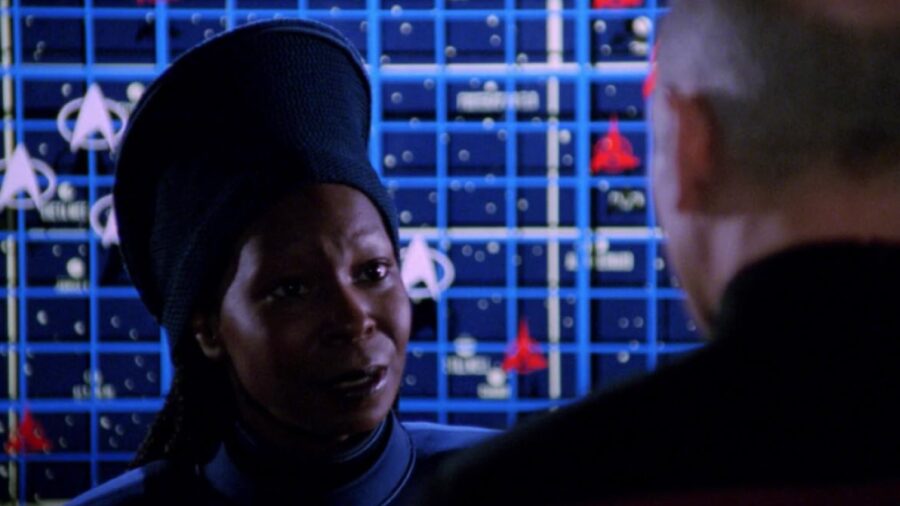
Despite having a game plan, they feared the episode would suck; according to Star Trek: The Next Generation–The Continuing Mission, Eric Stillwell (who developed the story) claimed, “Most of the writers were not very happy with the script. They thought it was going to be horrible, because they don’t like having to write [something] and make it work in three days.” However, these writers embraced a silver lining: they finally got to write the kind of dark, tension-filled episode that various Trek bigwigs (notably, Gene Roddenberry himself) always rejected. Fortunately, their hard work paid off, and “Yesterday’s Enterprise” became the third highest-watched episode of the entire series.
It’s hard to understate the influence of “Yesterday’s Enterprise,” which became a favorite episode of Denise Crosby, Rick Berman, and episode director David Carson. It won an Emmy and was voted the best episode of Star Trek: The Next Generation on six different occasions. And, for better or for worse, Roberto Orci later said this episode was the primary influence of Star Trek (2009), which kickstarted the Kelvinverse. Ironically enough, though, this insanely successful and influential TNG episode was written by four annoyed writers over three days, all of whom thought it would be completely awful and just wanted to eat some leftover turkey!
Entertainment
Raunchy 1970s Cult Classic Changed Post-Apocalyptic Sci-Fi Forever
By Jonathan Klotz
| Updated

The 70s was an odd time for sci-fi movies. On the one hand, the genre had broken free of the generic 50s mad scientist/monster movies and a new wave of filmmakers was experimenting with stories that pushed the envelope. On the other hand, those wild experiments sometimes got a little weird. Case in point 1975’s A Boy and His Dog, which follows Vic and his telepathic dog Blood wandering a post-apocalyptic wasteland as they search for food, and more importantly, women. Streaming for free on Tubi and Amazon Prime, it’s an unlikely inspiration for both Fallout and Mad Max, while a time capsule of what sci-fi was like before Star Wars changed everything.
A Boy And His Dog And His Libido

A Boy and His Dog stars Don Johnson as Vic, and Tim McIntire as the voice of Blood. The two constantly bicker as any two male best friends do. Blood’s ability to sniff out women is of incredible importance to the horny and lonely Vic, who after saving one girl, Quilla June (Susanne Benton) from mutants and finally getting laid again, decides to follow her to Downunder, a secret society beneath the surface that’s a near utopia compared to the nuclear blasted wasteland.
Unfortunately, Blood remains on the surface and none of the human characters can match his dry wit. It’s there, in the subterranean version of Topeka, that Vic learns he’ll achieve his dream of copulation thanks to a high “stud rating,” except he’ll be “sent to the farm” after impregnating 35 women. Worse, it’s all done through electrodes, and that more than anything is what spurs Vic to escape Topeka.
A Faithful Adaptation Of A Sci-Fi Legend

It’s a weird plot, but it’s also a rather faithful adaptation of the novella, A Boy and His Dog by the sci-fi icon Harlan Ellison. The biggest change was a few lines of dialogue that make the film more, according to Ellison, misogynistic than his novel ever was. It wasn’t enough to stop the film from becoming an immediate cult classic. It would never, ever be made today. Johnson’s performance, which makes it pretty clear that Vic can be outsmarted by everyone he comes across, goes so far as to start flipping the script.
The influence A Boy and His Dog had on Fallout is immediately clear. Vic calls Blood “Dogmeat,” Downunder is essentially a Vault-Tec experiment, and the complete breakdown of society’s old order explains why something as mundane as bottle caps became currency in the games. Who knew a black sci-fi comedy about a horny survivor would influence one of the best post-apocalyptic series of all time?

A Boy and His Dog bombed in theaters, but once it became a cult classic, work started on a sequel. Instead of Vic, it would follow a female survivor named Spike and of course, Blood, the real hero of the series. Nine years after he brought Vic to life, Don Johnson starred in Miami Vice and changed television forever. If you ever wanted to see Sonny Crockett as a horny scavenger, A Boy and His Dog is your chance.
A Boy and His Dog is streaming for free on Tubi, Amazon Prime Video, Pluto TV, Plex, and YouTube.
Entertainment
Another Major Delay Spells Doom For James Gunn’s DCU
By Chris Snellgrove
| Updated

When James Gunn’s DCU began with a Superman movie, many superhero fans had the same question: when are we going to see a team-up with Batman? Unfortunately, an onscreen collaboration between the World’s Finest seems increasingly farther away. Nobody has been officially cast as the DCU’s Batman, and his first movie doesn’t have a premiere date yet. Weirdly enough, that hasn’t kept Warner Bros. from greenlighting numerous projects focused on the Caped Crusader’s foes, including Clayface (releasing October 23) and a Deathstroke/Bane team-up film. Now, it seems like our odds of seeing Batman in the DCU have gotten worse with the surprise delay of a completely separate project.
Separate from James Gunn’s cinematic universe, Matt Reeves has continued working on the sequel to his 2022 hit film The Batman. The sequel was previously scheduled to be released on October 1, 2027, and fans were counting down the days until they’d see Robert Pattinson kicking butt and taking names once more. Unfortunately, the countdown just got longer: The Batman II has been officially delayed to February 18, 2028. This is actually the second delay for the movie, and one that may effectively endanger the DCU by forcing two different Dark Knights to compete against each other.
Dancing With The Delay In The Pale Moonlight

Fans of Matt Reeves’ The Batman are getting all too used to the sequel getting pushed back. Originally, the movie had a release date of October 2, 2026, but the studio delayed it until October 1, 2027, to give Reeves more time for postproduction. Now, it has been delayed until February 18, 2028, which gives the director even more time to polish the sequel. Nonetheless, the repeated delays have concerned some fans who worry that the film is a Supergirl-style stinker Reeves is trying to fix in post. Others worry that even if the film is great, making us wait over half a decade between sequels will kill any momentum the movie could have had.
DC Studios co-CEO James Gunn disagrees, of course. On Threads, he mentioned how several sequels achieved critical and commercial success despite a long wait between films. “7 years between Alien and Aliens. 14 years between Incredibles. 7 years between the first two Terminators. 13 years between Avatars. 36 years between Top Guns. And, of course, six years between Guardians Vol 2 and Vol 3.” While he has a point, it’s worth noting that several of his examples (including Aliens, Terminator 2, and The Incredibles 2) succeeded back before audiences were collectively hooked on the never-ending stream of new content from platforms like TikTok.
Will Audiences Respond To The Next Bat-Signal?
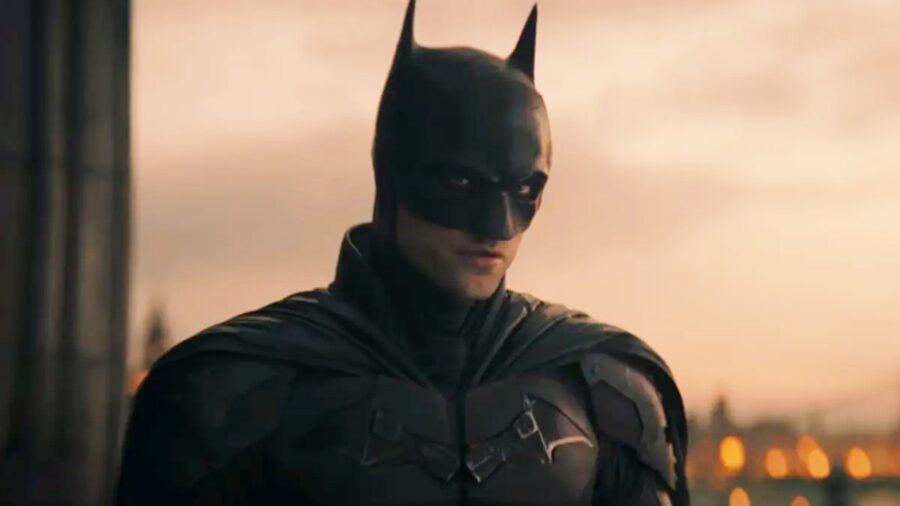
In other words, a huge wait between The Batman and The Batman II might be a turn-off for younger audiences more attuned to movies like Obsession and Backrooms, both of which were created by filmmakers who first achieved success on YouTube. The real elephant in the room, though, is that delaying Matt Reeves’ latest film may end up hurting the eventual Batman DCU film. Rumors have been swirling that Warner Bros. is trying to find the right actor for the role, and the failure of Supergirl may encourage the studio to focus on a new Dark Knight movie sooner rather than focusing on another relatively minor character.
If that happens, the DCU Dark Knight movie (Batman: The Brave and the Bold) could come out very soon after The Batman II; possibly less than a year later. Should this occur, one or both of the films are likely to suffer at the box office. For example, if mainstream audiences know that The Brave and the Bold is coming, they may avoid The Batman II, like audiences avoided Blue Beetle and The Flash when they knew the DCEU was coming to an end. Conversely, if Reeves’ sequel is really great, The Brave and the Bold may suffer from comparison, with fans wondering why the latest DCU film can’t be as good as what came before.
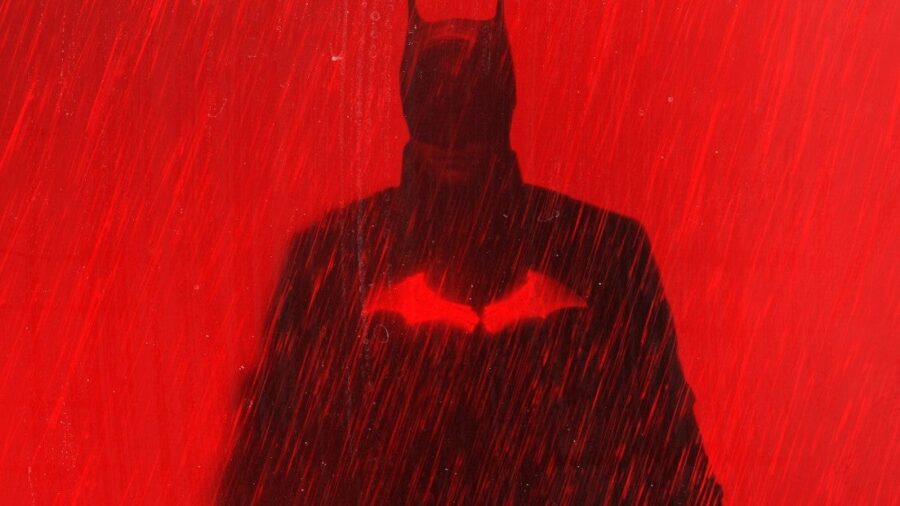
Batman is my absolutely favorite superhero, so I’d love to be wrong about this. In my perfect world, The Batman II will be even better than the original, and Batman: The Brave and the Bold will be the best film in the DCU. But the failure of Supergirl (which had very little to compete with) has underscored how fickle audiences can be when it comes to superhero cinema. Delaying The Batman II for over half a decade may very well sink that movie’s chances at the box office even as it sabotages the next film featuring the Caped Crusader. Forget the Joker: as it turns out, Batman’s greatest enemy may be studio interference!

Paige Bueckers leaves game after collision, hitting head on floor
Yankees option RHP Elmer Rodriguez to Triple-A


