
Entertainment
Marvel's Most Hated Movie Is Better Than The Current MCU

By Jennifer Asencio
| Published

The 1986 Lucasfilm movie Howard the Duck was never going to win any awards. Right from the beginning, everyone recognized how cheesy it was. Few people, aside from true comic book nerds, knew Howard had anything to do with the Marvel universe. Coming from the studio that brought us the original Star Wars trilogy and featuring Lea Thompson fresh from her first turn as Lorraine Baines-McFly, the movie just seemed like it was out of left field.
An Insane Plot And Production

Howard is a very ordinary duck, enjoying his life in Marshington, DC, when suddenly a portal opens and drags him right from his living room and into the very Earthling city of Cleveland. There, he meets Beverly, herself an aspiring musician. She takes him in and introduces him to Phil, a groupie for her band who also happens to work in the lab at the local museum. Howard is hoping Phil can help get him home, but in the meantime, he looks for a job and helps Beverly by managing her band.
Phil gets help in the form of Dr. Walter Jennings, whose laser experiment is what dragged Howard to Earth, but it also brought along “someone else”: an interdimensional monster so ugly and dangerous that it could single-handedly destroy the planet. It doesn’t want to do that until it can invite a few friends along using Jennings’ laser, and Howard and his new friends are all that stands between the Earth and certain destruction.
So Ahead Of Its Time, We’re Just Now Catching Up With It

Let’s face it: Howard the Duck is not a good movie, and it never was. But between oversaturation of the Marvel Cinematic Universe as it is today and the ensemble cast that somehow carried this very 80s comic adventure, the movie is a lot more fun today than it was when it first came out. It was ahead of its time as a lampoon of the Marvel universe, well before the Avengers ever assembled onscreen. Howard is actually part of the Guardians of the Galaxy continuity, which makes sense given that they have a talking raccoon and a sentient tree.
The amazing cast is led by Thompson, Tim Robbins as Phil, and Jeffrey Jones as Dr. Jennings, with a team of puppeteers moving Howard around, while he is voiced by Chip Zien. Notable cameos include Holly Robinson as one of Beverly’s bandmates; police procedural star Paul Guilfoyle as, unsurprisingly, a cop; and comic actor David Paymer as Jennings’ lab assistant. Jorli McLain, an obscure actress who looks a lot like Tracy Gold of Growing Pains, steals her scene as a waitress in a restaurant called Cajun Sushi.

Jones is especially good, which is a little uncomfortable when you know his off-screen crimes, but the actor was excellent at his craft, as evidenced by a range of other roles as disparate as Beetlejuice, The Hunt for Red October, Ferris Bueller’s Day Off, and Valmont. As Dr. Jennings, he plays it deadpan, as though a walking, talking duck is normal in his world. As his alter ego, his delivery of lines and comic timing make it obvious why he was allowed to continue acting after he served his time. He is the best part of an over-the-top and chaotic movie, setting up its zany heroes with hilarious precision.
Tim Robbins is known for being a very pedantic actor, memorizing his every line and movement. He is also not known for this kind of comedy, so his appearance is a pleasant surprise from an actor who is usually found in more witty films like The Hudsucker Proxy and Bull Durham. Yet he plays his character with the same zeal as a 1930s screwball actor, including trips, falls, and numerous physical stunts played for the laugh.
A Certified Cult Classic

Lea Thompson bears the brunt of the film, though, having to appear in the most scenes with the puppet that represents Howard. Playing against an inanimate object, she pulls out all the stops and leans into the outrageous plot, from the seedy club to her studio apartment, the all-night sushi place, and the mad scientists’ lab. It’s not one of her best performances, but it is worthy of an actress who had to play opposite an anthropomorphic waterfowl, especially when she is skirting the fine line of the romance that never quite happens between them.
The movie is still a cult classic, despite being objectively terrible, and a large part of that goes to both the cast and the puppetry. Howard always looks like a puppet, but we can overlook that because all the rest of the special effects are deliberately worse. The movie is based on a campy comic book and manages to capture that tone with its framing and imagery, never attempting to be more than it is. This is not the quality of the Marvel Cinematic Universe, and that’s okay, because it was never trying to be that kind of blockbuster. Maybe if the MCU followed the Duck’s lead and leaned more into campiness and less into attempted gritty backstories, it wouldn’t be as tiresome as it is now.


Unfortunately, to watch Howard the Duck, you’ll have to rent it through Amazon Prime Video, YouTube, or Fandango at Home. It’s not quite a family movie with its flash of duck boobies and hinted romance between Beverly and Howard, but with all that in perspective, it’s still worth the rental for a nice cheesy popcorn night. Clocking in at just under two hours, it’s also more endurable than an MCU slog.
Entertainment
The Last NCIS Has One Fatal Flaw
By Robert Scucci
| Published

NCIS is one of those ride-or-die franchises you’ll have a shaky relationship with for the rest of your life if you started watching at a certain age. I remember sitting with my parents watching the flagship series when it first came out, and over the years I’ve kept tabs on its many spinoffs. Now that NCIS: Los Angeles, New Orleans, and Hawai’i have run their course, and the one-off Tony & Ziva miniseries totally screwed the pooch, we’re back to just the flagship series and its prequel, NCIS: Origins.
Honestly, I’m okay with this. The original series still has its charm despite its many personnel changes, and NCIS: Origins allows for some great retconning and callbacks that are obvious enough for diehard fans, but not so granular that newcomers can’t jump in without doing homework. It’s a perfect show if you’re a fan of the franchise, and the best thing that’s been put out in years.

However, there’s one big problem that NCIS: Origins runs into, and it’s something unavoidable: there’s no suspense. Don’t get me wrong, there are plenty of thrills in the heat of the moment when the drama gets dialed up. There are also surprisingly strong action sequences for a series that belongs to a franchise that’s basically a procedural soap opera for boomers who just want to tune into their stories week after week.
One Specific Kind Of Suspense Is Missing
On an episode-to-episode basis, there are plenty of reasons to keep tuning into NCIS: Origins. We get to learn about the early days of Special Agent in Charge Leroy Jethro Gibbs, and how he cut his teeth working for NIS before it became the agency and franchise we all know and love. We see how his 91 rules came to be. We get more backstory on Special Agent Mike Franks, the best character in the series (and it’s not even close), and Kyle Schmid is a dead ringer for the older, somehow more cynical Franks from the original series (Muse Watson).

Even better, comic relief comes in the form of Randy Randolf (Caleb Foote), who, if it weren’t for Franks, would be the standout character. We also get the best kind of wise-cracking forensic nerd banter from Woody (Bobby Moynihan) and Philip (Ely Henry). I could go on, but the point is, NCIS: Origins is a beyond solid series, sans one thing.
There’s no real suspense.
Yes, people get hurt, and dangerous leads get chased, but that’s not the kind of suspense I’m talking about.
The kind of suspense the show is missing, which is par for the course when it comes to prequels, is the kind it could never have in the first place. The show stars Austin Stowell as a young and hungry Gibbs, but it’s still narrated by Mark Harmon. More importantly, we know Gibbs rises through the ranks and then has a 20-year tenure on NCIS. In other words, any time Gibbs finds himself in danger in NCIS: Origins, we know without a sliver of doubt that he’s going to be just fine.

The same can be said for Franks, and the rest of the gang to a certain degree. While I’m speculating here, I think we can guess Lala’s (Mariel Molino) fate as well. She’s never mentioned in the flagship series, yet she’s a constant presence in NCIS: Origins, the series that tells Gibbs’ entire backstory leading up to NCIS. I could be grasping at straws, but I have reason to believe something terrible happens to her that’s too painful to bring up later. The series has done an excellent job retconning the original series, so it’s surprising that they’d come up with a character who could have easily been one of the dozens of agents mentioned in the main series but never actually seen on screen or seen in passing.
In other words, as much as I like her character, I’m not going to get too attached because she’ll probably meet a tragic end at some point.
Fortunately, We Don’t Need This Kind Of Suspense

Thankfully, NCIS: Origins is worth tuning into week after week, not for the suspense, which we’ve established doesn’t exist here for obvious reasons, but because it’s an excellent character study of one of cable’s most iconic, coffee-chugging curmudgeons. We’re currently watching Gibbs’ second marriage, which has yet to fall apart, and I can’t wait to see how that whole thing dissolves, along with his (checks notes) third and fourth marriages.
Lack of pure, adrenaline-pumping thrills aside, showrunners Gina Lucita Monreal and David J. North know what they’re doing with the lore. NCIS: Origins remains a great watch for old-timers and newcomers alike. But if you’re like me and find yourself asking your wife, “Do you think he’s going to make it?” for the thousandth time in an attempt to be funny (she doesn’t find it funny), you’ll be pleased to know that Gibbs does, in fact, make it out alive, and then goes on to star in another 435 episodes.
NCIS: Origins is streaming on Paramount+
Entertainment
Lord Of The Rings Is Now In The Hands Of One Of America's Most Hated Celebrities
By Jennifer Asencio
| Updated

Just when we thought the cancellation of The Late Show with Stephen Colbert meant the end of seeing the comedian’s rhetoric, he’s rising again like Sauron trying to collect the One Ring. But this time, the target of his didactic punditry is nerddom: Colbert is penning a “sequel” to The Lord of the Rings.
One Sequel To Rule Them All
The movie’s working title is The Lord of the Rings: Shadow of the Past and is going into production after the newest entry, The Hunt for Gollum.
Colbert believes he can add to JRR Tolkien’s work with a story that begins 14 years after Frodo leaves for the Grey Wastes. Sam’s daughter goes girl-boss and makes a discovery that leads her “to uncover why the War of the Ring was nearly lost before it began.” That leads to a flashback in which the movie will cover chapters 3-8 of The Fellowship of the Ring, a story that includes exciting prospects like The Barrow Downs.

As if The Hobbit and Rings of Power weren’t damaging enough to Tolkien’s legacy, now we’re getting another shameless cash grab at the expense of the author’s work. Only this time, one of the most divisive and extremely political personalities in Hollywood is writing the script.
Colbert is co-writing the film with his son, Peter McGee, and “franchise veteran” Philippa Boyens. Boyens has long been a part of the Peter Jackson productions; she co-wrote The Lord of the Rings, The Hobbit, and Jackson’s King Kong.
Colbert Really Is A Certified Tolkien Obsessive
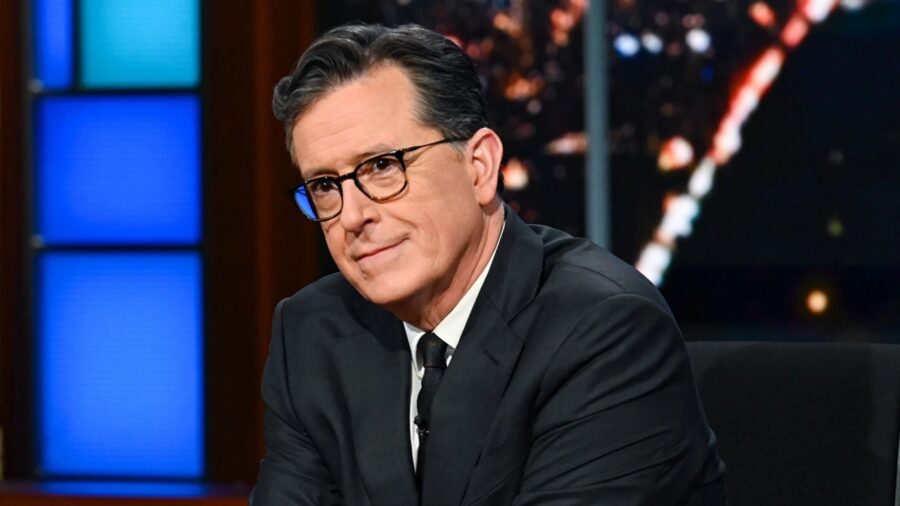
Colbert has been held out as a Tolkien expert since the announcement on March 24, 2026, and that is actually fair, no matter what one thinks of his extreme political views. He has studied the author’s work extensively, to the point where he can speak both Elvish languages, Quenya and Sindarin.
The biggest question on the minds of fans is whether Colbert will be tempted to infuse the story with his personal politics, or if the writing team will try to add extra material that isn’t needed by Tolkien’s story. The Hobbit didn’t work because it added embellishments, such as the romance between Tauriel and Kili. Rings of Power doesn’t work because, on top of adding modern identity politics to the series, it also doesn’t follow the source material, earning the derision of many Tolkien fans.
Boyens has shown that when she sticks to Middle Earth and not regular Earth, she can deliver on Tolkien’s mastery. However, the inclusion of Colbert raises concerns that this movie will stray beyond Tolkien’s boundaries.

In his other job as a talk show host, Colbert has made it a mission to inject his divisive personal politics into his work. That tendency towards personalizing what he does could either strongly enhance a new Lord of the Rings project or turn it into a stain on Tolkien’s legacy by applying themes to the world of the One Ring that Tolkien never intended. Which Colbert will ultimately write the script: the political loudmouth or the Tolkien scholar?
Entertainment
Sandra Bullock’s Sexy, 90s Action Thriller Will Make You Care About Floppy Disks Again
By Robert Scucci
| Published

There’s nothing more entertaining than watching a movie about cutting-edge technology from the 90s, 30 years after the fact. On one hand, I’ll give 1995’s The Net credit where it’s due. It’s well-acted, Sandra Bullock is the hottest computer geek in cinematic history (sorry, Hackers), and the plot actually kind of makes sense because they don’t drown you in tech jargon and junk science. There’s a golden rule when it comes to technological thrillers: the less you explain the logic, the better. The Net toes this line perfectly because I know enough about computers to pick up what they’re throwing down, but I’m also dumb enough to think, “that makes sense,” while watching.
I’m not going to pause the movie and look up the technical semantics to prove this point, but the storyline is immersive enough to grab your attention without getting so convoluted that it takes you out of the experience. I don’t know how any of this stuff works at this level, and as a viewer, I appreciate that The Net doesn’t treat me like I’m too dumb to understand the implications, while also refusing to hold my hand because it’s all pretty straightforward.
Sandra Bullock Is Lost In The Net

The Net focuses on Sandra Bullock’s Angela Bennett. She’s a perfect patsy for what’s about to go down because she’s a freelance systems analyst who works from home. Most of her relationships are the kind of faceless encounters you have online, and her mother lives in a nursing home because she has Alzheimer’s disease and barely remembers she exists. It’s a lonely life for Angela, but she’s also well connected through her work. Or so she thinks.
When Angela’s coworker Dale (Ray McKinnon) sends her a floppy disk known as Mozart’s Ghost, she’s told to click on the Pi button hidden in the document, which functions as a backdoor into an application known as Gatekeeper, an elaborate cybersecurity system she’s not supposed to have access to.

Dale dies under mysterious circumstances, and Angela goes on vacation, where she meets a man named Jack Devlin (Jeremy Northam). Jack brings Angela out on his boat, but he’s outed when she realizes he plans to kill her and take the floppy disk. After a violent scuffle, Angela wakes up in the hospital three days later and learns that Jack and his nameless, faceless associates have scrubbed her identity from existence and given her a new one: Ruth Marx.
As Ruth, Angela uncovers a vast conspiracy involving a group of cyber terrorists known as the Praetorians, who are using the Gatekeeper software to orchestrate massive network failures across the country while framing her in the process. Angela confides in her former therapist and lover, Dr. Alan Champion (Dennis Miller), who doesn’t necessarily believe her conspiracy theories but isn’t going to turn down a motel meetup with her either.
A Solid Tech Thriller For The Average iPhone User

While I knew my way around MS-DOS as a kid and have kept up with tech to some degree (I have an iPhone that’s about five generations behind), what I like most about The Net is that it gets its point across without being patronizing or overly complex. There are plenty of flashes of computer screens that help drive the story, but everything is so straightforward that you don’t get lost in granular details. The main focus is the conspiracy and identity theft plot that drives The Net. While you need the occasional tech speak to get from point A to B, you don’t need to be a genius to read between the lines and enjoy the thriller for what it is.
All you need to know is that Sandra Bullock does her best computing in a bikini, everybody thinks she’s somebody she’s not, and because of this, she can’t trust anybody. It’s obviously a bit dated by today’s standards, but it’s still a fun watch because it deals with cybersecurity concepts that remain relevant. I’d imagine similar conversations about different applications are happening behind closed doors today. We’re just getting the 1995 version here.

As of this writing, The Net is streaming for free on Tubi.

Joe Pyfer stops former champ Israel Adesanya in 2nd round of UFC Seattle
Alexander Kerfoot, Logan Cooley score twice as Mammoth rout Kings


