
Entertainment
Leftist meme creators are undeterred by Meta’s rightward shift
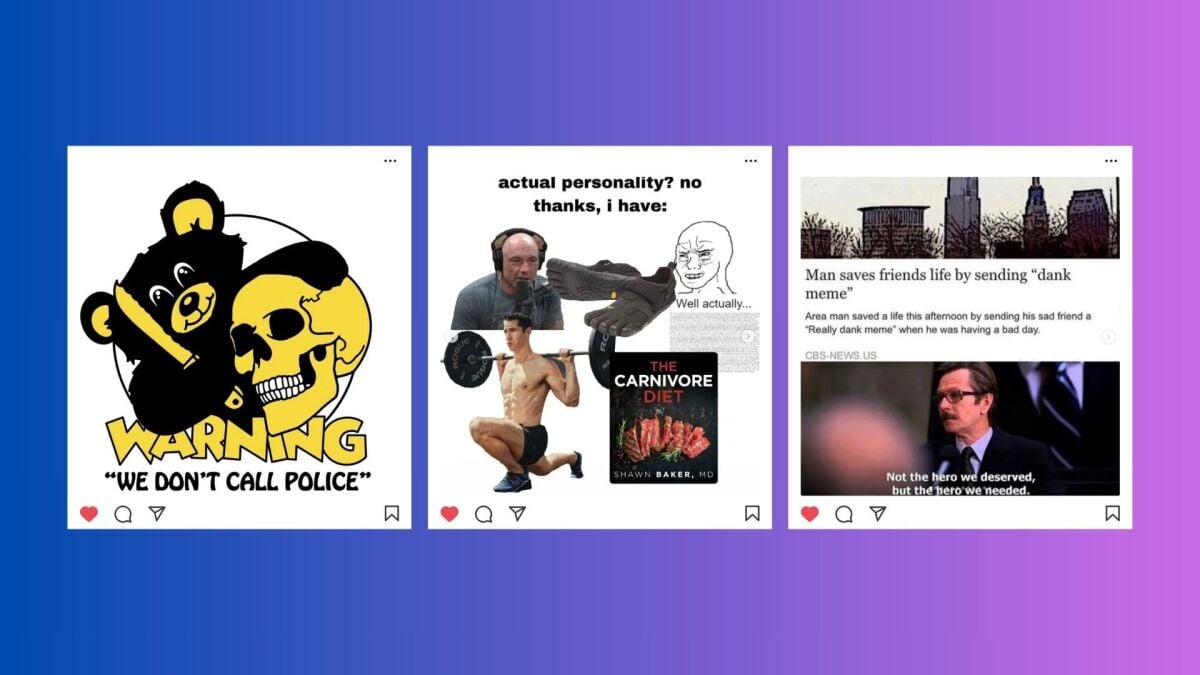
Since Donald Trump won his second presidential term, Meta CEO Mark Zuckerberg has enacted a tirade of right-leaning policy changes that critics warn could amplify hate speech, misinformation, and harassment across its platforms. These changes include eliminating fact-checkers in favor of community notes, lifting prohibitions on certain forms of hate speech, scrapping DEI initiatives, removing trans-inclusive features from its apps, and reinstating political content recommendations.
Many activists view these changes as a stark, rightward shift, but for leftist meme creators on Instagram, it’s just more of the same — a continued struggle to navigate an increasingly hostile digital landscape. For creators, platform changes go beyond a simple policy shift; they reshape the environment in which they create and share their work.
Despite escalating hostility on Meta’s platforms, it’s created digital spaces that are inherently necessary for creators. Leftist meme creators aren’t logging off en masse, but, instead, are adapting and resisting. While Meta’s rightward shift may shape the digital battleground, it isn’t extinguishing the creativity, subversion, and activism that define leftist meme culture. For some, it’s pushing them to become more radical.
After all, they argue, Meta has always been antagonistic to their cause, and they’ve managed to carve out a space for themselves despite it.
Instagram’s longstanding tensions with progressive and leftist creators
Instagram isn’t a platform exclusively for political memes. As Pew Research found in 2024, the platform is primarily for entertainment and connecting, not politics — an opinion temporarily shared by Instagram head Adam Mosseri when the platform limited political content for a short time. However, Instagram has increasingly become a hub for news, art, and memes, as well as a tool for elected officials and activists to engage with the public.
You simply can’t deny the popularity of memes. Users share over a million memes every day, according to one 2022 study. Not all memes are political, of course, but more and more are being shared by candidates and political parties. As NPR highlighted in 2023, the vast majority of political memes are created and shared by everyday users, making them a sort of grassroots medium for spreading political ideas. And while not every meme goes viral, those that do often see more user engagement than posts from prominent news organizations, another study showed.
Aiden Arata, an Instagram meme creator at @aidenarata, doesn’t make inherently political memes. But her work does touch on themes — such as creation without capitalism, nature and nurture, and empathy — that lean toward progressive politics. She describes the memes she creates as “modern folk art,” existing both within and often in opposition to hostile structures. This description holds true for many of the more contentious political meme creators.
“[Memes] take these institutionalized ideas and allow you to subvert them and make them about something else and give them a new meaning,” Arata told Mashable. “Honestly, the meme already operates under structures that it doesn’t quite agree with.”
Jake Stoner of @eco_socialist told Mashable that he “lean[s] heavily on memes” because of their shareability. “I view memes as modern-day pamphlets.”
“My view on memes is that they function as a kind of outlet or possibly even a conversation starter,” John, the creator of @socialistsopranosmemes, told Mashable. “I don’t think that changes just because Meta will be easing up on censorship. We’ll probably see more from a certain particularly odious segment of the political spectrum, but if those people want to volunteer to show everyone just how vile their views are, I say we let them.”
Ultimately, Jon argues, there are “real limits to digital activism.” Online political discourse needs to move to real-world action, he says. But meme creation is part of that larger movement, one that leads to political organizing. According to one 2020 study, this kind of posting facilitated offline protests through advertising and organizing. The study argues that communications of the day — what were once pamphlets, town square assemblies, and rumors — played an important role in “the group dynamics of mobilization similar to that played by social media today.”
“Memes can be good ways to express opinions and feelings that people might have and relate to others that feel the same. I hope this gives people hope and community and inspires them to do political organizing in their communities [and] workplaces,” the creator of @bigdawgsocialism told Mashable over Instagram DM. “Sometimes the comedic aspect of memes can disarm people that otherwise might be hostile to left-wing politics.”
The challenge of combating misinformation and hate speech in a space with fewer guardrails is ongoing. It involves the use of coded language, satire, and creative workarounds to bypass moderation, but leftist creators argue this is nothing new.
That subversion is political. Meta has struggled to manage politics on its platforms — for years, it allowed political content on its sites, which led to the spread of misinformation and extremism. By the early 2020s, Meta began oscillating between limiting and encouraging political discussion. This created a constant tension between Meta’s profit-driven motives and the creators who use its platforms for activism.
As Davey, who runs the meme page @renaissance__man on Instagram, told Mashable, Meta has always followed the money, not ideology.
Mashable Top Stories
Adapting to a hostile online climate
Hostility online isn’t new for leftist creators, and these creators have always had to modify their content strategies to avoid suppression, shadowbanning, or algorithmic penalties. So, some posters are hoping to use these changes to their advantage.
John, for instance, says he “welcomes these changes.”
“I’ve previously had to self-censor on Meta’s platforms,” he told Mashable. “I’ve actually had content that was flagged as hateful before, which is something that I find laughable. The memes express a political opinion and are supposed to hopefully make people laugh.”
He argues that his posts aren’t hateful, and he doesn’t think tech companies “should be adjudicating whether or not” they are.
“I see it as this is my enemy’s house. I’m using my enemy’s equipment and his machines and his algorithms against his interests.”
Creator @bigdawgsocialism told Mashable that they are “way less careful about posting stuff that used to get me content strikes or suspensions,” like using certain words.
“They say a master’s tools will never disassemble a master’s house,” Davey said. “But a hammer is a hammer. And hammers smash. The house will be gone.”
And, as Stephen Potter of @adorable__communism told Mashable, “I see it as this is my enemy’s house. I’m using my enemy’s equipment and his machines and his algorithms against his interests.”
Davey added that while the rollback of content moderation could, in theory, benefit radical leftist speech as well, he’s skeptical that Meta will apply its enforcement evenly. This concern seems to be shared by many leftist meme creators. For instance, @bigdawgsocialism told Mashable that while these changes will likely create space for “nasty stuff overall,” “theoretically, our side can post more of what we want.” However, they also pointed out that “with the mainstream political climate becoming more reactionary, the cards are still stacked against the far left.”
According to Potter, “free speech absolutism isn’t” afforded to leftist creators. He said it’s “naive” to think the platform would begin treating leftist content any differently.
“It doesn’t really apply to us because what we’re talking about is the power structure and the people who own these things,” Potter said. “If you’re really gonna be an effective propagandist, you’re not going to be the thing that Mark Zuckerberg likes. You’re going to be the exact opposite of that. We’re here against their wishes already.”
Still, there is hope that political memes will remain powerful enough — through engagement and real-world impact — to warrant staying on the app.
“Though Trump’s very unpopular policies that are hurting people will likely drive people towards different answers,” @bigdawgsocialism said, “we can give them some class-based solutions to problems. Ones that lead with solidarity rather than scapegoating and division.”
Why creators probably aren’t leaving the app
No matter their internal politics or outward political posting, many creators probably aren’t leaving the app. Despite disliking Meta’s policies, Arata feels compelled to stay on Instagram because it’s where her audience is — especially with a book release coming, one which she likely wouldn’t have had without the success of her meme page. How else do you exist as a creative online without using the platforms at your disposal?
“There have been too many attempts to replace Facebook, Instagram, and X,” John told Mashable. “It’s just not happening. I also have accounts on Bluesky and Threads, but I don’t particularly care for those platforms and often forget they exist when I have something to post.”
Stoner agreed, saying that since Instagram is such a visual platform, paired with a robust caption option, there isn’t anything else comparable.
Beyond a lack of alternative platforms for creators to migrate to, as Potter puts it, “My concern about Meta’s rightward shift is in lockstep with my concern about the country’s rightward shift.”
Meta’s rightward shift might be reshaping Instagram, but these meme creators see it as just another step in the platform’s long-standing trajectory. They don’t want to leave the platform in protest only to see right-wing creators and narratives thrive.
“The whole point of the meme page is to disrupt the imperialist narratives that they’re going to use social media to push,” Potter said. “So why would I leave? I wouldn’t give [Zuckerberg] the satisfaction.”
The issue, however, isn’t just Meta. Every major platform is a capitalist venture, and the fight for digital space remains a constant struggle for anti-capitalists.
“I don’t think any platform that is owned by a billionaire is going to be open to leftist anything,” Stoner said. “They don’t want challenges to their power, things that would disturb the status quo. They’re interested in preserving it because that’s how they’re making ungodly amounts of money.”
Is there hope for a meaningful social media platform under capitalism? Sure — as much as there is hope for any genuine community to thrive in a capitalist system. As long as memes remain a tool for subversion, creators will continue to post them.
Entertainment
Xtra suddenly cancels preorders for its clone of banned DJI Osmo Pocket 4 Pro camera

Xtra, the camera company that suddenly popped up last year, is canceling preorders and issuing refunds for its upcoming Xtra Muse 2 Pro gimbal camera.
“After reviewing our product and launch readiness, XTRA has decided to pause the current Early Bird program,” the company said in a statement posted on its website and in emails sent to customers viewed by Mashable. “Because we are unable to confirm a reliable launch timeline at this stage, we do not believe customers’ funds should remain on hold.”
Xtra customers had put down a $20 reservation for the Xtra Muse 2 Pro in exchange for a pre-order and an early bird discount of $60 off the camera when it went on sale. Along with a refund, Xtra is also issuing a 10 percent off coupon to customers that can be used on their current line of products.
Despite taking preorders, Xtra never shared a prospective launch date for the camera, which was a major point of criticism for customers across social media.
Why did Xtra cancel camera preorders?
Xtra says the refunds were due to “product and launch readiness” and didn’t provide any further explanation. However, the preorder cancellations come shortly after the FCC announced investigations into eight companies, including Xtra.
Mashable Light Speed
DJI, the popular China-based drone and action camera company, has effectively been banned in the U.S. As Mashable previously reported, the ban started late last year after Trump’s FCC cited national security concerns and data-spying issues. DJI products that were for sale before the ban can still be sold for now. Consumers with DJI devices can still use them. However, the U.S. government has not approved any new DJI products, so they can’t be imported into the country.
Enter Xtra. Xtra came onto the scene last year with its lines of cameras that appear to be clones of DJI’s line of cameras. The company is rumored to be a “DJI front company,” or a company explicitly set up to import DJI’s banned products into the U.S. Online sleuths and outlets such as The Verge have previously looked into Xtra’s potential relations with DJI and found numerous similarities and connections. Xtra’s Muse 2 Pro camera, for example, looks exactly like DJI’s new Osmo Pocket 4 Pro camera aside from a few design alterations.
In addition, DJI has gone after competitors like Insta360 with legal claims involving its camera patents. Yet, DJI has remained mum on Xtra’s products, which would appear to infringe way more than others.
The eight companies under investigation were previously asked to provide information on whether any of the products it sells should be on the list of banned items. However, none of these companies apparently responded to the FCC. As a result, the FCC is demanding the information and has levied a $25,000 fine against each of them, including Xtra.
The FCC is now looking into retroactively banning Xtra’s previously approved products as well.
At this point, the status of the Xtra Muse 2 Pro is unclear. The company is not outright canceling the launch; however, the preorder cancellations and the FCC news point to a potentially grim outcome for U.S. consumers. For now, at least, U.S. consumers looking to buy an Xtra Muse 2 Pro or DJI Osmo Pocket 4 Pro can look into the Insta360 Luna Ultra, which is not banned in the country.
Entertainment
Comic-Con 2026: All the movie and TV announcements you need to know
Comic-Con International: San Diego has always been a barometer for where the entertainment industry is placing its biggest bets, and this year’s lineup made that clearer than ever. Over the course of a single weekend, Marvel Studios, Prime Video, Apple TV, and AMC all used the convention floor to unveil casting reveals and first-look footage for some of their most closely watched projects, spanning superhero blockbusters, prestige sci-fi, and small-screen horror alike.
Long-simmering rumors finally became official announcements, decades-old franchises got new leads and new timelines, and fans packed into panels for a glimpse of what’s coming to theaters and streaming over the next two years.
Here’s a rundown of the biggest reveals to come out of Comic-Con 2026.
MCU’s Ghost Rider

Credit: Jesse Grant/Getty Images for Disney
Ryan Gosling was confirmed as Johnny Blaze in a new Ghost Rider film directed by Shawn Levy, ending years of speculation about the actor joining the MCU. This film is set to release in 2028.
Black Panther 3 release date reveal

Credit: Michael Buckner/Variety via Getty Images
The same Marvel panel brought news of another long-rumored casting: David Jonsson was announced as the new Black Panther, playing the son of Chadwick Boseman’s T’Challa, in a film directed by Ryan Coogler and set for release on December 15, 2028.
The Lord of the Rings: The Rings of Power
Season 3’s trailer teased Sauron’s completion of the One Ring and the outbreak of full-scale war across Middle-earth. New cast additions include Simon Pegg voicing the Balrog, Eddie Marsan as Dwarven royal Thrain, and Andrew Richardson as the future King of Gondor, Anárion. Season 3 premieres November 11.
Mashable Top Stories
Blade Runner 2099
Prime Video debuted the first trailer for its Blade Runner series, set decades after Blade Runner 2049. Michelle Yeoh stars as Olwen, a replicant confronting the end of her life, opposite Hunter Schafer as a human fugitive on the run from Blade Runners. Ridley Scott executive produces, with Silka Luisa serving as showrunner. The series arrives November 25.
Carrie
Mike Flanagan’s Carrie series got its first trailer, dragging Stephen King’s telekinetic teen into the smartphone era ahead of an October 7 premiere on Prime Video. The eight-episode miniseries follows Carrie White as she endures bullying at school and abuse at home from her fanatically religious mother, Margaret — all while discovering she has telekinetic powers.
Summer H. Howell leads the new cast as Carrie White, alongside Samantha Sloyan as Margaret, Siena Agudong as Sue Snell, and Matthew Lillard as Principal Grayle, with Alison Thornton, Thalia Dudek, Amber Midthunder, Josie Totah, Arthur Conti, and Joel Oulette rounding out the ensemble.
Yaga
AMC+ and Crave released a teaser for this Canadian supernatural mystery series, starring Noah Reid as a detective investigating the disappearance of Henry Park, an heir to a commercial fishery, in a small coastal town. Park is played by Hudson Williams, known to fans of the queer romance series Heated Rivalry.
The cast also includes Carrie-Anne Moss and Clark Backo, with the series created by Kat Sandler based on her own 2019 stage play of the same name.
Neuromancer
Apple TV entered the fray outside Marvel and Prime’s orbit, releasing its first trailer for an adaptation of William Gibson’s cyberpunk classic, starring Callum Turner as hacker Case.
This article will continue to be updated….
Entertainment
Potential World Cup manipulation on Polymarket flagged by sports advisory group
An independent group that monitors potential manipulation of sports competitions has announced the results of a yet-to-be-released report examining irregularities related to betting and gambling on FIFA World Cup matches.
The organization called Group of Copenhagen monitored all 104 matches and determined that 15 games rose to the level of requiring enhanced monitoring. The group also assessed 12 major controversies from an “integrity risk perspective.”
While the Group of Copenhagen has yet to release its full detailed report, the New York Times has reported that a few of these flagged events involve the online prediction market Polymarket.
The report singles out how $4.8 million was placed on Polymarket for Spain not to defeat Cape Verde in their group stage game, which was the first game either team played in this year’s tournament. The game’s result, a goalless draw, was considered to be one of the biggest shocks of the entire World Cup. Spain was a tournament favorite and went on to win the championship. Cape Verde was playing its first-ever World Cup game.
However, much more notable than a surprising game outcome is the market that was opened on Polymarket based on the red card issued to the U.S. Men’s National Team striker Folarin Balogun.
Mashable Light Speed
According to the report, a Polymarket market was opened on July 2, which asked: “Will Folarin Balogun play against Belgium?” That was the same day that Balogun was issued a red card in U.S.’s match against Bosnia and Herzegovina. The red card meant Balogun would not be able to play in the match against Belgium.
However, on July 5, before the U.S. vs. Belgium match, FIFA announced that Balogun would be allowed to play and that his ban would be suspended. President Donald Trump would take credit for FIFA’s decision shortly after, saying he had a phone call with FIFA head Gianni Infantino. Reporting later confirmed that U.S. officials went to work immediately following the red card being issued to have it overturned.
Did Trump officials who were privy to this information partake in insider trading to make a profit on Polymarket? It’s a legitimate question to ask, especially in light of recent news that Trump’s teleprompter operator profited from their position by placing trades on Kalshi.
Prediction markets have blown up in popularity in recent years. Kalshi, a prediction market that partnered with the World Cup’s official prediction market sponsor, ADI Predictstreet, has said that a record $1.2 billion in trades was placed on its platform to predict the World Cup winner. The company said it also gained 3 million new users directly from the World Cup.
According to experts interviewed by the New York Times, the irregularities don’t necessarily mean that any manipulation occurred. While the Group of Copenhagen’s research was coordinated with FIFA’s own Integrity Task Force, FIFA has released its own findings claiming that “no suspicious betting activity or indications of match manipulation in connection with any fixture” had been identified.

Xtra suddenly cancels preorders for its clone of banned DJI Osmo Pocket 4 Pro camera
Comic-Con 2026: All the movie and TV announcements you need to know


