
Tech
India has changed its startup rules for deep tech
Deep tech startups in sectors such as space, semiconductors, and biotech take far longer to mature than conventional ventures. Because of that India is adjusting its startup rules, and mobilizing public capital, hoping to help more of them make it to commercial products.
This week, the Indian government updated its startup framework, doubling the period for which deep tech companies are treated as startups to 20 years and raising the revenue threshold for startup-specific tax, grant, and regulatory benefits to ₹3 billion (about $33.12 million), from ₹1 billion (around $11.04 million) previously. The change aims to align policy timelines with the long development cycles typical of science- and engineering-led businesses.
The change also forms part of New Delhi’s effort to build a long-horizon deep tech ecosystem by combining regulatory reform with public capital, including the ₹1 trillion (around $11 billion) Research, Development and Innovation Fund (RDI), announced last year. That fund is intended to expand patient financing for science-led and R&D-driven companies. Against that backdrop, U.S. and Indian venture firms later came together to launch the India Deep Tech Alliance, $1 billion-plus private investor coalition that includes Accel, Blume Ventures, Celesta Capital, Premji Invest, Ideaspring Capital, Qualcomm Ventures, and Kalaari Capital, with chipmaker Nvidia acting as an adviser.
For founders, these changes may fix what some see as an artificial pressure point. Under the previous framework, companies often risked losing startup status while still pre-commercial, creating a “false failure signal” that judged science-led ventures on policy timelines rather than technological progress, said Vishesh Rajaram, founding partner at Speciale Invest, an Indian deep tech venture capital firm.
“By formally recognizing deep tech as different, the policy reduces friction in fundraising, follow-on capital, and engagement with the state, which absolutely shows up in a founder’s operating reality over time,” Rajaram told TechCrunch.
Still, investors say access to capital remains a more binding constraint, particularly beyond the early stages. “The biggest gap has historically been funding depth at Series A and beyond, especially for capital-intensive deep tech companies,” Rajaram said. That is where the government’s earlier RDI fund is meant to play a complementary role.
“The real benefit of the RDI framework is to increase the funding available to deep tech companies at early and growth stages,” said Arun Kumar, managing partner at Celesta Capital. By routing public capital through venture funds with tenors similar to private capital, he said, the fund is designed to address chronic gaps in follow-on funding without altering the commercial criteria that govern private investment decisions.
Techcrunch event
Boston, MA
|
June 23, 2026
Siddarth Pai, founding partner at 3one4 Capital and co-chair of regulatory affairs at the Indian Venture and Alternate Capital Association, said India’s deep tech framework avoids a “graduation cliff” that has historically cut companies off from support just as they scale.
These policy changes come as the RDI fund is beginning to take shape operationally, Pai said, with the first batch of fund managers identified and the process of selecting venture and private equity managers under way.
While private capital for deep tech already exists in India — particularly in areas such as biotech — Pai told TechCrunch the RDI Fund is intended to act as a nucleus around which greater capital formation can occur. Unlike a traditional fund-of-funds, he noted, the vehicle is also designed to take direct positions and provide credit and grants to deep tech startups.
India’s deep tech funding grows
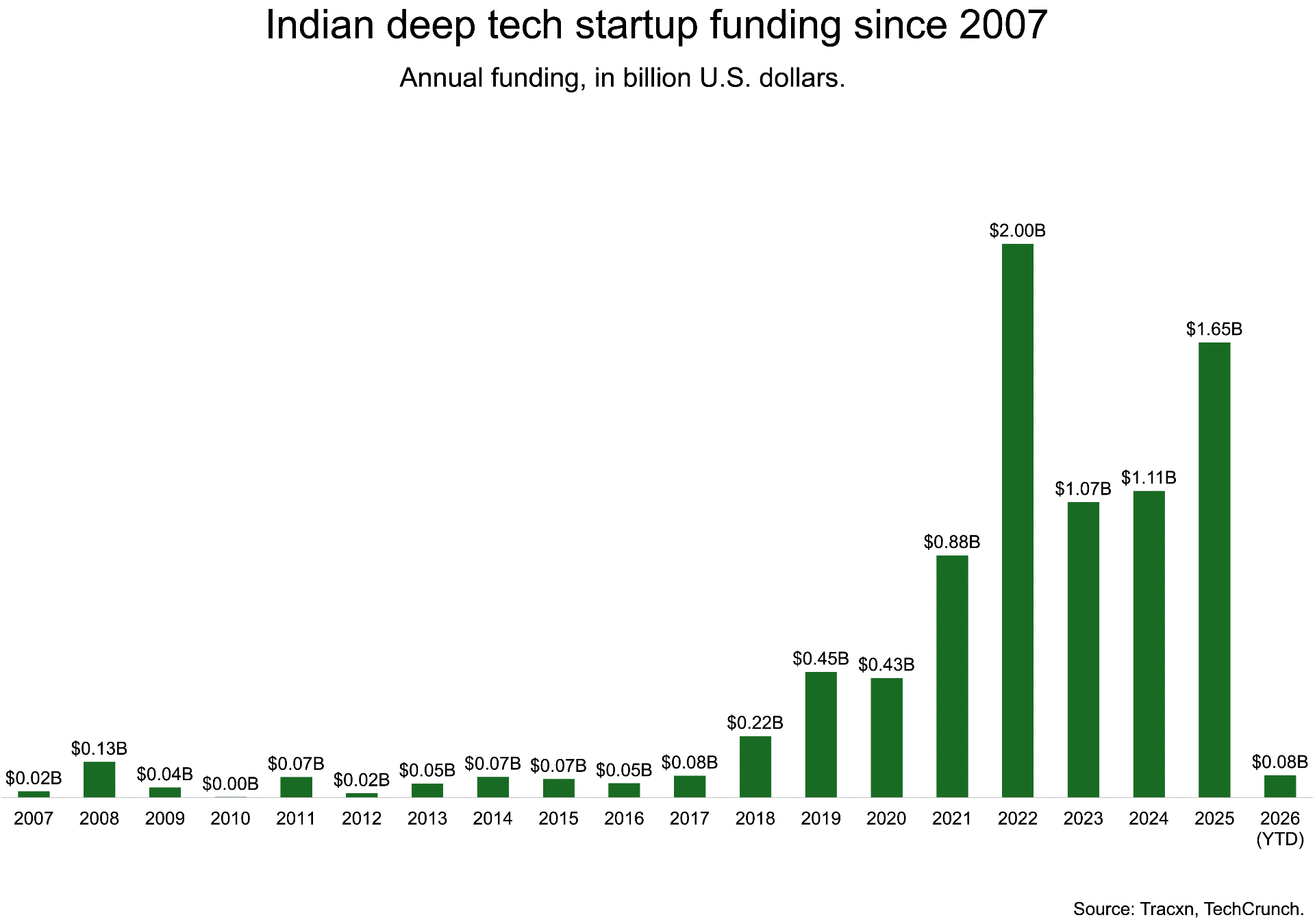
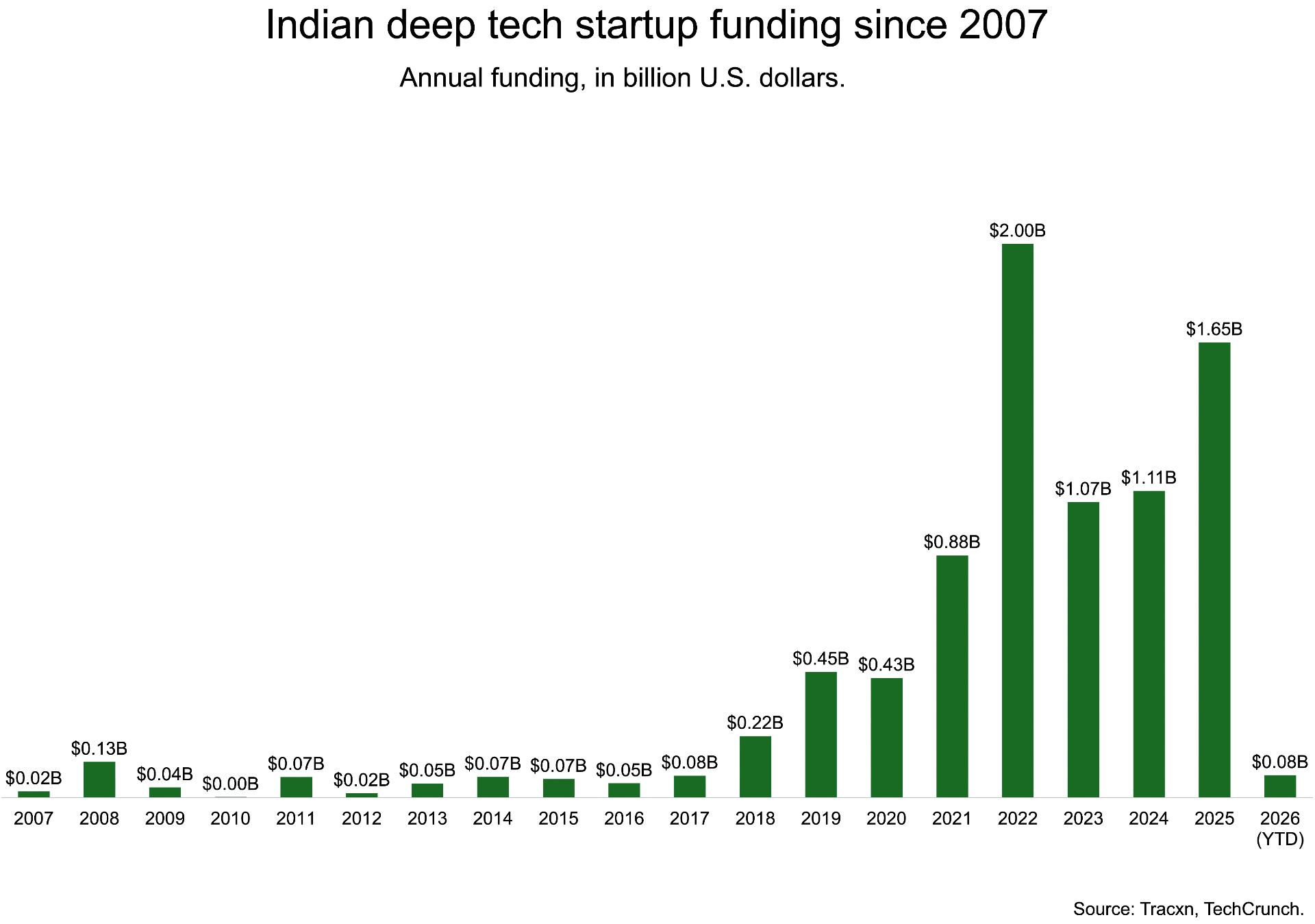
In terms of scale, India remains an emerging rather than dominant deep tech market. Indian deep tech startups have raised $8.54 billion in total to date, but recent data point to renewed momentum. Indian deep tech startups raised $1.65 billion in 2025, a sharp rebound from $1.1 billion in each of the previous two years after funding peaked at $2 billion in 2022, per Tracxn. The recovery suggests growing investor confidence, particularly in areas aligned with national priorities such as advanced manufacturing, defence, climate technologies, and semiconductors.
“Overall, the pickup in funding suggests a gradual move toward longer-horizon investing,” said Neha Singh, co-founder of Tracxn.
In comparison, U.S. deep tech startups raised about $147 billion in 2025, more than 80 times the amount deployed in India that year, while China accounted for roughly $81 billion, data from Tracxn shows.
The disparity highlights the challenge India faces in building capital-intensive technologies, even with its wealth of engineering talent. So the hope is that these moves by the Indian government will lead to more investor participation over the medium term.
A longer-term signal
For global investors, New Delhi’s framework change is being read as a signal of longer-term policy intent rather than a trigger for immediate shifts in allocation. “Deep tech companies operate on seven- to twelve-year horizons, so regulatory recognition that stretches the lifecycle gives investors greater confidence that the policy environment will not change mid-journey,” said Pratik Agarwal, a partner at Accel. While he said the change would not alter allocation models overnight or eliminate policy risk entirely, it increased investor comfort that India is thinking about deep tech on longer time horizons.
“The change shows that India is learning from the U.S. and Europe on how to create patient frameworks for frontier building,” Agarwal told TechCrunch.
Whether the move will reduce the tendency of Indian startups to shift their headquarters overseas as they scale remains an open question.
The extended runway strengthens the case for building and staying in India, Agarwal said, though access to capital and customers still matters. Over the past five years, he added, India’s public markets have shown a growing appetite for venture-backed tech companies, making domestic listings a more credible option than in the past. That, in turn, could ease some of the pressure on deep tech founders to incorporate overseas, even if access to procurement and late-stage capital will continue to shape where companies ultimately scale.
For investors backing long-horizon technologies, the ultimate test will be whether India can deliver globally competitive outcomes. The real signal, Kumar of Celesta Capital said, would be the emergence of a critical mass of Indian deep tech companies succeeding on the world stage.
“It would be great to see ten globally competitive deep tech companies from India achieve sustained success over the next decade,” he said, describing that as the benchmark he would look for in assessing whether India’s deep tech ecosystem is maturing.
Tech
Can orbital data centers help justify a massive valuation for SpaceX?

SpaceX has reportedly filed confidential paperwork for an initial public offering in which the company would raise $75 billion at a $1.75 trillion valuation. And according to CEO Elon Musk, orbital data centers will be a big part of SpaceX’s future.
On the latest episode of TechCrunch’s Equity podcast, Kirsten Korosec, Sean O’Kane, and I discussed Musk’s vision, as well as other companies that are pursuing similar goals.
It will take significant tech development and massive capital spending to make orbital data centers a reality, but as Sean noted, with “opposition happening around the country to data centers in general,” executives like Musk and Jeff Bezos may be thinking, “The engineering challenge may be less than the social challenge back here” on Earth.
Read a preview of our conversation, edited for length and clarity, below.
Sean: This has been a trend — I would say a rapidly forming trend — over the last half year to a year, and we have different examples of it. We have SpaceX; I feel like in some ways, Elon Musk was late on this trend. And for the moment, let’s set aside the actual mechanics and the viability of data centers in space. We could talk about that in a second if we want, but —
Kirsten: We have a really good story we’ll link to in the show notes, by the way. One of our most recent hires, Tim Fernholz, is amazing. He writes all about the physics and the constraints of that.
Sean: Yeah, I think it’s a really interesting engineering challenge. It’s a really interesting physics challenge. It’s a really interesting orbital mechanics challenge. But it’s something that clearly a bunch of companies and people are going to try and chase. [There’s] going to be SpaceX doing it, with a kind of variance of what they’re already working on with their Starlink network.
Techcrunch event
San Francisco, CA
|
October 13-15, 2026
There’s a startup that had come out of Y Combinator, originally called Starcloud, that was really one of the first ones out there trying to build a huge business around this, that just raised $170 million this week, their valuation [on] that tipped them over into a unicorn status.
Jeff Bezos is trying to go after this as well. This is a next generation version of the competition that we’ve seen happening between Starlink and Amazon’s Leo satellite network, and Blue Origin has its own satellite network coming online as well in the next couple of years.
So there’s going to be a whole bunch of this happening, and it feels like it wasn’t happening a year ago. I know the way that Elon Musk pitches it is — we know he’s allergic to red tape, he’s built a data center in Memphis, too. Maybe now he knows the challenges and the risks you have to take to sidestep that red tape.
There’s a lot of opposition happening around the country to data centers in general. And these people say, “We have access to space, so let’s just try and do it up there.” The engineering challenge may be less than the social challenge back here on our [planet].
Kirsten: And it also creates excitement, right? If a company is about to go [public] and they’re working on data centers in space, this is something that people can have expectations about in a positive way and ignore the constraints. It feels like a company that is working on something that’s not old and outdated, but signals the future. And it’s really a great strategy when you think about it.
Anthony: Not that Elon Musk is the only one who does this, but it seems like he’s incredibly successful at being like, “Don’t judge my companies based on how much money they’re making now, judge them based on these grand visions that I can spin out about what will happen in the future.”
And going back to a point that Sean was making, I think that part of what’s interesting is to [ask]: How does this fit in with the broader data center rollout? How does it fit in with opposition and the idea that maybe people are not going to be able to build as many data centers as they want to?
I don’t think any of us are engineers who can really assess the viability of these plans. It does certainly have a tinge of fantasy to it, but even when they do lay out these plans, it feels like just a drop in the bucket in terms of compute capabilities compared to what they want to build out on Earth. So it feels like there’s not a scenario where this replaces a whole bunch of new data centers on Earth. It’s just sort of a […] supplement to it.
Sean: The last two things I’ll point out that are really front and center for me is, one, we’ve seen a backing off in some ways [from] data centers — not just because of opposition, but because maybe we don’t need as much, right? We see a bunch of jockeying from some of the AI labs about, “Well, maybe we don’t need to lease this much from this company,” or whatever. And if that becomes a thing that is more true than it was five months ago, do you all of a sudden lose all that momentum to do something as crazy as putting the data centers in space? Providing that it works, even.
The other thing is that the idea of building these massive data centers in space, with all these satellites that make up the quote unquote “data center,” is business for SpaceX. And I think this is unique to them compared to these other companies: They are a launch company primarily, even though they generate a bunch of revenue from Starlink. They are the vehicle that gets the data centers to space. They get to book that as revenue for SpaceX.
And so it becomes this thing where, of course [Musk] wants — whether or not it works, he would eventually have to prove it — but of course he wants to send more and more satellites into space because it’s more revenue for SpaceX. And that makes SpaceX look better as a public company. And then you just kind of tumble down the path until he finds something else to pitch the investors on.
Tech
TechCrunch Mobility: ‘A stunning lack of transparency’
Welcome back to TechCrunch Mobility — your central hub for news and insights on the future of transportation. To get this in your inbox, sign up here for free — just click TechCrunch Mobility!
You might recall the congressional hearing last month that sparked criticism against Waymo over its use of remote assistance workers in the Philippines. We have covered that issue extensively. You can read about the company’s remote assistance and road assistance teams here and here.
Waymo tends to get the most attention because, well, those robotaxis are now operating commercially in 10 U.S. cities, with more coming soon. But the issue of remote assistance is not a Waymo issue. It’s an autonomous vehicle technology issue.
A new report from Sen. Ed Markey (D-MA) makes my point.
Markey sent letters to seven U.S. companies — Aurora, May Mobility, Motional, Nuro, Tesla, Waymo, and Zoox — working on autonomous vehicle technology with a list of questions. He wanted to know how often these companies’ vehicles relied on input from remote staff.
They all refused to say, according to the results of Markey’s investigation. Markey said it was a “stunning lack of transparency from the AV companies around their use of remote assistance operators to help guide their AVs.”
You can read senior reporter Sean O’Kane’s article, which digs into the issue and includes the rather mute responses from the companies. (TechCrunch reached out to all of them.) One interesting admission from Tesla: The company said its remote assistance workers are authorized to temporarily assume direct vehicle control (a very different thing than “remote assistance”) as a final escalation maneuver.
Techcrunch event
San Francisco, CA
|
October 13-15, 2026
But here’s the thing — this is not going away. And silence will not defuse the matter. If anything, Markey seems more motivated than ever to get answers. He is now calling on the National Highway Traffic Safety Administration to investigate companies’ use of remote assistance workers and said he is “working on legislation to impose strict guardrails on AV companies’ use of remote operators.”
A little bird

Nothing this week that we have been able to verify. Send us tips! Have one? Email Kirsten Korosec at kirsten.korosec@techcrunch.com or my Signal at kkorosec.07, or email Sean O’Kane at sean.okane@techcrunch.com.
Deals!

It seems like just last week I was writing about Uber being everywhere, all at once. And I see it is still a trend, although this time it isn’t directly related to autonomous vehicles.
Uber said it is buying Berlin-based startup Blacklane, which provides on-demand, black-car chauffeur services, as the ride-hail giant expands deeper into luxury and executive travel services. Blacklane, which was founded in 2011, had raised more than $100 million to date from rental car company Sixt, Mercedes-Benz, and Alfahim, a conglomerate in the UAE.
The timing of the acquisition is notable. It comes just a few weeks after Uber announced the launch of Uber Elite, a chauffeur service that also offers a bunch of luxury offerings like airport meet-and-greets and in-vehicle amenities.
Other deals that got my attention …
Manna Air Delivery, a consumer drone delivery startup based in Ireland, raised $50 million from ARK Invest, the Ireland Strategic Investment Fund, Schooner Capital, Coca-Cola HBC, and Molten Ventures.
Saronic Technologies, an autonomous military ship developer based in Austin, raised $1.75 billion in a Series D funding round led by Kleiner Perkins. The company is now valued at $9.25 billion. Other investors include Advent International, Bessemer Venture Partners, DFJ Growth, BAM Elevate, and other new partners and recognizes the continued commitment of its existing investors, including 8VC, Caffeinated Capital, Andreessen Horowitz, Elad Gil, and Franklin Templeton.
Voltify, a startup that has developed a way to retrofit diesel locomotives with battery power, raised $30 million in seed funding co-led by Israeli venture firm Aleph and Australian miner Fortescue.
Notable reads and other tidbits

Also, the micromobility company created inside Rivian that spun out last year, will work with DoorDash to develop autonomous delivery vehicles. As part of the deal, DoorDash took part in Also’s $200 million Series C funding round, which was led by Greenoaks Capital. DoorDash is getting a seat on Also’s board of directors, too.
Baidu robotaxis stalled throughout Wuhan, China, in some cases trapping passengers for up to two hours due to system failure.
GM is ramping up its efforts to improve its advanced driver-assistance system, Super Cruise. CEO Mary Barra posted on LinkedIn that GM has started supervised testing of its next-gen automated driving system on public highways in California and Michigan.
“Soon, more than 200 supervised and manual test vehicles will be in live traffic, with trained drivers ready to take over at any time. This data will guide future updates to strengthen our autonomous capabilities,” she wrote.
Lucid issued a recall for more than 4,000 Gravity SUVs after discovering a problem with the seat belts.
The National Highway Traffic Safety Administration reported that traffic deaths fell 6.7% to 36,640 in 2025 from the prior year. This is the second-lowest traffic fatality rate in recorded history at 1,10 fatalities per 100 million vehicle miles traveled, according to the NHTSA.
All of those long TSA lines are prompting airlines to catch up and adapt. For instance, United Airlines has updated its mobile app to show TSA wait times at select airports.
The Subaru-Toyota partnership keeps cranking out EVs. At the New York Auto Show, Subaru introduced the all-electric Gateway, a three-row SUV that is essentially a rebadged Toyota Highlander EV.
Tesla’s Q1 sales figures show its cheaper vehicles aren’t helping it turn around declining sales. (Some legacy automakers have seen EV sales plummet.) That seems to have affected Tesla’s workforce numbers at its Austin, Texas, factory, which dropped 22% in 2025. Meanwhile, I riff on the changing of the guard over at Tesla (and, no, I am not referring to the string of executive departures there, although that is interesting). CEO Elon Musk shared that production of the Tesla Model S and X has ended, a milestone that marks the shift away from building cars designed for people to drive and toward robots and self-driving cars.
Toyota’s Woven Capital has appointed a new CIO and COO in a push to find the “future of mobility.”
Uber and Chinese autonomous vehicle company WeRide launched robotaxi operations without a human safety operator in Dubai as part of a broader expansion in the Middle East.
Waymo’s robotaxi service is now live at San Antonio International, its fourth major airport. Meanwhile, Wired looked at Waymo’s school bus problem (meaning the investigation into the illegal behavior of its robotaxis around school buses). The article provides new details on how the Austin School District tried to help Waymo solve the problem. It didn’t work.
One more thing …
My podcast, the Autonocast, spent some time talking with Ashu Rege, DoorDash’s VP of Autonomy. We recorded the episode prior to the Also-DoorDash announcement, which makes his comments about the company’s strategy all the more interesting. Check out the episode here.
Tech
Copilot is ‘for entertainment purposes only,’ according to Microsoft’s terms of use
AI skeptics aren’t the only ones warning users not to unthinkingly trust models’ outputs — that’s what the AI companies say themselves in their terms of service.
Take Microsoft, which is currently focused on getting corporate customers to pay for Copilot. But it’s also been getting dinged on social media over Copilot’s terms of use, which appear to have been last updated on October 24, 2025.
“Copilot is for entertainment purposes only,” the company warned. “It can make mistakes, and it may not work as intended. Don’t rely on Copilot for important advice. Use Copilot at your own risk.”
A Microsoft spokesperson told PCMag that the company will be updating what they described as “legacy language.”
“As the product has evolved, that language is no longer reflective of how Copilot is used today and will be altered with our next update,” the spokesperson said.
Tom’s Hardware noted that Microsoft isn’t the only company using this kind of disclaimer for AI. For example, both OpenAI and xAI caution users that they should not rely on their output as “the truth” (to quote xAI) or as “a sole service of truth or factual information” (OpenAI).

How An R-Rated Attempt To Make Reddit Relevant Became A Streaming Disaster
Can orbital data centers help justify a massive valuation for SpaceX?


