
Entertainment
Iconic Superhero Movie Being Hidden From Streaming, Disney Doesn't Want You To Watch It

By Robert Scucci
| Published

Listen, I’m not the most reliable source when it comes to comic book movies, but I’ve seen most of them despite my lack of knowledge about the source material that inspires them. I once watched 34 MCU movies in just as many weeks on a dare after I said I loved the Fast and Furious movies but hated Marvel movies, which resulted in a long lecture about how I should love them because they’re basically the same thing. Letting my pride get the best of me, I watched every single movie that had been released up to that point, and it was alright. I wouldn’t do it again, but I think I get the gist by now.
That entire journey eventually led me to 2003’s Hulk, which I put off for years because it’s only available through on demand purchases. While I don’t have definitive proof as to why it’s not available on a streaming service except as a rental, I’m inclined to believe it has something to do with Disney’s stranglehold over all things Marvel related. Or maybe there’s just no demand for it. Either way, the point still stands that you have to throw down money to watch it, which is probably for the better, because this movie made some choices that genuinely baffle me.
Decisions Were Made

If you’re reading this article for a full rundown on all things Hulk related, I’m sorry to disappoint. What I’m here to talk about specifically is how much better the MCU handled the overall story. We all know that Bruce Banner (Eric Bana) turns big and green when he’s angry, and that General Thaddeus “Thunderbolt” Ross (Sam Elliott) has a complicated history with Bruce’s father, David Banner (Nick Nolte). That history forces Ross to intervene after a series of unsanctioned experiments lead to Bruce’s transformation.
Collateral damage is inevitable. Bruce falls in love with Betty Ross (Jennifer Connelly), the general’s daughter, and Ross repeatedly threatens to lock him up for “the rest of his natural life.” This is said several times throughout the film, even though there’s nothing remotely natural about any of it, making that recurring line make absolutely no sense.

I’m not a tights and flights guy. I haven’t seen the new DCU’s Superman. I tapped out of the MCU after The Marvels, and I’ll only return if we get more Deadpool and Wolverine action at some point. With that bias firmly established, I’m here to extend an olive branch and explain why 2003’s Hulk pales in comparison to 2008’s The Incredible Hulk.
Hulk’s biggest problem is pacing. We get the David Banner and Thunderbolt backstory. We learn about Bruce Banner’s repressed memories and identity issues. We’re subjected to all the usual junk science explaining how he becomes Hulk, along with explosions and extended emotional yammering about all of it. The movie runs 138 minutes, and we don’t even get to see Hulk doing Hulk stuff until more than 40 minutes in.

The film is trying to function as both an origin story and its subsequent adventures in one sitting, while also attempting to appeal to casual viewers and diehard comic book fans at the same time. That’s a tall order, and it never really works.
The MCU, on the other hand, does a much better job with worldbuilding. There are standalone origin films like Iron Man, The Incredible Hulk, Thor, and Captain America: The First Avenger. All of these build toward the first Avengers movie, which arrived in 2012. Every Avengers film hits harder because we don’t need drawn-out origin stories anymore. They already happened. In other words, we get Avengers doing Avengers stuff because we’re already in the know. Hulk tries to do too much at once and, in my mind, was doomed from the start to never be a fully satisfying film.
The Comic Book Panels Are Laughable

One thing that completely took me out of Hulk was the gratuitous use of picture overlap. Director Ang Lee was clearly going for a comic book panel look, showing multiple moments at once in a single frame, but it honestly resembles the kind of amateur editing I do when cutting podcast episodes.
There’s a scene that shows Nick Nolte’s face in one frame and his foot in another, just so we know his foot is up to something. I understand what they were trying to do, but I’m still baffled by the execution. It’s an uncomfortable visual experience that feels less like a stylistic choice and more like a PowerPoint presentation that’s been left on autoplay.

While Hulk does have some charm in its own cheesy way, I much prefer the MCU version because it’s part of a larger plan that eventually leads to a more satisfying payoff. As a standalone film, Hulk doesn’t have what it takes to be everything it wants to be. That said, it’s still an interesting watch if you’re trying to check another Marvel movie off your list.

As of this writing, you can purchase Hulk on demand through YouTube, Apple TV+, and Amazon Prime Video.
Entertainment
Netflix Has Emma Stone's New Rated-R Sci-Fi Movie, It'll Turn You Inside Out

By TeeJay Small
| Published

If you’re into weird, trippy movies with complex characters, twisted conspiracies, and some overarching sci-fi elements, you’re probably already a fan of Greek filmmaker Yorgos Lanthimos. Lanthimos’ oeuvre includes The Lobster, The Killing of a Sacred Deer, and Kinds of Kindness, just to name a few. While each of these films offers a mind-bending adventure, none has turned my head inside out quite like his latest, Bugonia, now streaming on Netflix.
Bugonia stars Emma Stone as a ruthless CEO of a massive pharmaceutical conglomerate. Fresh off a slew of bad press for suppressing workers’ rights, Stone’s Michelle Fuller goes above and beyond to present the image of a caring, easygoing boss. She encourages her employees to take time for their mental health and leave early, while subtly implying that doing so would mean risking their jobs. She’s your run-of-the-mill billionaire monster.

As Fuller goes about her daily routine, we are introduced to conspiracy theorist Teddy Gatz, played expertly by Breaking Bad‘s Jesse Plemons, and his cousin Don, portrayed by newcomer Aidan Delbis. Teddy, like many real-life viewers at home, is a disenfranchised wage worker who has fallen down a deep rabbit hole of online alien conspiracies. He has come to believe that a race of alien creatures has assimilated into Earth’s population, disguised themselves as corporate elites, and subjugated the world through a series of telepathic commands.
Bugonia really picks up when Teddy and Don kidnap and imprison Michelle in their basement, believing her to be a member of the alien race. Based on information they’ve collected in insulated internet chatrooms, the duo shave her head, chain her up, and slather her entire body with antihistamine lotion. They believe these measures will prevent the CEO from utilizing her mind-control powers or contacting her alien mothership for backup.

From there, most of Bugonia centers on Michelle as she attempts to escape from her captors by any means necessary. She tries to enlighten the kidnappers with logic and deprogram their conspiracy-addled minds. She even tries leaning into the conspiracy and promising that she’ll bring them into contact with her alien superiors if they let her go. The whole time, Teddy and Don are taking measures to prevent themselves from being manipulated by Michelle, by chemically sterilizing themselves and taking prescription drugs against label instructions.
Bugonia is an absolute wild ride from start to finish, and one that I simply couldn’t pry my eyes away from. Everything from Emma Stone’s spectacular leading performance to the quirky, bizarre writing to the occasional mind-bending twist kept me on the edge of my seat, constantly questioning the film’s reality. By my estimation, it’s the perfect conspiracy movie for a post-Epstein list world, where even the most twisted conspiracies don’t seem as ridiculous as they did five or ten years ago.

If you get the chance to catch Bugonia on Netflix, don’t miss it. Just be sure to throw away everything you think you know before going in, or you just might find yourself manipulated by a race of malevolent alien overlords.
Entertainment
Get AdGuard Family Plan for $16 and protect up to 9 devices
TL;DR: The AdGuard Family Plan covers up to nine devices with ad blocking, privacy protection, and parental controls, now on sale for $15.97 (reg. $169.99).
$15.97
$169.99
Save $154.02
Most households aren’t running on just one device anymore. You probably have a few of your own, and everyone else under the same roof likely does, too. That means a mix of phones, laptops, and tablets — and all the ads, trackers, and distractions that seem to follow them everywhere. The AdGuard Family Plan is built to handle that, covering up to nine devices with ad blocking, privacy protection, and parental controls, now on sale for $15.97 (reg. $169.99).
If you’re tired of seeing ads every other scroll, chances are the rest of your household is, too. AdGuard helps cut through that noise by filtering out banners, pop-ups, and autoplay videos before they load. The result is a cleaner, less distracting browsing experience across devices.
Mashable Deals
It also adds a layer of privacy. AdGuard helps limit trackers and data collection while you browse, shop, or just wander the internet. It can also block access to known phishing and malicious sites, which is especially useful when not everyone using your Wi-Fi has the same browsing habits.
For households with kids, the parental controls help keep things in check. You can restrict access to adult content and set boundaries around what’s accessible online, helping keep things a bit more age-appropriate without constant supervision.
The Family Plan works across iOS, Android, Windows, and macOS, making it easy to cover most setups. With support for up to nine devices, it’s a good fit for households where screens tend to multiply.
Mashable Deals
Originally $169.99, you can score a lifetime subscription to AdGuard Family Plan for just $15.97.
StackSocial prices subject to change.
Entertainment
These Forgotten Star Trek Episodes Tried To Warn Us About AI Slop
By Chris Snellgrove
| Published

One of the most weirdly persistent debates of the modern world is over whether AI can create art. Sure, you can type a prompt into ChatGPT or any number of AI platforms and have a unique image within seconds. But while the image is technically unique, it’s not exactly original. The AI was trained on every image it could get its grubby little gears on, so you never get a truly one-of-a-kind image. Instead, you get a mishmash of one or more artists’ styles that the AI bot helpfully masses off as completely original art.
The debate over the matter is so fierce because the two sides are so diametrically opposed. AI bros claim that this technology effectively democratizes art, making it possible for anyone to share their vision with the world. Traditional artists, meanwhile, claim that art has always been democratic and that AI is just a soulless alternative to learning how to draw. While ChatGPT and other generative AI platforms are relatively new, this debate stretches back decades, and in two forgotten episodes of Star Trek: The Next Generation, the android officer Data reminds us of the limits of AI art.
To Prompt Or Not To Prompt

One such example came from the episode “The Defector,” which begins with Data and Captain Picard acting out Shakespeare’s Henry V on the holodeck. After Data gives a surprisingly solid performance, Picard compliments the android’s acting. However, Data demurs and basically admits that his acting was an amalgamation of other performers who have played this role. He tells Picard, “I plan to study the performances of Olivier, Branagh, Shapiro, [and] Kullnark.” The captain replies that while Shakespeare is perfect “to learn about the human condition…you must discover it through your own performance, not by imitating others.”
This episode first aired in 1990, but Picard’s dialogue fits right in with our modern AI debate. Data, fittingly enough, is doing what artificial intelligence always does: mashing together the work of several different artists. It looks like an original performance at first, which is why Picard applauds. But after finding out what Data did, he chides the android for just mashing a few other performances together and calling it a day. After all, he will never develop as an artist if he doesn’t take the time to develop his own style instead of copying everyone’s homework.
Picard Has Entered The Chat

This obviously reflects our modern discourse about generative AI. As an avid Shakespeare fan, Picard understands that what made those earlier actors so great was that they found ways to put their own spin on Henry V. If those performers hadn’t, in turn, just tried to copy others, then acting becomes functionally meaningless.
The conversation about Data creating art actually echoes another conversation in the earlier episode “The Ensigns of Command.” When Picard tells the android that his recent violin performance “shows feeling,” Data corrects him. “Strictly speaking, sir, it is not my playing. It is a precise imitation of the techniques of Jascha Heifetz and Trenka Bronken.” Picard insists that Data created something original because he successfully combined two very different performances. Reluctantly, Data takes the compliment, telling his commanding officer that “I have learned to be creative…when necessary.”
At this point, AI bros might think that Captain Picard is on their side. After all, he argues that by choosing to combine two wildly different musicians, Data is actually synthesizing something new, which is akin to “prompt engineers” feeding a bunch of contrary ideas into ChatGPT and hoping for the best. The key difference, though, is that Data still had to bust out the violin and successfully perform this composition himself. Picard considers Data an artist because the android actually makes art. So-called prompt engineers aren’t even doing that; they are simply asking the computer to make something cool and then taking the credit.
Computer: End Program
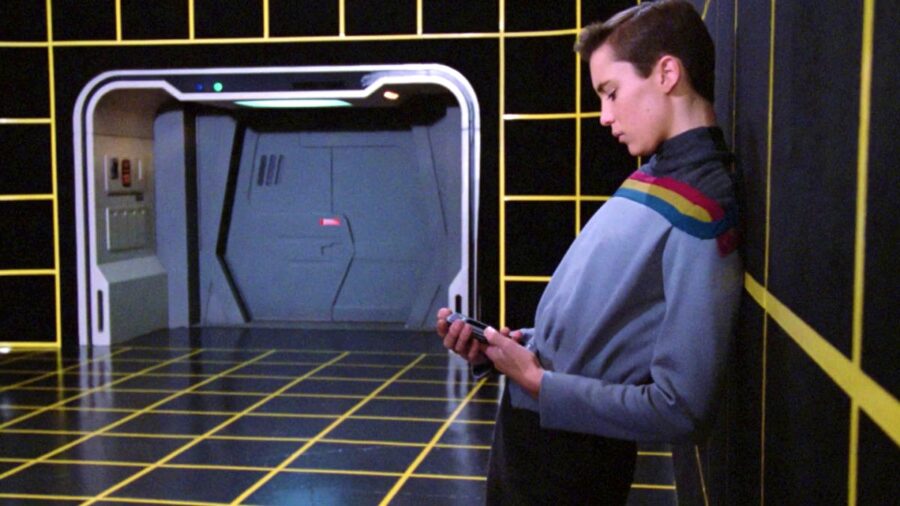
To keep our Star Trek framing, think of it this way: simply telling a computer to draw a picture is a bit like an Enterprise crewman telling the holodeck to create an exotic vista. Obviously, it takes some level of thought to generate an idea and tell it to the ship’s computer. But the crew doesn’t have to program anything or render anything because the Enterprise does all of the hard work for them. That’s why, in the far-flung future of the 24th century, nobody calls themselves an artist for barking a sentence or two at the computer when they get bored.
Unfortunately, the world is far less enlightened here in the 21st century. The laziest people in the world are typing one sentence into a glorified search engine and treating the resulting aesthetic abomination as a startlingly brilliant and original piece of art. Even wilder, they get grumpy when you don’t treat them like serious artists who spent a lifetime perfecting their craft. As it turns out, both now and in the future, there’s one thing that AI can’t generate: the approval from others that these tech bros so desperately need!

Jannik Sinner wins Madrid, shatters record for consecutive ATP Masters 1000 titles
Raptors' Brandon Ingram downgraded to doubtful for Game 7


