
Entertainment
How A Superhero Movie Drove Peaceful Americans To Madness And Violence
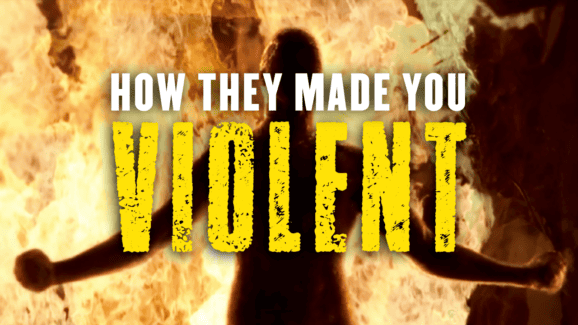
screenwashed (adjective) — When something seen on a screen completely changes how someone thinks or feels, as if their old beliefs were erased and replaced by what they just saw.
By Joshua Tyler
| Updated

In 2020, violent protests rocked the United States, devastating major cities. Since then, dozens more have appeared, so many that it almost seems normal.
But it isn’t normal.
Make a list of the most violent protests of the past 20 years, and you’ll find that the majority of them didn’t happen until after 2019. Before that, most protests, even the big ones like Occupy Wall Street or the Tea Party protests of the early 2000s, were just a lot of dudes walking around with signs until it got dark. There were exceptions, like the disastrous riots in Ferguson, Missouri, but those were noteworthy because they were unusual.
Now, violence, particularly from supposedly peaceful protesters themselves, is the norm. A daily occurrence in some cities, a regular seasonal event in others. What changed? In 2019, one movie took theaters by storm and manipulated its most ardent viewers to stop playing nice.
This is the story of how Joker screenwashed Americans into accepting violence as personal expression.
The Story Of Joker

Joker was billed as being about Batman’s arch-nemesis, but it has no true connection to the world of comic books. Instead, it’s a grim character study about Arthur Fleck, a mentally ill, socially invisible man slowly crushed by a city that doesn’t care whether he lives or dies. There are no superheroes, no grand conspiracies, and no redemption arc, just a sad, broken man discovering that the only time the world notices him is when he stops playing by its rules and embraces nihilism.
When Joker arrived in theaters, it was both controversial and a huge box office hit. No movie captured a bigger share of the cultural conversation in 2019 than it did, and theaters were packed with people looking for something edgy, different, and maybe even dangerous.
The Lone Observer

The debate over Joker often centered on whether it might inspire mass shootings or homicides. All of that discussion missed the true danger in the film.
Only one person saw the truth. It wasn’t mass murderers or an increase in individual homicides that we needed to worry about. A few months after Joker’s release, at the start of the George Floyd riots in 2020, master persuader Scott Adams made this observation:
“I’m willing to bet 90% of the protesters have seen Joker. It’s so powerful and well-made that it bounces around in your brain and burrows in, forming a dominant go-to pattern for your thinking.” – Scott Adams
Scott then asked, “Can one movie nudge a young person into violence and anarchy? A bad movie can’t. Even a good movie can’t do that. But Joker can. That movie is next-level, persuasion.”
Joker doesn’t merely depict unrest; it romanticizes it. It does it, using some very specific persuasion tricks.
Catharsis Through Violence

The film presents social collapse as catharsis. Arthur Fleck’s personal breakdown is fused to a citywide explosion of masked demonstrators who burn, riot, and kill. All while the camera treats it like liberation.
That’s what Catharsis is. The release of pent-up emotion through experience or expression leaves the mind clearer by safely discharging feelings that were previously contained or unresolved.
The need for catharsis exists in all of us. It’s an irresistible pull. That can be healthy, prompting reflection, relief, and clarity. But it can also distort judgment, causing people to chase emotional release for its own sake, overreact, or embrace narratives that justify anger, sadness, or guilt just to feel unburdened.
That’s what Joker taps into.

The violence isn’t framed as tragic or cautionary. It’s operatic. The mob becomes the chorus validating Arthur’s transformation. Gotham’s chaos isn’t shown as a failure of civilization, but as a necessary purge.
This matters because culture isn’t created through instruction; it’s learned by association.
Arthur Fleck is introduced as powerless, humiliated, and ignored. By anchoring the audience inside his suffering before any violence occurs, the film ensures viewers emotionally identify with him.
Joker’s Six Screenwashing Tricks

Joker screenwashes its audience by employing six distinct persuasion techniques.
Responsibility for violence is consistently shifted away from the character and onto abstract forces: “the system,” “the rich,” “society.” This trains viewers to see violence as an inevitable consequence, not a moral failure.
- Two, Aestheticization of Chaos
Riots are filmed beautifully. When violence is visually pleasing, the brain associates it with power and release rather than danger or shame.
- Three, Catharsis Substitution
The film substitutes violence for resolution. Destruction itself is the payoff, reinforcing the idea that “burning it down” is a valid emotional endpoint.
Arthur’s transformation is validated not by reasoned argument, but by mass approval. Viewers subconsciously absorb the same validation loop.
- Five, Thinking Past The Sale
The story strongly implies that violent societal collapse is unavoidable. When outcomes feel predetermined, audiences stop asking whether violence is right and start asking only when.
- Six, Meaning Injection Into Rage
Most importantly, the film gives rage a story. Raw anger becomes “truth.” Once anger is framed as insight rather than impulse, acting on it feels justified.

Before Joker, America had a culture in which only truly peaceful protest was acceptable. After Joker, the cultural zeitgeist became one in which violent protest wasn’t just acceptable, it was the only way to be heard.
In the movie, Joker had nothing to say; he just wanted to be heard. And now, being heard is all that matters, not whether or not you have anything worth saying.
The Case Against Joker’s Power Of Persuasion

Those without an understanding of persuasion say audiences are smart enough to separate fiction from reality and can’t be affected by what they see in screen. If culture can be changed by a single movie, then why didn’t the movie V for Vendetta have a similar effect?
A movie like V for Vendetta could never achieve the same effect because it frames violence as symbolic, ideological, and abstract, not emotionally personal. V is not an everyman the audience inhabits; he’s a mythic construct with clarity, planning, and moral certainty. His actions are presented as an allegory, not catharsis. The film creates distance through stylization, speeches, and overt political philosophy. This keeps viewers analyzing rather than identifying.
Joker is a totally unique piece of screenwashing because of the way it collapses that distance, rooting chaos in intimate humiliation and emotional grievance, making mass violent release feel personal, spontaneous, and psychologically relatable rather than theatrical or ideological.
Was Joker’s Impact Intentional?

I think it’s important to say here that it’s not clear if plunging America into endless violent riots was the intent of director Todd Phillips when he made Joker. Little is known about Phillips’ personal political views; he refuses to be categorized.
It’s possible Philips’s goal was something besides the one he achieved. Indeed, the movie’s sequel suggests he wasn’t entirely happy with the effect his first movie had on its viewers. Joker 2 attempts to undo much of what the first movie did, revealing Joker as a fraud and his followers equally so.
Of course, Joker wasn’t solely to blame for a cultural shift towards violence. COVID lockdowns created a powder keg, and irresponsible media coverage lit it. But would things have gone as badly as they did, and continue in that direction for years after, if Joker hadn’t been there, at that exact moment, to condition rioters in advance?

Watch one of the riot scenes from Joker. Then watch any Portland, Oregon protest and ask yourself if what you’re seeing is organic or just Joker cosplay.
Joker didn’t invent violent protest. But it did something arguably more influential: it made violent protest feel understandable, beautiful, and emotionally correct. Once culture grants moral permission, reality tends to follow, no manifesto required.
Congratulations, fiery but mostly peaceful protestors, you’ve been Screenwashed.
Entertainment
Put multiple AI models to work at once with this $80 tool

TL;DR: Upgrade your AI workflow with a lifetime subscription to 1min.AI’s Advanced Business Plan, now just $79.97 (reg. $540) until May 10.
Most AI models spit out one answer. There’s one problem with this — you don’t know if it’s the best option unless you run it through multiple models, which takes a whole lot of time. That’s where 1min.AI shines, letting you put your prompt in one place and see answers from dozens of AI models.
Right now, you can streamline your AI workflow with a lifetime subscription to 1min.AI Advanced Business Plan for only $79.97 (reg. $540) through May 10.
Mashable Deals
Imagine seeing results from dozens of popular AI models in one window, with no tab-hopping or copying and pasting required. That’s what 1min.AI offers — a one-stop-shop for all your AI needs.
With 1min.AI, you can see responses from major AI models like ChatGPT, Claude, Gemini, Grok, Mistral, and more, all in one spot.
Compare them all and easily find the best answer. You can get help with coding, video editing, image generation, answering simple questions, and much more. Just always give things a human once-over, because edits might be required.
Not only does 1min.AI let you consolidate your AI workflow, but it also saves you money in the long run. This lifetime subscription allows you to pay once and avoid not only monthly subscription fees, but also the cost of accessing multiple models.
Your lifetime subscription to the 1min.AI Advanced Business Plan provides an unlimited prompt library, unlimited storage, unlimited brand voice options, and weekly updates. You’ll also receive 4 million credits a month.
Mashable Deals
Wondering what you can do with those credits? You can use them to write 1,112,500 words, research up to 5,933 SEO keywords, generate up to 1,186 images, or create up to 37 videos per month. If you need more, you can earn them for free by using the app, leaving a review, or referring your friends.
Lock in major savings with a lifetime subscription to 1min.AI’s Advanced Business Plan for only $79.97 through May 10.
StackSocial prices subject to change.
Topics
Artificial Intelligence
Entertainment
NYT Connections Sports Edition today: Hints and answers for May 2, 2026
Today’s Connections: Sports Edition will require some knowledge of popular U.S. sports and pop culture.
As we’ve shared in previous hints stories, this is a version of the popular New York Times word game that seeks to test the knowledge of sports fans.
Like the original Connections, the game is all about finding the “common threads between words.” And just like Wordle, Connections resets after midnight and each new set of words gets trickier and trickier — so we’ve served up some hints and tips to get you over the hurdle.
If you just want to be told today’s puzzle, you can jump to the end of this article for the latest Connections solution. But if you’d rather solve it yourself, keep reading for some clues, tips, and strategies to assist you.
What is Connections: Sports Edition?
The NYT‘s latest daily word game has launched in association with The Athletic, the New York Times property that provides the publication’s sports coverage. The sports Connections can be played on both web browsers and mobile devices and require players to group four words that share something in common.
This Tweet is currently unavailable. It might be loading or has been removed.
Each puzzle features 16 words, and each grouping of words is split into four categories. These sets could comprise anything from book titles, software, country names, etc. Even though multiple words will seem like they fit together, there’s only one correct answer.
If a player gets all four words in a set correct, those words are removed from the board. Guess wrong and it counts as a mistake — players get up to four mistakes before the game ends.
This Tweet is currently unavailable. It might be loading or has been removed.
Players can also rearrange and shuffle the board to make spotting connections easier. Additionally, each group is color-coded with yellow being the easiest, followed by green, blue, and purple. Like Wordle, you can share the results with your friends on social media.
Mashable Top Stories
Here’s a hint for today’s Connections: Sports Edition categories
Want a hint about the categories without being told the categories? Then give these a try:
Here are today’s Connections: Sports Edition categories
Need a little extra help? Today’s connections fall into the following categories:
-
Yellow: A Pittsburgh Athlete
-
Green: Seen on an MLB Scorebug
-
Blue: Teams in the PWHL Playoffs
-
Purple: Horse Racing Triple Crowns
Looking for Wordle today? Here’s the answer to today’s Wordle.
Ready for the answers? This is your last chance to turn back and solve today’s puzzle before we reveal the solutions.
Drumroll, please!
The solution to today’s Connections: Sports Edition #585 is…
What is the answer to Connections: Sports Edition today?
-
A Pittsburgh Athlete: PANTHER, PENGUIN, PIRATE, STEELER
-
Seen on an MLB Scorebug: COUNT, INNING, OUTS, SCORE
-
Teams in the PWHL Playoffs: CHARGE, FLEET, FROST, VICTORIE
-
Horse Racing Triple Crowns: AFFIRMED, CITATION, JUSTIFY, WHIRLAWAY
Don’t feel down if you didn’t manage to guess it this time. There will be new sports Connections for you to stretch your brain with tomorrow, and we’ll be back again to guide you with more helpful hints.
Are you also playing NYT Strands? See hints and answers for today’s Strands.
If you’re looking for more puzzles, Mashable’s got games now! Check out our games hub for Mahjong, Sudoku, free crossword, and more.
Not the day you’re after? Here’s the solution to today’s Connections.
Entertainment
NYT Pips hints, answers for May 2, 2026
Welcome to your guide to Pips, the latest game in the New York Times catalogue.
Released in August 2025, Pips puts a unique spin on dominoes, creating a fun single-player experience that could become your next daily gaming habit.
Currently, if you’re stuck, the game only offers to reveal the entire puzzle, forcing you to move on to the next difficulty level and start over. However, we have you covered! Below are piecemeal answers that will serve as hints so that you can find your way through each difficulty level.
How to play Pips
If you’ve ever played dominoes, you’ll have a passing familiarity with how Pips is played. As we’ve shared in our previous hints stories for Pips, the tiles, like dominoes, are placed vertically or horizontally and connect with each other. The main difference between a traditional game of dominoes and Pips is the color-coded conditions you have to address. The touching tiles don’t necessarily have to match.
The conditions you have to meet are specific to the color-coded spaces. For example, if it provides a single number, every side of a tile in that space must add up to the number provided. It is possible — and common — for only half a tile to be within a color-coded space.
Here are common examples you’ll run into across the difficulty levels:
-
Number: All the pips in this space must add up to the number.
-
Equal: Every domino half in this space must be the same number of pips.
-
Not Equal: Every domino half in this space must have a completely different number of pips.
-
Less than: Every domino half in this space must add up to less than the number.
-
Greater than: Every domino half in this space must add up to more than the number.
If an area does not have any color coding, it means there are no conditions on the portions of dominoes within those spaces.
Easy difficulty hints, answers for May 2 Pips
Equal (6): Everything in this space must be equal to 6. The answer is 0-6, placed horizontally; 6-3, placed horizontally.
Equal (3): Everything in this space must be equal to 3. The answer is 6-3, placed horizontally; 3-4, placed horizontally.
Equal (4): Everything in this space must be equal to 4. The answer is 3-4, placed horizontally; 4-4, placed horizontally.
Less Than (6): Everything in this space must be less than 6. The answer is 1-1, placed vertically.
Medium difficulty hints, answers for May 2 Pips
Less Than (2): Everything in this space must be less than 2. The answer is 0-3, placed vertically.
Equal (5): Everything in this space must be equal to 5. The answer is 5-5, placed horizontally.
Mashable Top Stories
Greater Than (4): Everything in this space must be greater than 4. The answer is 5-4, placed horizontally
Equal (4): Everything in this space must be equal to 4. The answer is 5-4, placed horizontally; 4-4, placed vertically.
Equal (2): Everything in this space must be equal to 2. The answer is 2-2, placed horizontally; 2-6, placed vertically.
Equal (6): Everything in this space must be equal to 6. The answer is 2-6, placed vertically; 5-6, placed vertically.
Number (5): Everything in this space must add up to 5. The answer is 5-6, placed vertically.
Hard difficulty hints, answers for May 2 Pips
Number (6): Everything in this space must add up to 6. The answer is 4-5, placed vertically; 2-5, placed vertically.
Number (6): Everything in this space must add up to 6. The answer is 6-3, placed vertically.
Number (15): Everything in this space must add up to 15. The answer is 3-5, placed horizontally.
Number (7): Everything in this space must add up to 7. The answer is 3-4, placed horizontally; 6-3, placed vertically.
Equal (6): Everything in this space must be equal to 6. The answer is 6-6, placed horizontally.
Number (2): Everything in this space must add up to 2. The answer is 2-1, placed vertically.
Number (2): Everything in this space must add up to 2. The answer is 2-1, placed vertically; 1-3, placed horizontally.
Equal (3): Everything in this space must be equal to 3. The answer is 3-5, placed horizontally; 3-3, placed horizontally; 3-4, placed horizontally; 1-3, placed horizontally; 0-3, placed horizontally.
Greater Than (3): Everything in this space must be greater than 3. The answer is 0-6, placed horizontally.
Equal (0): Everything in this space must be equal to 0. The answer is 0-6, placed horizontally; 0-3, placed horizontally; 0-1, placed horizontally.
Less Than (3): Everything in this space must be less than 3. The answer is 0-1, placed horizontally.
If you’re looking for more puzzles, Mashable’s got games now! Check out our games hub for Mahjong, Sudoku, free crossword, and more.

Down 2-0, LAFC score twice late in draw vs. San Diego
Canes keep rolling, blank Flyers to open East semifinal series


