
Entertainment
How A Movie Drove Peaceful Americans To Madness And Violence
screenwashed (adjective) — When something seen on a screen completely changes how someone thinks or feels, as if their old beliefs were erased and replaced by what they just saw.
By Joshua Tyler
| Updated

In 2020, violent protests rocked the United States, devastating major cities. Since then, dozens more have appeared, so many that it almost seems normal.
But it isn’t normal.
Make a list of the most violent protests of the past 20 years, and you’ll find that the majority of them didn’t happen until after 2019. Before that, most protests, even the big ones like Occupy Wall Street or the Tea Party protests of the early 2000s, were just a lot of dudes walking around with signs until it got dark. There were exceptions, like the disastrous riots in Ferguson, Missouri, but those were noteworthy because they were unusual.
Now, violence, particularly from supposedly peaceful protesters themselves, is the norm. A daily occurrence in some cities, a regular seasonal event in others. What changed? In 2019, one movie took theaters by storm and manipulated its most ardent viewers to stop playing nice.
This is the story of how Joker screenwashed Americans into accepting violence as personal expression.
The Story Of Joker

Joker was billed as being about Batman’s arch-nemesis, but it has no true connection to the world of comic books. Instead, it’s a grim character study about Arthur Fleck, a mentally ill, socially invisible man slowly crushed by a city that doesn’t care whether he lives or dies. There are no superheroes, no grand conspiracies, and no redemption arc, just a sad, broken man discovering that the only time the world notices him is when he stops playing by its rules and embraces nihilism.
When Joker arrived in theaters, it was both controversial and a huge box office hit. No movie captured a bigger share of the cultural conversation in 2019 than it did, and theaters were packed with people looking for something edgy, different, and maybe even dangerous.
The Lone Observer

The debate over Joker often centered on whether it might inspire mass shootings or homicides. All of that discussion missed the true danger in the film.
Only one person saw the truth. It wasn’t mass murderers or an increase in individual homicides that we needed to worry about. A few months after Joker’s release, at the start of the George Floyd riots in 2020, master persuader Scott Adams made this observation:
“I’m willing to bet 90% of the protesters have seen Joker. It’s so powerful and well-made that it bounces around in your brain and burrows in, forming a dominant go-to pattern for your thinking.” – Scott Adams
Scott then asked, “Can one movie nudge a young person into violence and anarchy? A bad movie can’t. Even a good movie can’t do that. But Joker can. That movie is next-level, persuasion.”
Joker doesn’t merely depict unrest; it romanticizes it. It does it, using some very specific persuasion tricks.
Catharsis Through Violence

The film presents social collapse as catharsis. Arthur Fleck’s personal breakdown is fused to a citywide explosion of masked demonstrators who burn, riot, and kill. All while the camera treats it like liberation.
That’s what Catharsis is. The release of pent-up emotion through experience or expression leaves the mind clearer by safely discharging feelings that were previously contained or unresolved.
The need for catharsis exists in all of us. It’s an irresistible pull. That can be healthy, prompting reflection, relief, and clarity. But it can also distort judgment, causing people to chase emotional release for its own sake, overreact, or embrace narratives that justify anger, sadness, or guilt just to feel unburdened.
That’s what Joker taps into.

The violence isn’t framed as tragic or cautionary. It’s operatic. The mob becomes the chorus validating Arthur’s transformation. Gotham’s chaos isn’t shown as a failure of civilization, but as a necessary purge.
This matters because culture isn’t created through instruction; it’s learned by association.
Arthur Fleck is introduced as powerless, humiliated, and ignored. By anchoring the audience inside his suffering before any violence occurs, the film ensures viewers emotionally identify with him.
Joker’s Six Screenwashing Tricks

Joker screenwashes its audience by employing six distinct persuasion techniques.
Responsibility for violence is consistently shifted away from the character and onto abstract forces: “the system,” “the rich,” “society.” This trains viewers to see violence as an inevitable consequence, not a moral failure.
- Two, Aestheticization of Chaos
Riots are filmed beautifully. When violence is visually pleasing, the brain associates it with power and release rather than danger or shame.
- Three, Catharsis Substitution
The film substitutes violence for resolution. Destruction itself is the payoff, reinforcing the idea that “burning it down” is a valid emotional endpoint.
Arthur’s transformation is validated not by reasoned argument, but by mass approval. Viewers subconsciously absorb the same validation loop.
- Five, Thinking Past The Sale
The story strongly implies that violent societal collapse is unavoidable. When outcomes feel predetermined, audiences stop asking whether violence is right and start asking only when.
- Six, Meaning Injection Into Rage
Most importantly, the film gives rage a story. Raw anger becomes “truth.” Once anger is framed as insight rather than impulse, acting on it feels justified.

Before Joker, America had a culture in which only truly peaceful protest was acceptable. After Joker, the cultural zeitgeist became one in which violent protest wasn’t just acceptable, it was the only way to be heard.
In the movie, Joker had nothing to say; he just wanted to be heard. And now, being heard is all that matters, not whether or not you have anything worth saying.
The Case Against Joker’s Power Of Persuasion

Those without an understanding of persuasion say audiences are smart enough to separate fiction from reality and can’t be affected by what they see in screen. If culture can be changed by a single movie, then why didn’t the movie V for Vendetta have a similar effect?
A movie like V for Vendetta could never achieve the same effect because it frames violence as symbolic, ideological, and abstract, not emotionally personal. V is not an everyman the audience inhabits; he’s a mythic construct with clarity, planning, and moral certainty. His actions are presented as an allegory, not catharsis. The film creates distance through stylization, speeches, and overt political philosophy. This keeps viewers analyzing rather than identifying.
Joker is a totally unique piece of screenwashing because of the way it collapses that distance, rooting chaos in intimate humiliation and emotional grievance, making mass violent release feel personal, spontaneous, and psychologically relatable rather than theatrical or ideological.
Was Joker’s Impact Intentional?

I think it’s important to say here that it’s not clear if plunging America into endless violent riots was the intent of director Todd Phillips when he made Joker. Little is known about Phillips’ personal political views; he refuses to be categorized.
It’s possible Philips’s goal was something besides the one he achieved. Indeed, the movie’s sequel suggests he wasn’t entirely happy with the effect his first movie had on its viewers. Joker 2 attempts to undo much of what the first movie did, revealing Joker as a fraud and his followers equally so.
Of course, Joker wasn’t solely to blame for a cultural shift towards violence. COVID lockdowns created a powder keg, and irresponsible media coverage lit it. But would things have gone as badly as they did, and continue in that direction for years after, if Joker hadn’t been there, at that exact moment, to condition rioters in advance?

Watch one of the riot scenes from Joker. Then watch any Portland, Oregon protest and ask yourself if what you’re seeing is organic or just Joker cosplay.
Joker didn’t invent violent protest. But it did something arguably more influential: it made violent protest feel understandable, beautiful, and emotionally correct. Once culture grants moral permission, reality tends to follow, no manifesto required.
Congratulations, fiery but mostly peaceful protestors, you’ve been Screenwashed.
Entertainment
Netflix Has Emma Stone's New Rated-R Sci-Fi Movie, It'll Turn You Inside Out

By TeeJay Small
| Published

If you’re into weird, trippy movies with complex characters, twisted conspiracies, and some overarching sci-fi elements, you’re probably already a fan of Greek filmmaker Yorgos Lanthimos. Lanthimos’ oeuvre includes The Lobster, The Killing of a Sacred Deer, and Kinds of Kindness, just to name a few. While each of these films offers a mind-bending adventure, none has turned my head inside out quite like his latest, Bugonia, now streaming on Netflix.
Bugonia stars Emma Stone as a ruthless CEO of a massive pharmaceutical conglomerate. Fresh off a slew of bad press for suppressing workers’ rights, Stone’s Michelle Fuller goes above and beyond to present the image of a caring, easygoing boss. She encourages her employees to take time for their mental health and leave early, while subtly implying that doing so would mean risking their jobs. She’s your run-of-the-mill billionaire monster.

As Fuller goes about her daily routine, we are introduced to conspiracy theorist Teddy Gatz, played expertly by Breaking Bad‘s Jesse Plemons, and his cousin Don, portrayed by newcomer Aidan Delbis. Teddy, like many real-life viewers at home, is a disenfranchised wage worker who has fallen down a deep rabbit hole of online alien conspiracies. He has come to believe that a race of alien creatures has assimilated into Earth’s population, disguised themselves as corporate elites, and subjugated the world through a series of telepathic commands.
Bugonia really picks up when Teddy and Don kidnap and imprison Michelle in their basement, believing her to be a member of the alien race. Based on information they’ve collected in insulated internet chatrooms, the duo shave her head, chain her up, and slather her entire body with antihistamine lotion. They believe these measures will prevent the CEO from utilizing her mind-control powers or contacting her alien mothership for backup.

From there, most of Bugonia centers on Michelle as she attempts to escape from her captors by any means necessary. She tries to enlighten the kidnappers with logic and deprogram their conspiracy-addled minds. She even tries leaning into the conspiracy and promising that she’ll bring them into contact with her alien superiors if they let her go. The whole time, Teddy and Don are taking measures to prevent themselves from being manipulated by Michelle, by chemically sterilizing themselves and taking prescription drugs against label instructions.
Bugonia is an absolute wild ride from start to finish, and one that I simply couldn’t pry my eyes away from. Everything from Emma Stone’s spectacular leading performance to the quirky, bizarre writing to the occasional mind-bending twist kept me on the edge of my seat, constantly questioning the film’s reality. By my estimation, it’s the perfect conspiracy movie for a post-Epstein list world, where even the most twisted conspiracies don’t seem as ridiculous as they did five or ten years ago.

If you get the chance to catch Bugonia on Netflix, don’t miss it. Just be sure to throw away everything you think you know before going in, or you just might find yourself manipulated by a race of malevolent alien overlords.

Entertainment
Get AdGuard Family Plan for $16 and protect up to 9 devices
TL;DR: The AdGuard Family Plan covers up to nine devices with ad blocking, privacy protection, and parental controls, now on sale for $15.97 (reg. $169.99).
$15.97
$169.99
Save $154.02
Most households aren’t running on just one device anymore. You probably have a few of your own, and everyone else under the same roof likely does, too. That means a mix of phones, laptops, and tablets — and all the ads, trackers, and distractions that seem to follow them everywhere. The AdGuard Family Plan is built to handle that, covering up to nine devices with ad blocking, privacy protection, and parental controls, now on sale for $15.97 (reg. $169.99).
If you’re tired of seeing ads every other scroll, chances are the rest of your household is, too. AdGuard helps cut through that noise by filtering out banners, pop-ups, and autoplay videos before they load. The result is a cleaner, less distracting browsing experience across devices.
Mashable Deals
It also adds a layer of privacy. AdGuard helps limit trackers and data collection while you browse, shop, or just wander the internet. It can also block access to known phishing and malicious sites, which is especially useful when not everyone using your Wi-Fi has the same browsing habits.
For households with kids, the parental controls help keep things in check. You can restrict access to adult content and set boundaries around what’s accessible online, helping keep things a bit more age-appropriate without constant supervision.
The Family Plan works across iOS, Android, Windows, and macOS, making it easy to cover most setups. With support for up to nine devices, it’s a good fit for households where screens tend to multiply.
Mashable Deals
Originally $169.99, you can score a lifetime subscription to AdGuard Family Plan for just $15.97.
StackSocial prices subject to change.
Entertainment
These Forgotten Star Trek Episodes Tried To Warn Us About AI Slop
By Chris Snellgrove
| Published

One of the most weirdly persistent debates of the modern world is over whether AI can create art. Sure, you can type a prompt into ChatGPT or any number of AI platforms and have a unique image within seconds. But while the image is technically unique, it’s not exactly original. The AI was trained on every image it could get its grubby little gears on, so you never get a truly one-of-a-kind image. Instead, you get a mishmash of one or more artists’ styles that the AI bot helpfully masses off as completely original art.
The debate over the matter is so fierce because the two sides are so diametrically opposed. AI bros claim that this technology effectively democratizes art, making it possible for anyone to share their vision with the world. Traditional artists, meanwhile, claim that art has always been democratic and that AI is just a soulless alternative to learning how to draw. While ChatGPT and other generative AI platforms are relatively new, this debate stretches back decades, and in two forgotten episodes of Star Trek: The Next Generation, the android officer Data reminds us of the limits of AI art.
To Prompt Or Not To Prompt

One such example came from the episode “The Defector,” which begins with Data and Captain Picard acting out Shakespeare’s Henry V on the holodeck. After Data gives a surprisingly solid performance, Picard compliments the android’s acting. However, Data demurs and basically admits that his acting was an amalgamation of other performers who have played this role. He tells Picard, “I plan to study the performances of Olivier, Branagh, Shapiro, [and] Kullnark.” The captain replies that while Shakespeare is perfect “to learn about the human condition…you must discover it through your own performance, not by imitating others.”
This episode first aired in 1990, but Picard’s dialogue fits right in with our modern AI debate. Data, fittingly enough, is doing what artificial intelligence always does: mashing together the work of several different artists. It looks like an original performance at first, which is why Picard applauds. But after finding out what Data did, he chides the android for just mashing a few other performances together and calling it a day. After all, he will never develop as an artist if he doesn’t take the time to develop his own style instead of copying everyone’s homework.
Picard Has Entered The Chat

This obviously reflects our modern discourse about generative AI. As an avid Shakespeare fan, Picard understands that what made those earlier actors so great was that they found ways to put their own spin on Henry V. If those performers hadn’t, in turn, just tried to copy others, then acting becomes functionally meaningless.
The conversation about Data creating art actually echoes another conversation in the earlier episode “The Ensigns of Command.” When Picard tells the android that his recent violin performance “shows feeling,” Data corrects him. “Strictly speaking, sir, it is not my playing. It is a precise imitation of the techniques of Jascha Heifetz and Trenka Bronken.” Picard insists that Data created something original because he successfully combined two very different performances. Reluctantly, Data takes the compliment, telling his commanding officer that “I have learned to be creative…when necessary.”
At this point, AI bros might think that Captain Picard is on their side. After all, he argues that by choosing to combine two wildly different musicians, Data is actually synthesizing something new, which is akin to “prompt engineers” feeding a bunch of contrary ideas into ChatGPT and hoping for the best. The key difference, though, is that Data still had to bust out the violin and successfully perform this composition himself. Picard considers Data an artist because the android actually makes art. So-called prompt engineers aren’t even doing that; they are simply asking the computer to make something cool and then taking the credit.
Computer: End Program
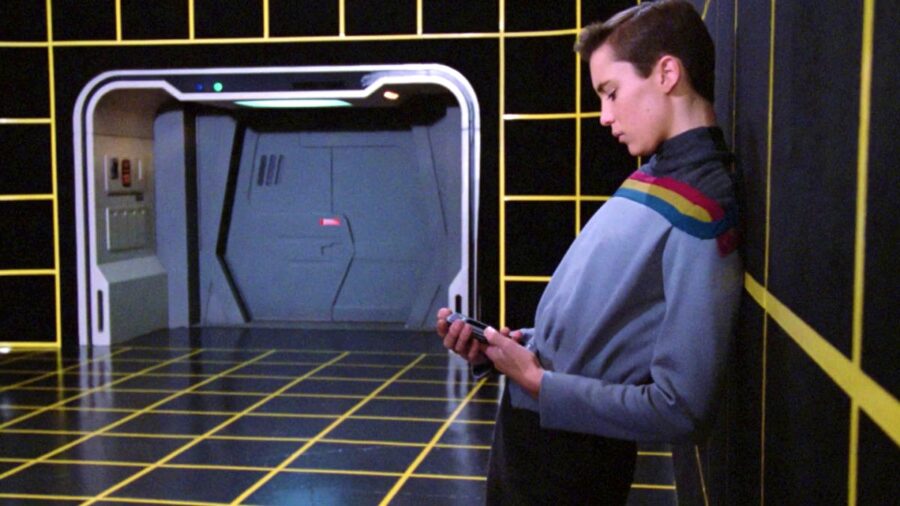
To keep our Star Trek framing, think of it this way: simply telling a computer to draw a picture is a bit like an Enterprise crewman telling the holodeck to create an exotic vista. Obviously, it takes some level of thought to generate an idea and tell it to the ship’s computer. But the crew doesn’t have to program anything or render anything because the Enterprise does all of the hard work for them. That’s why, in the far-flung future of the 24th century, nobody calls themselves an artist for barking a sentence or two at the computer when they get bored.
Unfortunately, the world is far less enlightened here in the 21st century. The laziest people in the world are typing one sentence into a glorified search engine and treating the resulting aesthetic abomination as a startlingly brilliant and original piece of art. Even wilder, they get grumpy when you don’t treat them like serious artists who spent a lifetime perfecting their craft. As it turns out, both now and in the future, there’s one thing that AI can’t generate: the approval from others that these tech bros so desperately need!

Jannik Sinner wins Madrid, shatters record for consecutive ATP Masters 1000 titles
Raptors' Brandon Ingram downgraded to doubtful for Game 7


