
Sports
Hornets rally past Pelicans for 7th straight win
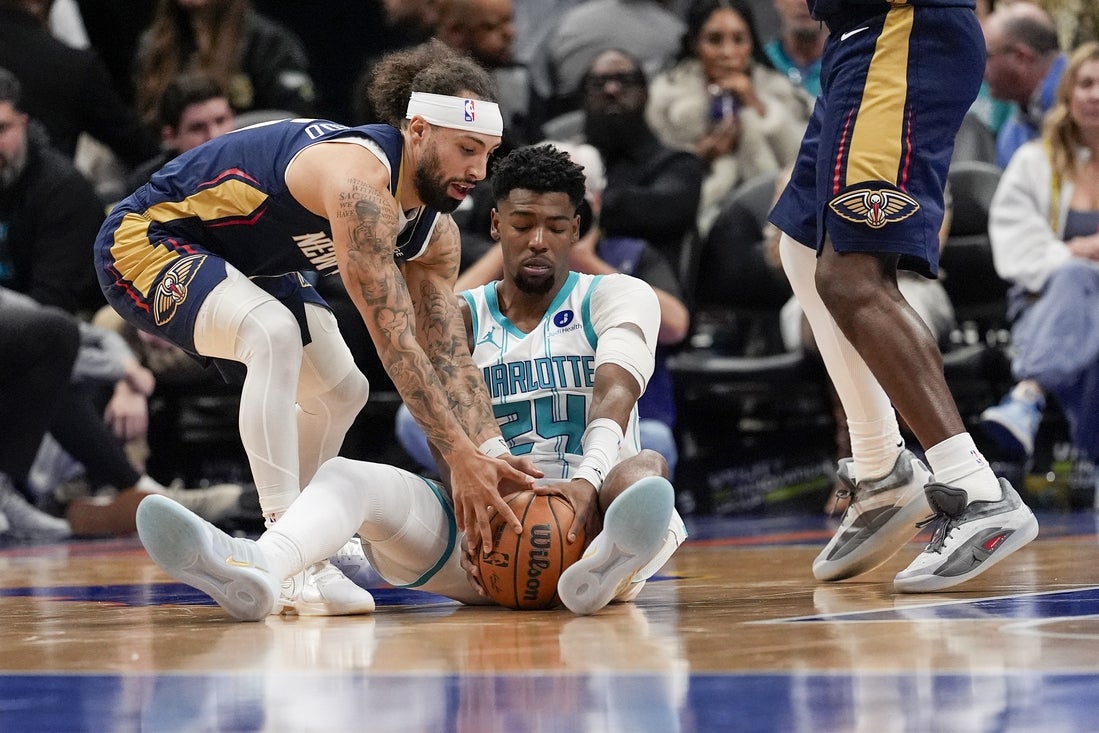
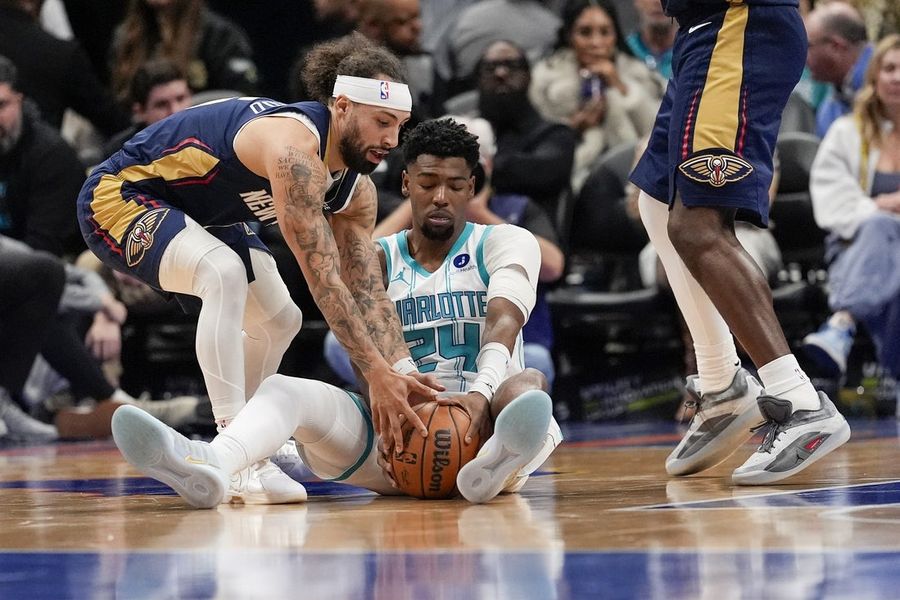 Feb 2, 2026; Charlotte, North Carolina, USA; Charlotte Hornets forward Brandon Miller (24) and New Orleans Pelicans guard Jose Alvarado (15) scramble for the loose ball during the second quarter at the Spectrum Center. Mandatory Credit: Jim Dedmon-Imagn Images
 LaMelo Ball scored 24 points and the Charlotte Hornets won their seventh consecutive game by overcoming a 22-point deficit to defeat the visiting New Orleans Pelicans 102-95 on Monday afternoon.
Kon Knueppel chipped in 17 points and nine rebounds and Brandon Miller added 16 points and eight rebounds. Grant Williams provided 16 points and nine rebounds off the bench and fellow reserve Ryan Kalkbrenner supplied 10 points for Charlotte, which is on its longest winning streak in nearly 10 years.
Ball struggled at times, shooting 3-for-14 on 3-pointers, but he was 5-for-6 from inside the arc. He also contributed eight rebounds and a team-high five assists.
The Pelicans, who scored just 13 points in the fourth quarter and 31 for the whole second half, lost for the third time in their last four games despite Trey Murphy III’s 27 points. Derik Queen contributed 16 points and eight rebounds, while Zion Williamson added 14 points and 11 boards.
Charlotte committed 16 turnovers and was limited to 16 assists, but held a 59-34 rebounding advantage. Six Hornets had seven or more rebounds.
Murphy shrugged off a recent shooting slump, going 3-for-8 on 3-pointers after making only seven total 3s in his last four games combined. He was 10-for-20 overall from the field.
The Pelicans built a 64-49 lead by halftime. When Charlotte scored the first nine points of the fourth quarter, it gave the Hornets an 87-82 lead.
The Pelicans went cold, managing just seven points — with the only two field goals coming from Williamson — in the first nine minutes of the final quarter.
Soon after, Charlotte’s advantage grew to 98-89.
The Hornets finished 12-for-50 on 3-point attempts, with more than half of their 85 total shots coming from long range.
The game was another in a recent series of Charlotte home games that had a time change, with tip-off moved up four hours due to weather concerns.
–Field Level Media
Sports
Coaches in elite company clash when Kansas faces St. John's

 Mar 19, 2026; San Diego, CA, USA; Kansas Jayhawks head coach Bill Self speaks at a press conference ahead of the first round of the men’s 2026 NCAA Tournament at Viejas Arena. Mandatory Credit: Denis Poroy-Imagn Images
 SAN DIEGO — Only three active head coaches in Division I college basketball have won multiple national championships. Two of them meet for a berth in the Sweet 16 when Bill Self’s No. 4 Kansas Jayhawks face Rick Pitino’s No. 5 St. John’s Red Storm on Sunday in the second round of the NCAA Tournament East Region.
Self, winner of the 2008 and 2022 national championships at Kansas, praised Pitino’s continued success over multiple eras. Pitino is 30 years removed from winning his first title with Kentucky in 1996 and won another at Louisville in 2013, although the latter has been officially vacated by the NCAA.
“To me, the coaches (who) are so impressive are (those who) coached without a 3-point line, then became efficient with the 3-point line. Coached without a shot clock, then became one of the best with the shot clock – always evolving with the game,” Self said. “And (Pitino) has done that as well as anybody maybe ever.”
Pitino began his full-time head-coaching career in 1978 at Boston University, seven years before the introduction of the shot clock and eight before the 3-point line was introduced across college basketball.
His longevity puts Pitino in the unique position to guide his fourth different program, along with Providence, Kentucky and Louisville, to the Sweet 16. It would be the first such appearance since 1999 for St. John’s (29-6).
The Red Storm advanced to the second round with a 79-53 rout of No. 12 Northern Iowa on Friday, St. John’s seventh straight win overall and fourth in a row by 10-plus points.
The veteran trio of Oziyah Sellers, Bryce Hopkins and Kansas transfer Zuby Ejiofor have paced St. John’s, combining to average 40.5 of St. John’s 81.6 points per game. Ejiofor, the Big East Conference Player of the Year, posted a 14-point, 11-rebound double-double in Friday’s win.
Kansas (24-10), meanwhile, weathered a furious second-half comeback on Friday to advance past No. 13 Cal Baptist behind standout freshman Darryn Peterson’s 28 points.
The Jayhawks led by as many as 26 points before Cal Baptist cut the deficit to six points with 1:20 left in the 68-60 Kansas win.
Pitino offered effusive praise of Peterson, a potential No. 1 overall pick in this summer’s NBA draft. The 6-foot-6 guard is averaging 20.1 points per game despite battling a variety of injury issues throughout the season.
“He’s got great size,” Pitino said of Peterson. “He’s got a beautiful-looking jump shot. …He’s going to be a great NBA player because he has an NBA game.”
Peterson’s presence on the Kansas roster reflects one of the many positives Pitino touted when analyzing his counterpart in Self. Pitino called the Kansas coach a “great evaluator of talent” on top of being a multidimensional tactician.
“He’s a great offensive coach and he’s a great defensive coach,” Pitino said. “He’s such a well-rounded guy. His teams do everything well.”
The Jayhawks come into the second round with a balanced resume but with especially impressive defensive credentials. They have held opponents to 44.5% shooting on 2-point field-goal attempts and only 30.5% from beyond the arc, both top 25 nationally.
Big men Flory Bidunga and Bryson Tiller both rank in the top 150 nationally in block percentage, per KenPom.com.
They will clash with a stout St. John’s frontcourt led by Ejiofor, whose 16.3 points per game come on 55% shooting from the floor.
–Kyle Kensing, Field Level Media
Sports
Arizona eyes 3rd straight Sweet 16, but Utah St. feeling confident
SAN DIEGO — West Region No. 1 seed Arizona can advance to its third consecutive Sweet 16, but must first get past a ninth-seeded Utah State team on a “revenge tour” heading into Sunday’s second-round matchup.
Using what it viewed as a slight about its seeding for motivation, Utah State (29-6) made an initial statement with its 86-76 win over No. 8 seed Villanova on Friday.
The Aggies rallied from down 10 early in the first half, led by the backcourt tandem of MJ Collins Jr. and Mason Falslev, the Mountain West Conference Player of the Year. The two scored 20 and 22 points, respectively, with each delivering critical baskets down the stretch.
“When you’ve got big-time players and they’re really connected and playing for something bigger than themselves, something special can happen,” Utah State coach Jerrod Calhoun said. “When MJ has it going, I’ve said this all along: I think he’s one of the best players in the county. (Collins) and Mason Falslev are one of the best one-two punches in college basketball.”
Collins averaged a team-high 17.7 points per game this season, followed by Falslev’s 16.2. Along with combo-guard Drake Allen, who leads the Aggies at 4.7 assists per game, Utah State features a dynamic, rangy perimeter foundation.
Along with setting the tone offensively, the trio have helped Utah State produce turnovers on 20.6% of opponent possessions — ranking in the Top 20 in the nation per KenPom.com metrics.
“In the Big 12 (Conference), we saw a lot of different defenses, different (schemes),” Arizona guard Jaden Bradley said. “But I’m pretty sure (Utah State)’s going to be tough after looking at their game plan.”
Bradley led the Wildcats (33-2) into the second round after a 92-58 rout of No. 16 seed Long Island on Friday for Arizona’s 10th consecutive win. The Wildcats controlled throughout, though they endured a sloppy stretch in the second half.
Arizona offset any ball-control issues against the Sharks with a 52-31 advantage on the glass, paced by freshman Ivan Karchenkov’s career-high-tying 10 rebounds. The Wildcats have successfully leveraged their collective length to boast a plus-11.1-per game average in rebounding margin, the fourth-best in Division I.
Utah State big man Zach Keller cited Arizona’s rebounding proficiency as the facet of the Wildcats’ game that immediately stands out.
Five Wildcats average more than four rebounds per game, led by senior forward Tobe Awaka’s 9.5. Motiejus Krivas, a 7-foot-2 junior center, averages eight rebounds and Karchenkov averages 4.2.
Also among the quintet are the freshman duo of Brayden Burries (4.7 rpg) and Koa Peat (5.4), Arizona’s top scorers.
Burries knocked down four 3-pointers in the first round, part of a six 3-pointer barrage in the first half for a Wildcats team that averages fewer than six treys a contest. Arizona has instead leaned on its interior scoring, with 57.3% of its scoring coming from inside the arc, the 10th-highest rate in the nation per KenPom.com.
Conversely, Utah State has limited opponents to 44.8% of their offense on two-point field-goal attempts.
–Kyle Kensing, Field Level Media
Sports
No. 4 Alabama, No. 5 Texas Tech keep winning without star players
 Mar 7, 2026; Tuscaloosa, AL, USA; Alabama guard Labaron Philon Jr. (0) flexes during a time out of the game with Auburn at Coleman Coliseum. Alabama defeated Auburn 96-84. Mandatory Credit: Gary Cosby Jr.-Tuscaloosa News
 Alabama and Texas Tech both had concerns regarding their roster makeup entering the NCAA Tournament.
Now one of them is guaranteed a spot in the Sweet 16.
The teams meet in Sunday night’s Midwest Region second-round game in Tampa, Fla.
Fifth-seeded Texas Tech (23-10) was looking like a national championship contender until losing star forward JT Toppin to a season-ending torn ACL on Feb. 17.
Still, the Red Raiders will challenge the Crimson Tide in many ways, particularly because of guard play — much of which was on display during the second half of Friday’s 91-71 handling of No. 12 Akron.
“This team does as good a job as anybody as I’ve seen at hunting mismatches,” Alabama coach Nate Oats said of Texas Tech.
Fourth-seeded Alabama (24-9) is without suspended guard Aden Holloway, who was second on the team in scoring with 16.8 points per game. He faces a felony drug charge stemming from his arrest on Monday.
Yet there’s plenty of firepower out there for both teams. Labaron Philon Jr. averages 22 points per game for Alabama, which rallied past 13 seed Hofstra 90-70 on Friday.
“I don’t know if there’s a comparison just because he’s got size and can do it in a lot of different ways,” Texas Tech coach Grant McCasland said of Alabama’s Oats. “But definitely impressed with his ability to win.”
The Crimson Tide are hoping that experience against different types of lineups will come in handy for Sunday’s showdown. Texas Tech is bound to want to keep the tempo at a moderate pace, while Alabama likes a brisker pace.
“I would say we’ve just got to get adjusted to how they play,” Alabama forward Aiden Sherrell said. “We play so many teams throughout the season that have a great guard play, and at the end of the day, we had to get adjusted.”
Sherrell had his third double-double of the season with 15 points and 15 rebounds against Hofstra. He’s ready to do more if that’s what’s needed.
“The key will be just trying to make the winning plays for sure, just doing whatever it takes to help my teammates succeed and help us win,” Sherrell said. “Just giving that second effort on every possession.”
Much of the outcome of the second-round game might depend on if Alabama can rebound at the rate that it did against Hofstra (a 46-34 advantage).
“I do think part of what makes Texas Tech good is all the hustle plays,” Oats said.
Texas Tech has had to compensate for rebounding since losing Toppin. It has become more of a group effort.
“I think that the guards since JT has been injured have stepped up for us,” forward LeJuan Watts said.
Watts said Alabama’s 17 offensive rebounds from the Hofstra game caught the Red Raiders’ attention.
McCasland said rebounding is a topic that has been uncomfortable for Texas Tech since Toppin’s injury. He understands why it’s viewed as such an important topic.
“Guard rebounding is huge for us,” McCasland said. “When we play our best, our guards are five rebounds-plus each, and that’s where it feels like we need to create advantages.”
Shooting from the perimeter might turn out as important.
“We like to get 3s off,” Oats said. “So do they. If we can get more good looks off than them, I like our chances.”
–Field Level Media

Coaches in elite company clash when Kansas faces St. John's
Moon phase today: What the Moon will look like on March 22


