
Entertainment
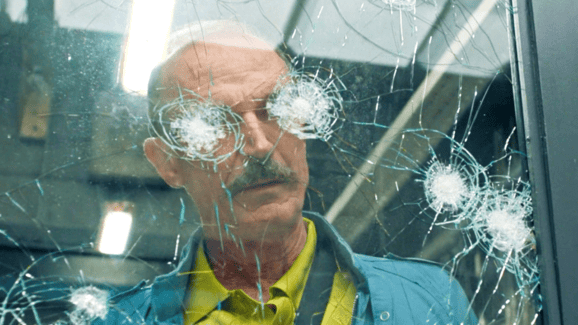
Gerard Butler's R-Rated Action Thriller On Netflix Is A Brutal Lockdown Showdown
By Robert Scucci
| Published

Imagine getting yourself into so much trouble that you decide the best thing to do for your personal safety is to stage a fight with a cop so they arrest you. This solution, as seen in 2021’s Copshop, may seem simple enough because there’s no safer place than a holding cell hidden behind a bulletproof door. The problem is that one of the men who has a bounty on you knows exactly where you’re hiding, so he stages a drunk driving accident with the intention of getting booked and transported to the cell across from the one you’re currently hiding out in until things blow over.
Even worse, there’s yet another psychopath who’s after both of you and has absolutely no qualms about mowing down an entire police station with machine guns for the love of the game. He’s also friendly with a couple of corrupt officers on the inside, meaning you’re all pretty much dead meat because the only person on duty at this late hour is a rookie cop who’s not incompetent by any stretch of the imagination, but severely outnumbered.

Here’s the thing about Copshop, as well as a bunch of other neo noir crime thrillers that fall in this wheelhouse. They’re billed as action films, mystery films, and suspense films, but they’re never called comedies despite the fact that they’re way more fun than they have any right to be. Watching Copshop is such a treat because it plays things straight, while also maintaining a wicked sense of humor that keeps the entire experience infinitely rewatchable.
Location, Location, Location
Copshop first introduces us to a fixer on the run named Teddy Murretto (Frank Grillo). Teddy takes on a job that gets him in trouble with some very dangerous people in high places, resulting in his desperate attempt to lay low until things blow over. His plan is simple. Punch rookie cop Val Young (Alexis Louder) in the face in front of witnesses so he gets dragged to the precinct and processed. He does exactly that and thinks he’s safe for a while, but matters get complicated when one of the hitmen hired to ice him, Bob Viddick (Gerard Butler), catches wise to this plan and tracks him down.

Bob Viddick intentionally gets himself arrested by pretending to drive drunk and crashing into a routine traffic stop in the area, knowing he’ll be brought to the same jail. Unaware of the larger scheme at play, Val throws the hitman into the holding cell across from Teddy, and the two immediately start exchanging threatening words once they’re left alone.
Meanwhile, Officer Huber (Ryan O’Nan) starts snooping around the evidence locker because he’s been skimming drugs from inventory, which has rightfully made Sergeant Duane Mitchell (Chad Coleman) suspicious of his extracurricular activities.

To make matters infinitely worse, there’s yet another dangerous man named Tony Lamb (Toby Huss) who knows exactly where both Murretto and Viddick are located, and he just so happens to be working with Officer Huber. Tony Lamb is a picture-perfect psychopath who laughs his way through the precinct while pumping the place full of lead. A rival hitman to Viddick, the only thing Lamb cares about is stealing the job out from under him and cashing in on the bounty. As chaos unfolds inside the police station, Val realizes she’s alone in her attempts to neutralize the situation and will have to take matters into her own hands.
Absolute Bedlam Behind Bulletproof Glass
The story told in Copshop is a fairly simple one, but it’s executed flawlessly. The dynamic between a rookie cop with a home team advantage and the people who have infiltrated her station to play their war games makes for some supremely tense moments once everybody’s motives become clear. Val, who clearly has combat experience despite being relatively new to the force, isn’t a damsel in distress, but she’s undeniably outnumbered.

Tony Lamb unloads ammo on anybody who crosses his path, seemingly on impulse, and you can tell he’s the scariest guy in the room based entirely on how much fun he’s having. Viddick and Murretto are a bit more complicated because they’re both trying to win Val’s trust in order to gain the upper hand. The problem for them is that they got themselves arrested under false pretenses, meaning they’re professional liars by default.
Good, Violent Fun
Copshop, while not necessarily offering anything new to this locked down brand of neo noir crime thrillers, succeeds because everybody brings their A game. There’s always humor behind the menace, especially from Toby Huss, who’s having just a little too much fun portraying Tony Lamb with sadistic glee. The entire premise is a spectacle because there’s no better place to stage a shootout than a building with a literal armory on site, and Copshop takes full advantage of its setting.


Part of the fun of watching Copshop comes from knowing that every single antagonist is a terrible person. Val is forced to decide which of these men she can work with if she wants to make it out of the station alive, and the unfortunate reality is that she probably shouldn’t trust any of them. If you find yourself wondering how this is all going to play out and could use a bit of levity to carry you through an otherwise tense, action-packed thriller, you can stream Copshop on Netflix as of this writing.
Entertainment
What I Won’t Tell My Friend About Dementia


“My dad got diagnosed on Tuesday, and I’m scared.” My friend’s text comes in the middle of the night.
I sit on the toilet at 3 a.m., considering how to welcome her to the most awful club.
My own mother was diagnosed with dementia a few weeks into COVID, shortly after my husband and I had asked her and my dad to move nearby and help with the kids, drowning as we were in online kindergarten. My mom had been a little “off” for years, and then forgetful, then increasingly paranoid. But she’d always been in love with the grandkids and our family. It was both a devastating surprise of a diagnosis, and not.
Now, years into this experience, the texts come regularly when friends’ parents are diagnosed. Every time I pause. What can I say that will help? What can I share of my experience that isn’t just the pain, the pain, the pain? There are so many things I want to tell her, and so many that I feel I can’t.
I lie awake feeling the chasm between myself now and myself the moment of my mom’s diagnosis, trying to find rocks to stand on in this river — something solid I can share with my friend, something that might steady her as the current pulls.
I’ll tell her what came before the diagnosis, because I know my friend’s loss has already started. The months or years before a diagnosis are their own kind of hell, not knowing what is happening. Questioning one’s own mother — wondering if she’s aging or sick or just being difficult — is a loss of its own, even before doctors are involved.
I’ll tell her about my mom showing up when my daughter was born, paranoid that our house had bed bugs despite no evidence, no bites. I took my newborn to the library when she was two days old so my husband and dad could inspect everything. I felt angry, abandoned, confused — I’d just given birth, but she was the one acting crazy. Now I know she wasn’t crazy, she was sick.
I’ll tell my friend that I hope now she is less lonely. My mom’s diagnosis at least gave a name to the pain I had been feeling of losing someone I loved, and it allowed me to talk about it more openly with friends. While there was so much grief in her diagnosis, there was also a clearer way to understand what my family had been moving through.
Along with the diagnosis came endless, impossible decisions. We spent a long time terrified of moving my mom into a care facility. She was the matriarch of our family, deeply in love with my dad and her garden, and it felt dehumanizing to take her away from what she knew. But she was wandering alone into the snow, waking up in the middle of the night to unplug every single appliance in the house, convinced the computer was going to catch fire. My dad wasn’t sleeping. My siblings and I became just as worried about his health as our mom’s.
There was a precise pain I felt the last time my mom was in my house — knowing it would be the last time, knowing she didn’t know that. She was joyful. We’d had Christmas with all the grandkids, and she and my dad had worn train conductor hats as the kids collected hot chocolate from them, Polar Express style. But she was also having bizarre mood swings and flashes of anger — at one point she tried to put out the fire with a large butcher knife.
The move to a care facility was clearly the right call. The experience reminded me of my kids starting daycare. It felt like a HUGE deal beforehand, then once she was there it was clear she was so happy. I slept better knowing my dad could rest and my mom was chatting with her new friend Martha over puzzles, and happy singing in the afternoon sessions. I fell in love with the people who cared for her, just as I had with my kids’ daycare teachers.
I’ll also tell my friend some small things that helped. When my mom had first shown signs of dementia, we encouraged her to complete a StoryWorth book. We now read her stories to her, and they calm her. My daughter reads them in her own bed every night. Sometimes that makes me cry. When she was still home and starting to wander, we put an AirTag in her shoe. We try to take care of the staff of her facility with the same care they give her — stocking the staff lounge with snacks, writing thank you cards, offering genuine gratitude.
Lying in bed in the middle of the night, I hold onto these practical steps like a life raft, because the emotional truth is harder. I’ll tell my friend that nothing anyone says will feel good. Things I hear regularly — “this has been so hard for so long” and “it’s happening so fast” — make me want to throw things even though (or, really, because) they are true.
But I’ll tell her what did help: friends who showed up without words. Junk food waiting at my parents’ house before a tough visit. Fancy shower products after I mentioned crying in the shower. Their presence in the hardest moments made me feel less alone.
Mostly, when I talk to my friend, I will tell her I am so sorry.
But I will not tell her everything. I will not tell her what’s coming, because if I had known how painful this was going to be, I would have welcomed the bed bugs, the fire, the knife.
I will not tell her about emergency calls to my therapist; the reports we get from my father’s daily visits; my mom currently being on her thirteenth month of hospice. I will not tell her I now understand the word agony.
Instead, I might tell her this: My mom was a woman who loved to help. A theater director and school librarian, she loved nothing more than telling people what to do. In some ways, helping friends now feels like honoring her — trying to make sense and meaning of her story.
When I’m talking to my friend, I also know I will have the exact same feeling that I still have when sitting by my mom’s bedside — there is so much more to say, so much left unsaid. I will want to say to my friend, as I want to say to my mom, she is doing great. The love won’t go away, it never could. Everything else may go, but as the current pulls us both forward, I can tell her this: the love remains.
And of course, I will tell my friend the one thing I cannot truthfully tell my mom, as much as I want to — she will survive this. She will. Most days, I remember I will too.
Kathleen Donahoe is a writer and poet living in Seattle. She has previously written for Cup of Jo about how she stopped drinking. She is writing her first novel and warmly invites you to follow her free Substack newsletter, A Little Laugh.
P.S. Rebecca Handler’s beautiful essay on loving her father through his final years of Alzheimer’s, and a parenting realization that really moved me.
(Photo by Darina Belonogova/Stocksy.)
Entertainment
Big Salad’s Birthday Sale!

This week only, we’re offering 20% off annual subscriptions to Big Salad, our weekly newsletter (and the #1 fashion/beauty publication on Substack). For $4/month, you will get every issue for a year — packed with fun finds, life realizations, and essays on sex, dating, love, marriage, divorce, parenting, and friendship — plus access to our deep archives.
Last Friday, I wrote about a dating realization I had that changed everything (gift link, free for all). The comments were truly incredible, and I felt really moved by the ability to share relationship (and life) highs and lows with women who really get it. We really are all in this together.
Here are a few more issues you may enjoy…
On sex, dating, relationships, and friendship:
The genius advice my therapist gave me when my marriage ended.
What it felt like to have sex for the first time post-divorce.
How do you know if it’s time to get divorced?
Four ways I’ve learned to deepen friendships.
The book that profoundly changed my friend’s sex life.
Reader question: “I want to talk dirty in bed, but I’m nervous.”
Nine habits that are making my 40s my favorite decade.
On fashion and beauty:
How to style a shirt like a Copenhagen girl.
7 things we spotted people wearing in Paris (plus, two magic Paris itineraries).
13 beauty products we always finish.
Do I get botox or filler? Readers asked, and I answered. 🙂
At age 46, I finally figured out my hair.
Gemma’s #1 drugstore beauty find.
Our 13 favorite swimsuits.
And, most of all, amazing life insights from women we love:
Ashley C. Ford on why poverty makes it hard to figure out what you like.
Anne Helen Petersen’s book-filled island cottage.
Three people share how they changed their careers. Then, three more women share!
Brooke Barker’s great conversation starter.
Hunter Harris tells us what movies and shows to watch right now.
Abbey Nova’s jaw-dropping garden makeover.
Natasha Pickowicz wants you to throw yourself a party.
My sister’s parenting hack that I can’t stop thinking about.
Alison Piepmeyer’s amazing wallpaper before-and-after photos.
15 incredible books to read.
Nine ways Kate Baer is coming out to play in her 40s.

Here’s the discount link for 20% off annual subscriptions, and here’s the Big Salad homepage, if you’d like to check it out. We would love to have you, and thank you so much for your support and readership. Joannaxo
P.S. We also offer 50 comped subscriptions per month for those who’d like to read Big Salad but aren’t in a place to pay for it at the moment. Just email newsletter@cupofjo.com to get on the list. Thank you!
Entertainment
The Apple MacBook Air M4 is close to $150 off right now at Amazon — act fast to score this low price
SAVE OVER $100: As of Feb. 10, the Apple MacBook Air M4 is on sale for $849.99 at Amazon. This 15% discount saves you $149.01 off its list price of $999.
$849.99
at Amazon
$999
Save $149.01
Amazon has knocked nearly $150 off the price of the Apple MacBook Air M4. If you’ve been hoping to upgrade your laptop for the year ahead, this is a great time to scoop up this popular model at a cheaper price.
The 2025 13-inch MacBook Air usually comes with a price tag of $999, but it’s currently available for $849.99. In total, this saves you $149.01 off its list price. If you’re in the Apple ecosystem already, it’s a laptop that’s certainly worth picking up on sale.
Mashable Deals
We consider the 2025 13-inch MacBook Air to be the best MacBook for students, thanks to “its greater portability and even cheaper price,” but it’s an option for everyone. Whether you’re using it for work or personal use, the M4 chip offers up speedy and smooth processing power, and with up to 18 hours of battery life, it’ll keep you going throughout the day.
Its Liquid Retina display offers up crisp, colorful visuals. This particular model comes with 16GB of Unified Memory and a 256GB SSD.
Mashable Deals
Don’t miss this excellent deal on the Apple MacBook Air M4 at Amazon.

Ben Ogden (silver) wins 1st US men's cross-country skiing medal in 50 years in sprint
Union sign F Agustin Anello on permanent transfer


