
Entertainment
Event Horizon Ties Into Another Sci-Fi Universe Nobody Expected

By Jonathan Klotz
| Published
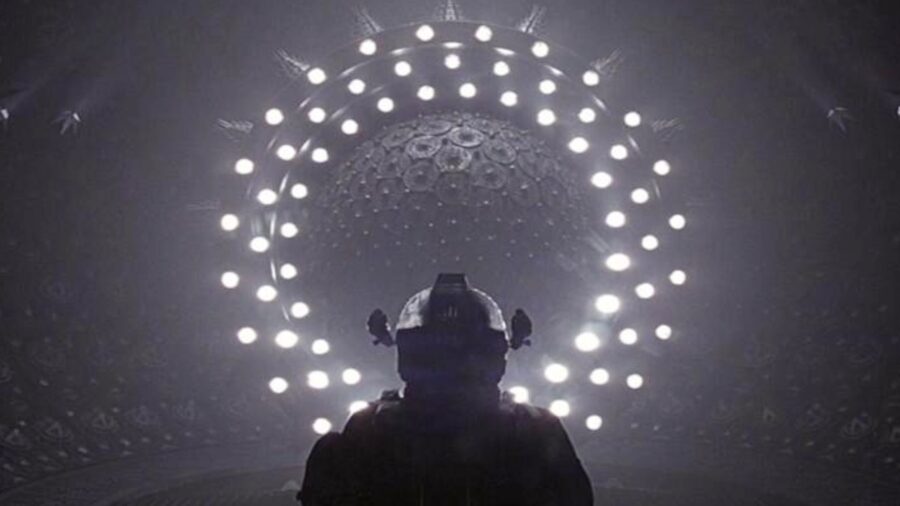
Fan theories can range from the plausible and very likely, such as the “Pixar connected universe,” or “Elsa and Anna’s brother is Tarzan,” to the unbelievable, “Snowpiercer’s Wilford is Wily Wonka,” or “Jar Jar Binks is a Sith,” but there’s one that’s so perfect, it has to be true: Event Horizon is set in the Warhammer 40k universe.
This theory makes sense from the very beginning, when the titular spaceship activates its gravity engine and travels through a nightmarish dimension that’s full of demons and cosmic horrors. That’s exactly how ships travel in the world of Warhammer 40k, and it’s only the start of the connections.
Event Horizon Traveled Through The Warp
Event Horizon takes place after the ship mysteriously reappears after it was missing for years, with the entire crew dead, and as the Captain’s log reveals, it was the crew themselves that turned violent and killed each other. The Captain, having ripped out his own eyeballs, issues a warning, in Latin of course, to “Save yourself from Hell.” It’s a gruesome, bloody sequence filled with rapid flashes of violence that make it hard to focus, and the first time seeing the film, it’s hard to comprehend what you’re even seeing.
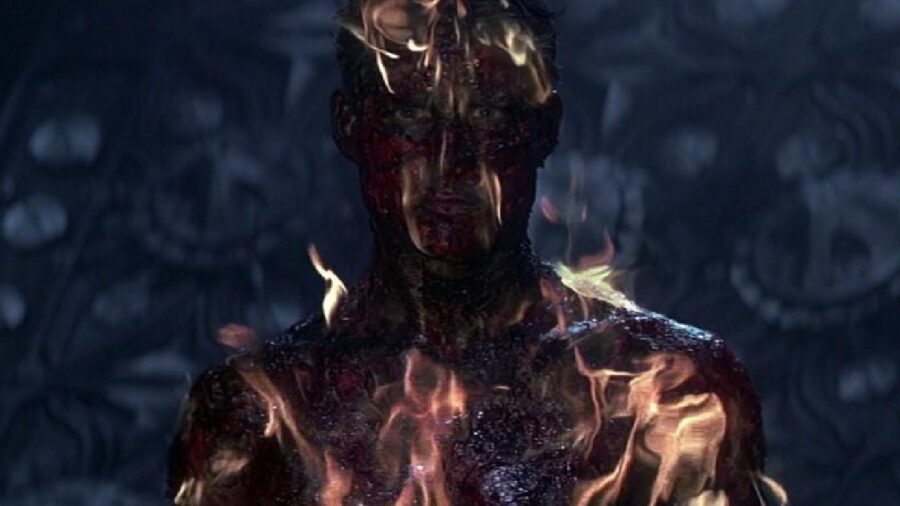
The rescue crew ends up giving into the spreading madness themselves, or rather, Dr. Weir (Sam Neill, the perfect star for a film about cosmic horror), the designer of the Event Horizon, goes mad and has to be put down by the rescue ship’s Captain Miller (Laurence Fishburne). And he is, but after he’s sucked into space, Weir comes back having embraced the strange and bizarre Hell-like dimension, and he taunts Miller by showing him visions from the Hell dimension. It’s a dark and disturbing moment, but it’s also an amazing live-scene depiction of Warhammer 40ks The Warp, a strange dimension in which time and space have no meaning, that happens to be filled with Daemons and, in Games Workshop’s universe, is used by humanity as an intergalactic superhighway.
The Influence Of Chaos
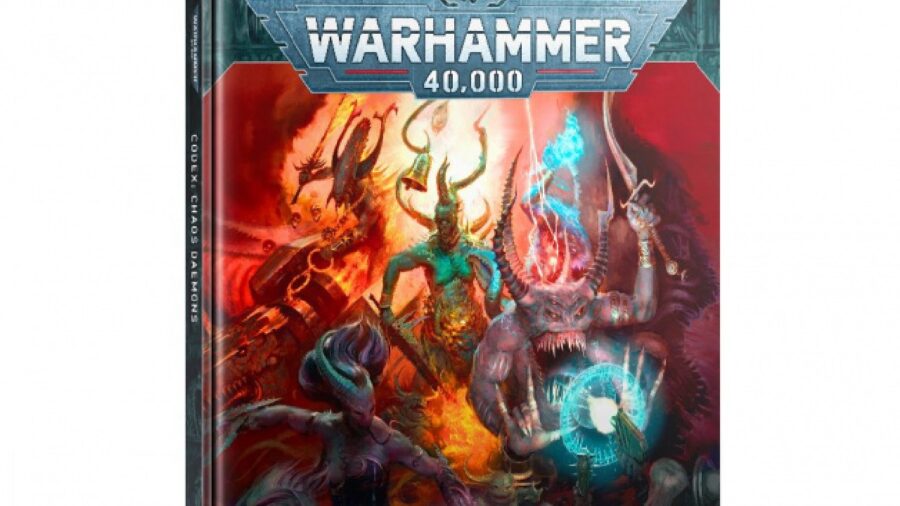
The Warp is a dangerous dimension that exists outside of four-dimensional space, but it’s also able to be navigated by psychic humans called Navigators who use the Astronomican, a massive psychic beacon waypoint that you think of as a transdimensional lighthouse, to remain safe while traveling through. In Event Horizon, set in the year 2048, it’s the experimental gravity engine that pulls the ship out of our reality and into The Warp, making it humanity’s first experience with Chaos Deamons and the horrors that lurk outside our universe. Those dangers include the Chaos Gods, Tzeentch, Khorne, Nurgle, and Slaanesh, and amazingly, Paul W.S. Anderson’s sci-fi horror even implies the influence of these beings on the ship’s original crew.
While the rescue crew from the Lewis and Clark is watching the original Captain’s video, it’s clear that the crew is killing each other (that would be Khorne, the Blood God, encouraging slaughter and destruction), but at the same time, it’s clear that Slaanesh, the Prince of Pleasure, is involved since some of the crew to be “enjoying” themselves. The other two, Tzeentch and Nurgle, may be sitting this one out, but Event Horizon includes one other story beat that touches on the technology of Warhammer 40k. Weir implies during the back half of the film that the ship itself has become possessed by a Deamonic spirit, and of course, that’s a huge part of the Warhammer 40k setting where humanity believes machine spirits power all machines. ]
The Machine Spirits
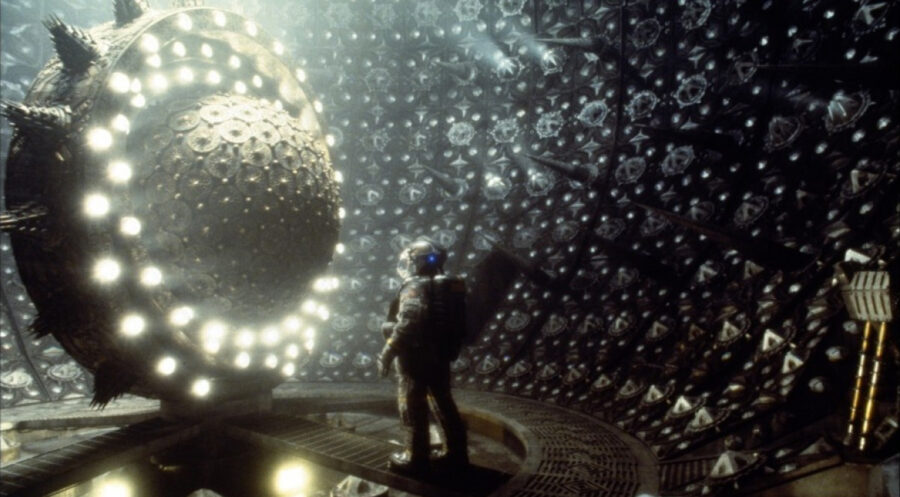
In the grim darkness of the far future in Warhammer 40k, technology is incredibly advanced but also oddly primitive, with Tech Priests rubbing ointments and saying prayers over military vehicles before they go to war to embolden the machine spirits within. The denizens of The Warp are able to possess technology and infect with their own Daemonic spirits, giving players the option to use twisted versions of the Imperium of Man’s own weapons against them. If that sounds like exactly what happens to the ship in Event Horizon, well, that’s another reason why this is secretly a Warhammer 40k film.
The Event Horizon fan theory may not even be a fan theory, and is instead confirmed thanks to screenwriter Philip Eisner commenting on Twitter in 207 that “I played the sh*t out of 40K, so it was definitely an influence, conscious or otherwise.” Writers who went on to work at Games Workshop to help shape the universe returned the favor, with an attempt to name-drop the ship in one of the game’s official codexes, but the U.K.-based company stopped it from seeing print. Still, it’s a comment straight from the twisted mind behind the film that the classic tabletop miniatures game’s gothic setting had an impact on the film.
Event Horizon Is A Gateway To Warhammer 40k
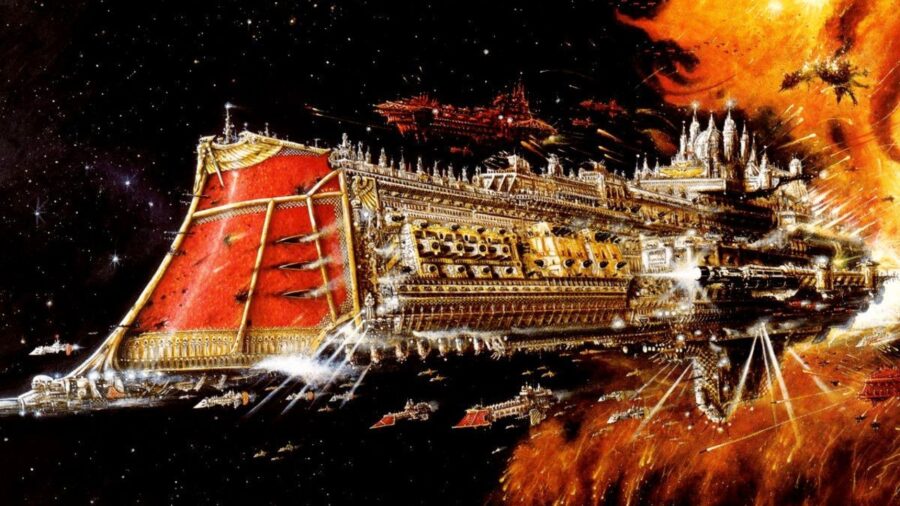
When Henry Cavill and Amazon bring Warhammer 40k to life, it won’t look like Event Horizon, but there’s no doubt that, intentionally or not, the 1997 sci-fi horror is the perfect companion piece to the grimdark future franchise. If you enjoy the movie, there are multiple Black Library novels out there that you should check out, starting with Xenos by Dan Abnett, the first of the Eisenhorn novels, which isn’t nearly as bloody and gruesome as the movie, but it nails the dark, ominous feeling of something being very, very wrong that first half of the movie does so well.
The Event Horizon/Warhammer 40k fan theory has existed since the film first hit theaters, over a decade after Games Workshop released Rogue Trader, the first game set in the world of 40k. It’s been an enduring fan theory because it honors both the film and the gaming franchise, and it doesn’t demand either one of them, and simply says, “Hey, this would be really cool.” The best fan theories are just that, they’re fun, but this time around, the Sam Neill horror film is also a perfect introduction to how crazy the Warhammer 40k setting can get, and given the cost of running a well-painted 3,000-point competitive army, that might be the most horrifying part of the movie.
Entertainment
How I scored ad-free Paramount+ Premium for only 99 cents
SAVE $26: As of April 22, returning subscribers can score two months of ad-free Paramount+ Premium for only 99 cents per month with the code N8C27L. Usually $13.99 per month, that’s $26 in savings. Just note that your mileage may vary.
$0.99/month for 2 months (save $13/month) with code N8C27L
If you’re looking to save some money on your streaming lineup, my number one recommendation is to cancel your subscriptions. While it doesn’t work for every streamer, many will offer you a special discount to come back. Not to mention, you’ll be eligible for any new deals that may appear that are marketed to “new and returning customers.” Case in point: as of April 22, returning subscribers can get two months of ad-free Paramount+ Premium for just 99 cents per month.
I’ve tested this out myself, so I can vouch for it. When you navigate to Paramount+ and sign in to your existing account, you’ll be prompted to pick a plan. Select the Paramount+ Premium monthly plan for $13.99 per month. On the “Welcome back!” page, scroll down to the box that says “Have a promo code?” and enter N8C27L. Once you hit “apply” the price should drop to just 99 cents per month.

Credit: Paramount+
That’s all, folks. You can take advantage of two full months of ad-free Paramount+, Showtime, BET, CBS, Comedy Central, MTV, Nickelodeon, CBS live TV, UFC fights, and more for less than two bucks. That’s $26 total in savings.
Mashable Deals
Paramount+ has a surprisingly hefty library. Subscribers can enjoy Paramount+ Originals like Landman and RuPaul Drag Race All Stars, Showtime series like Dexter Resurrection and Yellowjackets, CBS hits like Survivor and NCIS, and nostalgic shows from Nickelodeon and MTV. Not to mention, there’s a lineup of movies that’ll keep you fully entertained for your two-month promotional period. Just be sure to cancel again before the second month is over if you want to avoid paying full cost. You can always sign up again when another deal arises. I know I will.
Entertainment
How Stargate SG-1 Used A Classic Trope To Emotionally Wreck Its Fans
By Jonathan Klotz
| Published

Garfield and Friends said it best: “Oh no, we’ve resorted to an evil twin storyline.” Star Trek: The Original Series did it the best with Mirror Universe Spock, and ever since, it’s been a lazy excuse for every series to use when they run out of ideas. The exception is Stargate SG-1’s sixth episode, “Cold Lazarus,” which plays with the trope by making the twin less evil and more confused.
When fans say they skip this episode when rewatching, it’s not because it’s a lazy, poorly written episode. In fact, it’s the opposite. The ending of “Cold Lazarus” is a pivotal character moment for Jack O’Neill (Richard Dean Anderson) and a gut punch to the audience.
Stargate SG-1’s First Evil Twin

“Cold Lazarus” opens with the SG-1 team on a planet that doesn’t look like Vancouver (it was a giant pile of sulfur at the port of Vancouver). The desert landscape is dotted with shattered blue crystals that look like the remnants of a civilization until we see a crystal eye-view of O’Neill, a mysterious light knocks him out, and all of a sudden, a second O’Neill is looking down at the first. Turns out, the crystals are the civilization.
Fake O’Neill is trying to figure out who O’Neill is and what SGC is all about. When he pulls out photos of his family, it takes Samantha Carter (Amanda Tapping) by surprise. O’Neill’s never mentioned his wife, Sara, or his son, Charlie. Confused, the Fake O’Neill goes to the home, where Sara is disgusted he’d come by and thinks it’s a sick joke that he’s asking about Charlie. If you’re wondering if you missed a key part of O’Neill’s backstory, don’t worry, this is the first time that either Sara or Charlie is mentioned, and tragically, we soon learn why.
No One Ever Dies

Charlie shot himself with O’Neill’s gun. Fake O’Neill starts to piece this together when he goes into Charlie’s old room and breaks down, prompting Sara and him to finally have the conversation about their shared grief. Back in SGC, the crystal’s nature is revealed to be an energy alien calling itself Unity, which accidentally killed a Jaffa, and the Goa’uld shattered them in retribution. That’s when O’Neill stumbles back through the Stargate, and the team realizes the mistake they made.
The Fake O’Neill is soon captured at a local hospital, suffering from Earth’s radiation, where he explains that he sensed O’Neill’s pain after he took his form and wanted to help ease the suffering, as nothing ever truly dies to Unity. To prove its point, Unity transforms into Charlie, giving O’Neill and Sara one last chance to see their child. Fans who haven’t lost a child can understand the emotion, but for fans who have, this scene is emotional torture, in the best way possible.

Jack knows this isn’t Charlie, but he talks to him like he is, and then they walk together through the Stargate back to Unity’s planet. It’s a beautiful moment that explains so much about O’Neill’s throwing himself into work and how even his friendships remain professional. “Cold Lazarus” may have started out with the “evil twin” trope in full effect, but the ending is proof that even early during its run, Stargate SG-1 was going to be the greatest.
Entertainment
Star Trek’s Scariest Episode Secretly Answered Fans’ Oldest Complaint
By Chris Snellgrove
| Published

Star Trek is a long-running franchise filled with tropes, some of them more annoying than others. For many fans, the dumbest trope that keeps popping up is when there’s only one ship that can save Earth from one catastrophe or another. It always begs the question: why isn’t the seat of the United Federation of Planets better protected? It certainly feels like such an important planet would have its own fleet for protection rather than relying on a long-range vessel like the Enterprise to warp in and save the day.
However, it seems that Star Trek’s scariest episode might have secretly answered fans’ oldest complaint about the franchise. Over on Reddit, user u/Wallname_Liability presented a compelling theory: that in the Star Trek: The Next Generation two-parter “The Best of Both Worlds,” the collection of Starfleet vessels lost fighting the Borg at Wolf 359 was the home fleet. This theory would help explain that Earth was typically better-defended than we might imagine and why there were fewer ships to protect the planet in later movies and shows.
My Borg Friend’s Back (And There’s Gonna Be Trouble)

In Star Trek: The Next Generation, most of the adventures take place in deep space because the intrepid crew has an ongoing mission to explore strange new worlds, seek out new life and new civilizations, and (come on, you know you’re already saying it out loud) boldly go where no one has gone before. But in “The Best of Both Worlds,” a Borg Cube starts heading directly for Earth. The Enterprise crew tries to develop a weapon that can defeat this implacable foe, one who seems nearly unstoppable after they assimilate Captain Picard. Meanwhile, a fleet of Starfleet ships assembles at Wolf 359 for one last stand against the Borg.
Unfortunately, that entire fleet is wiped out. The Borg makes it to Earth, but the Enterprise manages to stop these bionic baddies after rescuing Captain Picard. Data exploits Picard’s connection to the Collective and puts the cube to “sleep,” and it explodes soon after that. Picard and his crew get a mostly happy ending, but the same can’t be said for the crew of the ships that fought at Wolf 359. All vessels were lost, and only a handful of people survived, including Benjamin Sisko and Liam Shaw.
Resistance Was Futile

According to this Redditor’s theory, the fleet that assembled at Wolf 359 was the home fleet assigned to (among other things) protect Earth. Some of the ships were likely already at Earth (possibly undergoing repairs or retrofits), and others might have been located near some of humanity’s older colonies. But everyone would have had to have been close enough to Earth to quickly warp to Wolf 359, a real star system that is only eight light-years from humanity’s home planet.
Why is the idea that this was the home fleet so important? In various Star Trek episodes and films, there has often only been one ship (usually the Enterprise) close enough to save Earth. In Star Trek: Generations, for example, the Enterprise-B is on a shakedown cruise, but it’s the only ship close enough to save the El-Aurian refugees from the threat of the Nexus. In Star Trek: The Motion Picture, only the Enterprise can intercept V’ger. In Nemesis, the Enterprise is the only Starfleet ship capable of preventing Shinzon from killing everyone on Earth, and so on.
The Best Of Trope Worlds

This trope can get frustrating when you start comparing Starfleet to, say, the United States Navy. How insane would it be if the whole country had to keep relying on a single ship to save us from major existential threats? Star Trek asks us to repeatedly believe that there’s only one ship within spitting distance of the entire solar system that can take care of the crisis du jour. It’s completely unbelievable, but this Wolf 359 home fleet theory helps make these frustrating moments make more sense.
It’s entirely possible that, in the time of Star Trek: The Original Series and its spinoff movies, there wasn’t a home fleet. Starfleet was a lot smaller back then. Remember, the original Enterprise was one of only 12 Constitution-class vessels. However, both The Motion Picture and The Voyage Home had Earth being attacked by seemingly unstoppable alien forces. In each case, the only man who could stop things was James T. Kirk, but Starfleet must have known he wouldn’t be around forever. Therefore, sometime before The Next Generation premiered, they developed a home fleet that could protect the Earth from overpowered alien attackers.
The Worst Massacre In Starfleet History

Or so they thought. The Borg wiped the floor with the fleet at Wolf 359, which helps to explain why the admiralty needed to assemble an ersatz fleet in First Contact. They were still rebuilding from earlier losses, and most spare vessels were probably being ordered to areas of interest as the Dominion War loomed near. Speaking of which, that war is the most likely reason that the Enterprise was the only ship that could help in Nemesis. The movie took place four years after the Dominion War ended, and once more, Starfleet would have needed time to fully rebuild its fleet.
Obviously, these are only theories, but they are compelling ones. It makes sense that Starfleet would have learned its lessons from V’ger and the Alien Probe and developed a home fleet, only for it to be destroyed by the Borg at Wolf 359. Afterward, the next big Borg attack and the Dominion War destroyed many vessels, all while requiring the existing fleet to stretch that much thinner. Fortunately, Earth was in good hands. No matter how bad the war with the Dominion got, Captain Sisko and Admiral Ross ensured that there was always a fleet or two close enough to protect paradise, even from those pesky Breen.

MLB roundup: Cubs score 7, win 7th straight as Phils' skid hits 7
Cardinals, in decisive game vs. Marlins, chase 3rd straight series win


