
Entertainment
Buffy’s Most Heartbreaking Plot Twist Was Inspired By History's Darkest Devil Story

By Chris Snellgrove
| Published

In Buffy the Vampire Slayer, Angel is a character stricken by a very specific curse: as a vampire, one of his victims’ families gives him his soul back, forcing him to constantly experience the crushing guilt of everyone he has ever hurt or killed. To make things worse, there was a catch to this curse that served to twist the knife in Angel’s heart. Specifically, if he ever experiences a moment of true happiness, he would lose his soul and once again become Angelus, one of the scariest vampires the planet had ever known.
All of this makes Angel (played by David Boreanaz) one of the most complex and fascinating characters in television history, and many Buffy fans have wondered where showrunner Joss Whedon got the idea for this gut-wrenching curse. But you don’t have to look far to discover the answer: as it turns out, Whedon drew inspiration from one of the most famous stories in all of literature. You see, Angel’s curse is very similar to what we see in the tale of Faust, better known as the original “deal with the devil” story.
What A Terrible Night For A Curse

If your memories of English class are a little fuzzy, here’s a quick primer: Faust was originally a German legend about a man who, despite his success, simply wanted more out of life. In order to get it, he made a deal with the devil in which he would get all of the worldly knowledge and pleasures that he could ever want. But after a life of experiencing what amounted to Heaven on Earth, his soul would go straight to Hell once he died.
Multiple authors have adapted this German folktale, and the most famous was created by Johann Wolfgang von Goethe. He added his own twists to Faust’s pact with the devil, including Faust making a very special wager: he will become a servant in Hell only if the Devil can provide him with a moment of true happiness that he would want to last forever. This unexpectedly happens when Faust begins dreaming of people working together to make the world a better place; this moment of happiness damns his soul, but he is effectively saved by God, who rewards Faust with salvation because of his righteous dream of human harmony.
The Most Tortured Vampire In History

Needless to say, there is plenty of parallelism between what happens to Goethe’s Faust and what happens to Angel in Buffy the Vampire Slayer. Once his soul is restored, Angel does his best to atone for all the terrible acts that he committed as a vampire. But once he experiences a moment of true happiness (which happened, awkwardly enough, during sex with Buffy), he loses his soul, becoming once more a terrible monster who damns himself with each transgressive act.
Arguably, Angel is also the beneficiary of the same divine grace that saved Faust: after losing his soul and becoming Angelus, he enacts a plan meant to plunge the entire world into Hell. Buffy stops him, but only after Willow successfully restores his soul. This leads to the most heartbreaking moment in the entire series, in which Buffy has to kill the only man she has ever loved, sending him to a hell dimension in order to save every human on the planet.
Saved By The Spell

He is inexplicably resurrected in Season 3, and there is never an official explanation given for who or what brings him back from Hell. But one very prominent fan theory is that he was brought back by The Powers That Be, the same mysterious group of cosmic powerhouses who ensured Angel met Buffy. Later, they gave prophetic visions to Doyle, the demon who helped Angel become a champion of the helpless once he moved to Los Angeles.
Angel was originally condemned to Hell thanks to a very Faustian curse, and he may have been saved in the same way: by divine powers that rewarded his dream of making the world a better place. Either way, it’s clear that the tale of the most iconic vampire in Buffy the Vampire Slayer was influenced by the original deal with the devil story, one that has been influencing storytellers for centuries. Even though most fans never clocked it, this means that the hottest TV show of the ‘90s is forever connected to a German folktale that became popular nearly 500 years ago!
Entertainment
Creative Assembly drops first look at the Alien: Isolation sequel

Twelve years after the original Alien: Isolation game was released across platforms, on the official “Alien Day” meant to celebrate the beloved franchise, game developers Creative Assembly are returning to the world of xenomorphs and unreliable robots to once again terrify the living daylights out of us.
The teaser trailer, aptly titled “False Sense of Security,” does a lot with very little, from the flashing red light in a poorly lit room to the ominous background music and eventual close-up of what looks to be a payphone, with the word “Emergency” appropriately backlit.
As you might expect from the makers of the original game, Creative Assembly is clearly reluctant to over-share, relying on atmosphere and sound to do the heavy lifting, but the brief glimpse we get of the background when the door opens suggests the possibility that, unlike the first game, the sequel might also take place on a planet’s surface, perhaps hinting at a much larger game world.
Needless to say, we’ll be covering more details about the game’s development and progress as they emerge.
Entertainment
YouTube is prompting users to enable watch history. Heres the workaround.
Before AI became the defining buzzword of the 21st century, algorithms held that crown. And frankly, algorithmic recommendations have always kind of sucked. YouTube, in particular, has long been criticized for serving up low-quality content — and more troublingly, for functioning as a gateway to right-wing rabbit holes.
The best workaround has always been simple: pause your YouTube watch history. Without it running, your recommendations pull from your likes, saved videos, and subscriptions — not from that one iceberg video you clicked at 2 a.m. that suddenly has the algorithm convinced you want an endless stream of “SJW owned” compilations.
That fix, however, appears to be breaking down. Last week, a wave of YouTube users reported that with watch history paused, the platform has stopped serving homepage recommendations entirely — replacing their feeds with a prompt to re-enable watch history so YouTube can “populate” it.

Credit: Mashable screenshot / YouTube
The issue isn’t universal. Users who recently paused their history still see recommendations, likely because YouTube has enough residual data to work with. The problem is hitting hardest for users who have kept watch history off for years — a group that, until now, had no issues. For the record, this writer has had watch history paused since 2017 without a single problem — until now, apparently.
Mashable Light Speed
This change hasn’t gone down well, with many taking to Reddit to voice their complaints. “I’ve had my watch history off since 2013. Why is this suddenly a requirement? Maliciously incompetent company,” says the top comment on one Reddit thread. Another commentor states, “Haven’t had watch history on for 9 years. Now they’re forcing me to turn it on to get recommended what they recommend me on my PC even though the reason they stated they cant recommend anything is because I don’t have watch history on??? Makes no sense and its almost blatant.”
While this isn’t the first time YouTube has nudged users toward enabling tracking, some see this latest move as a more aggressive push to harvest search histories for ad targeting. There’s also a legitimate question worth asking: why does YouTube suddenly need watch history to generate homepage recommendations when it had been doing exactly that for years without it?
Mashable reached out to YouTube with questions about the change and had not received a response by publication time.
Users have already found a workaround. Re-enable your watch history, refresh the page, then immediately pause it again. Your homepage recommendations should repopulate. To access the page to re-pause, head to Settings, click “View or change your Google Account settings,” navigate to Data & Privacy, and toggle off YouTube history.
Entertainment
Star Wars' Most Hated Plot Hole Actually Makes Perfect Sense
By Chris Snellgrove
| Published

Do you know what happens when Star Wars fans get together? If you said “embarrassing things,” you’re correct, but I meant more specifically. After a few conversations and a few beers (or maybe spiked blue milks), everyone starts dishing on their favorite franchise plot holes. These are supposedly narrative mistakes that make this famous galaxy far, far away feel that much less immersive. Incidentally, the one “plot hole” that comes up most frequently in these discussions is the idea that Order 66 should have killed more Jedi than it actually did.
In the Original Trilogy, we are introduced to the idea that Obi-Wan Kenobi and Yoda are the last Jedi in the galaxy. But the prequels, sequels, and an entire universe of tie-in books, comics, and games have increasingly introduced more Jedi characters that survived Emperor Palpatine’s galactic purge of these laser sword-wielding do-gooders. However, as usual, the fandom is griping for no good reason because, based on the sheer onscreen incompetence of Palpatine and his clones, it’s a miracle that more Jedi didn’t survive this sloppy attempt at mass murder.
The Stupidest Order In The Galaxy

The Star Wars movies A New Hope and The Empire Strikes Back presented Obi-Wan Kenobi and Yoda as the only surviving Jedi. Of course, Kenobi didn’t give too many granular details as to how the Jedi died. All he told young Luke Skywalker in that first movie is that Darth Vader “helped the Empire hunt down and destroy the Jedi Knights.… now, the Jedi are all but extinct.” Nobody really questioned this because we had no idea how many Jedi there were to begin with. Plus, it was easy enough to imagine the most powerful guy in the galaxy using all of a vast, galaxy-spanning Empire’s resources to hunt and kill a bunch of hippie space wizards.
But in Revenge of the Sith, we see how it all went down. Palpatine had a hidden command secretly installed in the brains of all the clones who were fighting side-by-side with the Jedi during the Clone Wars. Once the Emperor commanded them to “Execute Order 66,” all of the clones stopped what they were doing to immediately kill the closest Jedi. In a montage of bleak scenes, we see how sudden surprise blaster fire was enough to kill even Jedi Masters like Ki-Adi Mundi, Plo Koon, and Aayla Secura.
Holo Pursuits
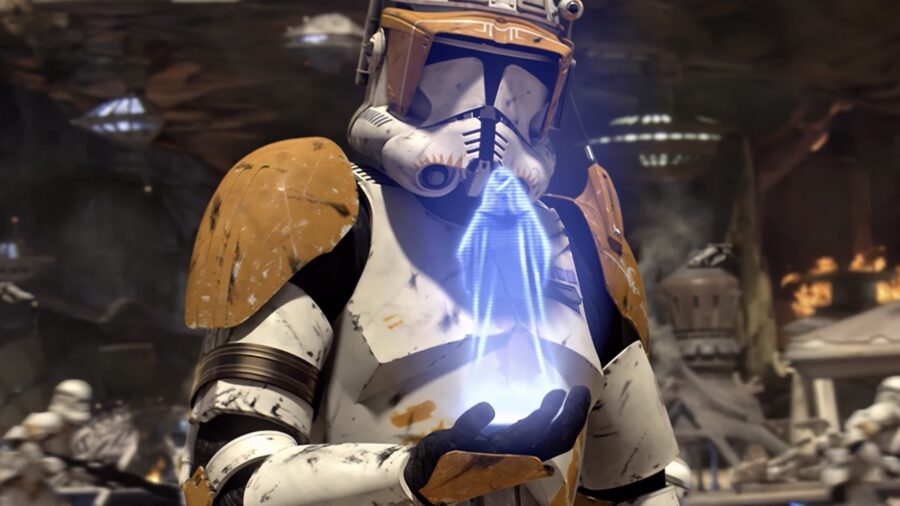
At the time, it made a kind of morbid sense. We had previously seen how Jedi like Qui-Gon Jinn and Obi-Wan Kenobi could deflect a handful of blaster bolts, so it seemed reasonable to believe they couldn’t survive if a small army fired on them all at once. However, some of the clones were downright sloppy with their execution attempts. Because of their methods and the whole design of Palpatine’s harebrained scheme, it was basically inevitable that countless warriors would survive this attempted purge. This would explain why popular Jedi like Kanan Jarrus, Ahsoka Tano, Cal Kestis, and even Grogu survived Order 66.
When you re-watch Revenge of the Sith, notice how sloppy the Clone Troopers are. Cody basically fires one shot at Obi-Wan Kenobi and assumes falling into the water will be enough to kill the guy who can take on entire droid armies by himself. The handful of clones who try to kill Yoda somehow forget that he can sense their intent through the Force. Even some of the successful kills are sloppy. Like, sure, y’all blew Plo Koon out of the sky, but other Jedi flying starships could likely hyperspace to safety (yes, they’d have to get to a hyperspace ring first, you can stop writing that comment).
When The Sith Go Marching In

My theory is simple: assuming other Jedi were in similar situations throughout the galaxy, quite a few Jedi would survive Order 66. If the Clone Troopers tried to fire on other warriors who were very far away (like Obi-Wan), the targeted Jedi would likely escape. If other clones tried to sneak up on Jedi in non-combat situations (like with Yoda), these Force users would sense their intent and kill them out of self-defense. Furthermore, if there aren’t enough Clones around when the order goes through, a Jedi could survive, say, only three or four people trying to shoot him, much like Obi-Wan did when fighting Battle Droids throughout the prequels.
Long story not very short, the Emperor came up with a stupid plan and executed it in the sloppiest possible way. Plus, contrary to what Obi-Wan said in A New Hope, later Star Wars shows make it seem like Vader stopped personally hunting down Jedi and left that task to the Inquisitors. Whenever the Inquisitors fight someone other than a helpless child or scared former Padawan, they get their butts handed to them, as seen in everything from Star Wars Rebels to the Fallen Order and Survivor video games. Because Order 66 was done so poorly, and Palpatine’s brute squad sucked so hard, it’s no wonder so many Jedi survived the purge.

In retrospect, this makes sense, too. Palpatine is infamous among fans for his insane plans, which included playing the commander in chief of two different warring armies so he could land the job of “mutilated president for life.” It’s only because of (let’s face it) bad writing on George Lucas’ part that any of the Emperor’s plans ever succeed. Order 66 was so utterly stupid and handled so poorly that it guaranteed plenty of Jedi survivors. But what else would you expect from someone who spent all his Empire’s credits on a space station that’s so easy to blow up … twice!

Nelly Korda posts another 65, builds major lead at Chevron
Cardinals draft Miami QB Carson Beck to open third round


