
Tech
Bluesky teases 2026 roadmap: A better Discover feed, real-time features, and more
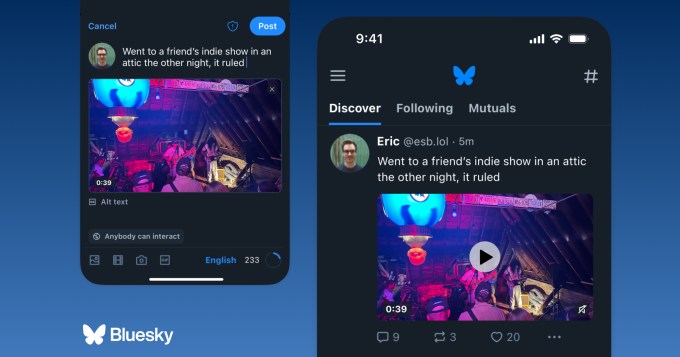
Social network Bluesky is teasing its roadmap for the year ahead, emphasizing a focus on things like improving the app’s algorithmic Discover feed, offering its users better recommendations on who to follow, giving the app more of a real-time feel, and more.
At the same time, the company admitted that it needs to work on getting the “basics” right, too.
Launched to the public in early 2024 after an invite-only period, the decentralized X and Threads alternative has since scaled to over 42 million users, according to data sourced directly from the Bluesky API for developers.
Though it’s differentiated from mainstream social media with its custom feeds and configurable algorithms, Bluesky hasn’t caught up to rivals with regard to basic features, like private accounts, drafts, support for longer videos, and more.
Bluesky’s head of product, Alex Benzer, acknowledged some of these concerns in a new post on the company’s website, where he said that the “basics need to be solid” before Bluesky can expect users to stick around.
Those remarks come after a usage slowdown on Bluesky, which saw a 40% year-over-year drop in daily active users as of October 2025, according to data from market intelligence provider Similarweb, as reported by Forbes.

In addition to supporting drafts, Benzer said the app’s composer should handle media better, noting that three-minute-long videos aren’t enough, and videos should upload faster. Plus, he wants Bluesky to support posting more than four photos at a time, and thinks threads should be easier to create, too.
Techcrunch event
San Francisco
|
October 13-15, 2026
The need for private accounts wasn’t addressed, but those will take longer to realize, Bluesky has previously explained. The plan is for the underlying protocol, the AT Protocol (or AT Proto for short), to eventually support private accounts. But that won’t be coming anytime soon.
Benzer also pointed to improvements to the app’s Discover feed, which could add topic tags as a way to guide people to posts related to their interests. “Who to follow” suggestions will also be improved, as finding high-quality connections can improve the overall user experience.

Benzer believes that Bluesky needs to have more of a “real-time” feel, whether that’s around events like sports, or political moments of interest like elections. The company is building curation tools for its team to make high-quality and timely custom feeds available during live events, he said. The team is exploring other new features within feeds that would make these feeds feel “less like just scrolling through posts and more like hanging out,” Benzer said. (What that means, we’re not exactly sure!)
In terms of growing the overall ecosystem, which the community has dubbed the “Atmosphere,” the company will look to improve interoperability with other apps that are also built on the underlying AT Protocol.
For instance, if you go live on Twitch or Streamplace, another app powered by the AT Protocol, you’ll see a LIVE badge appear on your profile photo on Bluesky.

Benzer said another integration like this is coming “soon.”
While Bluesky has succeeded in adding users, actual usage on Bluesky ebbs and flows, with surges often timed to changes at X or moments of political tension. Meanwhile, Meta’s Threads has become the next-nearest competitor to X. New third-party data indicates that Threads is now outpacing X in daily mobile users, though X was still ahead on the desktop web.
Threads’ main advantage is that it’s backed by the resources of a tech giant, allowing for heavy cross-promotion, easier onboarding, and tons of resources. As a result, Threads has been rapidly shipping new features over the past year or so, including things like interest-based communities, better filters, DMs, long-form text, and disappearing posts. That’s helped to differentiate it from X and gain traction among users, including those who want a network that favors creator content over politics, which Threads had deprioritized up until a year ago.
Tech
Passionfroot raises $15M to expand its B2B creator marketplace to the US

Passionfroot, a German startup building a marketplace connecting B2B creators with brands, said on Wednesday it has raised $15 million in a Series A funding round led by Insight Partners.
Rebecca Liu-Doyle, managing director at Insight Partners, said Passionfroot is placed well at a time when creators are specializing as AI companies look for more visibility.
“Passionfroot has the perfect dynamics on both sides to warrant a true marketplace for B2B creators. On the demand side, there is increasing consumerization of the way B2B brands go to market. That’s a product of, in part, AI technology requiring evangelism, narrative building, and education. On the supply side, there are people who have real expertise, understand a market deeply, and want to create quality content,” she told TechCrunch over a call.
With the funding, the Berlin-based startup’s co-founder and CEO, Jen Phan, is moving to New York, where Passionfroot is opening an office to expand its U.S. operations. The company is also opening an office in São Paulo, and expanding its current headcount of 15 employees.
As AI makes it easier to build products, companies are focusing on using creators to improve brand recall and recognition, Phan said.
“Every head of marketing or growth leader I’m talking to is saying really the same thing: AI is commoditizing software and flooding every category with new products, features, and launches. It’s incredibly crowded and noisy. That is why B2B buyers are going to channels like LinkedIn, a creator’s Substack, or a podcast on YouTube to discover new products and tools,” she said.
Phan said over the last year, the company increased its revenue by 13 times, and onboarded clients such as ElevenLabs, Figma, Replit, Framer, and Gamma.
Since its last fundraise in 2024, the company has released an AI agent called Zest, which helps brands create, execute and monitor the performance of campaigns. Passionfruit claims Zest can also help companies find suitable creators both inside and outside the platform that are suited to its marketing strategy.
The startup says it uses a proprietary creator graph based on data about reach and performance from thousands of campaigns. There’s also a wallet that companies can use to pay creators across the globe, and measure their expenditure.
Passionfroot claims it has paid at least $10 million to creators on its platform in the last 18 months.
The company says it is working on helping its clients measure how a campaign is impacting AI citations, and how their brand appears in AI-powered answers. The startup is also planning to build AI features for creators, such as helping them with monetization tips and content ideas.
The funding comes as creator platforms like Substack and Beehiiv move to help creators find better monetization opportunities. Beehiiv launched a new community and ad marketplace last week, and Substack has introduced subscriber-only perks within newsletters.
Passionfroot’s Series A also saw participation from existing investors Creandum, Supernode Global, and s16vc. The company has raised more than $21 million so far.
When you purchase through links in our articles, we may earn a small commission. This doesn’t affect our editorial independence.
Tech
Cascade raises $3.5M to help construction firms find and win projects
Cascade, a startup building a platform to help architecture, engineering, and construction firms find and win projects, has raised a $3.5 million seed round from Andreessen Horowitz Speedrun, Ada Ventures, and Snowball VC.
Launched in 2025, Cascade is a result of its founders, Hannia Zia and Joana Ferreira, witnessing firsthand the difficulty construction businesses face with predictably securing work.
“My mother worked in a company that sold materials to construction companies, and my uncle built mansions in the Middle East. They’re incredible at their craft but just don’t have access to the right tools to get more work,” Ferreira told TechCrunch. And Zia recalled the time her father tried starting a construction business back in her native Pakistan: “He just couldn’t get enough projects to sustain himself.”
Zia describes the current process of finding construction projects as a “constant treasure hunt,” with firms having to log into each U.S. state, city, district, county, and federal agency’s portals. “So if you’re really good at building suspension bridges, you have to find all of those opportunities across these disparate portals.”
Cascade aims to help architecture, construction, and engineering firms on this front by tracking ongoing and upcoming projects, and then using prior tender data to predict which developers are likely to win the deals.
Here’s how the platform works: A company signs up to the platform, and then Cascade uses AI tools to determine which projects they have the best chance of winning. It also predicts what projects are coming up, using different signals and data points across U.S. states, local districts, private contracts, and federal agencies. For example, if a state announces a $100 million affordable housing grant, Cascade will monitor which developers won the grant the last time it was announced.
“We connect that data, and we tell our customers: ‘Most likely one of these five developers will win this newly announced grant, so go start talking to them to win projects,’” Ferreira explained.
The duo applied to a16z’s Speedrun last September. They said the pressure to do well on demo day and being around the “brilliance” of other founders helped the company sign contracts with firms that have built the JFK and La Guardia airports, Four Seasons hotels, and some data centers. “Speedrun gave us visibility and a stamp of approval to close big deals,” Zia said.
The startup will use the fresh cash to go to market, host industry events, and hire more engineers.
Other startups in this area include GovWin IQ and ConstructConnect, but Ferreira argues Cascade is a bit more AI-native than these platforms.
“Every time a customer wins a bid, they give feedback, so the system keeps getting smarter. Over time, we’ll have a complete map of the industry that our AI can traverse to predict the best projects and leads for each customer,” she said.
When you purchase through links in our articles, we may earn a small commission. This doesn’t affect our editorial independence.
Tech
If you pay a hacker’s ransom, chances are that they’ll come back for more
Governments have long warned not to pay a hacker’s ransom demands, arguing that doing so only lets criminals profit from their cyberattacks and funds the next one. There’s also another reason: The hackers are unlikely to leave you alone if you pay up once, and many will come back demanding more.
In a report published Wednesday, cybersecurity giant Proofpoint said it surveyed 953 companies and found that over one-third of companies that paid a hacker’s ransom were hit with a second extortion demand. The findings underscore the long-held understanding among security researchers and network defenders that it’s impossible to negotiate in good faith with an extortion racket because there’s no incentive for the other side to actually walk away.
Proofpoint’s data shows that ransomware attacks and extortion attacks have evolved from a single transaction where hackers would get paid once and move on, into an effort using multiple forms of leverage, such as retaining stolen data under the threat of publicly releasing it.
While hackers have claimed in the past that they will delete or destroy the victim’s stolen data, past incidents have shown that not to be the case.
Last month, a hack at market research firm Klue exposed data belonging to its customers, including several cybersecurity firms. The company said it struck a deal with the hackers, who claimed to have deleted the data, but the company later conceded that a separate hacking group swiped a sample of the company’s stolen data, leaving its customers exposed to potential future extortion demands.
A similar situation befell Change Healthcare in 2024, after a Russian-speaking ransomware gang stole the health and medical data of the majority of people in America, some 192 million people. Amid a dispute between the hackers and their affiliates (criminal groups often subcontract out attacks), Change Healthcare paid separate ransoms to both groups of criminals to keep the sensitive medical data off of the internet.
Security researchers have long suspected that ransomware gangs and extortion rackets will keep hold of the victim’s stolen data, even after a payment is made. U.K. law enforcement confirmed this during their takedown efforts targeting the prolific LockBit ransomware gang in 2024. Police said that they found victims’ stolen data stored on LockBit’s servers long after they had paid the ransom.
When you purchase through links in our articles, we may earn a small commission. This doesn’t affect our editorial independence.

No. 1 pick Fernando Mendoza, Raiders at odds over bonus
Lynx coach: Napheesa Collier on minutes restriction in debut


