
Tech
Blue Origin pauses space tourism flights to focus on the moon
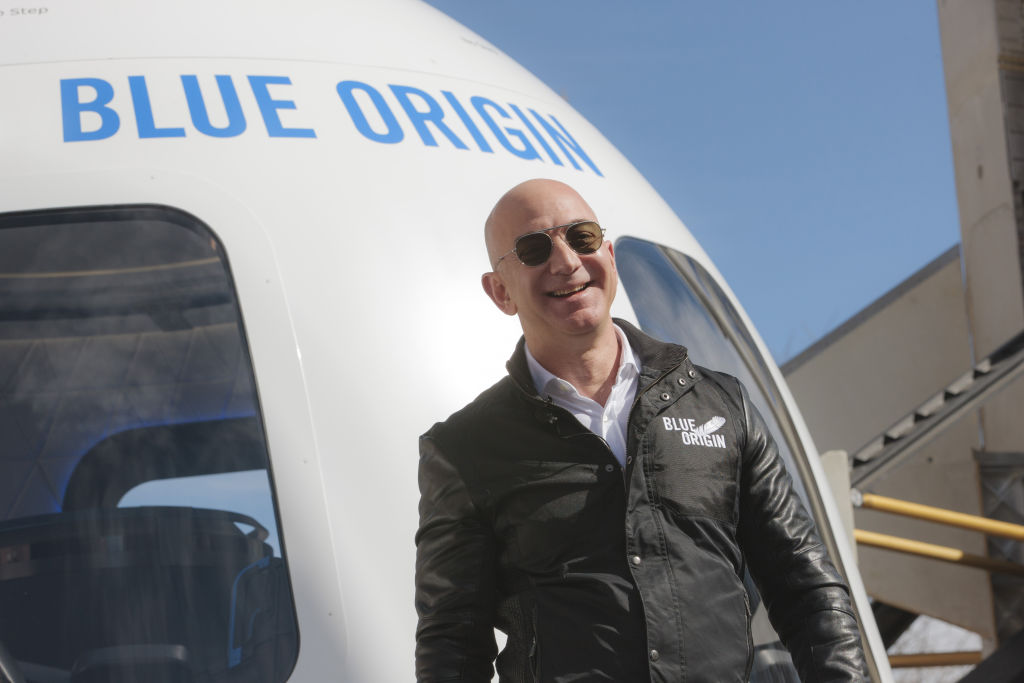
Jeff Bezos’ space company Blue Origin is pausing its space tourism flights for “no less than two years” in order to focus all of its resources on upcoming missions to the moon, the company announced Friday.
The decision puts a temporary halt on a program that Blue Origin has been using to fly humans past the Kármán line, the recognized boundary of space, for the last five years.
Blue Origin made the announcement just a few weeks ahead of the expected third launch of its New Glenn mega-rocket, which is slated for late February. The company had previously suggested it was going to use the third New Glenn launch to send its robotic lunar lander to the moon, but that spacecraft is still undergoing testing at NASA’s Johnson Space Center in Texas.
Since retaking office, President Donald Trump has put pressure on NASA to send astronauts back to the moon before the end of his second term. That has cleared the way for companies other than SpaceX to compete for these missions.
“The decision reflects Blue Origin’s commitment to the nation’s goal of returning to the Moon and establishing a permanent, sustained lunar presence,” the company wrote Friday.
Blue Origin first flew the New Shepard rocket more than a decade ago, and it became the first rocket to go to space and safely land back on Earth. Unlike SpaceX’s Falcon 9, though, the New Shepard rocket was never intended to reach Earth orbit. Its utility has therefore been limited to space tourism flights, which allow passengers around four minutes of weightlessness in Blue Origin’s space capsule, and science missions.
The company said Friday that New Shepard has flown 38 times and carried 98 humans to space, along with more than 200 scientific and research payloads.
Techcrunch event
Boston, MA
|
June 23, 2026
The New Shepard program was previously paused in 2022 after one of the company’s boosters exploded mid-flight. There were no humans on that flight, and the capsule safely ejected away from the booster. But New Shepard remained grounded until late 2023 while Blue Origin worked on identifying and fixing the cause.
Tech
Revolut eyes valuation of up to $200B in eventual IPO

British neobank Revolut seems to be eyeing a major valuation bump when it eventually goes public. The company is targeting a market cap between $150 billion and $200 billion in an initial public offering, the Financial Times reported on Tuesday, citing anonymous investor sources.
The fintech giant, which secured a full banking license in the United Kingdom in March after years of waiting, was most recently valued at $75 billion, up from $45 billion in 2024, in a secondary share sale that made it one of Europe’s most valuable private tech companies.
Revolut’s co-founder and CEO, Nik Storonsky, last week said that the company’s IPO was at least “two years away,” according to Bloomberg.
According to PitchBook and the Financial Times, the company is working on another secondary share sale, scheduled for the second half of 2026, that would value it at more than $100 billion.
As of November 2025, the company had raised a total of $5.89 billion, according to PitchBook. Revolut reported revenue of $6 billion in the financial year ended December 31, 2025, up from $4 billion in 2024. The company’s net profit grew to $1.7 billion, up from $1 billion in 2024, and counted 68.3 million retail customers at the end of 2025.
Revolut declined to comment.
Founded in 2015, Revolut offers a range of services spanning multi-currency accounts, payment and transfer services, crypto products, insurance, and more. The neobank has been pouring truckloads of cash into expanding its operations internationally, and recently applied for a banking license in the United States.
Besides the U.K., Revolut has a banking license in the European Union, and it operates in Australia, Japan, New Zealand, Singapore, Brazil, and the U.S. Revolut launched operations in India last October, is about to start operating in Colombia this year, and has received a banking license in Mexico.
When you purchase through links in our articles, we may earn a small commission. This doesn’t affect our editorial independence.
Tech
Amazon taps Sweden’s Einride for its electric big rigs
Einride is adding 75 of its electric heavy duty trucks to Amazon’s Relay freight network as part of a deal that gives the Swedish startup a toehold in the e-commerce giant’s operations. Einride will also provide charging infrastructure across five locations in the United States, under the agreement announced Tuesday.
Amazon isn’t buying or operating the electric trucks. Instead, Einride will own and manage (using its own Saga AI software) the trucks, which can be used by drivers in Amazon’s Relay freight network. Relay, launched in 2017, is an app that truck drivers can use to book hauling gigs with Amazon.
Einride CEO Roozbeh Charli, who took over as chief nearly a year ago, said working with Amazon is a powerful validation of the startup’s technology and strategic vision.
“By deploying our intelligent platform within one of the world’s most sophisticated logistics networks, we are accelerating growth, while continuing to build industry-leading operational expertise,” he said in a statement.
Einride has gained attention and investment for its two-pronged approach to freight. The company has developed and now operates a fleet of about 200 heavy-duty electric trucks for companies like Heineken, PepsiCo, and Carlsberg Sweden in Europe, North America, and the UAE. It has also developed autonomous pod-like trucks, which stand out for their cab-less design.
The agreement with Amazon doesn’t include the autonomous pods.
Einride has landed this agreement at a critical time: The startup is finalizing a merger with blank-check company Legato Merger Corp. and is expected to go public soon.
Techcrunch event
San Francisco, CA
|
October 13-15, 2026
While the agreement might not carry the same weight for Amazon, which has a market cap of $2.7 trillion, it does contribute to its low-carbon goals. Amazon has said it wants to reach net-zero carbon emissions across its operations by 2040.
“This rollout is an important step forward in addressing one of the toughest challenges we face in decarbonizing our transportation network — electrifying heavy-duty trucking,” an Amazon spokesperson said in an emailed statement. “We’re excited to continue to collaborate with Einride and learn from these operations as the trucks hit the road.”
When you purchase through links in our articles, we may earn a small commission. This doesn’t affect our editorial independence.
Tech
YouTube expands its AI likeness detection technology to celebrities
YouTube is expanding its new “likeness detection” technology, which identifies AI-generated content, such as deepfakes, to people within the entertainment industry, the company announced on Tuesday.
The technology works similarly to YouTube’s existing Content ID system, which detects copyright-protected material in users’ uploaded videos, allowing rights owners to request removal or share in the video’s revenue.
Likeness detection does the same, but for simulated faces. The feature is meant to help protect creators and other public figures from having their identities used without their permission — a common problem for celebrities who find their likenesses have been used in scam advertisements.
The technology was first made available to a subset of YouTube creators in a pilot program last year before expanding more broadly to include politicians, government officials, and journalists this spring.

Now YouTube says the technology is being made available to those in the entertainment industry, including talent agencies, management companies, and the celebrities they represent. The company has support from major agencies like CAA, UTA, WME, and Untitled Management, which offered feedback on the new tool.
Use of the likeness detection tool does not require entertainers to have their own YouTube channels.
Instead, the feature scans for AI-generated content to detect visual matches of an enrolled participant’s face. Users can then choose to request removal of the video for privacy policy violations, submit a copyright removal request, or do nothing. YouTube notes that it won’t remove all content, as it permits parody and satire content under its rules.
In the future, the technology will support audio as well, the company says.
Related to this, YouTube has also been advocating for similar protections at a federal level, with its support for the NO FAKES Act in Washington, D.C. This would regulate the use of AI to create unauthorized re-creations of an individual’s voice and visual likeness.
The company hasn’t yet said how many removals of AI deepfakes have been managed by the tool so far, but noted in March that the amount of removals was still “very small.”
When you purchase through links in our articles, we may earn a small commission. This doesn’t affect our editorial independence.

NASAs incredible new telescope will offer an atlas of the universe
400K MagSafe power banks recalled after fatal fire, the 10th power bank recall in a year


