
Entertainment
Bizarre Noise Coming From Mariana Trench For Over A Decade Identified


After a decade, a mysterious sound emanating from the Mariana Trench has been identified. The strange noise, described by researchers as a “biotwang” was first heard coming from the deep sea canyon in 2014, and scientists speculated about its source for years. Recently, a stroke of good luck and new AI technology allowed a team of oceanographers to identify the noise.
The Mariana Trench “biotwang” is a bizarre, almost otherworldly sound that combines sounds people associate with animals and those they don’t. Beginning as a low, grunt-like sound, it’s followed by high-pitched noises that sound mechanical to many. Lauren Hareel, a member of the team that unraveled the mystery, compared the higher sounds to those the Enterprise made in Star Trek.
The technology that helped solve the Mariana Trench mystery could be a huge asset to Oceanographers working on other research.
While many found the sounds coming from the Mariana Trench to sound unnatural, it was a common theory among oceanographers that they were whale sounds. Unfortunately, confirming that theory was incredibly difficult as it would require researchers to see the animals for themselves while encountering the sound and then link the two sounds. Against all odds, a team was able to do exactly that.
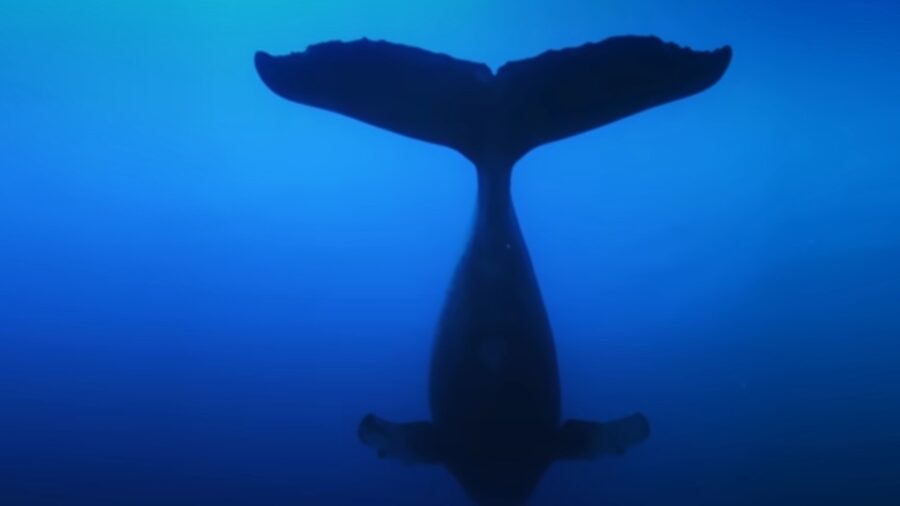
A lucky break led to a research team working near the Mariana Trench to spot a group of Bryde’s whales. The rare whales were heard making a distinct sound, which the team recorded. There were a total of 10 sightings of the whales during the research trip and the sound was heard during all but one of those sightings, firmly linking the sightings to the noise.
While many found the sounds coming from the Mariana Trench to sound unnatural, it was a common theory among oceanographers that they were whale sounds.
Of course, the research team didn’t immediately identify the sound of Bryde’s whales as the mysterious Mariana Trench sound. When the research team was trying to look for matches to the audio they were confronted by a database of over 200,000 hours of recordings. Ann Allen, one of the researchers who made the discovery, claims that when she was overwhelmed by the volume of data her dad suggested reaching out to Google for help.
Ann Allen took her father’s advice and asked Google for assistance on the project, which led to the final breakthrough on the Mariana Trench sound mystery. Using AI trained to turn sound files into Spectrograms and then compare those results to find patterns, the team was able to link the whales to the “biotwang.” The AI tools made it possible to make that connection, which otherwise would have taken hundreds of thousands of hours of manual comparison, a nearly impossible task.
The depths of the Mariana Trench remain mysterious in many ways, but the chilling “biotwang” sound has finally been demystified.
The technology that helped solve the Mariana Trench mystery could be a huge asset to Oceanographers working on other research. In addition to connecting that specific whale population to the sound from a decade ago, it helped the team track their movements through other recordings of their sound. That tracking capability could help scientists chart the influence of environmental factors on specific animal populations.
The depths of the Mariana Trench remain mysterious in many ways, but the chilling “biotwang” sound has finally been demystified. A combination of hard work, new technology, and good luck led to the breakthrough, which could end up helping future oceanographers solve similar mysteries much more quickly. Google has made the sound-identifying AI tool open source, which means the next time a mystery noise is picked up in the depths, researchers will have a new way to track its source down.
Source: Scientific American
Entertainment
LA public schools pass screen time limits for students in a first

Los Angeles public school students may be returning to the age of college-ruled notebooks and Scantrons, following a Tuesday school board vote that will limit the use of computers, laptops, and tablets in classrooms.
Titled “Using Technology with Intention,” the new resolution mandates the creation of grade-level and subject-specific screen time limits across Los Angeles Unified School District (LAUSD) schools, including a complete ban on device usage for kindergarten and first grade. The use of one-to-one devices, like individual Chromebooks, will be discouraged for second through fifth grades, as well.
Revised guidelines will also address video-aided lesson plans, access to video streaming platforms like YouTube, and expanded restrictions on gaming and social media platforms.
District staff must present the revised tech use policy by June, which will go into effect for all LAUSD students beginning with the 2026-2027 school year. Guidelines will be reevaluated every year, and schools are tasked with tracking and sharing student screen time numbers with parents.
Mashable Light Speed
The resolution cites increasing concern about the effect of screen time on young minds and alleged screen addiction, including recent Center for Disease Control and Prevention (CDC) studies that show a correlation between high screen time and adverse health effects. The board was unanimously in favor of the tech restrictions, with one recusal.
“We know that tech is not going away and can be a powerful tool in the classroom. This is not about going backwards. This is about rethinking school time and screen time in schools to ensure we are doing what actually helps students learn best,” board member Nick Melvoin said during Tuesday’s meeting.
“This is not about going backwards. This is about rethinking school time…”
Advocates, parents, and even students have spent the last year lobbying for greater tech restrictions following the passing of a 2025 bell-to-bell cellphone ban restricting the use of personal devices during school hours. Schools Beyond Screens, a national classroom tech safety coalition founded by LAUSD parents and teachers, helped craft the resolution in collaboration with board members and co-sponsors Melvoin, Karla Griego, Tanya Ortiz Franklin, Jerry Yang, Kelly Gonez, and Rocío Rivas.
“Now is the time for a safe and science-backed approach to classroom technology, one that is not guided by Big Tech talking points like screen value over screen time,” the organization wrote in a press release following the decision.
“There is much work to be done, and this is only the beginning, but today, we are proud, grateful, and – for the first time in a long time – hopeful. Our kids may yet have the kind of public education that they deserve — one that is proven effective and free of undue digital distraction, harmful content, and corporate exploitation.”
Topics
Social Good
Family & Parenting
Entertainment
The Bang & Olufsen Beosound Explore Bluetooth speaker is at the lowest price weve seen all year
SAVE $75: The Bang & Olufsen Beosound Explore Bluetooth speaker is on sale for $224 at Amazon, down from the standard price of $299. That’s a 25% discount.
$224
at Amazon
$299
Save $75
Packing up for an adventure means figuring out how to bring along a soundtrack. A trip to the cabin or a lakeside campground all deserve to be experienced with a great playlist. If you could use an upgrade before summer to get a waterproof Bluetooth speaker, check out this deal at Amazon.
As of April 22, the Bang & Olufsen Beosound Explore Bluetooth speaker is on sale for $224 at Amazon, marked down from the normal price of $299. That’s a 25% discount that takes $75 off the price. It’s also the lowest price we’ve seen at Amazon so far this year.
A compact speaker with a scratch-resistant aluminum shell is exactly what we should be packing on adventures. With an attached carabiner, the B&O Explore speaker is designed to clip onto your backpack when you hit the trail. Or you can utilize the rubber base to set it on a rock or even in the sand. It’s both waterproof and dustproof, adding to the durability.
Bang & Olufsen notes this model gets up to 27 hours of playtime before it needs to recharge. It weighs under 1.5 pounds, so it won’t add much bulk to your gear. It takes about two hours to recharge the Beosound Explore.
Mashable Deals
Before summer kicks into high gear, add the Bang & Olufsen Beosound Explore speaker to your pack. It’s ready for any adventure you have planned.
Entertainment
Get some new wrist candy with the CMF Watch Pro 2 at its lowest price ever
SAVE $39.01: As of April 22, get the CMF By Nothing Watch 2 Pro for $39.99 at Amazon, down from its usual price of $79. That’s a discount of 49% and the lowest price we’ve seen.
$39.99
at Amazon
$79
Save $39.01
There are tons of smartwatches on the market if you’re in need of one. But if you’re willing to look beyond the Apple Watches or Samsung devices out there, you’ll find an awesome alternative from the Nothing brand that’ll save you some serious cash. Not only is it more affordable than the competition, but it’s got everything you could want and then some. In fact, one of the models is on sale right now.
As of April 22, get the CMF By Nothing Watch 2 Pro for $39.99 at Amazon, down from its usual price of $79. That’s $39.01 off and a discount of 49%. It’s also the lowest price we’ve seen.
This affordable smartwatch not only comes in an attractive form factor, but it has just about everything you could ask for. It has your average comms tools like Bluetooth calling and gesture control, a built-in mic and speaker, contacts, message reminders, and music control. But from there, it offers a wide range of sensors and data to help you take control of your health.
It offers a portable blood oxygen saturation monitor, a heart rate monitor, sleep tracking, and so much more. All of this data, including workout information, steps, and much more, can be synced across all your favorite fitness apps, including Apple Health and Google Health Connect. There are 120 sports modes to choose from, GPS positioning, and even a 3D warm-up exercise guide to help get you on your feet each day.
Mashable Deals
With interchangeable watch straps and an attractive face, this extremely reasonable smartwatch is definitely one to rival Apple and Samsung. You’ll want to grab yours while it’s still down to the lowest price we’ve seen.

Braves put closer Raisel Iglesias on IL, Robert Suarez to close
Orlando City want attack to catch up to defense vs. Charlotte


